<?xml version="1.0" encoding="utf-8"?><feed xmlns="http://www.w3.org/2005/Atom" ><generator uri="https://jekyllrb.com/" version="4.4.1">Jekyll</generator><link href="https://collopy.net/feed/research/video.xml" rel="self" type="application/atom+xml" /><link href="https://collopy.net/" rel="alternate" type="text/html" /><updated>2026-05-01T13:46:40-07:00</updated><id>https://collopy.net/feed/research/video.xml</id><title type="html">Peter Sachs Collopy</title><author><name>Peter Sachs Collopy</name></author><entry><title type="html">Between Paradigms: Video and Art Therapy</title><link href="https://collopy.net/writing/2024/between-paradigms/" rel="alternate" type="text/html" title="Between Paradigms: Video and Art Therapy" /><published>2024-05-24T00:00:00-07:00</published><updated>2024-05-24T00:00:00-07:00</updated><id>https://collopy.net/writing/2024/between-paradigms</id><content type="html" xml:base="https://collopy.net/writing/2024/between-paradigms/"><![CDATA[As therapists developed the new field of video therapy in the 1950s and 1960s, they rarely interacted with the parallel field of art therapy or with the concept of creative expression at its core. Video therapy mostly involved recording and playing back talk therapy sessions. In only a few places did it become something like art therapy, a practice in which patients themselves made art to process their own experiences. This chapter traces how that resemblance developed at New York’s Village Project and elsewhere in the United States from about 1967 to 1975. It considers how painter Frank Gillette and philosopher-sociologist Victor Gioscia in particular drew from both modernist and emerging postmodernist intellectual currents, particularly the boundary-crossing work of media theorist Marshall McLuhan, to navigate the intersections of disciplines.]]></content><author><name>Peter Sachs Collopy</name></author><category term="writing" /><category term="technology" /><category term="media" /><category term="video" /><category term="cybernetics" /><category term="psychiatry" /><category term="consciousness" /><category term="visual culture" /><category term="human sciences" /><category term="medicine" /><category term="art" /><category term="drugs" /><category term="anarchism" /><category term="politics" /><category term="conservatism" /><category term="technopolitics" /><category term="philosophy" /><category term="New York" /><summary type="html"><![CDATA[As therapists developed the new field of video therapy in the 1950s and 1960s, they rarely interacted with the parallel field of art therapy or with the concept of creative expression at its core. Video therapy mostly involved recording and playing back talk therapy sessions. In only a few places did it become something like art therapy, a practice in which patients themselves made art to process their own experiences. This chapter traces how that resemblance developed at New York’s Village Project and elsewhere in the United States from about 1967 to 1975. It considers how painter Frank Gillette and philosopher-sociologist Victor Gioscia in particular drew from both modernist and emerging postmodernist intellectual currents, particularly the boundary-crossing work of media theorist Marshall McLuhan, to navigate the intersections of disciplines.]]></summary></entry><entry><title type="html">“Video Is as Powerful as LSD”: Electronics and Psychedelics as Technologies of Consciousness</title><link href="https://collopy.net/writing/2023/video-is-as-powerful-as-lsd/" rel="alternate" type="text/html" title="“Video Is as Powerful as LSD”: Electronics and Psychedelics as Technologies of Consciousness" /><published>2023-11-21T00:00:00-08:00</published><updated>2023-11-21T00:00:00-08:00</updated><id>https://collopy.net/writing/2023/video-is-as-powerful-as-lsd</id><content type="html" xml:base="https://collopy.net/writing/2023/video-is-as-powerful-as-lsd/"><![CDATA[<p>In the middle of the twentieth century, the invention and availability of new psychedelic drugs, and the growing cultural discourse around them, coincided with those of television, videotape, and computing. The technologies of psychedelics and electronics grew up together, and those using or thinking about one often implicated the other. When Sony and other Japanese manufacturers developed new portable videotape recorders in the late 1960s, for example, new communities of artists and tinkerers emerged around them, first in the US and Canada and then in Europe, Asia, North Africa, and Latin America. For the first time, declared these enthusiasts, many people could make their own television, breaking the broadcast oligopoly. In describing the psychological and sociological implications of this new technology, many compared it to psychedelic drugs.<p>

<p class="translation">A mediados del siglo XX, la invención y disponibilidad de nuevas drogas psicodélicas, y el creciente discurso cultural en torno a ellas, coincidieron con los de la televisión, las cintas de vídeo y la informática. Las tecnologías psicodélicas y la electrónica crecieron juntas, y quienes usaban o pensaban en una a menudo implicaban a la otra. Cuando Sony y otros fabricantes japoneses desarrollaron nuevos magnetoscopios portátiles a finales de los años sesenta, por ejemplo, surgieron nuevas comunidades de artistas a su alrededor, primero en Estados Unidos y Canadá, y después en Europa, Asia, el norte de África y América Latina. Por primera vez, declararon estos entusiastas, mucha gente podía hacer su propia televisión, rompiendo el oligopolio de la radiodifusión. Al describir las implicaciones psicológicas y sociológicas de esta nueva tecnología, muchos la compararon con las drogas psicodélicas.</p>]]></content><author><name>Peter Sachs Collopy</name></author><category term="writing" /><category term="technology" /><category term="media" /><category term="video" /><category term="synthesizers" /><category term="consciousness" /><category term="visual culture" /><category term="science" /><category term="biology" /><category term="evolution" /><category term="human sciences" /><category term="medicine" /><category term="engineering" /><category term="drugs" /><category term="art" /><category term="psychiatry" /><category term="California" /><summary type="html"><![CDATA[In the middle of the twentieth century, the invention and availability of new psychedelic drugs, and the growing cultural discourse around them, coincided with those of television, videotape, and computing. The technologies of psychedelics and electronics grew up together, and those using or thinking about one often implicated the other. When Sony and other Japanese manufacturers developed new portable videotape recorders in the late 1960s, for example, new communities of artists and tinkerers emerged around them, first in the US and Canada and then in Europe, Asia, North Africa, and Latin America. For the first time, declared these enthusiasts, many people could make their own television, breaking the broadcast oligopoly. In describing the psychological and sociological implications of this new technology, many compared it to psychedelic drugs. A mediados del siglo XX, la invención y disponibilidad de nuevas drogas psicodélicas, y el creciente discurso cultural en torno a ellas, coincidieron con los de la televisión, las cintas de vídeo y la informática. Las tecnologías psicodélicas y la electrónica crecieron juntas, y quienes usaban o pensaban en una a menudo implicaban a la otra. Cuando Sony y otros fabricantes japoneses desarrollaron nuevos magnetoscopios portátiles a finales de los años sesenta, por ejemplo, surgieron nuevas comunidades de artistas a su alrededor, primero en Estados Unidos y Canadá, y después en Europa, Asia, el norte de África y América Latina. Por primera vez, declararon estos entusiastas, mucha gente podía hacer su propia televisión, rompiendo el oligopolio de la radiodifusión. Al describir las implicaciones psicológicas y sociológicas de esta nueva tecnología, muchos la compararon con las drogas psicodélicas.]]></summary></entry><entry><title type="html">Video and the Self: Closed Circuit | Feedback | Narcissism</title><link href="https://collopy.net/writing/2022/video-and-the-self/" rel="alternate" type="text/html" title="Video and the Self: Closed Circuit | Feedback | Narcissism" /><published>2022-02-24T00:00:00-08:00</published><updated>2022-02-24T00:00:00-08:00</updated><id>https://collopy.net/writing/2022/video-and-the-self</id><content type="html" xml:base="https://collopy.net/writing/2022/video-and-the-self/"><![CDATA[A chapter which I guest edited:

The relationship between video and the self has been one of the central concerns of video theory. Prominent artists such as Vito Acconci, Dan Graham, Joan Jonas, and Bruce Nauman have organized their artistic practice around mediated self-observation, either using video to document and complicate their own expressions of self or building installations with which viewers can see and experience themselves in new ways. Such self-portraiture is the subject of the most widely cited essay in this volume, Rosalind Krauss’s 1976 “Video: The Aesthetics of Narcissism,” and of several essays responding to it.

Even before videotape became an artistic medium in 1965, though, video, self-observation, and narcissism were already the subjects of a theoretical literature produced by psychiatrists and psychologists. If patients saw how disordered they appeared to others, some psychotherapists suggested, they might be motivated to change. Other clinicians rewatched sessions with patients so that either could pause the video to discuss emotions or experiences which they hadn’t articulated, essentially putting themselves back into a moment in the conversation. Some of the most prominent artists and theorists working with video were directly influenced by this video therapy tradition.]]></content><author><name>Peter Sachs Collopy</name></author><category term="writing" /><category term="technology" /><category term="media" /><category term="video" /><category term="cybernetics" /><category term="consciousness" /><category term="visual culture" /><category term="human sciences" /><category term="medicine" /><category term="art" /><category term="psychiatry" /><summary type="html"><![CDATA[A chapter which I guest edited: The relationship between video and the self has been one of the central concerns of video theory. Prominent artists such as Vito Acconci, Dan Graham, Joan Jonas, and Bruce Nauman have organized their artistic practice around mediated self-observation, either using video to document and complicate their own expressions of self or building installations with which viewers can see and experience themselves in new ways. Such self-portraiture is the subject of the most widely cited essay in this volume, Rosalind Krauss’s 1976 “Video: The Aesthetics of Narcissism,” and of several essays responding to it. Even before videotape became an artistic medium in 1965, though, video, self-observation, and narcissism were already the subjects of a theoretical literature produced by psychiatrists and psychologists. If patients saw how disordered they appeared to others, some psychotherapists suggested, they might be motivated to change. Other clinicians rewatched sessions with patients so that either could pause the video to discuss emotions or experiences which they hadn’t articulated, essentially putting themselves back into a moment in the conversation. Some of the most prominent artists and theorists working with video were directly influenced by this video therapy tradition.]]></summary></entry><entry><title type="html">Virtual Talks with Video Activists: Dean and Dudley Evenson</title><link href="https://collopy.net/discussions/2022/dean-and-dudley-evenson/" rel="alternate" type="text/html" title="Virtual Talks with Video Activists: Dean and Dudley Evenson" /><published>2022-02-03T00:00:00-08:00</published><updated>2022-02-03T00:00:00-08:00</updated><id>https://collopy.net/discussions/2022/dean-and-dudley-evenson</id><content type="html" xml:base="https://collopy.net/discussions/2022/dean-and-dudley-evenson/"><![CDATA[Dean and Dudley Evenson are video pioneers who became immersed in the half-inch scene when in 1970 they happened to purchase the first AV Series Sony video portapack sold in Manhattan. They became members of the Raindance video group and co-edited Radical Software, working under grants from New York State Council on the Arts. They taught video to high school students through the Arts Awareness Program at the Metropolitan Museum of Art. Dean was the first person to hook up a half-inch video deck to the Sterling Manhattan Cable system paving the way for Public Access Television. They also ran Downsville TV in upstate New York where they would video local people and events and drive their VW Van to a telephone pole where they plugged into the cable head end and transmitted their weekly programs. During the 1970s, Dean and Dudley lived and traveled the country in a converted school bus documenting what they called ‘the emerging consciousness.’ They created hundreds of half-inch videos which they have been archiving and releasing on their Soundings Mindful Media YouTube Channel.]]></content><author><name>Peter Sachs Collopy</name></author><category term="discussions" /><category term="video" /><category term="art" /><category term="visual culture" /><category term="media" /><category term="technology" /><category term="New York" /><summary type="html"><![CDATA[Dean and Dudley Evenson are video pioneers who became immersed in the half-inch scene when in 1970 they happened to purchase the first AV Series Sony video portapack sold in Manhattan. They became members of the Raindance video group and co-edited Radical Software, working under grants from New York State Council on the Arts. They taught video to high school students through the Arts Awareness Program at the Metropolitan Museum of Art. Dean was the first person to hook up a half-inch video deck to the Sterling Manhattan Cable system paving the way for Public Access Television. They also ran Downsville TV in upstate New York where they would video local people and events and drive their VW Van to a telephone pole where they plugged into the cable head end and transmitted their weekly programs. During the 1970s, Dean and Dudley lived and traveled the country in a converted school bus documenting what they called ‘the emerging consciousness.’ They created hundreds of half-inch videos which they have been archiving and releasing on their Soundings Mindful Media YouTube Channel.]]></summary></entry><entry><title type="html">Electronic Artist Nam June Paik Celebrated in SFMOMA Retrospective</title><link href="https://collopy.net/discussions/2021/nam-june-paik/" rel="alternate" type="text/html" title="Electronic Artist Nam June Paik Celebrated in SFMOMA Retrospective" /><published>2021-07-23T00:00:00-07:00</published><updated>2021-07-23T00:00:00-07:00</updated><id>https://collopy.net/discussions/2021/nam-june-paik</id><content type="html" xml:base="https://collopy.net/discussions/2021/nam-june-paik/"><![CDATA[In the first retrospective of his work on the West Coast, SFMOMA’s current exhibition on electronic art pioneer Nam June Paik features more than 200 works from the artist whose five-decade career “changed the way we look at screens.” One of most acclaimed of the first generation of video artists, Paik’s early work in the 1960s changed perceptions of television, video and the boundary between art and spectator through its integration of camera, video, music and performance. We’ll talk about Paik’s work and legacy, and we’ll hear from contemporary video artists who will discuss Paik’s impact on their own art.]]></content><author><name>Peter Sachs Collopy</name></author><category term="discussions" /><category term="video" /><category term="art" /><category term="visual culture" /><category term="media" /><category term="technology" /><category term="consciousness" /><summary type="html"><![CDATA[In the first retrospective of his work on the West Coast, SFMOMA’s current exhibition on electronic art pioneer Nam June Paik features more than 200 works from the artist whose five-decade career “changed the way we look at screens.” One of most acclaimed of the first generation of video artists, Paik’s early work in the 1960s changed perceptions of television, video and the boundary between art and spectator through its integration of camera, video, music and performance. We’ll talk about Paik’s work and legacy, and we’ll hear from contemporary video artists who will discuss Paik’s impact on their own art.]]></summary></entry><entry><title type="html">The Revolution Will Be Videotaped: Consciousness and Digitization in the History of Video</title><link href="https://collopy.net/presentations/2019/revolution-will-be-videotaped/" rel="alternate" type="text/html" title="The Revolution Will Be Videotaped: Consciousness and Digitization in the History of Video" /><published>2019-04-08T00:00:00-07:00</published><updated>2019-04-08T00:00:00-07:00</updated><id>https://collopy.net/presentations/2019/revolution-will-be-videotaped</id><content type="html" xml:base="https://collopy.net/presentations/2019/revolution-will-be-videotaped/"><![CDATA[{% include youtube.html id=page.youtube %}]]></content><author><name>Peter Sachs Collopy</name></author><category term="presentations" /><category term="video" /><category term="computing" /><category term="analog/digital" /><category term="consciousness" /><category term="synthesizers" /><category term="visual culture" /><category term="art" /><category term="media" /><category term="technology" /><category term="human sciences" /><category term="medicine" /><category term="science" /><category term="psychiatry" /><summary type="html"><![CDATA[]]></summary></entry><entry><title type="html">Portable Moving Images: A Media History of Storage Formats</title><link href="https://collopy.net/writing/2019/portable-moving-images/" rel="alternate" type="text/html" title="Portable Moving Images: A Media History of Storage Formats" /><published>2019-01-01T00:00:00-08:00</published><updated>2019-01-01T00:00:00-08:00</updated><id>https://collopy.net/writing/2019/portable-moving-images</id><content type="html" xml:base="https://collopy.net/writing/2019/portable-moving-images/"><![CDATA[Although Ricardo Cedeño Montaña does not frame his project as such, <cite>Portable Moving Images</cite> is perhaps the most ambitious contribution yet to the “format theory” and “general history of compression” proposed by Jonathan Sterne in his <cite>MP3: The Meaning of a Format</cite>. <cite>Portable Moving Images</cite> is an expansive but sometimes frustrating history of the successive “reductions” that transformed first film, then analog video, and finally digital video from complex technologies for professional media production to ubiquitous tools used by amateurs. In each process, Montaña argues, cameras and other equipment became not only smaller but also more automated; reduction in both mass and the complexity of operation facilitated widespread use of new formats. “Portable media,” he writes, “compress the media factory into takeaway apparatuses that are then poured into the streets.”]]></content><author><name>Peter Sachs Collopy</name></author><category term="writing" /><category term="technology" /><category term="media" /><category term="visual culture" /><category term="video" /><category term="computing" /><category term="analog/digital" /><category term="engineering" /><summary type="html"><![CDATA[Although Ricardo Cedeño Montaña does not frame his project as such, Portable Moving Images is perhaps the most ambitious contribution yet to the “format theory” and “general history of compression” proposed by Jonathan Sterne in his MP3: The Meaning of a Format. Portable Moving Images is an expansive but sometimes frustrating history of the successive “reductions” that transformed first film, then analog video, and finally digital video from complex technologies for professional media production to ubiquitous tools used by amateurs. In each process, Montaña argues, cameras and other equipment became not only smaller but also more automated; reduction in both mass and the complexity of operation facilitated widespread use of new formats. “Portable media,” he writes, “compress the media factory into takeaway apparatuses that are then poured into the streets.”]]></summary></entry><entry><title type="html">La vidéo et les origines de la photographie électronique</title><link href="https://collopy.net/writing/2019/photographie-electronique/" rel="alternate" type="text/html" title="La vidéo et les origines de la photographie électronique" /><published>2019-01-01T00:00:00-08:00</published><updated>2019-01-01T00:00:00-08:00</updated><id>https://collopy.net/writing/2019/photographie-electronique</id><content type="html" xml:base="https://collopy.net/writing/2019/photographie-electronique/"><![CDATA[<p class="translation">Dans notre imaginaire historique, la récente révolution numérique de la photographie a tendance à occulter une révolution antérieure qui fut moins totale mais plus profonde : la révolution analogique, c’est-à-dire la traduction d’images en signaux électriques et en champs magnétiques variant de façon continue. La photographie analogique électronique a pris la forme de la télévision et de la vidéo, mais aussi de techniques d’enregistrement d’images fixes (par exemple le Videofile d’Ampex dans les années 1960 ; le Mavica de Sony dans les années 1980). Les principaux composants de ces nouvelles technologies, notamment ceux utilisés par les procédés d’enregistrement haute-fidélité et les tubes à vide pour les caméras vidéo, ont d’abord été mis au point à des fins militaires. L’électronique analogique partageait ces éléments et beaucoup d’autres – notamment les supports physiques d’enregistrement – avec les technologies numériques. Peter Sachs Collopy nous montre donc que ce n’est pas la numérisation qui a radicalement transformé la photographie au siècle dernier, mais bien le remplacement de la photochimie par des supports électromagnétiques, à la fois analogiques et numériques.</p>

<p>Our current association of the digital with progress can distract us from the historical fact that the most sophisticated electronic technologies have often been analog ones, processing information as continuous variations in voltage or current and recording it as continuous variations in magnetic fields. The discourse of the digital can also obscure continuities between electronic media, preventing us from seeing how much analog and digital modes of representing information have in common. Rather than thinking of the recent decline of film as a process of digitization, we might just as productively see it as a culmination of the rise of electronic photography, a phenomenon that has introduced into our visual experience not only the digital but also the analog.</p>]]></content><author><name>Peter Sachs Collopy</name></author><category term="writing" /><category term="technology" /><category term="media" /><category term="video" /><category term="visual culture" /><category term="analog/digital" /><category term="engineering" /><summary type="html"><![CDATA[Dans notre imaginaire historique, la récente révolution numérique de la photographie a tendance à occulter une révolution antérieure qui fut moins totale mais plus profonde : la révolution analogique, c’est-à-dire la traduction d’images en signaux électriques et en champs magnétiques variant de façon continue. La photographie analogique électronique a pris la forme de la télévision et de la vidéo, mais aussi de techniques d’enregistrement d’images fixes (par exemple le Videofile d’Ampex dans les années 1960 ; le Mavica de Sony dans les années 1980). Les principaux composants de ces nouvelles technologies, notamment ceux utilisés par les procédés d’enregistrement haute-fidélité et les tubes à vide pour les caméras vidéo, ont d’abord été mis au point à des fins militaires. L’électronique analogique partageait ces éléments et beaucoup d’autres – notamment les supports physiques d’enregistrement – avec les technologies numériques. Peter Sachs Collopy nous montre donc que ce n’est pas la numérisation qui a radicalement transformé la photographie au siècle dernier, mais bien le remplacement de la photochimie par des supports électromagnétiques, à la fois analogiques et numériques. Our current association of the digital with progress can distract us from the historical fact that the most sophisticated electronic technologies have often been analog ones, processing information as continuous variations in voltage or current and recording it as continuous variations in magnetic fields. The discourse of the digital can also obscure continuities between electronic media, preventing us from seeing how much analog and digital modes of representing information have in common. Rather than thinking of the recent decline of film as a process of digitization, we might just as productively see it as a culmination of the rise of electronic photography, a phenomenon that has introduced into our visual experience not only the digital but also the analog.]]></summary></entry><entry><title type="html">Ego Me Absolvo: Catholicism as Prototype in Paul Ryan’s Experimental Video</title><link href="https://collopy.net/writing/2016/ego-me-absolvo/" rel="alternate" type="text/html" title="Ego Me Absolvo: Catholicism as Prototype in Paul Ryan’s Experimental Video" /><published>2016-07-01T00:00:00-07:00</published><updated>2016-07-01T00:00:00-07:00</updated><id>https://collopy.net/writing/2016/ego-me-absolvo</id><content type="html" xml:base="https://collopy.net/writing/2016/ego-me-absolvo/"><![CDATA[In May 1969, a video installation entitled <cite>Everyman’s Moebius Strip</cite> appeared at the Howard Wise Gallery show <cite>TV as a Creative Medium</cite> in New York. When an individual entered a curtained booth, they found a video camera, a blank monitor, and an audio recording prompting participation. “React to the following people,” spoke the recording. “Nixon, your mother, Eldridge Cleaver, Teddy Kennedy, you.… For the next ten seconds do what you want.… Now, let your face be sad.… Turn away from the camera.… Now turn back.… Press the stop button.… Thank you.” After two minutes of this guidance, an attendant played a videotape of the viewer’s face back for them. Like its topological namesake, explained the artist, <cite>Everyman’s Moebius Strip</cite> “is used to take in our outside,” providing the viewer “one continuous (sur)face with nothing to hide.” Since each recording taped over the previous one, each participant received a unique, private experience of communing with the self.]]></content><author><name>Peter Sachs Collopy</name></author><category term="writing" /><category term="technology" /><category term="media" /><category term="video" /><category term="art" /><category term="visual culture" /><category term="cybernetics" /><category term="consciousness" /><category term="religion" /><category term="Christianity" /><category term="psychiatry" /><category term="New York" /><summary type="html"><![CDATA[In May 1969, a video installation entitled Everyman’s Moebius Strip appeared at the Howard Wise Gallery show TV as a Creative Medium in New York. When an individual entered a curtained booth, they found a video camera, a blank monitor, and an audio recording prompting participation. “React to the following people,” spoke the recording. “Nixon, your mother, Eldridge Cleaver, Teddy Kennedy, you.… For the next ten seconds do what you want.… Now, let your face be sad.… Turn away from the camera.… Now turn back.… Press the stop button.… Thank you.” After two minutes of this guidance, an attendant played a videotape of the viewer’s face back for them. Like its topological namesake, explained the artist, Everyman’s Moebius Strip “is used to take in our outside,” providing the viewer “one continuous (sur)face with nothing to hide.” Since each recording taped over the previous one, each participant received a unique, private experience of communing with the self.]]></summary></entry><entry><title type="html">Infolding the Self: From Video Therapy to Video Art</title><link href="https://collopy.net/presentations/2015/infolding-the-self/" rel="alternate" type="text/html" title="Infolding the Self: From Video Therapy to Video Art" /><published>2015-11-04T00:00:00-08:00</published><updated>2015-11-04T00:00:00-08:00</updated><id>https://collopy.net/presentations/2015/infolding-the-self</id><content type="html" xml:base="https://collopy.net/presentations/2015/infolding-the-self/"><![CDATA[{% include youtube.html id=page.youtube %}]]></content><author><name>Peter Sachs Collopy</name></author><category term="presentations" /><category term="video" /><category term="consciousness" /><category term="visual culture" /><category term="art" /><category term="media" /><category term="technology" /><category term="human sciences" /><category term="medicine" /><category term="science" /><category term="psychiatry" /><summary type="html"><![CDATA[]]></summary></entry><entry><title type="html">Video and Technologies of Consciousness: An Interview with Peter Sachs Collopy</title><link href="https://collopy.net/discussions/2015/video-and-technologies/" rel="alternate" type="text/html" title="Video and Technologies of Consciousness: An Interview with Peter Sachs Collopy" /><published>2015-11-02T00:00:00-08:00</published><updated>2015-11-02T00:00:00-08:00</updated><id>https://collopy.net/discussions/2015/video-and-technologies</id><content type="html" xml:base="https://collopy.net/discussions/2015/video-and-technologies/"><![CDATA[**We were really struck by your description of early video as a technology of consciousness. Can you tell us a bit more about this idea? Did early users of portable video technology use video in order to witness events?**

Absolutely! Technology of consciousness is a term I found in communications scholar Fred Turner’s work, particularly his essay on the composer Paul DeMarinis. Every technology affects how we think and experience the world, but I use this phrase specifically to refer to technologies whose users understood that they were doing so. The quintessential examples are psychedelic drugs, which people use specifically in order to alter their consciousness. For many videographers in the 1960s and 1970, video was like a drug in that it helped a person see the world in new ways; a cartoon in the magazine Radical Software proclaimed, for example, that “Video is as powerful as LSD.”]]></content><author><name>Peter Sachs Collopy</name></author><category term="discussions" /><category term="video" /><category term="consciousness" /><category term="visual culture" /><category term="analog/digital" /><category term="media" /><category term="technology" /><summary type="html"><![CDATA[We were really struck by your description of early video as a technology of consciousness. Can you tell us a bit more about this idea? Did early users of portable video technology use video in order to witness events? Absolutely! Technology of consciousness is a term I found in communications scholar Fred Turner’s work, particularly his essay on the composer Paul DeMarinis. Every technology affects how we think and experience the world, but I use this phrase specifically to refer to technologies whose users understood that they were doing so. The quintessential examples are psychedelic drugs, which people use specifically in order to alter their consciousness. For many videographers in the 1960s and 1970, video was like a drug in that it helped a person see the world in new ways; a cartoon in the magazine Radical Software proclaimed, for example, that “Video is as powerful as LSD.”]]></summary></entry><entry><title type="html">The Emergence of Video Processing Tools: Television Becoming Unglued</title><link href="https://collopy.net/writing/2015/emergence-of-video-processing/" rel="alternate" type="text/html" title="The Emergence of Video Processing Tools: Television Becoming Unglued" /><published>2015-10-01T00:00:00-07:00</published><updated>2015-10-01T00:00:00-07:00</updated><id>https://collopy.net/writing/2015/emergence-of-video-processing</id><content type="html" xml:base="https://collopy.net/writing/2015/emergence-of-video-processing/"><![CDATA[As artists gained access to the technologies of television production in the 1960s and 1970s, many began to build their own tools for electronically processing analog video signals to produce novel visual effects. For many artists, the construction and use of mixers, keyers, colorizers, and scan processors became the basis for aesthetic and critical engagements with electronic technologies, as well as collaboration with engineers. This expansive book consists of forty-three chapters by thirty-one authors—most of them artists or curators, many of them also participants in this history—on the people and machines that made up video processing in the United States.]]></content><author><name>Peter Sachs Collopy</name></author><category term="writing" /><category term="technology" /><category term="media" /><category term="visual culture" /><category term="art" /><category term="video" /><category term="synthesizers" /><category term="engineering" /><summary type="html"><![CDATA[As artists gained access to the technologies of television production in the 1960s and 1970s, many began to build their own tools for electronically processing analog video signals to produce novel visual effects. For many artists, the construction and use of mixers, keyers, colorizers, and scan processors became the basis for aesthetic and critical engagements with electronic technologies, as well as collaboration with engineers. This expansive book consists of forty-three chapters by thirty-one authors—most of them artists or curators, many of them also participants in this history—on the people and machines that made up video processing in the United States.]]></summary></entry><entry><title type="html">The Revolution Will Be Videotaped: Making a Technology of Consciousness in the Long 1960s</title><link href="https://collopy.net/writing/2015/revolution-will-be-videotaped/" rel="alternate" type="text/html" title="The Revolution Will Be Videotaped: Making a Technology of Consciousness in the Long 1960s" /><published>2015-07-13T00:00:00-07:00</published><updated>2015-07-13T00:00:00-07:00</updated><id>https://collopy.net/writing/2015/revolution-will-be-videotaped</id><content type="html" xml:base="https://collopy.net/writing/2015/revolution-will-be-videotaped/"><![CDATA[<p>In the late 1960s, video recorders became portable, leaving the television studio for the art gallery, the psychiatric hospital, and the streets. The technology of recording moving images on magnetic tape, previously of use only to broadcasters, became a tool for artistic expression, psychological experimentation, and political revolution. Video became portable not only materially but also culturally; it could be carried by an individual, but it could also be carried into institutions from the RAND Corporation to the Black Panther Party, from psychiatrists’ offices to art galleries, and from prisons to state-funded media access centers. Between 1967 and 1973, American videographers across many of these institutional contexts participated in a common discourse, sharing not only practical knowledge about the uses and maintenance of video equipment, but visions of its social significance, psychological effects, and utopian future. For many, video was a technology which would bring about a new kind of awareness, the communal consciousness that—influenced by the evolutionary philosophy of Henri Bergson—Pierre Teilhard de Chardin referred to as the noosphere and Marshall McLuhan as the global village. Experimental videographers across several fields were also influenced by the psychedelic research of the 1950s and early 1960s, by the development of cybernetics as a science of both social systems and interactions between humans and machines, by anthropology and humanistic psychology, and by revolutionary political movements in the United States and around the world.</p>]]></content><author><name>Peter Sachs Collopy</name></author><category term="writing" /><category term="politics" /><category term="technology" /><category term="media" /><category term="consciousness" /><category term="cybernetics" /><category term="video" /><category term="art" /><category term="visual culture" /><category term="analog/digital" /><category term="synthesizers" /><category term="evolution" /><category term="war" /><category term="technopolitics" /><category term="science" /><category term="human sciences" /><category term="medicine" /><category term="engineering" /><category term="drugs" /><category term="anthropology" /><category term="religion" /><category term="Christianity" /><category term="utopianism" /><category term="communism" /><category term="psychiatry" /><category term="fascism" /><category term="New York" /><category term="California" /><category term="biology" /><category term="philosophy" /><summary type="html"><![CDATA[In the late 1960s, video recorders became portable, leaving the television studio for the art gallery, the psychiatric hospital, and the streets. The technology of recording moving images on magnetic tape, previously of use only to broadcasters, became a tool for artistic expression, psychological experimentation, and political revolution. Video became portable not only materially but also culturally; it could be carried by an individual, but it could also be carried into institutions from the RAND Corporation to the Black Panther Party, from psychiatrists’ offices to art galleries, and from prisons to state-funded media access centers. Between 1967 and 1973, American videographers across many of these institutional contexts participated in a common discourse, sharing not only practical knowledge about the uses and maintenance of video equipment, but visions of its social significance, psychological effects, and utopian future. For many, video was a technology which would bring about a new kind of awareness, the communal consciousness that—influenced by the evolutionary philosophy of Henri Bergson—Pierre Teilhard de Chardin referred to as the noosphere and Marshall McLuhan as the global village. Experimental videographers across several fields were also influenced by the psychedelic research of the 1950s and early 1960s, by the development of cybernetics as a science of both social systems and interactions between humans and machines, by anthropology and humanistic psychology, and by revolutionary political movements in the United States and around the world.]]></summary></entry><entry><title type="html">Video Synthesizers: From Analog Computing to Digital Art</title><link href="https://collopy.net/writing/2014/video-synthesizers/" rel="alternate" type="text/html" title="Video Synthesizers: From Analog Computing to Digital Art" /><published>2014-12-11T00:00:00-08:00</published><updated>2014-12-11T00:00:00-08:00</updated><id>https://collopy.net/writing/2014/video-synthesizers</id><content type="html" xml:base="https://collopy.net/writing/2014/video-synthesizers/"><![CDATA[In the late 1960s, artists and engineers began building increasingly sophisticated video synthesizers, machines that produced abstract or distorted images by electronically manipulating either a video signal or the cathode ray tube on which it was displayed. This article explores how experimental videographers modeled video synthesizers on audio synthesizers, conceptualized them as analog computers, and starting in 1973, interfaced them with digital minicomputers.]]></content><author><name>Peter Sachs Collopy</name></author><category term="writing" /><category term="technology" /><category term="media" /><category term="computing" /><category term="video" /><category term="synthesizers" /><category term="consciousness" /><category term="art" /><category term="visual culture" /><category term="analog/digital" /><category term="engineering" /><category term="drugs" /><category term="utopianism" /><category term="New York" /><summary type="html"><![CDATA[In the late 1960s, artists and engineers began building increasingly sophisticated video synthesizers, machines that produced abstract or distorted images by electronically manipulating either a video signal or the cathode ray tube on which it was displayed. This article explores how experimental videographers modeled video synthesizers on audio synthesizers, conceptualized them as analog computers, and starting in 1973, interfaced them with digital minicomputers.]]></summary></entry><entry><title type="html">The Revolution Will Be Videotaped: Making a Technology of Consciousness in the Long 1960s</title><link href="https://collopy.net/presentations/2014/revolution-will-be-videotaped/" rel="alternate" type="text/html" title="The Revolution Will Be Videotaped: Making a Technology of Consciousness in the Long 1960s" /><published>2014-08-01T00:00:00-07:00</published><updated>2014-08-01T00:00:00-07:00</updated><id>https://collopy.net/presentations/2014/revolution-will-be-videotaped</id><content type="html" xml:base="https://collopy.net/presentations/2014/revolution-will-be-videotaped/"><![CDATA[{% include youtube.html id=page.youtube %}

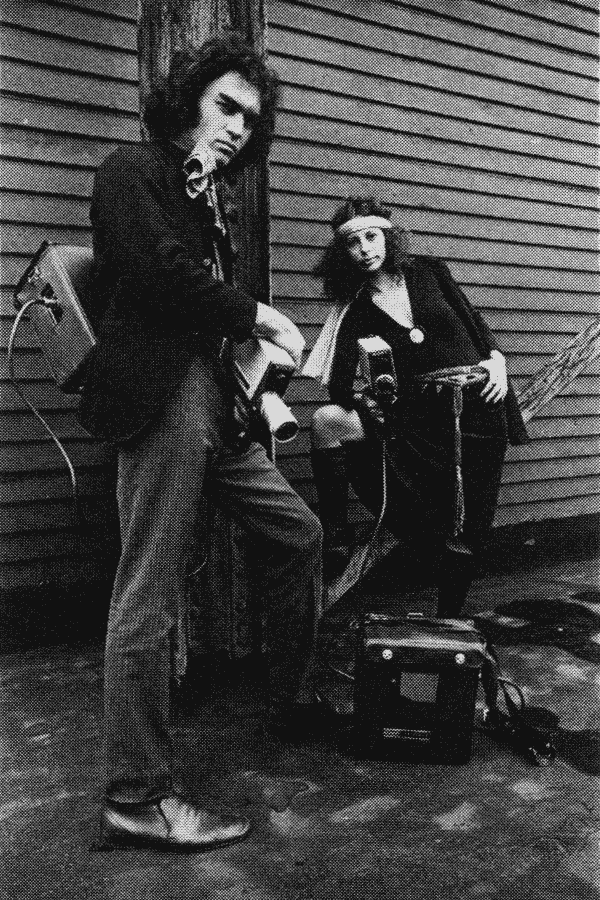
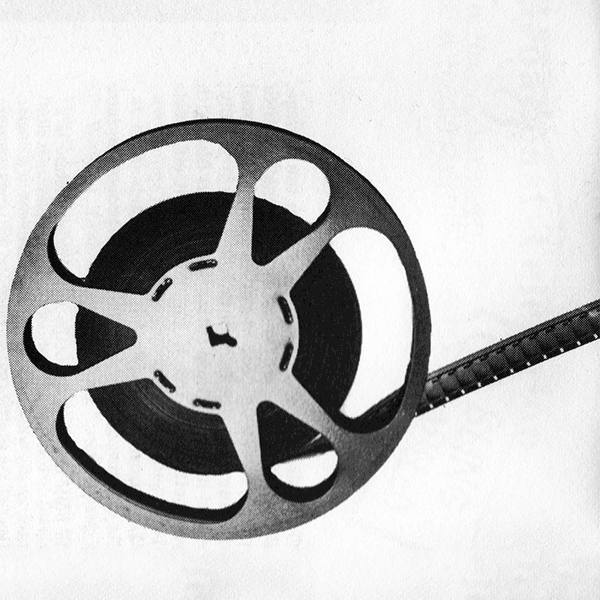
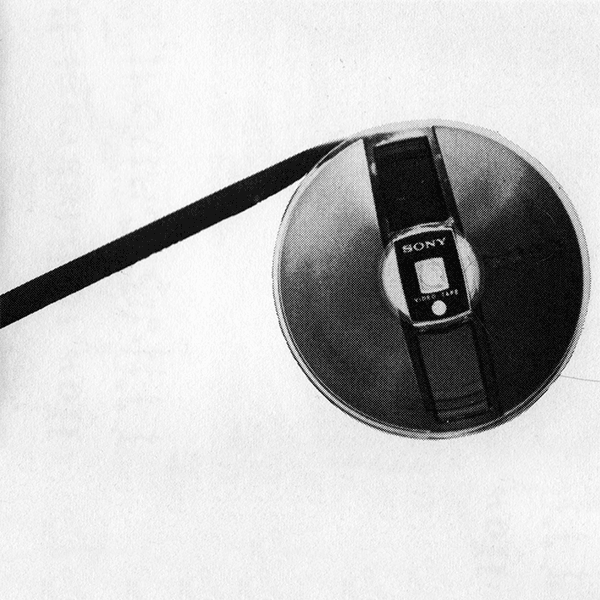
In the 1960s, video recording technology became portable. Tools that had previously been available only in television studios turned up in art galleries, in psychiatric hospitals, and in the Black Panther Party. This cultural portability was facilitated by a material portability: the technology got smaller, it got cheaper, it got lighter. For instance, this 1970 Sony camera is part of a piece of equipment called a portapak. Between the camera and the deck it was a complete video production studio that was light enough for somebody to carry around and was battery-powered. These recorders used half-inch open reel magnetic tape.

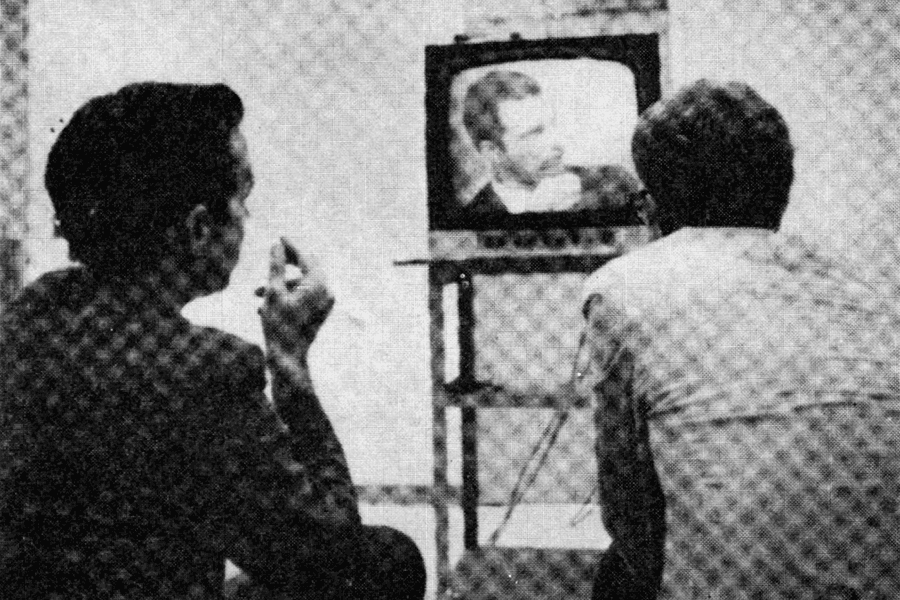
Many of the people using these new video technologies, from artists to psychiatrists to political activists, were particularly interested in what video meant for consciousness. They were interested in the experience of watching yourself on a television monitor. For some psychiatrists this was a self-confrontation experience that could force a person to confront how other people saw them and not merely experience themselves through their own impressions. For some artists this was a meditative experience, that watching yourself could be a path to holistic self-understanding.

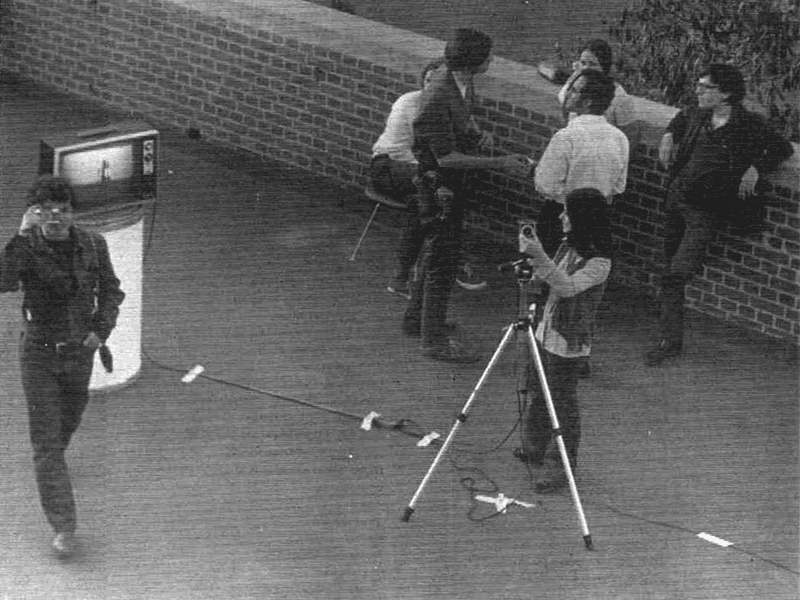
Many of these experimental videographers were also interested in pointing cameras at their own monitors, and in the kaleidoscopic visual effects that appeared when they did this. And they referred to both these kaleidoscopic effects, this practice of pointing cameras at monitors, and to watching oneself on a monitor, as feedback, borrowing a term from the field of cybernetics. This idea of taking the message of a system that comes out of that system, like what you see coming out of a television, and putting it back into that system in order to make it reflect upon itself was something that they understood as both an optical and electronic phenomenon that could be harnessed to aesthetic ends, and as a psychological phenomenon that could lead to new kinds of human understanding.

They also thought about this on a broader social scale. If you could watch yourself and understand yourself better, perhaps watching other people, or watching the world through other people's eyes—watching video that they had shot—could help you understand others better. And this seemed a path to a kind of universal consciousness that had been described by Pierre Teilhard de Chardin as the noosphere—the global mind—or by Marshall McLuhan, who as a media theorist was a big influence on experimental video, as the global village.]]></content><author><name>Peter Sachs Collopy</name></author><category term="presentations" /><category term="video" /><category term="consciousness" /><category term="visual culture" /><category term="cybernetics" /><category term="media" /><category term="technology" /><category term="art" /><summary type="html"><![CDATA[In the 1960s, video recording technology became portable. Tools that had previously been available only in television studios turned up in art galleries, in psychiatric hospitals, and in the Black Panther Party. This cultural portability was facilitated by a material portability: the technology got smaller, it got cheaper, it got lighter. For instance, this 1970 Sony camera is part of a piece of equipment called a portapak. Between the camera and the deck it was a complete video production studio that was light enough for somebody to carry around and was battery-powered. These recorders used half-inch open reel magnetic tape. Many of the people using these new video technologies, from artists to psychiatrists to political activists, were particularly interested in what video meant for consciousness. They were interested in the experience of watching yourself on a television monitor. For some psychiatrists this was a self-confrontation experience that could force a person to confront how other people saw them and not merely experience themselves through their own impressions. For some artists this was a meditative experience, that watching yourself could be a path to holistic self-understanding. Many of these experimental videographers were also interested in pointing cameras at their own monitors, and in the kaleidoscopic visual effects that appeared when they did this. And they referred to both these kaleidoscopic effects, this practice of pointing cameras at monitors, and to watching oneself on a monitor, as feedback, borrowing a term from the field of cybernetics. This idea of taking the message of a system that comes out of that system, like what you see coming out of a television, and putting it back into that system in order to make it reflect upon itself was something that they understood as both an optical and electronic phenomenon that could be harnessed to aesthetic ends, and as a psychological phenomenon that could lead to new kinds of human understanding. They also thought about this on a broader social scale. If you could watch yourself and understand yourself better, perhaps watching other people, or watching the world through other people’s eyes—watching video that they had shot—could help you understand others better. And this seemed a path to a kind of universal consciousness that had been described by Pierre Teilhard de Chardin as the noosphere—the global mind—or by Marshall McLuhan, who as a media theorist was a big influence on experimental video, as the global village.]]></summary></entry><entry><title type="html">Video Revolution: A Photocomic</title><link href="https://collopy.net/writing/2013/video-revolution/" rel="alternate" type="text/html" title="Video Revolution: A Photocomic" /><published>2013-01-01T00:00:00-08:00</published><updated>2013-01-01T00:00:00-08:00</updated><id>https://collopy.net/writing/2013/video-revolution</id><content type="html" xml:base="https://collopy.net/writing/2013/video-revolution/"><![CDATA[<style type="text/css" title="text/css">
	body {width: 1080px; max-width: none;}
	.column {float: left;}
	.panel {position: relative; border: 3px solid black; margin: 2px;}
	.caption {font: 18px Helvetica; position: absolute; line-height: 130%;}
	.translucent {background-color: white; opacity: 0.6; padding: 3px 6px;}
	.secondline {padding-left: 6px;}
</style>

<div style="white-space: nowrap; clear: both;"">
	<!--First row-->
	<div class="column panel" style="height: 450px">
			<img src="/writing/comic-images/portable.gif" alt="Photograph by George Adams, from Guerrilla Television" width="300" height="450" />
		<div class="caption" style="top: 238px; left: 10px"><span class="translucent">In the late 1960s, <br /><span class="secondline">video recorders became portable.</span></span></div>
	</div>
	<div class="column">
		<div class="panel" style="height: 190px; margin-bottom: 4px">
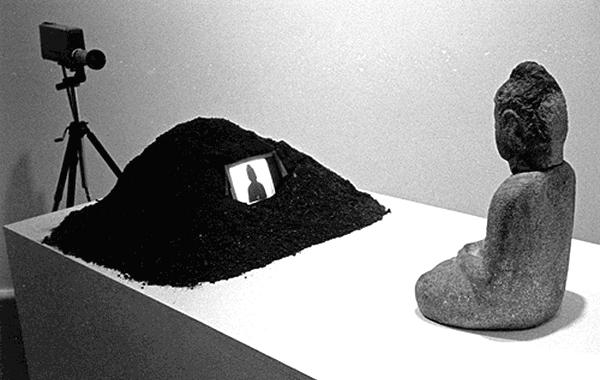
		    <img src="/writing/comic-images/buddha.gif" alt="TV Buddha by Nam June Paik, 1974" width="300" height="190" />
		    <div class="caption" style="top: 4px; right: 3px"><span class="translucent" style="padding: 2px 4px">They left the television studio <br /><span class="secondline">for the artist&rsquo;s studio,</span></span></div>
		</div>
		<div class="panel" style="height: 250px">
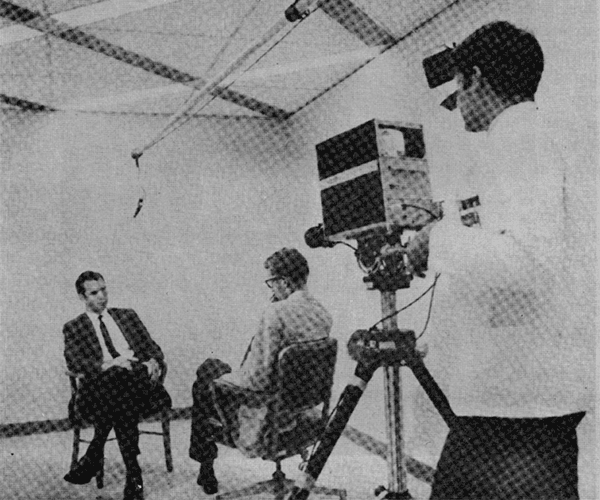
		    <img src="/writing/comic-images/psychiatry.gif" alt="Photograph from Videotape Techniques in Psychiatric Training and Treatment" width="300" height="250" />
		    <div class="caption" style="top: 24px; left: 6px"><span class="translucent">the psychiatric hospital,</span></div>
		</div>
	</div>
	<div class="column panel" style="height: 450px">
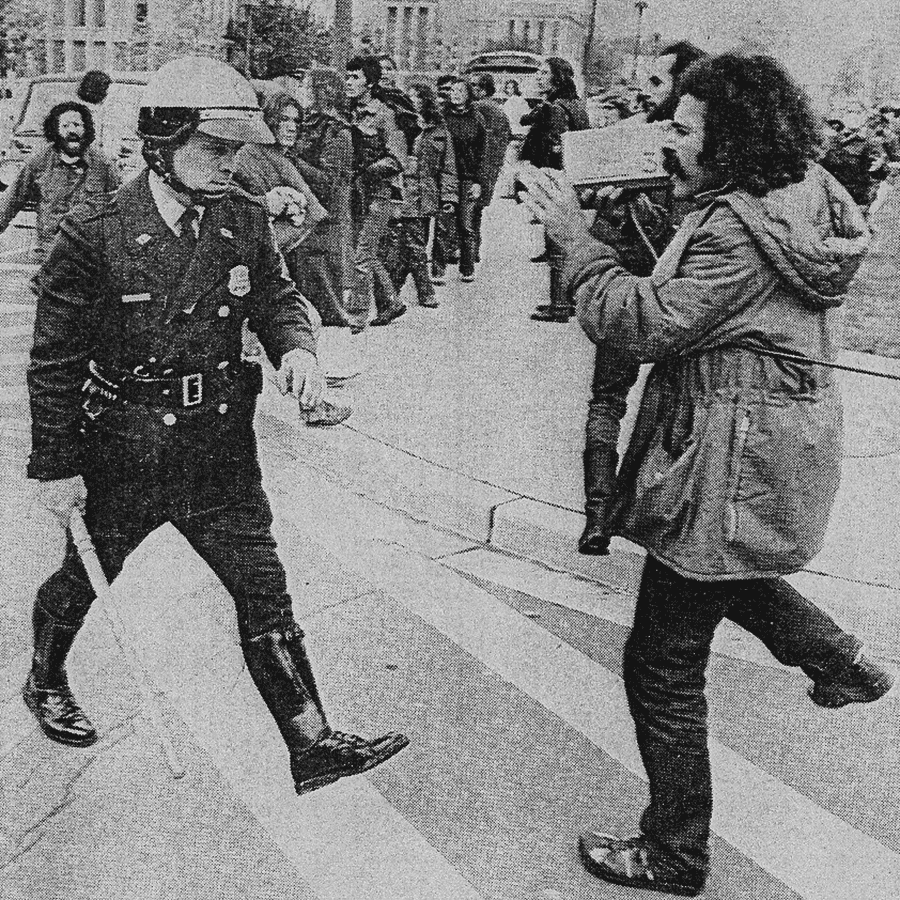
		<img src="/writing/comic-images/mayday.gif" alt="Mayday Realtime, 1971" width="450" height="450" />
		<div class="caption" style="bottom: 44px; right: 27px"><span class="translucent">and the streets.</span></div>
	</div>
	<br />
	
	<!--Second row-->
	<div class="column panel" style="height: 300px">
	    <img src="/writing/comic-images/film.gif" alt="Photograph from Guerrilla Television" width="300" height="300" />
	    <div class="caption" style="top: 6px; left: 13px"><span class="translucent">Unlike the optical medium of film <br /><span class="secondline">with its photographic frames,</span></span></div>
	</div>
	<div class="column panel" style="height: 300px">
	    <img src="/writing/comic-images/tape.gif" alt="Photograph from Guerrilla Television" width="300" height="300" />
	    <div class="caption" style="top: 29px; right: 12px"><span class="translucent">video was recorded electronically</span></div>
	    <div class="caption" style="bottom: 49px; right: 12px"><span class="translucent">on magnetic tape.</span></div>
	</div>
	<div class="column panel" style="height: 300px">
		<img src="/writing/comic-images/replay.gif" alt="Photograph from Videotape Techniques in Psychiatric Training and Treatment" width="450" height="300" />
		<div class="caption" style="bottom: 22px; left: 90px"><span class="translucent">It could be replayed immediately,</span></div>
	</div>
	<br />
	
	<!--Third row-->
	<div class="column panel" style="height: 300px">
		<img src="/writing/comic-images/usc.gif" alt="&ldquo;U.S.C. Piece May ’70 Environmental Performance by C. Bensinger,&rdquo; photograph from Radical Software 1, no. 2" width="400" height="300" />
		<div class="caption" style="bottom: 11px; right: 9px"><span class="translucent">or even screened live.</span></div>
	</div>
</div>
<div style="clear: both;">
</div>]]></content><author><name>Peter Sachs Collopy</name></author><category term="writing" /><category term="technology" /><category term="media" /><category term="video" /><category term="visual culture" /><summary type="html"><![CDATA[In the late 1960s, video recorders became portable. They left the television studio for the artist&rsquo;s studio, the psychiatric hospital, and the streets. Unlike the optical medium of film with its photographic frames, video was recorded electronically on magnetic tape. It could be replayed immediately, or even screened live.]]></summary></entry><entry><title type="html">Circa 1971: Early Video &amp;amp; Film from the EAI Archives</title><link href="https://collopy.net/writing/2012/circa-1971/" rel="alternate" type="text/html" title="Circa 1971: Early Video &amp;amp; Film from the EAI Archives" /><published>2012-12-07T00:00:00-08:00</published><updated>2012-12-07T00:00:00-08:00</updated><id>https://collopy.net/writing/2012/circa-1971</id><content type="html" xml:base="https://collopy.net/writing/2012/circa-1971/"><![CDATA[<p>In the years around 1971, the electronic medium of video became available to artists. Portable video recorders like the <a href="http://experimentaltvcenter.org/sony-av-3400-porta-pak">Sony AV-3400</a>—universally known to users as “portapaks”—brought video out of the television studio and into both the artist&#8217;s studio and the streets, where they were used to document political activism, countercultural exuberance, and everyday life. This is the moment curator Lori Zippay captures in <a href="http://diabeacon.org/exhibitions/main/118"><cite>Circa 1971: Early Video &#038; Film from the EAI Archives</cite></a>, an exhibit drawn on the collections of <a href="http://eai.org/">Electronic Arts Intermix</a> on display at <a href="http://diabeacon.org/">Dia:Beacon</a> through December 31.</p>
<!--more-->
<p><a href="http://diabeacon.org/exhibitions/page/118/1665">As Zippay writes</a>, “performance and visual artists, political activists, cybernetic theorists, filmmakers, <a href="http://www.moma.org/collection/theme.php?theme_id=10457">Fluxus</a> provocateurs, and self-described video freaks and electronic geeks all contributed to the fluid mix—and creative friction—of the emergent video art scene.” She portrays this diversity of early video by bringing together 15 video productions and eight related films from 1970, 1971, and 1972. This tight periodization means the show, like an archaeological dig site, reveals a single stratum of video&#8217;s early history rather than a chronology of video art.</p>
<img style="display: block; margin: 0 auto;" title="Mayday Realtime" src="/images/mayday.jpg" width="367" height="205">
<p>The most fascinating works are those sometimes described as video verité, which provide glimpses into an unrehearsed past. In <a href="http://www.vdb.org/titles/mayday-realtime"><cite>Mayday Realtime</cite></a>, for example, <a href="http://eai.org/artistBio.htm?id=370">David Cort</a> walks and drives around Washington, D.C. on <a href="http://libcom.org/library/ending-war-inventing-movement-mayday-1971">May Day 1971</a>, documenting antiwar demonstrations and the police response. Cort, founder of a video collective called the <a href="http://videofreex.com/">Videofreex</a> who lived in a communal house in the Catskills, consistently turned up with a camera at countercultural events like the <a href="http://bethelwoodscenter.org/museum/festivalhistory.aspx">Woodstock Festival</a> and the <a href="http://law2.umkc.edu/faculty/projects/ftrials/chicago7/chicago7.html">Chicago Seven trial</a>.</p>
<p><a href="http://projectshirley.com/bio.html">Shirley Clarke</a>’s <a href="http://eai.org/title.htm?id=5912">	<cite>The Tee Pee Video Space Troupe: The First Years</cite></a> portrays cultural moments both more mundane and more glamorous than Cort’s May Day. In one segment, Clarke carouses with John Lennon, Yoko Ono, and Andy Warhol. “Video gives me something to do at parties,” Clarke tells the audience with an intertitle. Like many other videographers, Clarke—already an Academy Award winning filmmaker—was fascinated by the unique features of the video medium. As she tells a silent, posing Ono, her camera recorded sound, as film cameras could not. (Recording sound for film requires separate recording equipment.)</p>
<p>In the second segment of <cite>The Tee Pee Video Space Troupe</cite>, Shirley Clarke and Arthur C. Clarke—no relation—experiment with the interactions between two new gadgets. The science fiction writer points a laser at the filmmaker’s video camera, producing beautiful “sunbursts” and kaleidoscopic images. She has set up monitors displaying the video being recorded, so he watches himself and the abstractions he produces in real time, a mirroring practice characteristic of experimental video.</p>
<img style="display: block; margin: 0 auto;" title="Vertical Roll" src="/images/jonas_vertical_web.jpg" width="250" height="188">
<p>Indeed, many of the more explicitly artistic videos in <cite>Circa 1971</cite> are subversive self-portraits. <a href="http://eai.org/artistBio.htm?id=408">Joan Jonas</a>’ <a href="http://www.vdb.org/titles/vertical-roll">	<cite>Vertical Roll</cite></a> consists of sensual explorations of the artist’s body interrupted by the vertical rolling characteristic of a poorly calibrated CRT television in time to a violent clanging sound. This disruption of the viewing experience challenges viewers to question the routine objectification of women’s bodies. Similarly, in <a href="http://www.vdb.org/titles/i-am-making-art"><cite>I Am Making Art</cite></a> <a href="http://baldessari.org/">John Baldessari</a> challenges the category of art itself by incessantly repeating the titular phrase while moving through the video frame.</p>
<p>As Zippay notes in her essay, these pieces convey “an analog—that is, slowed-down—experience of time” compared to that of 2012. The sparse arrangement of the self portraits—displayed on large video monitors set along the wall of the gallery like paintings, with no seating—compounds this sense of slowness. Since each of six is around 20 minutes long, I found myself circulating among them, returning to those I’d already watched for a few minutes to see how the artists were doing.</p>
<img style="display: block; margin: 0 auto;" title="Self-Portraits" src="/images/11_09_circa_image04.jpg" width="400" height="267">
<p>Experimental videographers generally embraced the ability to record continuously afforded by cheap tape—which, if you ran out, could also be recorded over. The ideal of cinema without editing pioneered by Warhol on film (and at least once on video) became common among videographers, and is evidenced here both by documentary works like <cite>Mayday Realtime</cite> and consciously artistic ones like <cite>I Am Making Art</cite>. It was often in editing, though, that experimental video most effectively demonstrated its emotional range.</p>
<p>In a series of <a href="http://eai.org/title.htm?id=2991">	<cite>Media Primers</cite></a>, three members of the video collective <a href="http://radicalsoftware.org/e/history.html">Raindance</a> edited together segments from their diverse tape collection. I was particularly struck by <a href="http://ira-schneider.com/artist/">Ira Schneider</a>’s contribution, perhaps the least cerebral of the three, in which a hippie playing guitar and singing euphorically is intercut with footage of a campaign event for Richard Nixon and scuffles in the audience at <a href="http://en.wikipedia.org/wiki/Altamont_Free_Concert">Altamont</a>.</p>
<img style="display: block; margin: 0 auto;" title="TV Cello Premiere" src="/images/11_09_circa_image02.jpg" width="400" height="267">
<p><cite>Circa 1971</cite> also includes a handful of short films from the era, which are projected rather than displayed on CRTs. <a href="http://eai.org/title.htm?id=13739">	<cite>TV Cello Premiere</cite></a> by <a href="http://paikstudios.com/">Nam June Paik</a> and <a href="http://hamsadesign.com/vidfilm/JudYalkut.html">Jud Yalkut</a>, shown at the exhibit’s entrance, depicts one of Paik’s collaborations with <a href="http://eai.org/artistBio.htm?id=344">Charlotte Moorman</a>. The cellist played a one-stringed cello constructed by Paik, <a href="http://collections.walkerart.org/item/object/881">	<cite>TV Cello</cite></a>, which displayed the performance, other cellists, and broadcast television on its three TV screens.</p>
<p>Many of the works in <cite>Circa 1971</cite>, most notably <cite>TV Cello Premiere</cite> and <cite>Vertical Roll</cite>,  reveal particular technical features of the video technology used to create them. This is not the technology on which they’re displayed, however; despite being about analog media, <cite>Circa 1971</cite> is an exhibit of digital reproductions. Given the fragility and glitchiness of analog video, such concessions to practicality are necessary to display this work, but they leave the analog video medium itself absent from the gallery. An exhibit which more fully portrayed analog video as both a technology and an artistic medium might feature a portapak on a pedestal in the center of the gallery, surrounded by the art it helped create.</p>
<img style="display: block; margin: 0 auto;" title="Portapak" src="/images/Feature_W1_pt1_portapak.jpg" width="282" height="243">]]></content><author><name>Peter Sachs Collopy</name></author><category term="writing" /><category term="technology" /><category term="media" /><category term="video" /><category term="art" /><category term="visual culture" /><category term="analog/digital" /><summary type="html"><![CDATA[In the years around 1971, the electronic medium of video became available to artists. Portable video recorders like the Sony AV-3400—universally known to users as “portapaks”—brought video out of the television studio and into both the artist&#8217;s studio and the streets, where they were used to document political activism, countercultural exuberance, and everyday life. This is the moment curator Lori Zippay captures in Circa 1971: Early Video &#038; Film from the EAI Archives, an exhibit drawn on the collections of Electronic Arts Intermix on display at Dia:Beacon through December 31.]]></summary></entry><entry><title type="html">Cyber-Utopianism Before the Internet</title><link href="https://collopy.net/writing/2012/cyber-utopianism/" rel="alternate" type="text/html" title="Cyber-Utopianism Before the Internet" /><published>2012-08-21T00:00:00-07:00</published><updated>2012-08-21T00:00:00-07:00</updated><id>https://collopy.net/writing/2012/cyber-utopianism</id><content type="html" xml:base="https://collopy.net/writing/2012/cyber-utopianism/"><![CDATA[<p>In his 2011 book <cite><a href="http://netdelusion.com/">The Net Delusion: The Dark Side of Internet Freedom</a></cite>, <a href="http://evgenymorozov.com/">Evgeny Morozov</a> defines <em>cyber-utopianism</em> as “a naîve belief in the emancipatory nature of online communication that rests on a stubborn refusal to acknowledge its downside.” This belief, he writes, has entered U.S. foreign policy through the State Department’s internet freedom agenda. Its effects can also be seen in the media, as in misplaced enthusiasm about the role of Twitter in the Iranian uprising of 2009. Foundational to Morozov’s portrayal is Andrew Sullivan’s <a href="http://www.theatlantic.com/daily-dish/archive/2009/06/the-revolution-will-be-twittered/200478/">announcement on his blog</a> that Iranians began communicating using Twitter after the government shut down the cell phone network. “That a new information technology could be improvised for this purpose so swiftly is a sign of the times,” wrote Sullivan. “You cannot stop people any longer. You cannot control them any longer. They can bypass your established media; they can broadcast to one another; they can organize as never before.”</p>
<!--more-->
<p>Intriguingly, Morozov traces cyber-utopianism to “former hippies’” attempts “to prove that the Internet could deliver what the 1960s couldn’t: boost democratic participation, trigger a renaissance of moribund communities, strengthen associational life, and serve as a bridge from bowling alone to blogging together.” Morozov is right that the counterculture had some influence on the cyber-utopianism of today, but it’s perhaps deeper than he acknowledges. Hippies did not wait for the emergence of the internet to embrace the vision of a networked society; rather, the countercultural politics of the 1960s already incorporated a belief in the democratizing power of decentralized, electronic media. Indeed, despite Sullivan’s suggestion that the people’s power is unprecedented, one can find rhetoric virtually identical to his decades earlier.</p>
<p><img class="aligncenter" title="Portapak" src="/images/portapak.jpg" alt="" width="370" height="250"/></p>
<p>The focus of this earlier cyber-utopianism was on breaking the oligopoly of broadcast television with cable television, satellites, and other new electronic technologies. Central to this vision was a portable device designed, like the cell phone, for an individual user: Sony’s VideoRover II, released in 1968. This portapak, as users called it, was much lighter and less imposing than traditional television cameras. From the beginning, users interpreted it as a new medium for artistic and political expression. In his 1972 memoir <cite><a href="https://openlibrary.org/works/OL4116949W/The_Stoned_Apocalypse">The Stoned Apocalypse</a></cite>, spiritual seeker and prolific erotica writer Marco Vassi anticipated Sullivan by 37 years: “The enthusiasm for videotape,” he wrote, “came from the evenings we spent using the equipment with each other, to create portraits, and modes of psychological insight, and sheer technological art. I suppose we all had our first flashes of power through those sessions, the realization that if one had access to the technology, he had as strong a voice in shaping the destiny of the world as the politicians and generals.” Many also saw video as an inherently democratic technology that would distribute this power to be heard more equitably.</p>
<p>This ideology was most fully elaborated by the video collective <a href="http://radicalsoftware.org/e/history.html">Raindance</a>, particularly in Michael Shamberg’s 1971 book <cite><a href="https://openlibrary.org/works/OL7098564W/Guerrilla_television">Guerrilla Television</a></cite>. Shamberg, who went on to become a Hollywood producer, presented television itself as a revolutionary technology which had already created a new “electronic environment,” “Media-America.” He was a technological determinist who believed that society was structured by its media; politics was mere superstructure which would follow automatically. “It’s nostalgia,” he wrote, “to think that… balance can be restored politically when politics are a function of Media-America, not vice-versa. Only through a radical re-design of its information structures to incorporate two-way, decentralized inputs can Media-America optimize the feedback it needs to come back to its senses.”</p>
<p><img class="aligncenter" title="Media-America" src="/images/media-america.jpg" alt="" width="386" height="250"/></p>
<p>Shamberg’s influences are evident even in this short quotation. Foremost among them was media theorist <a href="http://marshallmcluhan.com/biography/">Marshall McLuhan</a>, who proposed that electronic media were creating a new social environment for humanity, a highly participatory “global village.” McLuhan&#8217;s research assistant <a href="http://earthscore.org/about.html">Paul Ryan</a> (no relation to the politician) was an experimental videographer who associated with Raindance; it was Ryan who developed the metaphor Shamberg employed of videography as guerrilla warfare in <a href="http://radicalsoftware.org/volume1nr3/pdf/VOLUME1NR3_art01.pdf">an article</a> in Raindance’s magazine <cite><a href="http://radicalsoftware.org/e/">Radical Software</a></cite>. Both McLuhan and Ryan were in turn deeply influenced by the Jesuit paleontologist and mystic <a href="http://teilharddechardin.org/biography.html">Pierre Teilhard de Chardin</a>, particularly his interpretation of human communication as constituting a global mind or “noosphere.” A more effective noosphere—a “videophere,” in art critic <a href="http://geneyoungblood.com/">Gene Youngblood</a>’s terminology—became the political ideal of experimental videography.</p>
<p>More concretely, Shamberg believed that video would revolutionize particular social relations. “Going out to the suburbs with video cameras and taping commuters,” for example, could show them “how wasted they look from buying the suburban myth.” Being videotaped could sensitize police and prevent brutality. Shamberg’s technological optimism focused specifically on communication technology, as he saw new forms of television and other media as both the sources of social change and the proper replacements for an obsolete political sphere.</p>
<p>There were also those who warned against seeing video as a source of social change, though. Among them was Vassi, himself a founding member of Raindance. “There is some talk, and there will be more, in so-called underground tape circles about the revolutionary impact of tape,” <a href="http://radicalsoftware.org/volume1nr1/pdf/VOLUME1NR1_0020.pdf">wrote Vassi</a> in <cite>Radical Software</cite>. “I think it’s too late for all that. Every innovation in technology brought about by heads will be used by the power-trip neanderthals to furnish a more sophisticated 1984.… I think the thing to watch out for is this: That there be as little talking about all this as possible, not to keep the enemy from overhearing or any of that nonsense, but to guard against coming to believe one’s own rhetoric.”</p>
<p>All of which brings us back to the recent past. In January 2010, a few months after the Iranian uprising, Secretary of State Hillary Clinton delivered a speech, “<a href="http://www.state.gov/secretary/rm/2010/01/135519.htm">Remarks on Internet Freedom</a>,” at the Newseum in Washington. “The spread of information networks is forming a new nervous system for our planet,” she told her audience. “When something happens in Haiti or Hunan, the rest of us learn about it in real time—from real people.” Clinton invoked the same emphasis on direct communication—media without mediation—which Shamberg celebrated in video and Sullivan in Twitter, and the same notion of a global mind which McLuhan and Ryan found in Teilhard. ”Now, in many respects, information has never been so free,” Clinton continued, agreeing with countercultural entrepreneur <a href="http://sb.longnow.org/SB_homepage/">Stewart Brand</a>, who declared in 1984 that “information wants to be free.”</p>
<p><img class="aligncenter" title="Hillary Clinson" src="/images/clinton.jpg" alt="" width="355" height="200"/></p>
<p>Clinton’s optimism was tempered, though. “We must also recognize that these technologies are not an unmitigated blessing,” she continued. “These tools are also being exploited to undermine human progress and political rights.” Beyond that, we should heed Vassi’s warning and recognize the threat that we will be seduced by our tools and their false but persistent promise of revolutionary change without our active political effort. These information technologies can contribute to the success of political movements, but not if their users see them as replacements for political life.</p>]]></content><author><name>Peter Sachs Collopy</name></author><category term="writing" /><category term="computing" /><category term="internet" /><category term="video" /><category term="technology" /><category term="technopolitics" /><category term="utopianism" /><category term="politics" /><category term="liberalism" /><summary type="html"><![CDATA[In his 2011 book The Net Delusion: The Dark Side of Internet Freedom, Evgeny Morozov defines cyber-utopianism as “a naîve belief in the emancipatory nature of online communication that rests on a stubborn refusal to acknowledge its downside.” This belief, he writes, has entered U.S. foreign policy through the State Department’s internet freedom agenda. Its effects can also be seen in the media, as in misplaced enthusiasm about the role of Twitter in the Iranian uprising of 2009. Foundational to Morozov’s portrayal is Andrew Sullivan’s announcement on his blog that Iranians began communicating using Twitter after the government shut down the cell phone network. “That a new information technology could be improvised for this purpose so swiftly is a sign of the times,” wrote Sullivan. “You cannot stop people any longer. You cannot control them any longer. They can bypass your established media; they can broadcast to one another; they can organize as never before.”]]></summary></entry><entry><title type="html">Wipe Cycle: Feedback and Experimental Video</title><link href="https://collopy.net/presentations/2012/wipe-cycle/" rel="alternate" type="text/html" title="Wipe Cycle: Feedback and Experimental Video" /><published>2012-05-12T00:00:00-07:00</published><updated>2012-05-12T00:00:00-07:00</updated><id>https://collopy.net/presentations/2012/wipe-cycle</id><content type="html" xml:base="https://collopy.net/presentations/2012/wipe-cycle/"><![CDATA[{% include youtube.html id=page.youtube %}]]></content><author><name>Peter Sachs Collopy</name></author><category term="presentations" /><category term="video" /><category term="consciousness" /><category term="visual culture" /><category term="art" /><category term="cybernetics" /><category term="media" /><category term="technology" /><category term="New York" /><summary type="html"><![CDATA[]]></summary></entry><entry><title type="html">History of Cybernetics Bibliography</title><link href="https://collopy.net/writing/2012/cybernetics-bibliography/" rel="alternate" type="text/html" title="History of Cybernetics Bibliography" /><published>2012-02-29T00:00:00-08:00</published><updated>2012-02-29T00:00:00-08:00</updated><id>https://collopy.net/writing/2012/cybernetics-bibliography</id><content type="html" xml:base="https://collopy.net/writing/2012/cybernetics-bibliography/"><![CDATA[<p>This is a bibliography of historical and sociological works on cybernetics, a science of “control and communication in the animal and the machine” which flourished from World War II into the 1970s.</p>
<!--more-->
<p>If you’ve come here after asking yourself (or Google) what cybernetics is, I recommend starting with Bernard Geoghegan and Benjamin Peters’ entry “<a href="https://doi.org/10.1002/9781118766804.wbiect041">Cybernetics</a>,” from the <cite>International Encyclopedia of Communication Theory and Philosophy</cite>, and Geoffrey Bowker’s “<a href="https://www.jstor.org/stable/285691">How to Be Universal: Some Cybernetic Strategies, 1943–70</a>.” Ronald Kline’s <cite><a href="https://www.worldcat.org/title/cybernetics-moment-or-why-we-call-our-age-the-information-age/oclc/890127838">The Cybernetics Moment</a></cite> is the synthetic history the field has been waiting for. William Aspray’s “<a href="https://doi.org/10.1109/MAHC.1985.10018">The Scientific Conceptualization of Information: A Survey</a>” places cybernetics in the context of developments in computing and information theory, while Peter Galison’s “<a href="https://www.jstor.org/stable/1343893">The Ontology of the Enemy: Norbert Wiener and the Cybernetic Vision</a>” is a classic account of the field’s military origins. The texts listed below survey the many forms cybernetics took in the decades that followed.</p>
	
<p>This bibliography is limited in three ways: It includes only books and articles which focus on cybernetics rather than the related histories of cyborgs and information theory; it includes only texts in English, though there are also substantial literatures on the subject in other languages; and it excludes articles and dissertations that have been superseded by books by the same authors. Within these limitations, I welcome references to additional books and articles. I last updated this list in April 2026.</p>

<h3 id="big">The Big Picture <small>(but mostly Anglo-American)</small></h3>
<ol class="start">
	<li>A. A. Verveen, “<a href="https://doi.org/10.1016/0025-5564(71)90004-6">In Search of Processes: The Early History of Cybernetics</a>,” <cite>Mathematical Biosciences</cite> 11 (1971).
	<li>Michael Apter, “Cybernetics: A Case Study of a Scientific Subject-Complex,” in <cite><a href="https://www.worldcat.org/title/sociology-of-science/oclc/591825">The Sociology of Science</a></cite>, edited by Paul Halmos (University of Keele, 1972).</li>
	<li>Robert Lilienfeld, <cite><a href="https://www.worldcat.org/title/rise-of-systems-theory-an-ideological-analysis/oclc/3275488">The Rise of Systems Theory: An Ideological Analysis</a></cite> (Wiley, 1978).</li>
	<li><a href="http://www.ics.uci.edu/~gbowker/">Geoffrey Bowker</a>, “<a href="https://www.jstor.org/stable/285691">How to Be Universal: Some Cybernetic Strategies, 1943–70</a>,” <cite>Social Studies of Science</cite> 23 (1993).</li>
	<li><a href="http://nkhayles.com/">Katherine Hayles</a>, <cite><a href="https://www.worldcat.org/title/how-we-became-posthuman-virtual-bodies-in-cybernetics-literature-and-informatics/oclc/39539341">How We Became Posthuman: Virtual Bodies in Cybernetics, Literature, and Informatics</a></cite> (University of Chicago Press, 1999).</li>
	<li>Charles Fran&ccedil;ois, “<a href="https://doi.org/10.1002/(SICI)1099-1743(199905%2F06)16%3A3%3C203%3A%3AAID-SRES210%3E3.0.CO%3B2-1">Systemics and Cybernetics in a Historical Perspective</a>,” <cite>Systems Research and Behavioral Science</cite> 16 (1999).</li>
	<li><a href="http://sonoma.edu/hutchins/faculty/debora-hammond.html">Debora Hammond</a>, <cite><a href="https://www.worldcat.org/title/science-of-synthesis-exploring-the-social-implications-of-general-systems-theory/oclc/939936819">The Science of Synthesis: Exploring the Social Implications of General Systems Theory</a></cite> (University Press of Colorado, 2003).</li>
	<li><a href="http://www.ics.uci.edu/~gbowker/">Geoffrey Bowker</a>, “The Empty Archive: Cybernetics and the 1960s,” in <cite><a href="https://www.worldcat.org/title/memory-practices-in-the-sciences/oclc/60776866">Memory Practices in the Sciences</a></cite> (MIT Press, 2006).</li>
	<li><a href="http://bernardg.com/">Bernard Geoghegan</a>, “<a href="https://doi.org/10.1109/MAHC.2008.9">The Historiographic Conceptualization of Information: A Critical Survey</a>,” <cite>IEEE Annals of the History of Computing</cite> 30 (2008).</li>
	<li><a href="http://english.emory.edu/home/people/faculty/faculty_pages/johnston.html">John Johnston</a>, <cite><a href="https://www.worldcat.org/title/allure-of-machinic-life-cybernetics-artificial-life-and-the-new-ai/oclc/255975196">The Allure of Machinic Life: Cybernetics, Artificial Life, and the New AI</a></cite> (MIT Press, 2008).</li>
	<li>Philipp Aumann, “<a href="https://doi.org/10.1109/MAHC.2011.78">The Distinctiveness of a Unifying Science: Cybernetics’ Way to West Germany</a>” <cite>IEEE Annals of the History of Computing</cite> 33 (2011).</li>
	<li><a href="http://orithalpern.net/">Orit Halpern</a>, “<a href="https://doi.org/10.1179/0308018812Z.00000000018">Cybernetic Sense</a>,” <cite>Interdisciplinary Science Reviews</cite> 37 (2012).</li>
	<li><a href="http://orithalpern.net/">Orit Halpern</a>, <cite><a href="https://www.worldcat.org/title/beautiful-data-a-history-of-vision-and-reason-since-1945/oclc/875884461">Beautiful Data: A History of Vision and Reason since 1945</a></cite> (Duke University Press, 2014).</li>
	<li><a href="http://sts.cornell.edu/people/Kline.cfm">Ronald Kline</a>, <cite><a href="https://www.worldcat.org/title/cybernetics-moment-or-why-we-call-our-age-the-information-age/oclc/890127838">The Cybernetics Moment; or, Why We Call Our Age the Information Age</a></cite> (Johns Hopkins University Press, 2015).</li>
	<li><a href="http://medientheorie.com/">Claus Pias</a>, “The Age of Cybernetics,” in <cite><a href="https://www.worldcat.org/title/cybernetics-the-macy-conferences-1946-1953-transactions/oclc/945975579">Cybernetics: The Macy Conferences, 1946–1954; The Complete Transactions</a></cite> (diaphanes, 2016).</li>
	<li><a href="https://ridt.co/">Thomas Rid</a>, <cite><a href="https://www.worldcat.org/title/rise-of-the-machines-a-cybernetic-history/oclc/921868924">Rise of the Machines: A Cybernetic History</a></cite> (Norton, 2016).</li>
	<li><a href="http://bernardg.com/">Bernard Geoghegan</a> and <a href="https://petersbenjamin.wordpress.com/">Benjamin Peters</a>, “<a href="https://doi.org/10.1002/9781118766804.wbiect041">Cybernetics</a>,” <cite>International Encyclopedia of Communication Theory and Philosophy</cite> (2016).</li>
	<li><a href="http://elizabethpetrick.com">Elizabeth Petrick</a>, “<a href="https://doi.org/10.1177/0162243919881212">Building the Black Box: Cyberneticians and Complex Systems</a>,” <cite>Science, Technology, and Human Values</cite> (2019).</li>
</ol>

<h3 id="origins">Origins</h3>
<ol class="continue">
	<li>Otto Mayr, <cite><a href="https://www.worldcat.org/title/origins-of-feedback-control/oclc/102836">The Origins of Feedback Control</a></cite> (MIT Press, 1970).</li>
	<li><a href="https://www.ischool.utexas.edu/~bill/">William Aspray</a>, “<a href="https://doi.org/10.1109/MAHC.1985.10018">The Scientific Conceptualization of Information: A Survey</a>,” <cite>IEEE Annals of the History of Computing</cite> 7 (1985).</li>
	<li><a href="http://mindell.scripts.mit.edu/homepage/">David Mindell</a>, <cite><a href="https://www.worldcat.org/title/between-human-and-machine-feedback-control-and-computing-before-cybernetics/oclc/51493422">Between Human and Machine: Feedback, Control, and Computing before Cybernetics</a></cite> (Johns Hopkins University Press, 2002).</li>
</ol>

<h3 id="us">United States</h3>
<ol class="continue">
	<li><a href="http://galison.scholar.harvard.edu/">Peter Galison</a>, “<a href="https://www.jstor.org/stable/20027476">The Americanization of Unity</a>,” <cite>Daedalus</cite> 127 (1998).</li>
	<li>Peter Krieg, “<a href="https://doi.org/10.1108/03684920510581729">The Human Face of Cybernetics: Heinz von Foerster and the History of a Movement That Failed</a>,” <cite>Kybernetes</cite> 34 (2005).</li>
	<li><a href="https://www.gwu.edu/~umpleby/">Stuart Umpleby</a>, “<a href="http://www.gwu.edu/~umpleby/cybernetics/2005_WAS_History_of_Cybernetics_Movement.doc">A History of the Cybernetics Movement in the United States</a>,” <cite>Journal of the Washington Academy of Sciences</cite> 91 (2005).</li>
	<li>Christopher Johnson, “<a href="https://www.jstor.org/stable/43151893">Analogue Apollo: Cybernetics and the Space Age</a>,” <cite>Paragraph</cite> 31 (2008).</li>
</ol>

<h3 id="wiener">Norbert Wiener</h3>
<ol class="continue">
	<li>Steve Heims, <cite><a href="https://www.worldcat.org/title/john-von-neumann-and-norbert-wiener-from-mathematics-to-the-technologies-of-life-and-death/oclc/6304716">John von Neumann and Norbert Wiener: From Mathematics to the Technologies of Life and Death</a></cite> (MIT Press, 1982).</li>
	<li>Pesi Masani, <cite><a href="https://www.worldcat.org/title/norbert-wiener-1894-1964/oclc/19389460">Norbert Wiener, 1894–1964</a></cite> (Birkhauser, 1990).</li>
	<li><a href="http://galison.scholar.harvard.edu/">Peter Galison</a>, “<a href="https://www.jstor.org/stable/1343893">The Ontology of the Enemy: Norbert Wiener and the Cybernetic Vision</a>,” <cite>Critical Inquiry</cite> 21 (1994).</li>
	<li><a href="https://www.unizar.es/sociocybernetics/chen/felix/">Felix Geyer</a> and Johannes van der Zouwen, “<a href="https://doi.org/10.1108/03684929410068334">Norbert Wiener and the Social Sciences</a>,” <cite>Kybernetes</cite> 23 (1994).
	<li><a href="http://math.mit.edu/people/profile.php?pid=112">David Jerison</a> and <a href="http://math.mit.edu/people/profile.php?pid=268">Daniel Stroock</a>, “Norbert Wiener,” <cite><a href="https://www.worldcat.org/title/legacy-of-norbert-wiener-a-centennial-symposium-in-honor-of-the-100th-anniversary-of-norbert-wieners-birth-october-8-14-1994-massachusetts-institute-of-technology-cambridge-massachusetts/oclc/36307811">The Legacy of Norbert Wiener: A Centennial Symposium</a></cite> (1997).</li>
	<li><a href="http://conwayandsiegelman.stillpointpress.net/">Flo Conway and Jim Siegelman</a>, <cite><a href="https://www.worldcat.org/title/dark-hero-of-the-information-age-in-search-of-norbert-wiener-the-father-of-cybernetics/oclc/56656253">Dark Hero of the Information Age: In Search of Norbert Wiener, the Father of Cybernetics</a></cite> (Basic Books, 2004).</li>
	<li><a href="http://maramills.org/">Mara Mills</a>, “<a href="https://doi.org/10.1215/10407391-1428852">On Disability and Cybernetics: Helen Keller, Norbert Wiener, and the Hearing Glove</a>,” <cite>differences</cite> 22 (2011).</li>
	<li><a href="https://petersbenjamin.wordpress.com/">Benjamin Peters</a>, “<a href="https://doi.org/10.1080/19409419.2013.775544">Toward a Genealogy of a Cold War Communication Science: The Strange Loops of Leo and Norbert Wiener</a>,” <cite>Russian Journal of Communication</cite> 5 (2013).</li>
	<li><a href="https://www.uni-weimar.de/de/medien/professuren/medienwissenschaft/theorie-medialer-welten/personen/schmidgen/">Henning Schmidgen</a>, “<a href="https://doi.org/10.1177/0952695119880662">Cybernetic Times: Norbert Wiener, John Stroud, and the ‘Brain Clock’ Hypothesis</a>,” <cite>History of the Human Sciences</cite> 33 (2020).</li>
</ol>

<h3 id="ussr">Soviet and Comparative Studies</h3>
<ol class="continue">
	<li><a href="https://profiles.stanford.edu/david-holloway">David Holloway</a>, “<a href="https://www.jstor.org/stable/284545">Innovation in Science—The Case of Cybernetics in the Soviet Union</a>,” <cite>Science Studies</cite> 4 (1974).</li>
	<li>Peter Elias, “The Rise and Fall of Cybernetics in the US and the USSR,” <cite><a href="https://www.worldcat.org/title/legacy-of-norbert-wiener-a-centennial-symposium-in-honor-of-the-100th-anniversary-of-norbert-wieners-birth-october-8-14-1994-massachusetts-institute-of-technology-cambridge-massachusetts/oclc/36307811">The Legacy of Norbert Wiener: A Centennial Symposium</a></cite> (1997).</li>
	<li><a href="http://web.mit.edu/slava/homepage/">Slava Gerovitch</a>, <cite><a href="https://www.worldcat.org/title/from-newspeak-to-cyberspeak-a-history-of-soviet-cybernetics/oclc/48477582">From Newspeak to Cyberspeak: A History of Soviet Cybernetics</a></cite> (MIT Press, 2002).</li>
	<li><a href="http://mindell.scripts.mit.edu/homepage/">David Mindell</a>, <a href="http://jerome-segal.de/">J&eacute;r&ocirc;me Segal</a>, and <a href="http://web.mit.edu/slava/homepage/">Slava Gerovitch</a>, “From Communications Engineering to Communications Science: Cybernetics and Information Theory in the United States, France, and the Soviet Union,” in <cite><a href="https://www.worldcat.org/title/science-and-ideology-a-comparative-history/oclc/49395331">Science and Ideology: A Comparative History</a></cite>, edited by Mark Walker (Routledge, 2003).</li>
	<li><a href="https://petersbenjamin.wordpress.com/">Benjamin Peters</a>, “<a href="http://ijoc.org/ojs/index.php/ijoc/article/view/212">Betrothal and Betrayal: The Soviet Translation of Norbert Wiener’s Early Cybernetics</a>,” <cite>International Journal of Communications</cite> 2 (2008).</li>
	<li><a href="https://petersbenjamin.wordpress.com/">Benjamin Peters</a>, <cite><a href="https://www.worldcat.org/title/how-not-to-network-a-nation-the-uneasy-history-of-the-soviet-internet/oclc/927438758">How Not to Network a Nation: The Uneasy History of the Soviet Internet</a></cite> (MIT Press, 2016).</li>
	<li><a href="https://slavic.columbia.edu/content/adam-e-leeds">Adam Leeds</a>, “<a href="https://www.jstor.org/stable/26413630">Dreams in Cybernetic Fugue: Cold War Technoscience, the Intelligentsia, and the Birth of Soviet Mathematical Economics</a>,” <cite>Historical Studies in the Natural Sciences</cite> 46 (2016).</li>
	<li><a href="https://cla.auburn.edu/history/people/faculty/instructors/diana-kurkovsky-west/">Diana Kurkovsky West</a>, “<a href="https://doi.org/10.1177/0952695119886520">Cybernetics for the Command Economy: Foregrounding Entropy in Late Soviet Planning</a>,” <cite>History of the Human Sciences</cite> 33 (2020).</li>
	<li><a href="https://sites.lafayette.edu/sanbornj/">Joshua Sanborn</a>, “<a href="https://doi.org/10.1353/kri.2022.0044">Cybernetics and Surveillance: The Secret Police Enter the Computer Age</a>,” <cite>Kritika</cite> 23 (2022).</li>
</ol>

<h3 id="france">France and “French Theory”</h3>
<ol class="continue">
	<li><a href="http://socio.umontreal.ca/repertoire-departement/vue/lafontaine-celine/">C&eacute;line Lafontaine</a>, “<a href="https://doi.org/10.1177/0263276407084637">The Cybernetic Matrix of ‘French Theory,’</a>” <cite>Theory, Culture &amp; Society</cite> 24 (2007).</li>
	<li><a href="http://www.columbia.edu/~ll2410/">Lydia Liu</a>, “<a href="https://doi.org/10.1086/648527">The Cybernetic Unconscious: Rethinking Lacan, Poe, and French Theory</a>,” <cite>Critical Inquiry</cite> 36 (2010).</li>
	<li><a href="https://history.cornell.edu/jacob-krell">Jacob Krell</a>, “<a href="https://doi.org/10.1177/0952695119886988">What is the ‘Cybernetic’ in the ‘History of Cybernetics’? A French Case, 1968 to the Present</a>,” <cite>History of the Human Sciences</cite> 33 (2020).</li>
	<li><a href="https://www.sowi.hu-berlin.de/en/lehrbereiche-en/general-sociology/team/vincent-august/index">Vincent August</a>, “<a href="https://doi.org/10.1177/1368431021991046">Network Concepts in Social Theory: Foucault and Cybernetics</a>,” <cite>European Journal of Social Theory</cite> 24 (2021).</li>
	<li><a href="http://bernardg.com/">Bernard Geoghegan</a>, <cite><a href="https://search.worldcat.org/title/1346150607">Code: From Information Theory to French Theory</a></cite> (Duke University Press, 2023)</li>
</ol>

<h3 id="chile">Chile</h3>
<ol class="continue">
	<li><a href="https://edenmedina.mit.edu/">Eden Medina</a>, <cite><a href="https://www.worldcat.org/title/cybernetic-revolutionaries-technology-and-politics-in-allendes-chile/oclc/713834502">Cybernetic Revolutionaries: Technology and Politics in Allende’s Chile</a></cite> (MIT Press, 2011).</li>
	<li><a href="https://airandspace.si.edu/people/staff/martin-collins">Martin Collins</a>, <a href="https://doi.org/10.1080/07341512.2013.776857">introduction to forum on <cite>Cybernetic Revolutionaries</cite></a>, <cite>History and Technology</cite> 28 (2012).</li>
	<li><a href="https://usnwc.edu/Faculty-and-Departments/Directory/Michael-Aaron-Dennis">Michael Dennis</a>, “<a href="https://doi.org/10.1080/07341512.2012.756240">Scientific and Technical Knowledge and the Making of Political Order</a>,” <cite>History and Technology</cite> 28 (2012).</li>
	<li><a href="http://sts.cornell.edu/people/Kline.cfm">Ronald Kline</a>, “<a href="https://doi.org/10.1080/07341512.2012.756239">Beyond the Closed World</a>,” <cite>History and Technology</cite> 28 (2012).</li>
	<li><a href="https://drexel.edu/coas/faculty-research/faculty-directory/TiagoSaraiva/">Tiago Saraiva</a>, “<a href="https://doi.org/10.1080/07341512.2012.756238">The History of Cybernetics in McOndo</a>,” <cite>History and Technology</cite> 28 (2012).</li>
	<li><a href="https://edenmedina.mit.edu/">Eden Medina</a>, <a href="https://doi.org/10.1080/07341512.2012.756237">author response to forum on <cite>Cybernetic Revolutionaries</cite></a>, <cite>History and Technology</cite> 28 (2012).</li>
</ol>

<h3 id="biology">Biology</h3>
<ol class="continue">
	<li><a href="http://people.ucsc.edu/~haraway/">Donna Haraway</a>, “<a href="https://doi.org/10.1215/01636545-1979-20-206">The Biological Enterprise: Sex, Mind, and Profit from Human Engineering to Sociobiology</a>,” <cite>Radical History Review</cite> no. 20 (1979).</li>
	<li><a href="http://people.ucsc.edu/~haraway/">Donna Haraway</a>, “The High Cost of Information in Post World War II Evolutionary Biology: Ergonomics, Semiotics, and the Sociobiology of Communications Systems,” <cite><a href="https://www.worldcat.org/title/philosophical-forum/oclc/1787155">Philosophical Forum</a></cite> 13 (1981–2).</li>
	<li><a href="http://people.ucsc.edu/~haraway/">Donna Haraway</a>, “Signs of Dominance: From a Physiology to a Cybernetics of Primate Society, C.R. Carpenter, 1930–1970,” in <cite><a href="https://www.worldcat.org/title/studies-in-history-of-biology/oclc/2957828">Studies in History of Biology</a></cite> 6, edited by William Coleman and Camille Limoges (Johns Hopkins University Press, 1983).</li>
	<li><a href="http://people.ucsc.edu/~haraway/">Donna Haraway</a>, “A Semiotics of the Naturalistic Field, from C.R. Carpenter to S.A. Altmann, 1930–55,” in <cite><a href="https://www.worldcat.org/title/primate-visions-gender-race-and-nature-in-the-world-of-modern-science/oclc/19672184">Primate Visions: Gender, Race, and Nature in the World of Modern Science</a></cite> (Routledge, 1989).</li>
	<li><a href="http://web.mit.edu/sts/people/keller.html">Evelyn Fox Keller</a>, “The Body of a New Machine: Situating the Organism between Telegraphs and Computers,” in <cite><a href="https://www.worldcat.org/title/refiguring-life-metaphors-of-twentieth-century-biology/oclc/31606662">Refiguring Life: Metaphors of Twentieth-Century Biology</a></cite> (Columbia University Press, 1995).</li>
	<li>Lily Kay, <cite><a href="https://www.worldcat.org/title/who-wrote-the-book-of-life-a-history-of-the-genetic-code/oclc/41967065">Who Wrote the Book of Life? A History of the Genetic Code</a></cite> (Stanford University Press, 2000).</li>
	<li><a href="http://web.mit.edu/sts/people/keller.html">Evelyn Fox Keller</a>, “Taming the Cybernetic Metaphor” in <cite><a href="https://www.worldcat.org/title/making-sense-of-life-explaining-biological-development-with-models-metaphors-and-machines/oclc/48100379">Making Sense of Life: Explaining Biological Development with Models, Metaphors, and Machines</a></cite> (Harvard University Press, 2002).</li>
	<li><a href="https://sydney.edu.au/arts/history/staff/profiles/warwick.anderson.php">Warwick Anderson</a> and Ian MacKay, “The Science of Self,” in <cite><a href="https://www.worldcat.org/title/intolerant-bodies-a-short-history-of-autoimmunity/oclc/894511336">Intolerant Bodies: A Short History of Autoimmunity</a></cite> (Johns Hopkins University Press, 2014).</li>
</ol>

<h4 id="ecology">Ecology</h4>
<ol class="continue">
	<li><a href="http://faculty.umb.edu/pjt/">Peter Taylor</a>, “<a href="https://www.jstor.org/stable/4331051">Technocratic Optimism, H.T. Odum, and the Partial Transformation of Ecological Metaphor after World War II</a>,” <cite>Journal of the History of Biology</cite> 21 (1988).</li>
	<li><a href="http://host.jhu.edu/directory/sharon-kingsland/">Sharon Kingsland</a>, “Defining the Ecosystem,” in <cite><a href="https://www.worldcat.org/title/evolution-of-american-ecology-1890-2000/oclc/56982282">The Evolution of American Ecology, 1890–2000</a></cite> (John Hopkins University Press, 2005).</li>
	<li>William Bryant, “<a href="http://search.proquest.com/docview/305339541/">Whole System, Whole Earth: The Convergence of Technology and Ecology in Twentieth-Century American Culture</a>” (doctoral dissertation, University of Iowa, 2006).</li>
	<li><a href="https://www.depts.ttu.edu/english/general_info/directory/faculty_profile_pages/clarke_detailed.php">Bruce Clarke</a>, “Neocybernetics of Gaia: The Emergence of Second-Order Gaia Theory,” in <cite><a href="https://www.worldcat.org/title/gaia-in-turmoil-climate-change-biodepletion-and-earth-ethics-in-an-age-of-crisis/oclc/313017382">Gaia in Turmoil: Climate Change, Biodepletion, and Earth Ethics in an Age of Crisis</a></cite>, edited by Eileen Crist and H. Bruce Rinker (MIT Press, 2010).</li>
	<li>Nancy Slack, “Good Friends: Margaret Mead and Gregory Bateson” in <cite><a href="https://www.worldcat.org/title/g-evelyn-hutchinson-and-the-invention-of-modern-ecology/oclc/758332328">G. Evelyn Hutchinson and the Invention of Modern Ecology</a></cite> (Yale University Press, 2010).</li>
	<li><a href="https://www.usf.edu/arts-sciences/departments/humanities-cultural-studies/faculty/daniel-belgrad.aspx">Daniel Belgrad</a>, <cite><a href="https://search.worldcat.org/title/1153210310">The Culture of Feedback: Ecological Thinking in ’70s America</a></cite> (University of Chicago Press, 2019).</li>
</ol>

<h3 id="social">Social Sciences</h3>
<ol class="continue">
	<li>Steve Heims, <cite><a href="https://www.worldcat.org/title/cybernetics-group/oclc/23047769">Constructing a Social Science for Postwar America: The Cybernetics Group, 1946–1953</a></cite> (MIT Press, 1991).</li>
	<li><a href="http://www.albany.edu/~gpr/">George Richardson</a>, <cite><a href="https://www.worldcat.org/title/feedback-thought-in-social-science-and-systems-theory/oclc/22731896">Feedback Thought in Social Science and Systems Theory</a></cite> (University of Pennsylvania Press, 1991).</li>
	<li><a href="http://emsent.nl/">Esther-Mirjam Sent</a>, “<a href="http://muse.jhu.edu/journals/perspectives_on_science/v008/8.4sent.html">Herbert A. Simon as a Cyborg Scientist</a>,” <cite>Perspectives on Science</cite> 8 (2000).</li>
	<li><a href="http://reilly.nd.edu/people/reilly-fellows/philip-mirowski/">Philip Mirowski</a>, <cite><a href="https://www.worldcat.org/title/machine-dreams-economics-becomes-a-cyborg-science/oclc/45636899">Machine Dreams: Economics Becomes a Cyborg Science</a></cite> (Cambridge University Press, 2001).</li>
	<li><a href="http://cas.ou.edu/hunter-heyck">Hunter Crowther-Heyck</a>, <cite><a href="https://www.worldcat.org/title/herbert-a-simon-the-bounds-of-reason-in-modern-america/oclc/55511492">Herbert A. Simon: The Bounds of Reason in Modern America</a></cite> (Johns Hopkins University Press, 2005).</li>
	<li><a href="http://cas.ou.edu/hunter-heyck">Hunter Heyck</a>, <cite><a href="https://www.worldcat.org/title/age-of-system-understanding-the-development-of-modern-social-science/oclc/891185841">Age of System: Understanding the Development of Modern Social Science</a></cite> (Johns Hopkins University Press, 2015).</li>
	<li><a href="https://www.stefanos-geroulanos.com">Stefanos Geroulanos</a> and <a href="https://leifweatherby.org/">Leif Weatherby</a>, <a href="https://doi.org/10.1177/0952695119887098">“Cybernetics and the Human Sciences” special issue introduction</a>, <cite>History of the Human Sciences</cite> 33 (2020).</li>
	<li><a href="http://sts.cornell.edu/people/Kline.cfm">Ronald Kline</a>, “<a href="https://doi.org/10.1177/0952695119872111">How Disunity Matters to the History of Cybernetics in the Human Sciences in the United States, 1940–80</a>,” <cite>History of the Human Sciences</cite> 33 (2020).</li>
	<li>Poornima Paidipaty, “<a href="https://doi.org/10.1177/1463499619899747">‘Tortoises All the Way Down’: Geertz, Cybernetics and ‘Culture’ at the End of the Cold War</a>,” <cite>Anthropological Theory</cite> 20 (2020).</li>
</ol>

<h4 id="bateson">Gregory Bateson</h4>
<ol class="continue">
	<li><a href="http://cla.umn.edu/about/directory/profile/lipse001">David Lipset</a>, <cite><a href="https://www.worldcat.org/title/gregory-bateson-the-legacy-of-a-scientist/oclc/5894222">Gregory Bateson: The Legacy of a Scientist</a></cite> (Prentice Hall, 1980).</li>
	<li><a href="http://hss.sas.upenn.edu/people/tresch">John Tresch</a>, “<a href="https://www.jstor.org/stable/2783231">Heredity is an Open System: Gregory Bateson as Descendant and Ancestor</a>,” <cite>Anthropology Today</cite> 14 (1998).</li>
	<li><a href="http://www.armoniedeldisordine.it/">Leone Montagnini</a>, “<a href="https://doi.org/10.1108/03684920710777522">Looking for ‘Scientific’ Social Science: The Macy Conferences on Cybernetics in Bateson’s Itinerary</a>,” <cite>Kybernetes</cite> 36 (2007).</li>
	<li>Frank Thomas, Rebekah Waits, and Gail Hartsfield, “<a href="https://doi.org/10.1108/03684920710777397">The Influence of Gregory Bateson: Legacy or Vestige?</a>” <cite>Kybernetes</cite> 36 (2007).</li>
	<li><a href="https://www.northeastern.edu/camd/artdesign/people/william-kaizen/">William Kaizen</a>, “<a href="https://www.jstor.org/stable/40598913">Steps to an Ecology of Communication: <cite>Radical Software</cite>, Dan Graham, and the Legacy of Gregory Bateson</a>,” <cite>Art Journal</cite> 67 (2008).</li>
	<li><a href="http://history.ua.edu/faculty/erik-peterson/">Erik Peterson</a>, “<a href="http://etd.nd.edu/ETD-db/theses/available/etd-04132010-142514/">Finding Mind, Form, Organism, and Person in a Reductionist Age: The Challenge of Gregory Bateson and C. H. Waddington to Biological and Anthropological Orthodoxy, 1924–1980</a>” (doctoral dissertation, University of Notre Dame, 2010).</li>
	<li><a href="http://orithalpern.net/">Orit Halpern</a>, “<a href="http://sfonline.barnard.edu/feminist-media-theory/schizophrenic-techniques-cybernetics-the-human-sciences-and-the-double-bind/">Schizophrenic Techniques: Cybernetics, the Human Sciences, and the Double Bind</a>,” <cite>S&amp;F Online</cite> 10 (2012).</li>
	<li><a href="http://laps-dept.apps01.yorku.ca/anth/faculty/emeriti/harries.html">Peter Harries-Jones</a>, <cite><a href="https://www.worldcat.org/title/upside-down-gods-gregory-batesons-world-of-difference/oclc/952953457">Upside-Down Gods: Gregory Bateson’s World of Difference</a></cite> (Fordham University Press, 2016).</li>
	<li><a href="https://anthonychaney.com/">Anthony Chaney</a>, <cite><a href="https://www.worldcat.org/title/runaway-gregory-bateson-the-double-bind-and-the-rise-of-ecological-consciousness/oclc/1032366653">Runaway: Gregory Bateson, the Double Bind, and the Rise of Ecological Consciousness</a></cite> (University of North Carolina Press, 2017).</li>
</ol>

<h3 id="mind">Sciences of Mind</h3>
<ol class="continue">
	<li><a href="http://www.sv.uio.no/psi/personer/vit/geirki/">Geir Kirkeb&oslash;en</a>, “<a href="https://doi.org/10.1177/053901895034001002">From a Naked Emperor to Just Clothes: The Rise and Fall of Cybernetic Family Therapy</a>,” <cite>Social Science Information</cite> 34 (1995).</li>
	<li><a href="https://www.brown.edu/Departments/CLPS/people/james-anderson">James Anderson</a> and Edward Rosenfeld, <cite><a href="https://doi.org/10.7551/mitpress/6626.001.0001">Talking Nets: An Oral History of Neural Networks</a></cite> (MIT Press, 1998).</li>
	<li><a href="https://dlcl.stanford.edu/people/jean-pierre-dupuy">Jean-Pierre Dupuy</a>, <cite><a href="https://www.worldcat.org/title/mechanization-of-the-mind-on-the-origins-of-cognitive-science/oclc/44026149">The Mechanization of the Mind: The Origins of Cognitive Science</a></cite>, translated by M. B. DeBevoise (Princeton University Press, 2000).</li>
	<li>Roberto Cordeschi, <cite><a href="https://www.worldcat.org/title/discovery-of-the-artificial-behavior-mind-and-machines-before-and-beyond-cybernetics/oclc/49860160">The Discovery of the Artificial: Behavior, Mind and Machines Before and Beyond Cybernetics</a></cite> (Kluwer Academic Publishers, 2002).</li>
	<li><a href="http://www.triuhistory.ca/tara-abraham/">Tara Abraham</a>, “<a href="https://doi.org/10.1023/A:1024147708370">From Theory to Data: Representing Neurons in the 1940s</a>,” <cite>Biology and Philosophy</cite> 18 (2003).</li>
	<li><a href="http://www.triuhistory.ca/tara-abraham/">Tara Abraham</a>, “<a href="http://link.springer.com/article/10.1162/biot.2006.1.4.418">Cybernetics and Theoretical Approaches in 20th-Century Brain and Behavior Sciences</a>,” <cite>Biological Theory</cite> 1 (2006).</li>
	<li><a href="http://socialsciences.exeter.ac.uk/sociology/staff/pickering/">Andrew Pickering</a>, <cite><a href="https://www.worldcat.org/title/cybernetic-brain-sketches-of-another-future/oclc/615626770">The Cybernetic Brain: Sketches of Another Future</a></cite> (University of Chicago Press, 2010).</li>
	<li><a href="http://histsci.fas.harvard.edu/people/rebecca-lemov">Rebecca Lemov</a>, “<a href="http://limn.it/running-amok-in-labyrinthine-systems-the-cyber-behaviorist-origins-of-soft-torture/">Running Amok in Labyrinthine Systems: The Cyber-Behaviorist Origins of Soft Torture</a>,” <cite>Limn</cite> 1 (2011).</li>
	<li><a href="https://vivo.brown.edu/display/dweinste">Deborah Weinstein</a>, “‘Systems Everywhere’: Schizophrenia, Cybernetics, and the Double Bind,” in <cite><a href="https://www.worldcat.org/title/pathological-family-postwar-america-and-the-rise-of-family-therapy/oclc/800721205">The Pathological Family: Postwar America and the Rise of Family Therapy</a></cite> (Cornell University Press, 2013).</li>
	<li><a href="https://mediashiga.net/">John Shiga</a>, “<a href="http://amodern.net/article/of-other-networks/">Of Other Networks: Closed-World and Green-World Networks in the Work of John C. Lilly</a>,” <cite>Amodern</cite> 2 (2013).</li>
	<li><a href="https://hps.utoronto.ca/staff/chen-pang-yeang/">Chen-Pang Yeang</a>, “<a href="https://doi.org/10.1086/694184">From Modernizing the Chinese Language to Information Science: Chao Yuen Ren’s Route to Cybernetics</a>,” <cite>Isis</cite> 108 (2017).</li>
	<li><a href="https://anthropology.columbia.edu/content/danielle-judith-zola-carr">Danielle Judith Zola Carr</a>, “<a href="https://doi.org/10.1177/0952695119874009">‘Ghastly Marionettes’ and the Political Metaphysics of Cognitive Literalism: Anti-Behaviourism, Language, and the Origins of Totalitarianism</a>,” <cite>History of the Human Sciences</cite> 33 (2020).</li>
	<li><a href="http://www.christinavagt.com">Christina Vagt</a>, “<a href="https://doi.org/10.1177/0952695119882883">Design as Aesthetic Education: On the Politics and Aesthetics of Learning Environments</a>,” <cite>History of the Human Sciences</cite> 33 (2020).</li>
	<li><a href="https://history.princeton.edu/people/katja-guenther">Katja Guenther</a>, “The Dancing Robot: Grey Walter’s Cybernetic Mirror,” in <cite><a href="https://search.worldcat.org/title/1345590894">The Mirror and the Mind: A History of Self-Recognition in the Human Sciences</a></cite> (Princeton University Press, 2022).</li>
</ol>

<h4 id="mcculloch">Warren McCulloch and Walter Pitts</h4>
<ol class="continue">
	<li><a href="http://ngp.usc.edu/faculty/profile/?fid=16">Michael Arbib</a>, “<a href="https://doi.org/10.1353/pbm.2000.0001">Warren McCulloch’s Search for the Logic of the Nervous System</a>,” <cite>Perspectives in Biology and Medicine</cite> 43 (2000).</li>
	<li><a href="http://www.psych.uic.edu/department-of-psychiatry-faculty-list/154-about-us/directory/faculty/234-neil-r-smalheiser-md-phd">Neil Smalheiser</a>, “<a href="https://doi.org/10.1353/pbm.2000.0009">Walter Pitts</a>,” <cite>Perspectives in Biology and Medicine</cite> 43 (2000).</li>
	<li>Lily Kay, “<a href="https://doi.org/10.1017/S0269889701000266">From Logical Neurons to Poetic Embodiments of Mind: Warren S. McCulloch’s Project in Neuroscience</a>,” <cite>Science in Context</cite> 14 (2001).</li>
	<li><a href="http://www.triuhistory.ca/tara-abraham/">Tara Abraham</a>, “<a href="https://doi.org/10.1016/S0160-9327(03)00017-6">Integrating Mind and Brain: Warren S. McCulloch, Cerebral Localization, and Experimental Epistemology</a>,” <cite>Endeavour</cite> 27 (2003).</li>
	<li><a href="https://sites.google.com/site/kenaizawa/">Kenneth Aizawa</a>, “<a href="https://doi.org/10.1179/0308018812Z.00000000017">Warren McCulloch’s Turn to Cybernetics: What Walter Pitts Contributed</a>,” <cite>Interdisciplinary Science Reviews</cite> 37 (2012).</li>
	<li><a href="http://users.sussex.ac.uk/~philh/">Phil Husbands</a> and <a href="http://cswww.essex.ac.uk/staff/owen/">Owen Holland</a>, “<a href="https://doi.org/10.1179/0308018812Z.00000000019">Warren McCulloch and the British Cyberneticians</a>,” <cite>Interdisciplinary Science Reviews</cite> 37 (2012).</li>
	<li><a href="http://www.lancaster.ac.uk/psychology/contact-and-getting-here/people/alan-collins">Alan Collins</a>, “<a href="https://doi.org/10.1179/0308018812Z.00000000020">An Asymmetric Relationship: The Spirit of Kenneth Craik and the Work of Warren McCulloch</a>,” <cite>Interdisciplinary Science Reviews</cite> 37 (2012).</li>
	<li><a href="http://www.triuhistory.ca/tara-abraham/">Tara Abraham</a>, <cite><a href="https://mitpress.mit.edu/books/rebel-genius">Rebel Genius: Warren S. McCulloch’s Transdisciplinary Life in Science</a></cite> (MIT Press, 2016).</li>
</ol>

<h3 id="politics">Politics and Planning</h3>
<ol class="continue">
	<li><a href="http://pne.people.si.umich.edu/">Paul Edwards</a>, <cite><a href="https://www.worldcat.org/title/closed-world-computers-and-the-politics-of-discourse-in-cold-war-america/oclc/42636403">The Closed World: Computers and the Politics of Discourse in Cold War America</a></cite> (MIT Press, 1996).</li>
	<li><a href="http://web.mit.edu/sts/people/light.html">Jennifer Light</a>, <cite><a href="https://www.worldcat.org/title/from-warfare-to-welfare-defense-intellectuals-and-urban-problems-in-cold-war-america/oclc/51924188">From Warfare to Welfare: Defense Intellectuals and Urban Problems in Cold War America</a></cite> (Johns Hopkins University Press, 2003).</li>
	<li><a href="http://web.mit.edu/sts/people/light.html">Jennifer Light</a>, “<a href="https://doi.org/10.1353/tech.0.0007">Taking Games Seriously</a>,” <cite>Technology and Culture</cite> 49 (2008).</li>
	<li><a href="http://bbk.ac.uk/politics/our-staff/academic/antoine-bousquet">Antoine Bousquet</a>, “<a href="https://doi.org/10.1080/14682740701791359">Cyberneticizing the American War Machine: Science and Computers in the Cold War</a>,” <cite>Cold War History</cite> 8 (2008).</li>
	<li><a href="http://www.egs.edu/faculty/brian-holmes/">Brian Holmes</a>, <cite><a href="https://brianholmes.wordpress.com/2009/01/19/book-materials/">Escape the Overcode: Activist Art in the Control Society</a></cite> (Van Abbemuseum, 2009).</li>
	<li><a href="http://geography.utoronto.ca/matt-farish-home-page/">Matthew Ferish</a>, “The Cybernetic Continent: North America as Defense Laboratory,” in <cite><a href="https://www.worldcat.org/title/contours-of-americas-cold-war/oclc/698116870">The Contours of America’s Cold War</a></cite> (University of Minnesota Press, 2010).</li>
	<li><a href="https://www.democracycollaborative.org/john-duda">John Duda</a>, “<a href="https://www.lwbooks.co.uk/anarchist-studies/21-1/cybernetics-anarchism-and-self-organisation">Cybernetics, Anarchism and Self-Organisation</a>,” <cite>Anarchist Studies</cite> 21 (2013).</li>
	<li><a href="https://rhetoric.berkeley.edu/people/david-bates/">David Bates</a>, “<a href="https://doi.org/10.1177/0952695119864237">The Political Theology of Entropy: A Katechon for the Cybernetic Age</a>,” <cite>History of the Human Sciences</cite> 33 (2020).</li>
	<li><a href="https://www.eui.eu/DepartmentsAndCentres/HistoryAndCivilization/People/Professors/Guilhot">Nicolas Guilhot</a>, “<a href="https://doi.org/10.1177/0952695119864244">Automatic Leviathan: Cybernetics and Politics in Carl Schmitt’s Postwar Writings</a>,” <cite>History of the Human Sciences</cite> 33 (2020).</li>
	<li><a href="https://www.hf.uio.no/ikos/english/people/aca/middle-east-studies/temporary/joakimp/">Joakim Parslow</a>, “<a href="https://doi.org/10.1017/S0020743821001033">The Mechanical Atatürk: Cybernetics and State Violence in the Second Turkish Republic</a>,” <cite>International Journal of Middle East Studies</cite> 53 (2021).</li>
	<li>Thomas Swann, “<a href="https://anarchiststudies.org/acybernetics/">Anarchist Cybernetics</a>,” <cite>Perspectives in Anarchist Theory</cite> 33 (2023).</li>
</ol>

<h3 id="popular">Popular Culture and Counterculture</h3>
<ol class="continue">
	<li><a href="http://homepages.rpi.edu/~eglash/eglash.htm">Ron Eglash</a>, “<a href="https://doi.org/10.1080/095023898335474">Cybernetics in American Youth Subculture</a>,” <cite>Cultural Studies</cite> 12 (1998).</li>
	<li><a href="http://fredturner.stanford.edu/">Fred Turner</a>, <cite><a href="https://www.worldcat.org/title/from-counterculture-to-cyberculture-stewart-brand-the-whole-earth-network-and-the-rise-of-digital-utopianism/oclc/62533774">From Counterculture to Cyberculture: Stewart Brand, the Whole Earth Network, and the Rise of Digital Utopianism</a></cite> (University of Chicago Press, 2006).</li>
	<li><a href="https://www.depts.ttu.edu/english/general_info/directory/faculty_profile_pages/clarke_detailed.php">Bruce Clarke</a>, “<a href="http://www.univie.ac.at/constructivism/journal/7/3/196.clarke">From Information to Cognition: The Systems Counterculture, Heinz von Foerster’s Pedagogy, and Second-Order Cybernetics</a>,” <cite>Constructivist Foundations</cite> 7 (2012).</li>
	<li><a href="http://www.dubberly.com/about">Hugh Dubberly</a> and <a href="http://pangaro.com">Paul Pangaro</a>, “<a href="http://www.dubberly.com/articles/cybernetics-and-counterculture.html">How Cybernetics Connects Computing, Counterculture, and Design</a>,” in <cite>Hippie Modernism: The Struggle for Utopia</cite>, edited by Andrew Blauvelt (2015).</li>
</ol>

<h3 id="art">Art</h3>
<ol class="continue">
	<li><a href="http://daniels.utoronto.ca/people/lobsingerm">Mary Louise Lobsinger</a>, “Cybernetic Theory and the Architecture of Performance: Cedric Price’s Fun Palace,” in <cite><a href="https://www.worldcat.org/title/anxious-modernisms-experimentation-in-postwar-architectural-culture/oclc/46929153">Anxious Modernisms: Experimentation in Postwar Architectural Culture</a></cite> (Canadian Center for Architecture, 2000).</li>
	<li><a href="http://artexetra.wordpress.com">Edward Shanken</a>, “<a href="http://artexetra.com/CyberneticsArtCultConv.pdf">Cybernetics and Art: Cultural Convergence in the 1960s</a>,” in <cite><a href="https://www.worldcat.org/title/from-energy-to-information-representation-in-science-and-technology-art-and-literature/oclc/49821329">From Energy to Information</a></cite>, edited by Bruce Clarke and Linda Henderson (Stanford University Press, 2002).</li>
	<li><a href="http://arthistory.cornell.edu/people/fernandez.cfm">Maria Fernandez</a>, “<a href="http://muse.jhu.edu/journals/leonardo/v041/41.2.fernandez.html">Gordon Pask: Cybernetic Polymath</a>,” <cite>Leonardo</cite> 41 (2008).</li>
	<li><a href="http://arthistory.cornell.edu/people/fernandez.cfm">Maria Fernandez</a>, “<a href="https://www.jstor.org/stable/40598908">Detached from HiStory: Jasia Reichardt and Cybernetic Serendipity</a>,” <cite>Art Journal</cite> 67 (2008).</li>
	<li>Etan J. Ilfeld, “<a href="https://doi.org/10.1162/LEON_a_00326">Contemporary Art and Cybernetics: Waves of Cybernetic Discourse within Conceptual, Video and New Media Art</a>,” <cite>Leonardo</cite> 45 (2012).</li>
	<li><a href="http://etiennebenson.com/">Etienne Benson</a>, “<a href="https://doi.org/10.7275/R5HT2M7T">Environment between System and Nature: Alan Sonfist and the Art of the Cybernetic Environment</a>,” <cite>communication +1</cite> 3 (2014).</li>
</ol>

<h4 id="film">Film and Video</h4>
<ol class="continue">
	<li><a href="http://www.gc.cuny.edu/Page-Elements/Academics-Research-Centers-Initiatives/Doctoral-Programs/Art-History/Faculty-Bios/David-Joselit">David Joselit</a>, <cite><a href="https://www.worldcat.org/title/feedback-television-against-democracy/oclc/71322293">Feedback: Television Against Democracy</a></cite> (MIT Press, 2007).</li>
	<li><a href="http://art.stonybrook.edu/faculty/zabet-patterson/">Zabet Patterson</a>, “<a href="https://doi.org/10.1162/grey.2009.1.36.36">From the Gun Controller to the Mandala: The Cybernetic Cinema of John and James Whitney</a>,” <cite>Grey Room</cite> no. 36 (2009).</li>
	<li><a href="http://film.fsu.edu/People/Administration/Dr.-Andrew-Syder">Andrew Syder</a>, “<a href="http://digitallibrary.usc.edu/cdm/compoundobject/collection/p15799coll127/id/220820/">“Shaken Out of the Ruts of Ordinary Perception”: Vision, Culture and Technology in the Psychedelic Sixties</a>” (doctoral dissertation, University of Southern California, 2009).</li>
	<li><a href="http://kpaulsen.com/">Kris Paulsen</a>, “<a href="http://amodern.net/article/half-inch-revolution/">Half Inch Revolution: The Guerilla Video Tape Network</a>,” <cite>Amodern</cite> 2 (2013).</li>
	<li><a href="http://procom.ryerson.ca/people/carolyn-kane">Carolyn Kane</a>, “<a href="https://doi.org/10.1162/LEON_a_00871">The Tragedy of Radical Subjectivity: From Radical Software to Proprietary Subjects</a>,” <cite>Leonardo</cite> 47, no. 5 (2014).</li>
	<li><a href="https://collopy.net/">Peter Sachs Collopy</a>, “<a href="https://repository.upenn.edu/edissertations/1665/">The Revolution Will Be Videotaped: Making a Technology of Consciousness in the Long 1960s</a>” (doctoral dissertation, University of Pennsylvania, 2015).</li>
	<li><a href="https://medienwissenschaft.philhist.unibas.ch/de/personen/ute-holl/">Ute Holl</a>, <cite><a href="http://library.oapen.org/handle/20.500.12657/31337">Cinema, Trance and Cybernetics</a></cite> (Amsterdam University Press, 2017).
</ol>

<h4 id="sound">Sound and Music</h4>
<ol class="continue">
	<li><a href="http://annenberg.usc.edu/faculty/communication/christina-dunbar-hester">Christina Dunbar-Hester</a>, “<a href="https://doi.org/10.1177/0162243909337116">Listening to Cybernetics: Music, Machines, and Nervous Systems, 1950–1980</a>,” <cite>Science, Technology, &amp; Human Values</cite> 35 (2010).</li>
	<li><a href="http://sterneworks.org/">Jonathan Sterne</a>, “Nature Builds No Telephones” and “Perceptual Coding and the Domestication of Noise,” in <cite><a href="https://www.worldcat.org/title/mp3-the-meaning-of-a-format/oclc/769429993">MP3: The Meaning of a Format</a></cite> (2013).</li>
	<li><a href="https://www.birmingham.ac.uk/staff/profiles/music/haworth-christopher.aspx">Christopher Haworth</a>, “<a href="https://doi.org/10.1525/res.2021.2.4.461">Music and Cybernetics in Historical Perspective: Introduction to the Special Issue</a>,” <cite>Resonance</cite> 2 (2021).</li>
	<li><a href="https://deirdreloughridge.wordpress.com">Deirdre Loughridge</a>, “<a href="https://doi.org/10.1525/res.2021.2.4.503">Daphne Oram: Cyberneticist?</a>” <cite>Resonance</cite> 2 (2021).</li>
	<li><a href="https://www.eamonnbell.com">Eamonn Bell</a>, “<a href="https://doi.org/10.1525/res.2021.2.4.523">Cybernetics, Listening, and Sound-Studio Phenomenotechnique in Abraham Moles’s <cite>Théorie de l’information et perception esthétique</cite> (1958)</a>,” <cite>Resonance</cite> 2 (2021).</li>
	<li><a href="https://www.claralatham.com">Clara Latham</a>, “<a href="https://doi.org/10.1525/res.2021.2.4.559">The Sound Machine in the Body: Cybernetics and the Theremin</a>,” <cite>Resonance</cite> 2 (2021).</li>
	<li><a href="https://music.utexas.edu/about/people/eric-drott">Eric Drott</a>, “<a href="https://doi.org/10.1525/res.2021.2.4.578">Music and the Cybernetic Mundane</a>,” <cite>Resonance</cite> 2 (2021).</li>
	<li><a href="http://ted-gordon.net">Theodore Gordon</a>, “<a href="https://doi.org/10.1080/07494467.2021.2001939">‘Androgynous Music’: Pauline Oliveros’s Early Cybernetic Improvisation</a>,” <cite>Contemporary Music Review</cite> 40 (2022).</li>
</ol>]]></content><author><name>Peter Sachs Collopy</name></author><category term="writing" /><category term="cybernetics" /><category term="science" /><category term="technology" /><category term="politics" /><category term="computing" /><category term="art" /><category term="war" /><category term="biology" /><category term="video" /><category term="media" /><category term="anthropology" /><category term="visual culture" /><category term="consciousness" /><category term="human sciences" /><category term="medicine" /><category term="technopolitics" /><category term="engineering" /><category term="evolution" /><category term="psychiatry" /><summary type="html"><![CDATA[This is a bibliography of historical and sociological works on cybernetics, a science of “control and communication in the animal and the machine” which flourished from World War II into the 1970s.]]></summary></entry></feed>