<?xml version="1.0" encoding="utf-8"?><feed xmlns="http://www.w3.org/2005/Atom" ><generator uri="https://jekyllrb.com/" version="4.4.1">Jekyll</generator><link href="https://collopy.net/feed/research/technology.xml" rel="self" type="application/atom+xml" /><link href="https://collopy.net/" rel="alternate" type="text/html" /><updated>2026-08-10T10:42:51-07:00</updated><id>https://collopy.net/feed/research/technology.xml</id><title type="html">Peter Sachs Collopy</title><author><name>Peter Sachs Collopy</name></author><entry><title type="html">Joseph Gordon-Levitt Explores Where Film &amp;amp; Science Collide in LA</title><link href="https://collopy.net/presentations/2026/gordon-levitt/" rel="alternate" type="text/html" title="Joseph Gordon-Levitt Explores Where Film &amp;amp; Science Collide in LA" /><published>2026-02-24T00:00:00-08:00</published><updated>2026-02-24T00:00:00-08:00</updated><id>https://collopy.net/presentations/2026/gordon-levitt</id><content type="html" xml:base="https://collopy.net/presentations/2026/gordon-levitt/"><![CDATA[{% include youtube.html id=page.youtube %}

To celebrate the city of Los Angeles in the wake of last year's devastating fires, <cite>Architectural Digest</cite> asked a group of iconic Angelenos to share their favorite local places. This is Joseph Gordon-Levitt’s love letter to LA. The actor joins <cite>Architectural Digest</cite> at Caltech to explore how science, technology, and Hollywood filmmaking intersect in one of the world’s leading research institutions. From founding the Jet Propulsion Laboratory, which helped with the first moon landings, and NASA continues to manage today, to astrophysicist Kip Thorne’s collaboration with Christopher Nolan on <cite>Interstellar</cite>, discover why Joseph Gordon-Levitt believes the relationship between art and science makes Los Angeles one of the most important cities for science, and vital to its future.]]></content><author><name>Peter Sachs Collopy</name></author><category term="presentations" /><category term="Caltech" /><category term="science" /><category term="technology" /><category term="architecture" /><category term="visual culture" /><category term="California" /><summary type="html"><![CDATA[To celebrate the city of Los Angeles in the wake of last year’s devastating fires, Architectural Digest asked a group of iconic Angelenos to share their favorite local places. This is Joseph Gordon-Levitt’s love letter to LA. The actor joins Architectural Digest at Caltech to explore how science, technology, and Hollywood filmmaking intersect in one of the world’s leading research institutions. From founding the Jet Propulsion Laboratory, which helped with the first moon landings, and NASA continues to manage today, to astrophysicist Kip Thorne’s collaboration with Christopher Nolan on Interstellar, discover why Joseph Gordon-Levitt believes the relationship between art and science makes Los Angeles one of the most important cities for science, and vital to its future.]]></summary></entry><entry><title type="html">Electrifying Los Angeles</title><link href="https://collopy.net/teaching/2026/electrifying/" rel="alternate" type="text/html" title="Electrifying Los Angeles" /><published>2026-01-08T00:00:00-08:00</published><updated>2026-01-08T00:00:00-08:00</updated><id>https://collopy.net/teaching/2026/electrifying</id><content type="html" xml:base="https://collopy.net/teaching/2026/electrifying/"><![CDATA[<p>This term we will be exploring the meteoric rise of modern Los Angeles through two lenses: the history of its energy infrastructure and of our own institution, Caltech. These two histories intertwine in multiple ways, in the form of big personalities, grand ambitions, and feats of technical bravado. But innumerable smaller, less-visible parts of Caltech and Southern California history also play vital roles in the shaping of this region and our home institution. To trace these stories, large and small, we will be turning to the Caltech Archives and the digital collections of The Huntington Library. You will be learning how to research and communicate the history of archival objects, culminating in a final “group exhibition” of your curated pieces.</p>
<!--more-->


<h3>Schedule of Class Topics and Readings</h3>

<ul>
	<li>
		<h4>January 8: Caltech and Its Archives</h4>
		<ul>
			<li>Mike Davis, <cite>City of Quartz: Excavating the Future in Los Angeles</cite> (Verso, 1990), 54–62.</li>
		</ul>
	</li>
	<li>
		<h4>January 15: Thinking Critically About Infrastructure</h4>
		<ul>
			<li>Langdon Winner, “<a href="https://www.jstor.org/stable/20024652">Do Artifacts Have Politics?</a>” <cite>Daedelus</cite> 190 (1980): 121–136.</li>
		</ul>
	</li>
	<li>
		<h4>January 22: Electrifying America</h4>
		<ul>
			<li>David E. Nye, <cite>Electrifying America: Social Meanings of a New Technology, 1880–1940</cite> (MIT Press, 1992), ix–xi, 85–137.</li>
			<li>Explore the <a href="https://hdl.huntington.org/digital/collection/p16003coll2/search/order/date/ad/asc">Southern California Edison Photographs and Negatives</a> via the Huntington Digital Library.</li>
		</ul>
	</li>
	<li>
		<h4>January 29: Big Creek and the High Voltage Research Laboratory</h4>
		<ul>
			<li>Donald C. Jackson, <cite>Building the Ultimate Dam: John S. Eastman and the Control of Water in the West</cite> (University Press of Kansas, 1995), 59–83.</li>
			<li>Peter Sachs Collopy, “<a href="https://www.youtube.com/watch?v=zpmJstUFd2Y">Iterating Infrastructure from High Volts to X-Rays to Nuclear Physics: Early Caltech Science in the Archives</a>,” Caltech Physics Colloquium, January 13, 2022.</li>
		</ul>
	</li>
	<li>
		<h4>February 5: Gordon Kaufmann at Caltech</h4>
		<ul>
			<li>Helen Lefkowitz Horowitz, “<a href="https://doi.org/10.2307/3639569">Designing for the Genders: Curricula and Architecture at Scripps College and the California Institute of Technology</a>,” <cite>Pacific Historical Review</cite> 54 (1985): 439–461.</li>
		</ul>
	</li>
	<li>
		<h4>February 12: Hoover Dam and the Technological Sublime</h4>
		<ul>
			<li>David E. Nye, <cite>American Technological Sublime</cite> (MIT Press, 1994), 133–142.</li>
			<li>Donald Worster, <cite>Under Western Skies: Nature and History in the American West</cite> (Oxford University Press, 1992), 64–78.</li>
			<li>Joan Didion, “At the Dam,” originally published as “<a href="https://books.google.com/books?id=qVAEAAAAMBAJ&pg=PA20">A Piece of Work for Now and Doomsday</a>,” <cite>Life</cite>, March 13, 1970, 20B.</li>
		</ul>
	</li>
	<li>
		<h4>February 19: Electric Los Angeles</h4>
		<ul>
			<li>Daniel L. Wuebben, <cite>Power Lined: Electricity, Landscape, and the American Mind</cite> (University of Nebraska Press, 2019), 87–129.</li>
			<li>Visit from Prof. Brian Jacobson.</li>
		</ul>
	</li>
	<li>
		<h4>February 26</h4>
		<ul>
			<li>No class: independent Archives visits</li>
		</ul>
	</li>
	<li>
		<h4>March 4: <cite>Chinatown</cite> screening</h4>
	</li>
	<li>
		<h4>March 5: River Futures</h4>
		<ul>
			<li>Vittoria di Palma and Alexander Robinson, “<a href="https://placesjournal.org/article/willful-waters-los-angeles-river/">Willful Waters</a>,” <cite>Places</cite>, May 2018.</li>
			<li>Visit from Dr. Nick Earhart.</li>
		</ul>
	</li>
</ul>]]></content><author><name>Peter Sachs Collopy</name></author><category term="teaching" /><category term="science" /><category term="physics" /><category term="Caltech" /><category term="technology" /><category term="engineering" /><category term="technopolitics" /><category term="architecture" /><category term="politics" /><category term="California" /><category term="archives" /><category term="visual culture" /><summary type="html"><![CDATA[This term we will be exploring the meteoric rise of modern Los Angeles through two lenses: the history of its energy infrastructure and of our own institution, Caltech. These two histories intertwine in multiple ways, in the form of big personalities, grand ambitions, and feats of technical bravado. But innumerable smaller, less-visible parts of Caltech and Southern California history also play vital roles in the shaping of this region and our home institution. To trace these stories, large and small, we will be turning to the Caltech Archives and the digital collections of The Huntington Library. You will be learning how to research and communicate the history of archival objects, culminating in a final “group exhibition” of your curated pieces.]]></summary></entry><entry><title type="html">The Beckmans at Caltech, 1923–1939</title><link href="https://collopy.net/presentations/2025/beckmans/" rel="alternate" type="text/html" title="The Beckmans at Caltech, 1923–1939" /><published>2025-06-10T00:00:00-07:00</published><updated>2025-06-10T00:00:00-07:00</updated><id>https://collopy.net/presentations/2025/beckmans</id><content type="html" xml:base="https://collopy.net/presentations/2025/beckmans/"><![CDATA[{% include youtube.html id=page.youtube %}

From 1923 to 1939, Arnold Beckman was first a graduate student and then a professor at Caltech. Peter Sachs Collopy, PhD discusses Arnold and Mabel Beckman’s relationships with Caltech and how Caltech changed during this period.]]></content><author><name>Peter Sachs Collopy</name></author><category term="presentations" /><category term="Caltech" /><category term="chemistry" /><category term="electronics" /><category term="engineering" /><category term="science" /><category term="technology" /><category term="California" /><summary type="html"><![CDATA[From 1923 to 1939, Arnold Beckman was first a graduate student and then a professor at Caltech. Peter Sachs Collopy, PhD discusses Arnold and Mabel Beckman’s relationships with Caltech and how Caltech changed during this period.]]></summary></entry><entry><title type="html">Crossing Over: Art and Science at Caltech, 1920–2020</title><link href="https://collopy.net/writing/2024/crossing-over/" rel="alternate" type="text/html" title="Crossing Over: Art and Science at Caltech, 1920–2020" /><published>2024-10-17T00:00:00-07:00</published><updated>2024-10-17T00:00:00-07:00</updated><id>https://collopy.net/writing/2024/crossing-over</id><content type="html" xml:base="https://collopy.net/writing/2024/crossing-over/"><![CDATA[Science is as much a visual practice as a textual or quantitative one. For centuries, scientists have used microscopes, telescopes, painting, illustration, printing, and photography to perceive nature and communicate what they see in it, often in collaboration with artists. In the twentieth century, scientists also came to view creativity as an essential resource and looked to art to foster it.

*Crossing Over* is an interdisciplinary publication that looks at one prominent university—the California Institute of Technology (Caltech) in Pasadena—as a site for scientific and artistic image production. Uncovering the rich pictorial record embedded in its Archives and Special Collections, a team of visual culture scholars examines Caltech through a series of tightly focused case studies. How, the authors ask, have science and engineering institutions like Caltech used scientific representation, art, and architecture to construct themselves and produce discovery and invention? This book reveals new facets of life and work at Caltech that will be illuminating even to those familiar with the school, showcasing views that informed—and were informed by—the vibrant visual culture of Southern California.

This volume was published to accompany [an exhibition](/exhibits/2024/crossing-over) on view at the California Institute of Technology from September 27 to December 15, 2024. It was a [finalist](https://www.collegeart.org/news/2025/11/13/announcing-the-2026-morey-book-award-and-barr-awards-shortlists/) for the College Art Association’s 2026 Alfred H. Barr Jr. Award for Smaller Museums, Libraries, Collections, and Exhibitions.]]></content><author><name>Peter Sachs Collopy</name></author><category term="writing" /><category term="architecture" /><category term="art" /><category term="astronomy" /><category term="biology" /><category term="Caltech" /><category term="chemistry" /><category term="computing" /><category term="engineering" /><category term="geology" /><category term="laboratories" /><category term="media" /><category term="physics" /><category term="science" /><category term="technology" /><category term="visual culture" /><category term="war" /><category term="California" /><category term="education" /><category term="archives" /><summary type="html"><![CDATA[Science is as much a visual practice as a textual or quantitative one. For centuries, scientists have used microscopes, telescopes, painting, illustration, printing, and photography to perceive nature and communicate what they see in it, often in collaboration with artists. In the twentieth century, scientists also came to view creativity as an essential resource and looked to art to foster it. Crossing Over is an interdisciplinary publication that looks at one prominent university—the California Institute of Technology (Caltech) in Pasadena—as a site for scientific and artistic image production. Uncovering the rich pictorial record embedded in its Archives and Special Collections, a team of visual culture scholars examines Caltech through a series of tightly focused case studies. How, the authors ask, have science and engineering institutions like Caltech used scientific representation, art, and architecture to construct themselves and produce discovery and invention? This book reveals new facets of life and work at Caltech that will be illuminating even to those familiar with the school, showcasing views that informed—and were informed by—the vibrant visual culture of Southern California. This volume was published to accompany an exhibition on view at the California Institute of Technology from September 27 to December 15, 2024. It was a finalist for the College Art Association’s 2026 Alfred H. Barr Jr. Award for Smaller Museums, Libraries, Collections, and Exhibitions.]]></summary></entry><entry><title type="html">Passing in the Hallway: Art and Technology at Caltech, 1968–1972</title><link href="https://collopy.net/writing/2024/passing-in-the-hallway/" rel="alternate" type="text/html" title="Passing in the Hallway: Art and Technology at Caltech, 1968–1972" /><published>2024-10-17T00:00:00-07:00</published><updated>2024-10-17T00:00:00-07:00</updated><id>https://collopy.net/writing/2024/passing-in-the-hallway</id><content type="html" xml:base="https://collopy.net/writing/2024/passing-in-the-hallway/"><![CDATA[In 1969, Caltech converted seven rooms in its defunct Earhart Plant Research Laboratory into an art studio, hosting artists who worked in the media of plastics and computer animation. In the long 1960s, artists and scientists embraced each others’ professional practices, and universities created new centers for art and technology. Artists and scientists did not come to these new programs with the same motivations and expectations. Many artists were interested in synthesizing art with science and engineering, but most scientists and engineers who engaged in art were seeking a break from their technical work rather than a different mode of it, making genuine collaboration the exception rather than the rule.]]></content><author><name>Peter Sachs Collopy</name></author><category term="writing" /><category term="art" /><category term="Caltech" /><category term="chemistry" /><category term="computing" /><category term="engineering" /><category term="media" /><category term="science" /><category term="technology" /><category term="visual culture" /><category term="California" /><category term="education" /><summary type="html"><![CDATA[In 1969, Caltech converted seven rooms in its defunct Earhart Plant Research Laboratory into an art studio, hosting artists who worked in the media of plastics and computer animation. In the long 1960s, artists and scientists embraced each others’ professional practices, and universities created new centers for art and technology. Artists and scientists did not come to these new programs with the same motivations and expectations. Many artists were interested in synthesizing art with science and engineering, but most scientists and engineers who engaged in art were seeking a break from their technical work rather than a different mode of it, making genuine collaboration the exception rather than the rule.]]></summary></entry><entry><title type="html">Crossing Over: Art and Science at Caltech, 1920–2020</title><link href="https://collopy.net/exhibits/2024/crossing-over/" rel="alternate" type="text/html" title="Crossing Over: Art and Science at Caltech, 1920–2020" /><published>2024-09-27T00:00:00-07:00</published><updated>2024-09-27T00:00:00-07:00</updated><id>https://collopy.net/exhibits/2024/crossing-over</id><content type="html" xml:base="https://collopy.net/exhibits/2024/crossing-over/"><![CDATA[*Crossing Over* was an expansive public exhibition that wove together the history of science with historical and contemporary art. How, it asked, have scientists and engineers used images and collaborated with artists to discover, invent, and communicate? How have artists been inspired by Caltech science? Spread across six sites at Caltech, the exhibition featured displays of over 200 objects, most drawn from the Caltech Archives and Special Collections, including rare books, paintings, drawings, photographs, scientific instruments, molecular models, and video.

September 27 – December 15, 2024

<a href="https://www.archpaper.com/2025/12/honorable-mentions-2025-best-of-design-awards/">Honorable mention</a> for <cite>The Architect’s Newspaper</cite>’s 2025 Best of Design Award for Exhibition Design and <a href="https://winners.architizer.com/2026/Sustainability/built-3/sustainable-interior-project-3/">finalist</a> for the 2026 Architizer A+ Award for a Sustainable Interior Project, both for design by Tim Durfee Studio.]]></content><author><name>Peter Sachs Collopy</name></author><category term="exhibits" /><category term="art" /><category term="Caltech" /><category term="science" /><category term="visual culture" /><category term="astronomy" /><category term="biology" /><category term="chemistry" /><category term="geology" /><category term="physics" /><category term="engineering" /><category term="technology" /><category term="California" /><summary type="html"><![CDATA[Crossing Over was an expansive public exhibition that wove together the history of science with historical and contemporary art. How, it asked, have scientists and engineers used images and collaborated with artists to discover, invent, and communicate? How have artists been inspired by Caltech science? Spread across six sites at Caltech, the exhibition featured displays of over 200 objects, most drawn from the Caltech Archives and Special Collections, including rare books, paintings, drawings, photographs, scientific instruments, molecular models, and video. September 27 – December 15, 2024 Honorable mention for The Architect’s Newspaper’s 2025 Best of Design Award for Exhibition Design and finalist for the 2026 Architizer A+ Award for a Sustainable Interior Project, both for design by Tim Durfee Studio.]]></summary></entry><entry><title type="html">Between Paradigms: Video and Art Therapy</title><link href="https://collopy.net/writing/2024/between-paradigms/" rel="alternate" type="text/html" title="Between Paradigms: Video and Art Therapy" /><published>2024-05-24T00:00:00-07:00</published><updated>2024-05-24T00:00:00-07:00</updated><id>https://collopy.net/writing/2024/between-paradigms</id><content type="html" xml:base="https://collopy.net/writing/2024/between-paradigms/"><![CDATA[As therapists developed the new field of video therapy in the 1950s and 1960s, they rarely interacted with the parallel field of art therapy or with the concept of creative expression at its core. Video therapy mostly involved recording and playing back talk therapy sessions. In only a few places did it become something like art therapy, a practice in which patients themselves made art to process their own experiences. This chapter traces how that resemblance developed at New York’s Village Project and elsewhere in the United States from about 1967 to 1975. It considers how painter Frank Gillette and philosopher-sociologist Victor Gioscia in particular drew from both modernist and emerging postmodernist intellectual currents, particularly the boundary-crossing work of media theorist Marshall McLuhan, to navigate the intersections of disciplines.]]></content><author><name>Peter Sachs Collopy</name></author><category term="writing" /><category term="technology" /><category term="media" /><category term="video" /><category term="cybernetics" /><category term="psychiatry" /><category term="consciousness" /><category term="visual culture" /><category term="human sciences" /><category term="medicine" /><category term="art" /><category term="drugs" /><category term="anarchism" /><category term="politics" /><category term="conservatism" /><category term="technopolitics" /><category term="philosophy" /><category term="New York" /><summary type="html"><![CDATA[As therapists developed the new field of video therapy in the 1950s and 1960s, they rarely interacted with the parallel field of art therapy or with the concept of creative expression at its core. Video therapy mostly involved recording and playing back talk therapy sessions. In only a few places did it become something like art therapy, a practice in which patients themselves made art to process their own experiences. This chapter traces how that resemblance developed at New York’s Village Project and elsewhere in the United States from about 1967 to 1975. It considers how painter Frank Gillette and philosopher-sociologist Victor Gioscia in particular drew from both modernist and emerging postmodernist intellectual currents, particularly the boundary-crossing work of media theorist Marshall McLuhan, to navigate the intersections of disciplines.]]></summary></entry><entry><title type="html">“Video Is as Powerful as LSD”: Electronics and Psychedelics as Technologies of Consciousness</title><link href="https://collopy.net/writing/2023/video-is-as-powerful-as-lsd/" rel="alternate" type="text/html" title="“Video Is as Powerful as LSD”: Electronics and Psychedelics as Technologies of Consciousness" /><published>2023-11-21T00:00:00-08:00</published><updated>2023-11-21T00:00:00-08:00</updated><id>https://collopy.net/writing/2023/video-is-as-powerful-as-lsd</id><content type="html" xml:base="https://collopy.net/writing/2023/video-is-as-powerful-as-lsd/"><![CDATA[<p>In the middle of the twentieth century, the invention and availability of new psychedelic drugs, and the growing cultural discourse around them, coincided with those of television, videotape, and computing. The technologies of psychedelics and electronics grew up together, and those using or thinking about one often implicated the other. When Sony and other Japanese manufacturers developed new portable videotape recorders in the late 1960s, for example, new communities of artists and tinkerers emerged around them, first in the US and Canada and then in Europe, Asia, North Africa, and Latin America. For the first time, declared these enthusiasts, many people could make their own television, breaking the broadcast oligopoly. In describing the psychological and sociological implications of this new technology, many compared it to psychedelic drugs.<p>

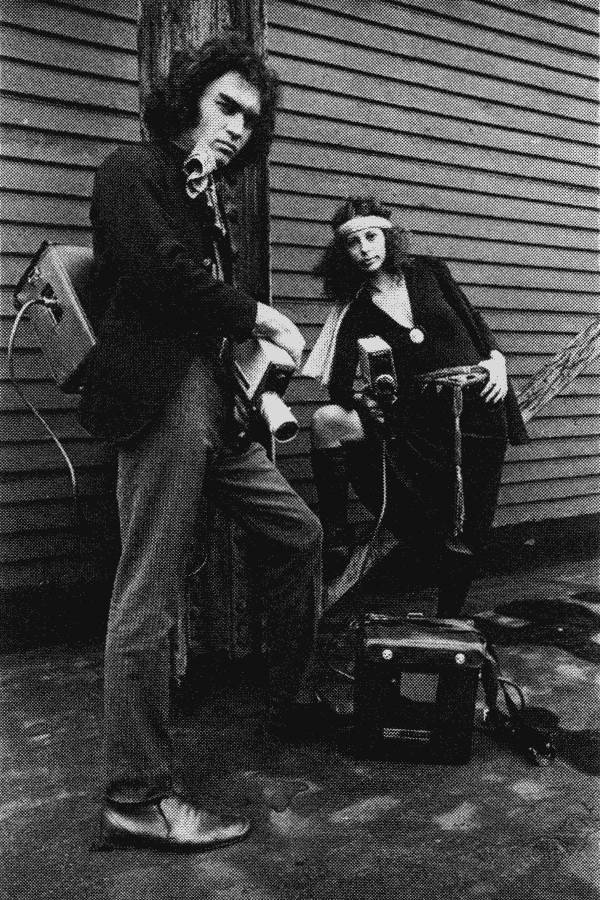
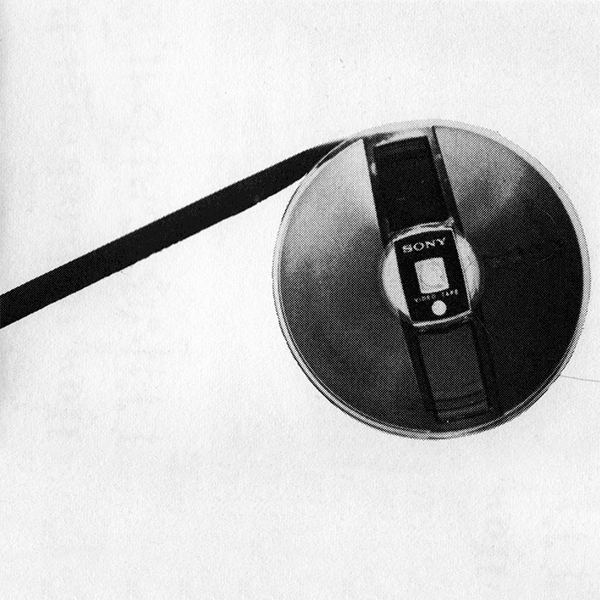
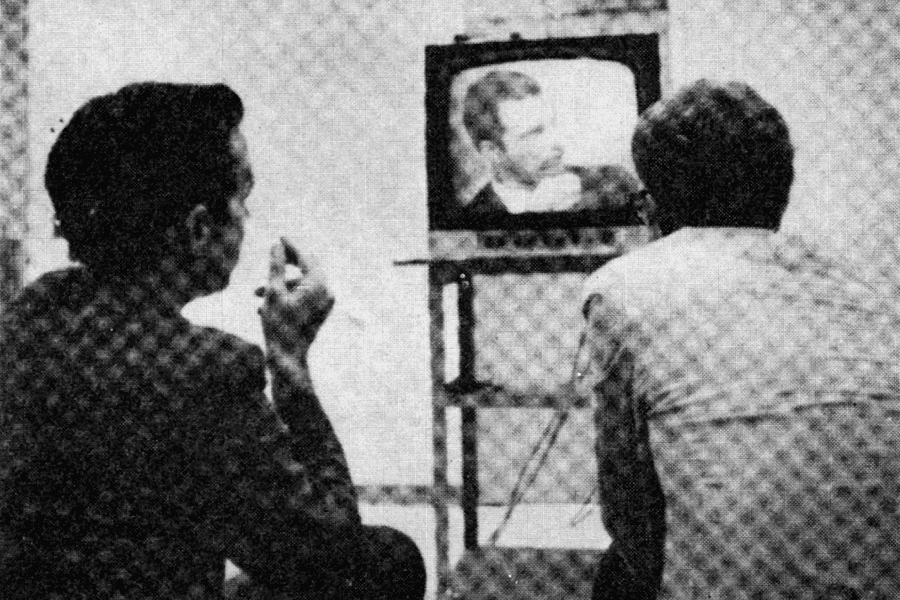
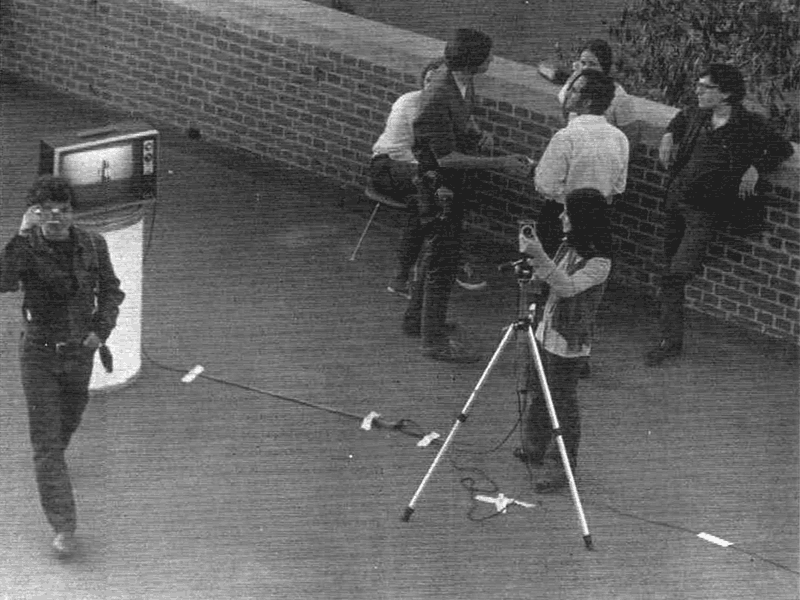
<p class="translation">A mediados del siglo XX, la invención y disponibilidad de nuevas drogas psicodélicas, y el creciente discurso cultural en torno a ellas, coincidieron con los de la televisión, las cintas de vídeo y la informática. Las tecnologías psicodélicas y la electrónica crecieron juntas, y quienes usaban o pensaban en una a menudo implicaban a la otra. Cuando Sony y otros fabricantes japoneses desarrollaron nuevos magnetoscopios portátiles a finales de los años sesenta, por ejemplo, surgieron nuevas comunidades de artistas a su alrededor, primero en Estados Unidos y Canadá, y después en Europa, Asia, el norte de África y América Latina. Por primera vez, declararon estos entusiastas, mucha gente podía hacer su propia televisión, rompiendo el oligopolio de la radiodifusión. Al describir las implicaciones psicológicas y sociológicas de esta nueva tecnología, muchos la compararon con las drogas psicodélicas.</p>]]></content><author><name>Peter Sachs Collopy</name></author><category term="writing" /><category term="technology" /><category term="media" /><category term="video" /><category term="synthesizers" /><category term="consciousness" /><category term="visual culture" /><category term="science" /><category term="biology" /><category term="evolution" /><category term="human sciences" /><category term="medicine" /><category term="engineering" /><category term="drugs" /><category term="art" /><category term="psychiatry" /><category term="California" /><category term="New York" /><summary type="html"><![CDATA[In the middle of the twentieth century, the invention and availability of new psychedelic drugs, and the growing cultural discourse around them, coincided with those of television, videotape, and computing. The technologies of psychedelics and electronics grew up together, and those using or thinking about one often implicated the other. When Sony and other Japanese manufacturers developed new portable videotape recorders in the late 1960s, for example, new communities of artists and tinkerers emerged around them, first in the US and Canada and then in Europe, Asia, North Africa, and Latin America. For the first time, declared these enthusiasts, many people could make their own television, breaking the broadcast oligopoly. In describing the psychological and sociological implications of this new technology, many compared it to psychedelic drugs. A mediados del siglo XX, la invención y disponibilidad de nuevas drogas psicodélicas, y el creciente discurso cultural en torno a ellas, coincidieron con los de la televisión, las cintas de vídeo y la informática. Las tecnologías psicodélicas y la electrónica crecieron juntas, y quienes usaban o pensaban en una a menudo implicaban a la otra. Cuando Sony y otros fabricantes japoneses desarrollaron nuevos magnetoscopios portátiles a finales de los años sesenta, por ejemplo, surgieron nuevas comunidades de artistas a su alrededor, primero en Estados Unidos y Canadá, y después en Europa, Asia, el norte de África y América Latina. Por primera vez, declararon estos entusiastas, mucha gente podía hacer su propia televisión, rompiendo el oligopolio de la radiodifusión. Al describir las implicaciones psicológicas y sociológicas de esta nueva tecnología, muchos la compararon con las drogas psicodélicas.]]></summary></entry><entry><title type="html">Curating Art and Science</title><link href="https://collopy.net/teaching/2022/curating/" rel="alternate" type="text/html" title="Curating Art and Science" /><published>2022-08-29T00:00:00-07:00</published><updated>2022-08-29T00:00:00-07:00</updated><id>https://collopy.net/teaching/2022/curating</id><content type="html" xml:base="https://collopy.net/teaching/2022/curating/"><![CDATA[<p>This is a syllabus for Curating Art and Science, a course offered in museum studies, history, and cultural studies in fall 2022 at Claremont Graduate University. This course will explore the history of interactions between art, science, and technology, and how to curate exhibitions on the subject. It is partly based on the instructors’ work, as part of the Getty Foundation’s Pacific Standard Time 2024 program on art, science, and LA, to develop a multi-sited, campus-wide exhibition at Caltech on Caltech’s own uses of visual culture over the last century to produce science, to communicate it, and to foster scientific identity and community. Our readings will emphasize the 20th century US, and sometimes specifically Caltech’s own history, but student projects may extend beyond this geographical and chronological context.</p>
<!--more-->
<p>The course will be divided into three modules:</p>

<ol>
	<li><b>Art and Science:</b> During the first part of the semester, we will think about the relationships between art, science, technology, and visual culture more generally, studying foundational texts on scientific illustration, the influence of science on modern and contemporary art, technological art, and the architecture of scientific institutions.</li>
	<li><b>Curating:</b> The second part of the semester takes an in-depth look at the history of exhibitions, both in the science and visual arts realms, and explores the nature and roles of archives and collections as sources for display. We will pay particular attention to contemporary curatorial theory and practice as it has evolved from the 1960s to the present. There will be site visits to the Benton Museum at Pomona College, where we will see an installation by California Light and Space artist Helen Pashgian; the Huntington Library, where we view a site-specific installation by artist Lita Albuquerque and meet with senior curators working on art and science exhibitions; and the Caltech Archives and Special Collections, where we will explore the records kept by scientific institutions. Other guests will join the conversation to deepen our understanding of discourse and standards in the field.</li>
	<li><b>Disciplinary Histories and Student Presentations:</b> During the third part of the semester, we will focus on the histories of visual culture in specific scientific disciplines, as well as art and architecture, often reading case studies from Caltech’s own history. Students will curate, design, and present possible exhibition displays on these topics drawing on the Caltech Archives and other local collections.</li>
</ol>

<p>Throughout the semester, students will investigate a range of visual practices at Caltech and other scientific institutions according to the specific scientific, artistic, and institutional functions they serve. What kinds of information do scientific images convey, and how do we best look at them in their varying contexts? How do we account for the choices scientists and artists make when they represent their work, and what cultural biases or preferences might their images contain? How do scientific images relate to other images in art, technology, and popular culture?</p>

<p>This course does not require any specific background preparation. For those unfamiliar with the academic study of visual culture, additional reading in James Elkins and Erna Fiorentini, <cite>Visual Worlds: Looking, Images, Visual Disciplines</cite> (Oxford University Press, 2020) may be useful for context.</p>

<h3>Student Learning Outcomes</h3>

<p>Upon successful completion of this course, students will be able to:</p>

<ol>
	<li>Understand the complex interactions between art, science, technology, and visual culture in the 20th and early 21st centuries, especially as they relate to the California Institute of Technology, other American science institutions, and Southern California.</li>
	<li>Navigate art and science discourses in the humanities.</li>
	<li>Reflect on and engage critically with trends and issues in contemporary curatorial practice.</li>
	<li>Collaborate with project partners.</li>
	<li>Strengthen research, writing, and presentation skills, communicating in a variety of formats and for diverse audiences.</li>
	<li>Create compelling exhibitions with an understanding of different spaces and their design, as well as the selection, care, and management of display objects.</li>
	<li>Know artists, scholars, curators, and design professionals working in the field.</li>
</ol>

<h3>Assignments</h3>

<ol>
	<li><b>Exhibition review</b> (500 words) of a local exhibition of your choice which engages with both art and science. Specific guidelines for this review will be posted online and discussed in class. Reviews are due electronically before class on October 24, 2022.</li>
	<li><b>Exhibition proposal</b> of a concept, items, didactic text, and layout for a small display on an art/science theme either chosen from a list provided by the course instructors or proposed by the student. Elements of the proposal will include a short introductory text (500 words), a checklist of 15–30 display items, a sample wall text (250 words) and didactic exhibition label (100 words), and space selection and layout/fabrication ideas. You may work independently or collaborate with one or more partners. In addition to handing in proposal materials, each student will present on their proposal during the third portion of the semester. Your presentation will be assessed based on the comprehensiveness and originality of your ideas; their viability in a real-life gallery, museum, or library setting; and your creative communication skills. Specific guidelines for a successful exhibition proposal will be posted online and discussed in class. Proposals are due on your assigned presentation day, between November 7 and December 12.</li>
	<li><b>Curatorial essay</b> (15–20 pages, no more than 5000 words) providing historical, cultural, aesthetic, or other scholarly analysis of your proposal exhibition, or, with permission of the instructors, of another topic. Specific guidelines for the creation of a curatorial essay will be posted online and discussed in class. Curatorial essays are due electronically on December 16.</li>
</ol>

<p>Your grade for the course will be based 20% on the exhibition review, 30% each on the exhibition proposal and curatorial essay, and 20% on your engaged and insightful participation in class.</p>

<p>We’ll discuss readings during every class, so please read everything assigned before the class meeting it’s listed under. Please submit assignments by email to both instructors.</p>

<h3>Schedule of Class Topics and Readings</h3>

<ul>
	<li>
		<h5>August 29: Introduction</h5>
	</li>
</ul>

<h4>Art and Science</h4>
<ul>
	<li>
		<h5>September 12: Scientific Images</h5>
		<ul>
			<li>James Elkins, <cite><a href="https://www.jstor.org/stable/10.7591/j.ctv3s8n8p">The Domain of Images</a></cite> (Cornell University Press, 1999), 3–51.</li>
			<li>Horst Bredekamp, Vera Dünkel, and Birgit Schneider, eds., <cite>The Technical Image: A History of Styles in Scientific Imagery</cite> (University of Chicago Press, 2015), 1–45.</li>
			<li>Bruno Latour, “<a href="http://www.bruno-latour.fr/sites/default/files/21-DRAWING-THINGS-TOGETHER-GB.pdf">Visualization and Cognition: Drawing Things Together</a>,” <cite>Knowledge and Society</cite> 6 (1986): 1–40.</li>
			<li>Lorraine Daston and Peter Galison, <cite><a href="https://www.jstor.org/stable/j.ctv1c9hq4d">Objectivity</a></cite> (Zone, 2007), 9–53.</li>
		</ul>
	</li>
	<li>
		<h5>September 19: Science in Art</h5>
		<ul>
			<li>James Elkins and Erna Fiorentini, <cite>Visual Worlds: Looking, Images, Visual Disciplines</cite> (Oxford University Press, 2020), 339–362.</li>
			<li>Chiara Ambrosio, “<a href="https://doi.org/10.1080/03080188.2016.1223586">Cubism and the Fourth Dimension</a>,” <cite>Interdisciplinary Science Reviews</cite> 41 (2016): 202–221.</li>
			<li>Linda Dalrymple Henderson, “<a href="https://doi.org/10.2307/776982">X Rays and the Quest for Invisible Reality in the Art of Kupka, Duchamp, and the Cubists</a>,” <cite>Art Journal</cite> 47 (1988): 323–340.</li>
			<li>Vanja V. Malloy, “From Macrocosm to Microcosm: Examining the Role of Modern Science in American Art,” in <cite>Dimensionism: Modern Art in the Age of Einstein</cite>, ed. Vanja V. Malloy (Mead Art Museum, Amherst College and MIT Press, 2018), 71–97.</li>
		</ul>
	</li>
	<li>
		<h5>September 26: The Architecture of Science</h5>
		<ul>
			<li>Sophie Forgan, “<a href="https://doi.org/10.1016/0039-3681(89)90017-4">The Architecture of Science and the Idea of a University</a>,” <cite>Studies in History and Philosophy of Science</cite> 20 (1989): 405–434.</li>
			<li>Robert E. Kohler, “<a href="https://doi.org/10.1177/007327530204000405">Labscapes: Naturalizing the Lab</a>,” <cite>History of Science</cite> 40 (2002): 473–501.</li>
			<li>Thomas F. Gieryn, “Two Faces on Science: Building Identities for Molecular Biology and Biotechnology,” in <cite><a href="https://hdl.handle.net/2027/heb08330.0001.001">The Architecture of Science</a></cite>, ed. Peter Galison and Emily Thompson (MIT Press, 1999), 423–455.</li>
			<li>Thomas F. Gieryn, “<a href="https://doi.org/10.1086/595773">Laboratory Design for Post-Fordist Science</a>,” <cite>Isis</cite> 99 (2008): 796–802.</li>
			<li>Peter Galison and Caroline A. Jones, “Factory, Laboratory, Studio: Dispersing Sites of Production,” in Galison and Thompson, <cite><a href="https://hdl.handle.net/2027/heb08330.0001.001">Architecture of Science</a></cite>, 497–540.</li>
		</ul>
	</li>
	<li>
		<h5>October 3: Art and Technology</h5>
		<ul>
			<li>Fred Turner, “<a href="https://doi.org/10.1177/1470412907087201">Romantic Automatism: Art, Technology, and Collaborative Labor in Cold War America</a>,” <cite>Journal of Visual Culture</cite> 7 (2008): 5–26.</li>
			<li>Anne Collins Goodyear, “<a href="https://www.jstor.org/stable/20206559">From Technophilia to Technophobia: The Impact of the Vietnam War on the Reception of ‘Art and Technology,’</a>” <cite>Leonardo</cite> 41, no. 2 (2008): 169–173.</li>
			<li>Matthew Wisnioski, “<a href="https://doi.org/10.1353/con.2013.0006">Why MIT Institutionalized the Avant-Garde: Negotiating Aesthetic Virtue in the Postwar Defense Institute</a>,” <cite>Configurations</cite> 21 (2013): 85–116.</li>
			<li>W. Patrick McCray, “Fallout and Spinoff: Commercializing the Art-Technology Nexus,” in <cite>Hybrid Practices: Art in Collaboration with Science and Technology in the Long 1960s</cite>, ed. David Cateforis, Steven Duval, and Shepherd Steiner (University of California Press, 2019), 61–77.</li>
		</ul>
	</li>
</ul>

<h4>Curating</h4>
<ul>
	<li>
		<h5>October 10: Showing Is Telling: Contemporary Curatorial Practice</h5>
		<ul>
			<li><i>Guest: <a href="https://www.timdurfee.com/">Tim Durfee</a>, Principal of Tim Durfee Studio and Professor of Media Design Practices, Art Center College of Design</i></li>
			<li>Robert Storr, “Show and Tell,” in <cite>What Makes a Great Exhibition?</cite> ed. Paula Marincola (Reaktion, 2006), 14–31.</li>
			<li>Kate Fowle, “Who Cares? Understanding the Role of the Curator Today,” in <cite>Cautionary Tales: Critical Curating</cite>, ed. Steven Rand and Heather Kouris (apexart, 2007).</li>
			<li>Hans Ulrich Obrist, <cite>Ways of Curating</cite> (Farrar, Straus and Giroux, 2014), 14–16, 22–35.</li>
			<li>Jens Hofmann and Maria Lind, “<a href="https://www.moussemagazine.it/magazine/jens-hoffmann-maria-lind-2011/">To Show or Not to Show</a>,” <cite>Mousse Magazine</cite>, no. 31 (November 2011).</li>
			<li>Adrian George, <cite>The Curator’s Handbook: Museums, Commercial Galleries, Independent Spaces</cite> (Thames and Hudson, 2015), 152–206.</li>
		</ul>
	</li>
	<li>
		<h5>October 17: Archives and Collections</h5>
		<ul>
			<li><i>Guest: <a href="http://www.elinoharaslavick.com/">elin o’Hara slavick</a>, artist and curator</i></li>
			<li>Elizabeth Yale, “<a href="https://www.jstor.org/stable/43956377">The History of Archives: The State of the Discipline</a>,” <cite>Book History</cite> 18 (2015): 332–359.</li>
			<li>Lorraine Daston, “<a href="https://doi.org/10.1086/667826">The Sciences of the Archive</a>,” <cite>Osiris</cite> 27 (2012): 156–187.</li>
			<li>Allan Sekula, “<a href="https://doi.org/10.2307/778312">The Body and the Archive</a>,” <cite>October</cite>, no. 39 (Winter 1986): 3–64.</li>
			<li>Jennifer Tucker, “<a href="https://doi.org/10.1086/501104">The Historian, the Picture, and the Archive</a>,” <cite>Isis</cite> 97 (2006): 111–120.</li>
			<li>George, <cite>Curator’s Handbook, 30–48 and 56–87.</li>
		</ul>
	</li>
	<li>
		<h5>October 24: Exhibiting Art, Exhibiting Science</h5>
		<ul>
			<li><i>Guest: Dan Lewis, Dibner Senior Curator of the History of Science and Technology, Huntington Library</i></li>
			<li>Sharon Macdonald, “Exhibitions of Power and Powers of Exhibitions: An Introduction to the Politics of Display,” in <cite>The Politics of Display: Museums, Science, and Culture</cite>, ed. Sharon Macdonald (Routledge, 1998), 1–24.</li>
			<li>Ivan Karp and Steven D. Lavine, eds., <cite>Exhibiting Cultures: The Poetics and Politics of Museum Display</cite> (Smithsonian Institution Press, 1991), 1–56.</li>
			<li>Tony Bennet, “The Exhibitionary Complex,” in <cite>Thinking About Exhibitions</cite>, ed. Reesa Greenberg, Bruce W. Fergusson, and Sandy Nairne (Routledge, 1996), 81–112.</li>
			<li>Terry Smith, <cite>Thinking Contemporary Curating</cite> (Independent Curators International, 2012), 57–100.</li>
		</ul>
	</li>
	<li>
		<h5>October 31: From White Cube to Black Box: Contemporary Curatorial Thought</h5>
		<ul>
			<li><i>Guest: Rebecca McGrew, Senior Curator, Benton Museum of Art, Pomona College</i></li>
			<li>Brian O’Doherty, “<a href="https://www.artforum.com/print/197603/inside-the-white-cube-notes-on-the-gallery-space-part-i-38508">Inside the White Cube: Notes on the Gallery Space, Part I</a>,” <cite>Artforum</cite>, March 1976.</li>
			<li>Okwui Enwezor, “The Black Box,” in <cite>Documenta 11_Platform 5: Exhibition, Catalogue</cite> (Hatje Cantz, 2002).</li>
			<li>Carolee Thea, “Okwui Enwezor,” in <cite>On Curating: Interviews with Ten International Curators</cite> (Distributed Art Publishers, 2009), 43–53.</li>
			<li>Paul O’Neill, <cite>The Culture of Curating and the Curating of Culture(s)</cite> (MIT Press, 2016), 9–49.</li>
			<li>Smith, <cite>Thinking Contemporary Curating</cite>, 178–246.</li>
			<li>Irit Rogoff, “<a href="https://xenopraxis.net/readings/rogoff_smuggling.pdf">‘Smuggling’: An Embodied Criticality</a>,” August 2006.</li>
		</ul>
	</li>
</ul>

<h4>Disciplinary Histories and Student Presentations</h4>
<ul>
	<li>
		<h5>November 7: Astronomy and Planetary Science</h5>
		<ul>
			<li>Alex Soojung-Kim Pang, “<a href="https://www.jstor.org/stable/4027716">‘Stars Should Henceforth Register Themselves’: Astrophotography at the Early Lick Observatory</a>,” <cite>British Journal for the History of Science</cite> 30 (1997): 177–205.</li>
			<li>Omar W. Nasim, “<a href="https://www.mprl-series.mpg.de/studies/12/10/index.html">Handling the Heavens: Things and the Photo-Objects of Astronomy</a>,” in <cite>Photo-Objects: On the Materiality of Photographs and Photo Archives in the Humanities and Sciences</cite>, ed. Julia Bärnighausen, Costanza Caraffa, Stefanie Klamm, Franka Schneider, and Petra Wodtke (Max-Planck-Gesellschaft zur Förderung der Wissenschaften, 2019), 161–175.</li>
			<li>Elizabeth A. Kessler, “<a href="https://doi.org/10.1353/tech.2021.0198">Technology’s Palette: Voyager’s Eyes and the Hyperchromatic Enhancement of Jupiter and Saturn</a>,” <cite>Technology and Culture</cite> 62 (2021): 1087–1118.</li>
			<li>Janet Vertesi, “<a href="https://doi.org/10.7551/mitpress/9780262525381.003.0002"><i>Drawing As</i>: Distinctions and Disambiguation in Digital Images of Mars</a>,” in <cite>Representation in Scientific Practice Revisited</cite>, ed. Catelijne Coopmans, Janet Vertesi, Michael Lynch, and Steve Woolgar (MIT Press, 2014), 15–36.</li>
		</ul>
	</li>
	<li>
		<h5>November 14: Biology</h5>
		<ul>
			<li>Nick Hopwood, “<a href="https://publicdomainreview.org/essay/copying-pictures-evidencing-evolution">Copying Pictures, Evidencing Evolution</a>,” <cite>Public Domain Review</cite>, May 18, 2016.</li>
			<li>Maura C. Flannery, “<a href="https://www.jstor.org/stable/1576571">Images of the Cell in Twentieth-Century Art and Science</a>,” <cite>Leonardo</cite> 31 (1998): 195–204.</li>
			<li>Christopher Kelty and Hannah Landecker, “<a href="https://doi.org/10.1162/1526381042464536">A Theory of Animation: Cells, L-Systems, and Film</a>,” <cite>Grey Room</cite>, no. 17 (2004): 31–63.</li>
			<li>Soraya de Chadarevian, “Models and the Making of Molecular Biology,” in <cite>Models: The Third Dimension of Science</cite>, ed. Soraya de Chadarevian and Nick Hopwood (Stanford University Press, 2004), 339–368.</li>
		</ul>
	</li>
	<li>
		<h5>November 21: Chemistry</h5>
		<ul>
			<li>Christoph Meinel, “Molecules and Croquet Balls,” in de Chadarevian and Hopwood, <cite>Models</cite>, 242–275.</li>
			<li>Alberto Cambrosio, Daniel Jacobi, and Peter Keating, “<a href="https://doi.org/10.1525/rep.2005.89.1.94">Arguing with Images: Pauling’s Theory of Antibody Formation</a>,” <cite>Representations</cite> 89, (2005): 94–130.</li>
		</ul>
	</li>
	<li>
		<h5>November 28: Art and Architecture</h5>
		<ul>
			<li>Stefanos Polyzoides, “<a href="https://www.classicist.org/pdf/classicist15/#page=10">Bertram Goodhue and the Architecture of Caltech, 1915 to 1939</a>,” <cite>Classicist</cite>, no. 15 (2018): 8–19.</li>
			<li>Zabet Patterson, “<a href="https://doi.org/10.1162/grey.2009.1.36.36">From the Gun Controller to the Mandala: The Cybernetic Cinema of John and James Whitney</a>,” <cite>Grey Room</cite>, no. 36 (2009): 36–57.</li>
			<li>Stephen Nowlin, “<a href="https://muse.jhu.edu/article/670950">@Caltech: Art, Science and Technology, 1969–1971</a>,” <cite>Leonardo</cite> 50 (2017): 443–447.</li>
			<li>Lisa Lynch, “‘Out-liers,’ ‘Insiders,’ and Practical Harvest: Art as Technology Transfer in a Research Environment,” <cite>Research in Science and Technology Studies</cite> 13 (2002): 239–265.</li>
		</ul>
	</li>
	<li>
		<h5>December 5: Physics</h5>
		<ul>
			<li>Peter Galison and Alexi Assmus, “Artificial Clouds, Real Particles,” in <cite>The Uses of Experiment: Studies in the Natural Sciences</cite>, ed. David Gooding, Trevor Pinch, and Simon Schaffer (Cambridge University Press, 1989), 225–274.</li>
			<li>David Kaiser, “<a href="https://doi.org/10.2307/2902893">Stick Figure Realism: Conventions, Reification, and the Persistence of Feynman Diagrams, 1948–1964</a>,” <cite>Representations</cite> 70 (2000): 49–86.</li>
			<li>James Elkins, <cite>Six Stories from the End of Representation: Images in Painting, Photography, Astronomy, Microscopy, Particle Physics, and Quantum Mechanics, 1980–2000</cite> (Stanford University Press, 2008), 156–223.</li>
			<li>Colleen O’Reilly, “<a href="https://www.jstor.org/stable/44011808">Pedagogical Interventions: The Physics Photographs of Berenice Abbott</a>,” <cite>RACAR: revue d'art canadienne / Canadian Art Review</cite> 41, no. 2 (2016): 77–90.</li>
		</ul>
	</li>
	<li>
		<h5>December 12: Conclusion</h5>
	</li>
</ul>]]></content><author><name>Peter Sachs Collopy</name></author><category term="teaching" /><category term="architecture" /><category term="art" /><category term="visual culture" /><category term="science" /><category term="technology" /><category term="media" /><category term="Caltech" /><category term="biology" /><category term="chemistry" /><category term="physics" /><category term="astronomy" /><category term="archives" /><summary type="html"><![CDATA[This is a syllabus for Curating Art and Science, a course offered in museum studies, history, and cultural studies in fall 2022 at Claremont Graduate University. This course will explore the history of interactions between art, science, and technology, and how to curate exhibitions on the subject. It is partly based on the instructors’ work, as part of the Getty Foundation’s Pacific Standard Time 2024 program on art, science, and LA, to develop a multi-sited, campus-wide exhibition at Caltech on Caltech’s own uses of visual culture over the last century to produce science, to communicate it, and to foster scientific identity and community. Our readings will emphasize the 20th century US, and sometimes specifically Caltech’s own history, but student projects may extend beyond this geographical and chronological context.]]></summary></entry><entry><title type="html">Behind the Book: Escape from Earth</title><link href="https://collopy.net/discussions/2022/escape-from-earth/" rel="alternate" type="text/html" title="Behind the Book: Escape from Earth" /><published>2022-03-24T00:00:00-07:00</published><updated>2022-03-24T00:00:00-07:00</updated><id>https://collopy.net/discussions/2022/escape-from-earth</id><content type="html" xml:base="https://collopy.net/discussions/2022/escape-from-earth/"><![CDATA[]]></content><author><name>Peter Sachs Collopy</name></author><category term="discussions" /><category term="Caltech" /><category term="politics" /><category term="technology" /><category term="technopolitics" /><category term="engineering" /><category term="communism" /><category term="California" /><category term="archives" /><summary type="html"><![CDATA[]]></summary></entry><entry><title type="html">Video and the Self: Closed Circuit | Feedback | Narcissism</title><link href="https://collopy.net/writing/2022/video-and-the-self/" rel="alternate" type="text/html" title="Video and the Self: Closed Circuit | Feedback | Narcissism" /><published>2022-02-24T00:00:00-08:00</published><updated>2022-02-24T00:00:00-08:00</updated><id>https://collopy.net/writing/2022/video-and-the-self</id><content type="html" xml:base="https://collopy.net/writing/2022/video-and-the-self/"><![CDATA[A chapter which I guest edited:

The relationship between video and the self has been one of the central concerns of video theory. Prominent artists such as Vito Acconci, Dan Graham, Joan Jonas, and Bruce Nauman have organized their artistic practice around mediated self-observation, either using video to document and complicate their own expressions of self or building installations with which viewers can see and experience themselves in new ways. Such self-portraiture is the subject of the most widely cited essay in this volume, Rosalind Krauss’s 1976 “Video: The Aesthetics of Narcissism,” and of several essays responding to it.

Even before videotape became an artistic medium in 1965, though, video, self-observation, and narcissism were already the subjects of a theoretical literature produced by psychiatrists and psychologists. If patients saw how disordered they appeared to others, some psychotherapists suggested, they might be motivated to change. Other clinicians rewatched sessions with patients so that either could pause the video to discuss emotions or experiences which they hadn’t articulated, essentially putting themselves back into a moment in the conversation. Some of the most prominent artists and theorists working with video were directly influenced by this video therapy tradition.]]></content><author><name>Peter Sachs Collopy</name></author><category term="writing" /><category term="technology" /><category term="media" /><category term="video" /><category term="cybernetics" /><category term="consciousness" /><category term="visual culture" /><category term="human sciences" /><category term="medicine" /><category term="art" /><category term="psychiatry" /><summary type="html"><![CDATA[A chapter which I guest edited: The relationship between video and the self has been one of the central concerns of video theory. Prominent artists such as Vito Acconci, Dan Graham, Joan Jonas, and Bruce Nauman have organized their artistic practice around mediated self-observation, either using video to document and complicate their own expressions of self or building installations with which viewers can see and experience themselves in new ways. Such self-portraiture is the subject of the most widely cited essay in this volume, Rosalind Krauss’s 1976 “Video: The Aesthetics of Narcissism,” and of several essays responding to it. Even before videotape became an artistic medium in 1965, though, video, self-observation, and narcissism were already the subjects of a theoretical literature produced by psychiatrists and psychologists. If patients saw how disordered they appeared to others, some psychotherapists suggested, they might be motivated to change. Other clinicians rewatched sessions with patients so that either could pause the video to discuss emotions or experiences which they hadn’t articulated, essentially putting themselves back into a moment in the conversation. Some of the most prominent artists and theorists working with video were directly influenced by this video therapy tradition.]]></summary></entry><entry><title type="html">Virtual Talks with Video Activists: Dean and Dudley Evenson</title><link href="https://collopy.net/discussions/2022/dean-and-dudley-evenson/" rel="alternate" type="text/html" title="Virtual Talks with Video Activists: Dean and Dudley Evenson" /><published>2022-02-03T00:00:00-08:00</published><updated>2022-02-03T00:00:00-08:00</updated><id>https://collopy.net/discussions/2022/dean-and-dudley-evenson</id><content type="html" xml:base="https://collopy.net/discussions/2022/dean-and-dudley-evenson/"><![CDATA[Dean and Dudley Evenson are video pioneers who became immersed in the half-inch scene when in 1970 they happened to purchase the first AV Series Sony video portapack sold in Manhattan. They became members of the Raindance video group and co-edited Radical Software, working under grants from New York State Council on the Arts. They taught video to high school students through the Arts Awareness Program at the Metropolitan Museum of Art. Dean was the first person to hook up a half-inch video deck to the Sterling Manhattan Cable system paving the way for Public Access Television. They also ran Downsville TV in upstate New York where they would video local people and events and drive their VW Van to a telephone pole where they plugged into the cable head end and transmitted their weekly programs. During the 1970s, Dean and Dudley lived and traveled the country in a converted school bus documenting what they called ‘the emerging consciousness.’ They created hundreds of half-inch videos which they have been archiving and releasing on their Soundings Mindful Media YouTube Channel.]]></content><author><name>Peter Sachs Collopy</name></author><category term="discussions" /><category term="video" /><category term="art" /><category term="visual culture" /><category term="media" /><category term="technology" /><category term="New York" /><summary type="html"><![CDATA[Dean and Dudley Evenson are video pioneers who became immersed in the half-inch scene when in 1970 they happened to purchase the first AV Series Sony video portapack sold in Manhattan. They became members of the Raindance video group and co-edited Radical Software, working under grants from New York State Council on the Arts. They taught video to high school students through the Arts Awareness Program at the Metropolitan Museum of Art. Dean was the first person to hook up a half-inch video deck to the Sterling Manhattan Cable system paving the way for Public Access Television. They also ran Downsville TV in upstate New York where they would video local people and events and drive their VW Van to a telephone pole where they plugged into the cable head end and transmitted their weekly programs. During the 1970s, Dean and Dudley lived and traveled the country in a converted school bus documenting what they called ‘the emerging consciousness.’ They created hundreds of half-inch videos which they have been archiving and releasing on their Soundings Mindful Media YouTube Channel.]]></summary></entry><entry><title type="html">Iterating Infrastructure from High Volts to X-Rays to Nuclear Physics: Early Caltech Science in the Archives</title><link href="https://collopy.net/presentations/2022/iterating-infrastructure/" rel="alternate" type="text/html" title="Iterating Infrastructure from High Volts to X-Rays to Nuclear Physics: Early Caltech Science in the Archives" /><published>2022-01-13T00:00:00-08:00</published><updated>2022-01-13T00:00:00-08:00</updated><id>https://collopy.net/presentations/2022/iterating-infrastructure</id><content type="html" xml:base="https://collopy.net/presentations/2022/iterating-infrastructure/"><![CDATA[{% include youtube.html id=page.youtube %}

In the 1920s and 1930s, Caltech iteratively developed infrastructure for research on high-voltage electricity, x-rays, and nuclear physics. In 1923, the Institute built the High Voltage Research Laboratory, now the Ronald and Maxine Lind Hall of Mathematics and Physics, with funding from Southern California Edison, which used the unique million-volt high-bay research facility to test high-voltage transmission equipment. Among Caltech's faculty, electrical engineer Royal Sorensen invented the cascade transformer for the facility, and physicist Robert Millikan planned to use its power to dismantle the atom and achieve the alchemists' dream of transmutation of matter. Instead, though, Millikan's student Charles Lauritsen made High Volts a key site for high-voltage x-ray research, including on the uses of radiation therapy for cancer, bringing medical physics to Caltech in the early 1930s. Lauritsen and his students in turn modified their x-ray tubes to conduct research in nuclear physics, realizing Millikan's vision of deconstructing the atom. These three research programs built on each other, repurposing apparatus and thus ultimately the resources of the electricity industry to develop experimental physics in new directions. In this talk, I will use this early history of Caltech physics to think about both how research programs are shaped by the material resources of earlier projects and what we can learn from the collections of the Caltech Archives.]]></content><author><name>Peter Sachs Collopy</name></author><category term="presentations" /><category term="physics" /><category term="Caltech" /><category term="technology" /><category term="science" /><category term="laboratories" /><category term="engineering" /><category term="California" /><summary type="html"><![CDATA[In the 1920s and 1930s, Caltech iteratively developed infrastructure for research on high-voltage electricity, x-rays, and nuclear physics. In 1923, the Institute built the High Voltage Research Laboratory, now the Ronald and Maxine Lind Hall of Mathematics and Physics, with funding from Southern California Edison, which used the unique million-volt high-bay research facility to test high-voltage transmission equipment. Among Caltech’s faculty, electrical engineer Royal Sorensen invented the cascade transformer for the facility, and physicist Robert Millikan planned to use its power to dismantle the atom and achieve the alchemists’ dream of transmutation of matter. Instead, though, Millikan’s student Charles Lauritsen made High Volts a key site for high-voltage x-ray research, including on the uses of radiation therapy for cancer, bringing medical physics to Caltech in the early 1930s. Lauritsen and his students in turn modified their x-ray tubes to conduct research in nuclear physics, realizing Millikan’s vision of deconstructing the atom. These three research programs built on each other, repurposing apparatus and thus ultimately the resources of the electricity industry to develop experimental physics in new directions. In this talk, I will use this early history of Caltech physics to think about both how research programs are shaped by the material resources of earlier projects and what we can learn from the collections of the Caltech Archives.]]></summary></entry><entry><title type="html">Electronic Artist Nam June Paik Celebrated in SFMOMA Retrospective</title><link href="https://collopy.net/discussions/2021/nam-june-paik/" rel="alternate" type="text/html" title="Electronic Artist Nam June Paik Celebrated in SFMOMA Retrospective" /><published>2021-07-23T00:00:00-07:00</published><updated>2021-07-23T00:00:00-07:00</updated><id>https://collopy.net/discussions/2021/nam-june-paik</id><content type="html" xml:base="https://collopy.net/discussions/2021/nam-june-paik/"><![CDATA[In the first retrospective of his work on the West Coast, SFMOMA’s current exhibition on electronic art pioneer Nam June Paik features more than 200 works from the artist whose five-decade career “changed the way we look at screens.” One of most acclaimed of the first generation of video artists, Paik’s early work in the 1960s changed perceptions of television, video and the boundary between art and spectator through its integration of camera, video, music and performance. We’ll talk about Paik’s work and legacy, and we’ll hear from contemporary video artists who will discuss Paik’s impact on their own art.]]></content><author><name>Peter Sachs Collopy</name></author><category term="discussions" /><category term="video" /><category term="art" /><category term="visual culture" /><category term="media" /><category term="technology" /><category term="consciousness" /><summary type="html"><![CDATA[In the first retrospective of his work on the West Coast, SFMOMA’s current exhibition on electronic art pioneer Nam June Paik features more than 200 works from the artist whose five-decade career “changed the way we look at screens.” One of most acclaimed of the first generation of video artists, Paik’s early work in the 1960s changed perceptions of television, video and the boundary between art and spectator through its integration of camera, video, music and performance. We’ll talk about Paik’s work and legacy, and we’ll hear from contemporary video artists who will discuss Paik’s impact on their own art.]]></summary></entry><entry><title type="html">Making Art Do Work</title><link href="https://collopy.net/writing/2020/making-art-do-work/" rel="alternate" type="text/html" title="Making Art Do Work" /><published>2020-10-22T00:00:00-07:00</published><updated>2020-10-22T00:00:00-07:00</updated><id>https://collopy.net/writing/2020/making-art-do-work</id><content type="html" xml:base="https://collopy.net/writing/2020/making-art-do-work/"><![CDATA[In <cite>Making Art Work</cite>, W. Patrick McCray asks why and how American artists and engineers collaborated to produce technological art in the 1960s and 1970s. In our current moment, so obviously marked by the American government’s failure to deploy scientific expertise against a pandemic, and by demonstrations against white supremacy and police brutality larger than those of the 1960s, this book also provokes additional questions. Of what did technological art make people aware? Could it in fact contribute to solving social problems like hunger, homelessness, and war? How did patriarchy and white supremacy shape this art and the awareness it produced? What roles did women and people of color play in constructing and contesting it? Although none of these questions is at the center of McCray’s book, he points toward some of the answers.]]></content><author><name>Peter Sachs Collopy</name></author><category term="writing" /><category term="technology" /><category term="media" /><category term="art" /><category term="visual culture" /><category term="politics" /><category term="engineering" /><category term="technopolitics" /><summary type="html"><![CDATA[In Making Art Work, W. Patrick McCray asks why and how American artists and engineers collaborated to produce technological art in the 1960s and 1970s. In our current moment, so obviously marked by the American government’s failure to deploy scientific expertise against a pandemic, and by demonstrations against white supremacy and police brutality larger than those of the 1960s, this book also provokes additional questions. Of what did technological art make people aware? Could it in fact contribute to solving social problems like hunger, homelessness, and war? How did patriarchy and white supremacy shape this art and the awareness it produced? What roles did women and people of color play in constructing and contesting it? Although none of these questions is at the center of McCray’s book, he points toward some of the answers.]]></summary></entry><entry><title type="html">Caltech’s House of Lightning</title><link href="https://collopy.net/presentations/2020/house-of-lightning/" rel="alternate" type="text/html" title="Caltech’s House of Lightning" /><published>2020-10-08T00:00:00-07:00</published><updated>2020-10-08T00:00:00-07:00</updated><id>https://collopy.net/presentations/2020/house-of-lightning</id><content type="html" xml:base="https://collopy.net/presentations/2020/house-of-lightning/"><![CDATA[{% include youtube.html id=page.youtube %}

In 1923, Caltech and Southern California Edison Company built the High Voltage Research Laboratory to test high-voltage equipment and conduct research in physics and electrical engineering. Designed by architect Bertram Goodhue, with sculpture by Lee Lawrie, it became home to electrical demonstrations and research on x-rays and nuclear physics.]]></content><author><name>Peter Sachs Collopy</name></author><category term="presentations" /><category term="Caltech" /><category term="physics" /><category term="science" /><category term="technology" /><category term="laboratories" /><category term="engineering" /><category term="architecture" /><category term="California" /><summary type="html"><![CDATA[In 1923, Caltech and Southern California Edison Company built the High Voltage Research Laboratory to test high-voltage equipment and conduct research in physics and electrical engineering. Designed by architect Bertram Goodhue, with sculpture by Lee Lawrie, it became home to electrical demonstrations and research on x-rays and nuclear physics.]]></summary></entry><entry><title type="html">Notes on Thomas J. Watson for Caltech’s Committee on Naming and Recognition</title><link href="https://collopy.net/writing/2020/thomas-j-watson/" rel="alternate" type="text/html" title="Notes on Thomas J. Watson for Caltech’s Committee on Naming and Recognition" /><published>2020-08-18T00:00:00-07:00</published><updated>2020-08-18T00:00:00-07:00</updated><id>https://collopy.net/writing/2020/thomas-j-watson</id><content type="html" xml:base="https://collopy.net/writing/2020/thomas-j-watson/"><![CDATA[Thomas J. Watson Sr. was leader of IBM—carrying at various times the titles of general manager, CEO, president, and chairman—from 1914 to 1956. During this period, the company became a major player in the American and international data processing industries, setting the stage for its dominance of computing in the decades that followed.

Watson is a controversial figure principally because of IBM’s relationship with the government of Nazi Germany. The history of this relationship, and of Watson’s role in it, is complex. It is the subject of a bestselling 2001 book, <cite>IBM and the Holocaust</cite>, by journalist Edwin Black. Unfortunately, <cite>IBM and the Holocaust</cite> is generally regarded as hyperbolic and inaccurate by historians who research related subjects.]]></content><author><name>Peter Sachs Collopy</name></author><category term="writing" /><category term="technology" /><category term="computing" /><category term="politics" /><category term="technopolitics" /><category term="engineering" /><category term="fascism" /><summary type="html"><![CDATA[Thomas J. Watson Sr. was leader of IBM—carrying at various times the titles of general manager, CEO, president, and chairman—from 1914 to 1956. During this period, the company became a major player in the American and international data processing industries, setting the stage for its dominance of computing in the decades that followed. Watson is a controversial figure principally because of IBM’s relationship with the government of Nazi Germany. The history of this relationship, and of Watson’s role in it, is complex. It is the subject of a bestselling 2001 book, IBM and the Holocaust, by journalist Edwin Black. Unfortunately, IBM and the Holocaust is generally regarded as hyperbolic and inaccurate by historians who research related subjects.]]></summary></entry><entry><title type="html">Ready, Set, Spark</title><link href="https://collopy.net/writing/2020/ready-set-spark/" rel="alternate" type="text/html" title="Ready, Set, Spark" /><published>2020-08-13T00:00:00-07:00</published><updated>2020-08-13T00:00:00-07:00</updated><id>https://collopy.net/writing/2020/ready-set-spark</id><content type="html" xml:base="https://collopy.net/writing/2020/ready-set-spark/"><![CDATA[When Caltech's former Sloan Lab reopened in January 2019 as the Linde Hall of Mathematics and Physics, staff, faculty, and students encountered a structure with a transformed interior that was originally built 97 years ago. Over the course of a century, it has witnessed many changes, evolving to suit the needs of the disciplines it has served: physics, mathematics, and electrical engineering. In its earliest years, the building was known by several names, including Edison High Tension Laboratory and High Voltage Research Laboratory, but was generally referred to as High Volts. It came into being out of a partnership between Caltech and the Southern California Edison (SCE) company, which contributed money to its construction in exchange for use of it for research. SCE had recently decided to change its transmission lines from 150,000 to 220,000 volts. The lines and associated equipment would need to be able to withstand a massive surge if they were struck by lightning, so SCE wanted to conduct research at a million volts, a higher voltage than could be reliably produced by any existing American laboratory.]]></content><author><name>Peter Sachs Collopy</name></author><category term="writing" /><category term="Caltech" /><category term="science" /><category term="physics" /><category term="technology" /><category term="engineering" /><category term="California" /><summary type="html"><![CDATA[When Caltech’s former Sloan Lab reopened in January 2019 as the Linde Hall of Mathematics and Physics, staff, faculty, and students encountered a structure with a transformed interior that was originally built 97 years ago. Over the course of a century, it has witnessed many changes, evolving to suit the needs of the disciplines it has served: physics, mathematics, and electrical engineering. In its earliest years, the building was known by several names, including Edison High Tension Laboratory and High Voltage Research Laboratory, but was generally referred to as High Volts. It came into being out of a partnership between Caltech and the Southern California Edison (SCE) company, which contributed money to its construction in exchange for use of it for research. SCE had recently decided to change its transmission lines from 150,000 to 220,000 volts. The lines and associated equipment would need to be able to withstand a massive surge if they were struck by lightning, so SCE wanted to conduct research at a million volts, a higher voltage than could be reliably produced by any existing American laboratory.]]></summary></entry><entry><title type="html">From High Volts to High Energy Physics</title><link href="https://collopy.net/presentations/2020/from-high-volts/" rel="alternate" type="text/html" title="From High Volts to High Energy Physics" /><published>2020-07-23T00:00:00-07:00</published><updated>2020-07-23T00:00:00-07:00</updated><id>https://collopy.net/presentations/2020/from-high-volts</id><content type="html" xml:base="https://collopy.net/presentations/2020/from-high-volts/"><![CDATA[{% include youtube.html id=page.youtube %}

Last year, Caltech rededicated a building on its campus following a major renovation. The Alfred P. Sloan Laboratory for Mathematics and Physics became the Ronald and Maxine Linde Hall of Mathematics and Physics. Linde Hall occupies a structure which is now 97 years old and has evolved over that time with the disciplines of physics, mathematics, and electrical engineering.

The building, constructed in 1923, originally had a few names, including Edison High Tension Laboratory, High Voltage Research Laboratory, and High Potential Research Laboratory, but was generally referred to as High Volts. It was the fifth permanent building constructed on Caltech’s campus, after Throop Hall, Gates Laboratory of Chemistry, Culbertson Auditorium, and the Norman Bridge Laboratory of Physics.

Astrophysicist George Ellery Hale, as a Caltech trustee, conceived of the laboratory as part of a strategy of persuading experimentalist Robert Millikan to come to Caltech. Millikan was tortured—his word, not mine—by his decision of whether to come to Caltech or stay at the University of Chicago. Hale’s fellow trustees Henry M. Robinson and Arthur Fleming—both of whom became namesakes of buildings on campus—were also on the board of directors of the local electric company, Southern California Edison.

Hale proposed to them that if the Edison Company bought Caltech a new laboratory, both parties would benefit: “I believe the Company would get its money back in the form of new information regarding insulation and other problems connected with high voltage lines, not to speak of the advertising value.” He was right: The company's interest came from a decision they made around 1920 to change their transmission lines from 150,000 to 220,000 volts. Such lines and associated insulators, transformers, circuit breakers, and other equipment would need to be able to withstand a massive surge if they were struck by lightning, so the Edison Company wanted to conduct research at a million volts, a higher voltage than could be reliably produced by any existing American laboratory. The lab cost $139,915, of which Edison paid $105,000.

The design of High Volts was also a collaboration. Millikan provided specifications, including a requirement that the building have ventilation to allow ozone to escape but also not let in light. The interior was dominated by a single large industrial space packed with high-voltage apparatus, including two key pieces of million-volt equipment. A million-volt surge generator produced rapid impulses of artificial lightning. In addition, Royal Sorensen, who founded electrical engineering at Caltech when he was hired in 1910, invented the cascade transformer in 1922 (an innovation which was simultaneously made by others in Germany) and designed a million-volt model, composed of four 250,000 volt transformers built by Westinghouse which each weighed 22 tons, for High Volts; it stepped an externally-supplied 15,000 volts up to a million volts of continuous current. Edison engineers designed a steel frame, the second constructed in Pasadena, and prominent architect Bertram Goodhue designed the exterior, which used a diamond pattern to provide texture in the absence of windows. The similarly prominent architectural sculptor Lee Lawrie produced a relief over the entry which conveyed the high voltage research performed within.

Sorensen regularly gave a public lecture and demonstration on high voltage electricity, with the latter portion taking place in High Volts. “It proved to have its usual strong draw this year when, on a rainy Friday evening, almost 1000 people stormed East Bridge,” reported *Engineering and Science*, Caltech’s research magazine, in 1949. “Prof. Sorensen obligingly gave his lecture twice, and the lab ran off three demonstrations, while a special police detail coped with the crush.”

In [his oral history](http://resolver.caltech.edu/CaltechOH:OH_Roberts_J), Caltech chemistry professor John Roberts recalls visiting Caltech as a teenager for these demonstrations:

>The High Voltage Lab was a fabulous attraction. What is now the Sloan building then had no windows in it. It was deep down inside—just a great big basement-like room with no upper floors. And they had these big girders up at the top. The floor of this room was filled with all kinds of electrical equipment—enormous transformers, and condensers, and so on, big swooping insulators. It looked like Frankenstein’s laboratory. Great transformers topped with big mushroom rings, you know, they used to shoot sparks off of.… They’d have a “horn gap,” where a pair of wires would be close together at the top of the transformer and far apart at the top of the room. They would start an arc at the bottom and it would grow in length and rise to the ceiling. That was really impressive to watch as the arcs got up to the ceiling, and then crack, and disappear. They’d make this crackling noise as they’d go up. And then they’d charge up the condensers and shoot off big sparks, and blow up some blocks of wood, and stuff like that.

According to the February 1949 issue of *Engineering and Science*, “these facilities have been used to aid Southern California Edison in the development of high voltage transmission lines, to furnish lightning protection of oil storage tanks for the oil industry, to test insulators for numerous utility companies.” The transmission lines tested at High Volts made it possible to transmit electricity to Southern California from the Hoover Dam in Nevada. Among the significant inventions of the lab was a vacuum switch designed by Sorensen and Millikan which was manufactured for aircraft and other industries.

Going back to 1921, though, as Hale saw it in his letter to his fellow trustees, though, High Volts would have an entirely different benefit for the physicist he was trying to recruit. “Millikan,” he wrote, “would also have the advantage of using enormous voltage to bust up some of his atoms. This possibility, which no other laboratory could match, is what excites him.… When a man gets on the trail of the philosopher's stone, even if he isn't after gold, you can accomplish a great deal by offering it to him!”

Millikan's interest did indeed come from his interest in taking apart atoms and discovering what they were made of. He was also seeking, as Hale's reference to the philosopher's stone suggests, to transmute matter from one element to another by reconstructing the nucleus. In 1904, Millikan had already written that “the dreams of the ancient alchemists are true, for the radioactive elements all appear to be slowly but spontaneously transmuting themselves into other elements.” In 1912, he believed he and his student George Winchester produced hydrogen ions from aluminum using high-voltage electricity. In 1919, Ernest Rutherford persuaded more physicists that he had caused nitrogen atoms to eject protons by bombarding them with alpha particles. Several scientists claimed they had turned various metals into gold in the 1920s using electricity—it was a renaissance of alchemy.

Although Millikan submitted a grant proposal for support for this research in 1921, and although he, Hale, and Caltech as an institution occasionally referred to the High Voltage Laboratory as intended for investigations inside the atom, Millikan never published the results of his efforts to transmute matter at Caltech, nor can evidence of it be found in his surviving laboratory notebooks. In his article on the subject, historian Robert Kargon, suggests that “these efforts may have in fact been made but were unsuccessful,” adding that Millikan “preferred to bury quietly unfruitful enterprises; he position as fundraiser for an exciting new research center made such unpublicized interment a practical necessity.” Ultimately, then, the new lab would find other uses.

Charles Lauritsen, who received his PhD from Caltech in 1929 and remained here for the rest of his career, made High Volts a key site for high-voltage X-ray research, building the first million-volt X-ray tube there in about 1930. Lauritsen soon became interested in the medical applications of this device, writing in his patent application that “radiations substantially the frequency of the gamma radiation from radium may be obtained from the tube” and that “such tubes can therefore be employed as the full equivalent of radium in the treatment of disease, or for therapeutic purposes.”

Although Caltech biologists steered clear of medical applications at this time, its physicists did not. Millikan enlisted local physician Seeley G. Mudd, whose mother was already donating a geology building to the Institute in memory of his father, mining tycoon Seeley W. Mudd. That building is now typically called North Mudd, as the younger Mudd later donated an associated building named after himself as well, South Mudd. I for one didn't realize until I was preparing this talk that the two buildings are named after two different men.

To return to our story, Millikan enlisted the younger Mudd in a partnership researching the therapeutic effects of Lauritsen's million-volt x-ray tube compared to lower voltage radiation already available in hospitals, and the Los Angeles County General Hospital began to bring cancer patients to High Volts for radiation therapy. Although he was independently wealthy and didn't receive a salary, and indeed donated money as well as his time to the project, Caltech appointed Mudd became Research Associate in Radiation, and later, in 1935, Professor of X-Ray Therapy. Physician Clyde Emery was made Assistant Professor of X-Ray Therapy at the same time. Caltech's medical physics research was so active that it became one of the main reasons for the Institute to construct a new building, Kellogg Radiation Laboratory, in 1932.

Meanwhile, Lauritsen’s students, funded by their work maintaining x-ray tubes for radiation therapy, began modifying High Volts equipment for nuclear physics, making Millikan's vision of deconstructing the atom there a reality; H. Richard Crane, for example, produced neutrons by ion beam for the first time in the early 1930s. “The transmutation of the elements, now an accomplished fact,” wrote Millikan to their funder, W. K. Kellogg, “plus artificial radioactivity, plus neutron beams—all three effects producible by Lauritsen tubes—plus the manifold uses of ultra-short wireless waves, therapeutic and otherwise, open up endless opportunities.”

As with many research programs, radiation therapy came to an end at Caltech when funders—not only Kellogg but also the National Academy of Sciences’ National Cancer Advisory Council and the Childs Foundation, decided to stop funding it. In the early 1940s, Kellogg was dramatically repurposed for research on rocketry as the US prepared to enter World War II.

High Volts retained its unusual, single-room architecture until 1960, when Caltech renovated it into the Alfred P. Sloan Laboratory of Mathematics and Physics, producing a more conventional internal structure, with windows and five floors of space, including new basements, rather than a single large room. By this point, it had had a storied career contributing to electrical engineering, nuclear physics, radiation therapy, spectacular public demonstrations, and even science we might call alchemy.]]></content><author><name>Peter Sachs Collopy</name></author><category term="presentations" /><category term="Caltech" /><category term="physics" /><category term="technology" /><category term="laboratories" /><category term="engineering" /><category term="science" /><category term="California" /><summary type="html"><![CDATA[Last year, Caltech rededicated a building on its campus following a major renovation. The Alfred P. Sloan Laboratory for Mathematics and Physics became the Ronald and Maxine Linde Hall of Mathematics and Physics. Linde Hall occupies a structure which is now 97 years old and has evolved over that time with the disciplines of physics, mathematics, and electrical engineering. The building, constructed in 1923, originally had a few names, including Edison High Tension Laboratory, High Voltage Research Laboratory, and High Potential Research Laboratory, but was generally referred to as High Volts. It was the fifth permanent building constructed on Caltech’s campus, after Throop Hall, Gates Laboratory of Chemistry, Culbertson Auditorium, and the Norman Bridge Laboratory of Physics. Astrophysicist George Ellery Hale, as a Caltech trustee, conceived of the laboratory as part of a strategy of persuading experimentalist Robert Millikan to come to Caltech. Millikan was tortured—his word, not mine—by his decision of whether to come to Caltech or stay at the University of Chicago. Hale’s fellow trustees Henry M. Robinson and Arthur Fleming—both of whom became namesakes of buildings on campus—were also on the board of directors of the local electric company, Southern California Edison. Hale proposed to them that if the Edison Company bought Caltech a new laboratory, both parties would benefit: “I believe the Company would get its money back in the form of new information regarding insulation and other problems connected with high voltage lines, not to speak of the advertising value.” He was right: The company’s interest came from a decision they made around 1920 to change their transmission lines from 150,000 to 220,000 volts. Such lines and associated insulators, transformers, circuit breakers, and other equipment would need to be able to withstand a massive surge if they were struck by lightning, so the Edison Company wanted to conduct research at a million volts, a higher voltage than could be reliably produced by any existing American laboratory. The lab cost $139,915, of which Edison paid $105,000. The design of High Volts was also a collaboration. Millikan provided specifications, including a requirement that the building have ventilation to allow ozone to escape but also not let in light. The interior was dominated by a single large industrial space packed with high-voltage apparatus, including two key pieces of million-volt equipment. A million-volt surge generator produced rapid impulses of artificial lightning. In addition, Royal Sorensen, who founded electrical engineering at Caltech when he was hired in 1910, invented the cascade transformer in 1922 (an innovation which was simultaneously made by others in Germany) and designed a million-volt model, composed of four 250,000 volt transformers built by Westinghouse which each weighed 22 tons, for High Volts; it stepped an externally-supplied 15,000 volts up to a million volts of continuous current. Edison engineers designed a steel frame, the second constructed in Pasadena, and prominent architect Bertram Goodhue designed the exterior, which used a diamond pattern to provide texture in the absence of windows. The similarly prominent architectural sculptor Lee Lawrie produced a relief over the entry which conveyed the high voltage research performed within. Sorensen regularly gave a public lecture and demonstration on high voltage electricity, with the latter portion taking place in High Volts. “It proved to have its usual strong draw this year when, on a rainy Friday evening, almost 1000 people stormed East Bridge,” reported Engineering and Science, Caltech’s research magazine, in 1949. “Prof. Sorensen obligingly gave his lecture twice, and the lab ran off three demonstrations, while a special police detail coped with the crush.” In his oral history, Caltech chemistry professor John Roberts recalls visiting Caltech as a teenager for these demonstrations: The High Voltage Lab was a fabulous attraction. What is now the Sloan building then had no windows in it. It was deep down inside—just a great big basement-like room with no upper floors. And they had these big girders up at the top. The floor of this room was filled with all kinds of electrical equipment—enormous transformers, and condensers, and so on, big swooping insulators. It looked like Frankenstein’s laboratory. Great transformers topped with big mushroom rings, you know, they used to shoot sparks off of.… They’d have a “horn gap,” where a pair of wires would be close together at the top of the transformer and far apart at the top of the room. They would start an arc at the bottom and it would grow in length and rise to the ceiling. That was really impressive to watch as the arcs got up to the ceiling, and then crack, and disappear. They’d make this crackling noise as they’d go up. And then they’d charge up the condensers and shoot off big sparks, and blow up some blocks of wood, and stuff like that. According to the February 1949 issue of Engineering and Science, “these facilities have been used to aid Southern California Edison in the development of high voltage transmission lines, to furnish lightning protection of oil storage tanks for the oil industry, to test insulators for numerous utility companies.” The transmission lines tested at High Volts made it possible to transmit electricity to Southern California from the Hoover Dam in Nevada. Among the significant inventions of the lab was a vacuum switch designed by Sorensen and Millikan which was manufactured for aircraft and other industries. Going back to 1921, though, as Hale saw it in his letter to his fellow trustees, though, High Volts would have an entirely different benefit for the physicist he was trying to recruit. “Millikan,” he wrote, “would also have the advantage of using enormous voltage to bust up some of his atoms. This possibility, which no other laboratory could match, is what excites him.… When a man gets on the trail of the philosopher’s stone, even if he isn’t after gold, you can accomplish a great deal by offering it to him!” Millikan’s interest did indeed come from his interest in taking apart atoms and discovering what they were made of. He was also seeking, as Hale’s reference to the philosopher’s stone suggests, to transmute matter from one element to another by reconstructing the nucleus. In 1904, Millikan had already written that “the dreams of the ancient alchemists are true, for the radioactive elements all appear to be slowly but spontaneously transmuting themselves into other elements.” In 1912, he believed he and his student George Winchester produced hydrogen ions from aluminum using high-voltage electricity. In 1919, Ernest Rutherford persuaded more physicists that he had caused nitrogen atoms to eject protons by bombarding them with alpha particles. Several scientists claimed they had turned various metals into gold in the 1920s using electricity—it was a renaissance of alchemy. Although Millikan submitted a grant proposal for support for this research in 1921, and although he, Hale, and Caltech as an institution occasionally referred to the High Voltage Laboratory as intended for investigations inside the atom, Millikan never published the results of his efforts to transmute matter at Caltech, nor can evidence of it be found in his surviving laboratory notebooks. In his article on the subject, historian Robert Kargon, suggests that “these efforts may have in fact been made but were unsuccessful,” adding that Millikan “preferred to bury quietly unfruitful enterprises; he position as fundraiser for an exciting new research center made such unpublicized interment a practical necessity.” Ultimately, then, the new lab would find other uses. Charles Lauritsen, who received his PhD from Caltech in 1929 and remained here for the rest of his career, made High Volts a key site for high-voltage X-ray research, building the first million-volt X-ray tube there in about 1930. Lauritsen soon became interested in the medical applications of this device, writing in his patent application that “radiations substantially the frequency of the gamma radiation from radium may be obtained from the tube” and that “such tubes can therefore be employed as the full equivalent of radium in the treatment of disease, or for therapeutic purposes.” Although Caltech biologists steered clear of medical applications at this time, its physicists did not. Millikan enlisted local physician Seeley G. Mudd, whose mother was already donating a geology building to the Institute in memory of his father, mining tycoon Seeley W. Mudd. That building is now typically called North Mudd, as the younger Mudd later donated an associated building named after himself as well, South Mudd. I for one didn’t realize until I was preparing this talk that the two buildings are named after two different men. To return to our story, Millikan enlisted the younger Mudd in a partnership researching the therapeutic effects of Lauritsen’s million-volt x-ray tube compared to lower voltage radiation already available in hospitals, and the Los Angeles County General Hospital began to bring cancer patients to High Volts for radiation therapy. Although he was independently wealthy and didn’t receive a salary, and indeed donated money as well as his time to the project, Caltech appointed Mudd became Research Associate in Radiation, and later, in 1935, Professor of X-Ray Therapy. Physician Clyde Emery was made Assistant Professor of X-Ray Therapy at the same time. Caltech’s medical physics research was so active that it became one of the main reasons for the Institute to construct a new building, Kellogg Radiation Laboratory, in 1932. Meanwhile, Lauritsen’s students, funded by their work maintaining x-ray tubes for radiation therapy, began modifying High Volts equipment for nuclear physics, making Millikan’s vision of deconstructing the atom there a reality; H. Richard Crane, for example, produced neutrons by ion beam for the first time in the early 1930s. “The transmutation of the elements, now an accomplished fact,” wrote Millikan to their funder, W. K. Kellogg, “plus artificial radioactivity, plus neutron beams—all three effects producible by Lauritsen tubes—plus the manifold uses of ultra-short wireless waves, therapeutic and otherwise, open up endless opportunities.” As with many research programs, radiation therapy came to an end at Caltech when funders—not only Kellogg but also the National Academy of Sciences’ National Cancer Advisory Council and the Childs Foundation, decided to stop funding it. In the early 1940s, Kellogg was dramatically repurposed for research on rocketry as the US prepared to enter World War II. High Volts retained its unusual, single-room architecture until 1960, when Caltech renovated it into the Alfred P. Sloan Laboratory of Mathematics and Physics, producing a more conventional internal structure, with windows and five floors of space, including new basements, rather than a single large room. By this point, it had had a storied career contributing to electrical engineering, nuclear physics, radiation therapy, spectacular public demonstrations, and even science we might call alchemy.]]></summary></entry><entry><title type="html">Becoming Caltech, 1910–1930: Presentations from the Archives</title><link href="https://collopy.net/presentations/2020/becoming-caltech/" rel="alternate" type="text/html" title="Becoming Caltech, 1910–1930: Presentations from the Archives" /><published>2020-06-11T00:00:00-07:00</published><updated>2020-06-11T00:00:00-07:00</updated><id>https://collopy.net/presentations/2020/becoming-caltech</id><content type="html" xml:base="https://collopy.net/presentations/2020/becoming-caltech/"><![CDATA[A century ago, a small institution called Throop Polytechnic Institute dramatically reinvented itself, transforming from a manual arts academy to an engineering school, then expanding into a research institute. In 1920, it became the California Institute of Technology. In summer 2020, Caltech archivists gave a series of livestreamed presentations on the science, engineering, architecture, and community life of early Caltech.]]></content><author><name>Peter Sachs Collopy</name></author><category term="presentations" /><category term="Caltech" /><category term="science" /><category term="technology" /><category term="medicine" /><category term="geology" /><category term="chemistry" /><category term="physics" /><category term="biology" /><category term="engineering" /><category term="education" /><category term="architecture" /><category term="California" /><category term="archives" /><summary type="html"><![CDATA[A century ago, a small institution called Throop Polytechnic Institute dramatically reinvented itself, transforming from a manual arts academy to an engineering school, then expanding into a research institute. In 1920, it became the California Institute of Technology. In summer 2020, Caltech archivists gave a series of livestreamed presentations on the science, engineering, architecture, and community life of early Caltech.]]></summary></entry><entry><title type="html">Documenting the World: Film, Photography, and the Scientific Record</title><link href="https://collopy.net/writing/2020/documenting-the-world/" rel="alternate" type="text/html" title="Documenting the World: Film, Photography, and the Scientific Record" /><published>2020-04-01T00:00:00-07:00</published><updated>2020-04-01T00:00:00-07:00</updated><id>https://collopy.net/writing/2020/documenting-the-world</id><content type="html" xml:base="https://collopy.net/writing/2020/documenting-the-world/"><![CDATA[Although photography and film are sometimes marginal subjects in the history of technology, the apparent dematerialization produced by digitization has prompted greater interest in materiality and technology from humanities disciplines more invested in their history. At the same time, historians of science have become increasingly attentive to visual representation and how images function as evidence.

<cite>Documenting the World</cite>’s nine contributors work mostly at the intersection of art history and history of science. The book also brings together scholarship on still photography and moving-image film, typically subjects of separate literatures despite their common materiality. With the exception of a chapter on planetary science, contributions focus on the human sciences broadly conceived, from anthropology to medicine to law.]]></content><author><name>Peter Sachs Collopy</name></author><category term="writing" /><category term="science" /><category term="technology" /><category term="media" /><category term="visual culture" /><category term="human sciences" /><category term="archives" /><summary type="html"><![CDATA[Although photography and film are sometimes marginal subjects in the history of technology, the apparent dematerialization produced by digitization has prompted greater interest in materiality and technology from humanities disciplines more invested in their history. At the same time, historians of science have become increasingly attentive to visual representation and how images function as evidence. Documenting the World’s nine contributors work mostly at the intersection of art history and history of science. The book also brings together scholarship on still photography and moving-image film, typically subjects of separate literatures despite their common materiality. With the exception of a chapter on planetary science, contributions focus on the human sciences broadly conceived, from anthropology to medicine to law.]]></summary></entry><entry><title type="html">Becoming Caltech: Building a Research Community, 1910–1930</title><link href="https://collopy.net/exhibits/2020/becoming-caltech/" rel="alternate" type="text/html" title="Becoming Caltech: Building a Research Community, 1910–1930" /><published>2020-02-10T00:00:00-08:00</published><updated>2020-02-10T00:00:00-08:00</updated><id>https://collopy.net/exhibits/2020/becoming-caltech</id><content type="html" xml:base="https://collopy.net/exhibits/2020/becoming-caltech/"><![CDATA[In the 1910s and 1920s, Caltech dramatically reinvented itself, transforming from a manual arts academy to an engineering school, then expanding into a research institute. The school began building its current campus, recruited renowned faculty, constructed sophisticated laboratories, trained students to become leading researchers, and established new relationships with industry and government. On February 10, 1920, the Institute’s trustees acknowledged this transformation by changing the institution’s name from Throop College of Technology to California Institute of Technology.

A century later, the Caltech Archives presents the exhibition “Becoming Caltech: Building a Research Community, 1910–1930.” It tells the story of Caltech's early growth through historical documents, objects, photographs, and film, organized into three sections. “Becoming” traces Caltech's evolution through the reformation instigated by George Ellery Hale and catalyzed by World War I. “Building Research” chronicles both the history of science, engineering, and the humanities at Caltech—ranging from the core activities of the 1910s (electrical engineering, chemistry, and physics) to the new fields of the 1920s (genetics, seismology, and aeronautics)—and the architecture and construction of the buildings which housed this research. “Community” explores the lives and culture of the students, faculty, and staff who made up the Institute, including athletics, clubs, the Athenaeum, and the big T that students carved out of the forest on the side of Mt. Wilson.]]></content><author><name>Peter Sachs Collopy</name></author><category term="exhibits" /><category term="Caltech" /><category term="science" /><category term="technology" /><category term="engineering" /><category term="laboratories" /><category term="architecture" /><category term="visual culture" /><category term="education" /><category term="California" /><summary type="html"><![CDATA[In the 1910s and 1920s, Caltech dramatically reinvented itself, transforming from a manual arts academy to an engineering school, then expanding into a research institute. The school began building its current campus, recruited renowned faculty, constructed sophisticated laboratories, trained students to become leading researchers, and established new relationships with industry and government. On February 10, 1920, the Institute’s trustees acknowledged this transformation by changing the institution’s name from Throop College of Technology to California Institute of Technology. A century later, the Caltech Archives presents the exhibition “Becoming Caltech: Building a Research Community, 1910–1930.” It tells the story of Caltech’s early growth through historical documents, objects, photographs, and film, organized into three sections. “Becoming” traces Caltech’s evolution through the reformation instigated by George Ellery Hale and catalyzed by World War I. “Building Research” chronicles both the history of science, engineering, and the humanities at Caltech—ranging from the core activities of the 1910s (electrical engineering, chemistry, and physics) to the new fields of the 1920s (genetics, seismology, and aeronautics)—and the architecture and construction of the buildings which housed this research. “Community” explores the lives and culture of the students, faculty, and staff who made up the Institute, including athletics, clubs, the Athenaeum, and the big T that students carved out of the forest on the side of Mt. Wilson.]]></summary></entry><entry><title type="html">The Cybernetics Moment, or Why We Call Our Age the Information Age</title><link href="https://collopy.net/writing/2019/cybernetics-moment/" rel="alternate" type="text/html" title="The Cybernetics Moment, or Why We Call Our Age the Information Age" /><published>2019-05-30T00:00:00-07:00</published><updated>2019-05-30T00:00:00-07:00</updated><id>https://collopy.net/writing/2019/cybernetics-moment</id><content type="html" xml:base="https://collopy.net/writing/2019/cybernetics-moment/"><![CDATA[The historical literature on cybernetics has ballooned in the last 15 years, as scholars have sought to understand how scientists and engineers studying “control and communication in the animal and the machine” (as Norbert Weiner subtitled his book <cite>Cybernetics</cite>) contributed to Soviet and Chilean computer networks, assistive technologies for the deaf, theories of schizophrenia, and experimental music and cinema, to name just a few of their projects. This range of topics raises anew the question—central to historians’ accounts since the early 1990s—of what exactly cybernetics was. As the first book to integrate the many dimensions of cybernetics into a single narrative, <cite>The Cybernetics Moment</cite> presents a new answer to this crucial question.]]></content><author><name>Peter Sachs Collopy</name></author><category term="writing" /><category term="science" /><category term="technology" /><category term="media" /><category term="computing" /><category term="cybernetics" /><category term="engineering" /><summary type="html"><![CDATA[The historical literature on cybernetics has ballooned in the last 15 years, as scholars have sought to understand how scientists and engineers studying “control and communication in the animal and the machine” (as Norbert Weiner subtitled his book Cybernetics) contributed to Soviet and Chilean computer networks, assistive technologies for the deaf, theories of schizophrenia, and experimental music and cinema, to name just a few of their projects. This range of topics raises anew the question—central to historians’ accounts since the early 1990s—of what exactly cybernetics was. As the first book to integrate the many dimensions of cybernetics into a single narrative, The Cybernetics Moment presents a new answer to this crucial question.]]></summary></entry><entry><title type="html">Copernicus to Feynman: Paper and Print in the Caltech Archives from 1500 to Present</title><link href="https://collopy.net/presentations/2019/copernicus-to-feynman/" rel="alternate" type="text/html" title="Copernicus to Feynman: Paper and Print in the Caltech Archives from 1500 to Present" /><published>2019-04-11T00:00:00-07:00</published><updated>2019-04-11T00:00:00-07:00</updated><id>https://collopy.net/presentations/2019/copernicus-to-feynman</id><content type="html" xml:base="https://collopy.net/presentations/2019/copernicus-to-feynman/"><![CDATA[{% include youtube.html id=page.youtube %}

Caltech’s Archives and Special Collections include rare books from the Scientific Revolution, the correspondence and research notes of Caltech scientists and engineers, and other records of the history of science and technology at Caltech. Our formats include film, magnetic tape, and a variety of digital media—but for this webinar we’ll be focusing on paper and print, to accompany Mark Kurlansky’s history Paper. We’ll look at some books from as early as 1502, only fifty years after the invention of movable type in Europe, including original editions of works by Copernicus, Galileo, Kepler, and Newton. And we’ll look at modern books, from a first edition of The Origin of Species published in 1859 to works by Caltech faculty like Robert Millikan, to see how paper and printing changed as they became industrial, steam-powered operations in the 1800s. Finally, we’ll look at some of our twentieth century scientists’ papers, with an eye towards the technology of paper, typewriting, and computer printing.]]></content><author><name>Peter Sachs Collopy</name></author><category term="presentations" /><category term="Caltech" /><category term="media" /><category term="technology" /><category term="science" /><category term="archives" /><category term="books" /><summary type="html"><![CDATA[Caltech’s Archives and Special Collections include rare books from the Scientific Revolution, the correspondence and research notes of Caltech scientists and engineers, and other records of the history of science and technology at Caltech. Our formats include film, magnetic tape, and a variety of digital media—but for this webinar we’ll be focusing on paper and print, to accompany Mark Kurlansky’s history Paper. We’ll look at some books from as early as 1502, only fifty years after the invention of movable type in Europe, including original editions of works by Copernicus, Galileo, Kepler, and Newton. And we’ll look at modern books, from a first edition of The Origin of Species published in 1859 to works by Caltech faculty like Robert Millikan, to see how paper and printing changed as they became industrial, steam-powered operations in the 1800s. Finally, we’ll look at some of our twentieth century scientists’ papers, with an eye towards the technology of paper, typewriting, and computer printing.]]></summary></entry><entry><title type="html">The Revolution Will Be Videotaped: Consciousness and Digitization in the History of Video</title><link href="https://collopy.net/presentations/2019/revolution-will-be-videotaped/" rel="alternate" type="text/html" title="The Revolution Will Be Videotaped: Consciousness and Digitization in the History of Video" /><published>2019-04-08T00:00:00-07:00</published><updated>2019-04-08T00:00:00-07:00</updated><id>https://collopy.net/presentations/2019/revolution-will-be-videotaped</id><content type="html" xml:base="https://collopy.net/presentations/2019/revolution-will-be-videotaped/"><![CDATA[{% include youtube.html id=page.youtube %}]]></content><author><name>Peter Sachs Collopy</name></author><category term="presentations" /><category term="video" /><category term="computing" /><category term="analog/digital" /><category term="consciousness" /><category term="synthesizers" /><category term="visual culture" /><category term="art" /><category term="media" /><category term="technology" /><category term="human sciences" /><category term="medicine" /><category term="science" /><category term="psychiatry" /><summary type="html"><![CDATA[]]></summary></entry><entry><title type="html">Portable Moving Images: A Media History of Storage Formats</title><link href="https://collopy.net/writing/2019/portable-moving-images/" rel="alternate" type="text/html" title="Portable Moving Images: A Media History of Storage Formats" /><published>2019-01-01T00:00:00-08:00</published><updated>2019-01-01T00:00:00-08:00</updated><id>https://collopy.net/writing/2019/portable-moving-images</id><content type="html" xml:base="https://collopy.net/writing/2019/portable-moving-images/"><![CDATA[Although Ricardo Cedeño Montaña does not frame his project as such, <cite>Portable Moving Images</cite> is perhaps the most ambitious contribution yet to the “format theory” and “general history of compression” proposed by Jonathan Sterne in his <cite>MP3: The Meaning of a Format</cite>. <cite>Portable Moving Images</cite> is an expansive but sometimes frustrating history of the successive “reductions” that transformed first film, then analog video, and finally digital video from complex technologies for professional media production to ubiquitous tools used by amateurs. In each process, Montaña argues, cameras and other equipment became not only smaller but also more automated; reduction in both mass and the complexity of operation facilitated widespread use of new formats. “Portable media,” he writes, “compress the media factory into takeaway apparatuses that are then poured into the streets.”]]></content><author><name>Peter Sachs Collopy</name></author><category term="writing" /><category term="technology" /><category term="media" /><category term="visual culture" /><category term="video" /><category term="computing" /><category term="analog/digital" /><category term="engineering" /><summary type="html"><![CDATA[Although Ricardo Cedeño Montaña does not frame his project as such, Portable Moving Images is perhaps the most ambitious contribution yet to the “format theory” and “general history of compression” proposed by Jonathan Sterne in his MP3: The Meaning of a Format. Portable Moving Images is an expansive but sometimes frustrating history of the successive “reductions” that transformed first film, then analog video, and finally digital video from complex technologies for professional media production to ubiquitous tools used by amateurs. In each process, Montaña argues, cameras and other equipment became not only smaller but also more automated; reduction in both mass and the complexity of operation facilitated widespread use of new formats. “Portable media,” he writes, “compress the media factory into takeaway apparatuses that are then poured into the streets.”]]></summary></entry><entry><title type="html">La vidéo et les origines de la photographie électronique</title><link href="https://collopy.net/writing/2019/photographie-electronique/" rel="alternate" type="text/html" title="La vidéo et les origines de la photographie électronique" /><published>2019-01-01T00:00:00-08:00</published><updated>2019-01-01T00:00:00-08:00</updated><id>https://collopy.net/writing/2019/photographie-electronique</id><content type="html" xml:base="https://collopy.net/writing/2019/photographie-electronique/"><![CDATA[<p class="translation">Dans notre imaginaire historique, la récente révolution numérique de la photographie a tendance à occulter une révolution antérieure qui fut moins totale mais plus profonde : la révolution analogique, c’est-à-dire la traduction d’images en signaux électriques et en champs magnétiques variant de façon continue. La photographie analogique électronique a pris la forme de la télévision et de la vidéo, mais aussi de techniques d’enregistrement d’images fixes (par exemple le Videofile d’Ampex dans les années 1960 ; le Mavica de Sony dans les années 1980). Les principaux composants de ces nouvelles technologies, notamment ceux utilisés par les procédés d’enregistrement haute-fidélité et les tubes à vide pour les caméras vidéo, ont d’abord été mis au point à des fins militaires. L’électronique analogique partageait ces éléments et beaucoup d’autres – notamment les supports physiques d’enregistrement – avec les technologies numériques. Peter Sachs Collopy nous montre donc que ce n’est pas la numérisation qui a radicalement transformé la photographie au siècle dernier, mais bien le remplacement de la photochimie par des supports électromagnétiques, à la fois analogiques et numériques.</p>

<p>Our current association of the digital with progress can distract us from the historical fact that the most sophisticated electronic technologies have often been analog ones, processing information as continuous variations in voltage or current and recording it as continuous variations in magnetic fields. The discourse of the digital can also obscure continuities between electronic media, preventing us from seeing how much analog and digital modes of representing information have in common. Rather than thinking of the recent decline of film as a process of digitization, we might just as productively see it as a culmination of the rise of electronic photography, a phenomenon that has introduced into our visual experience not only the digital but also the analog.</p>]]></content><author><name>Peter Sachs Collopy</name></author><category term="writing" /><category term="technology" /><category term="media" /><category term="video" /><category term="visual culture" /><category term="analog/digital" /><category term="engineering" /><summary type="html"><![CDATA[Dans notre imaginaire historique, la récente révolution numérique de la photographie a tendance à occulter une révolution antérieure qui fut moins totale mais plus profonde : la révolution analogique, c’est-à-dire la traduction d’images en signaux électriques et en champs magnétiques variant de façon continue. La photographie analogique électronique a pris la forme de la télévision et de la vidéo, mais aussi de techniques d’enregistrement d’images fixes (par exemple le Videofile d’Ampex dans les années 1960 ; le Mavica de Sony dans les années 1980). Les principaux composants de ces nouvelles technologies, notamment ceux utilisés par les procédés d’enregistrement haute-fidélité et les tubes à vide pour les caméras vidéo, ont d’abord été mis au point à des fins militaires. L’électronique analogique partageait ces éléments et beaucoup d’autres – notamment les supports physiques d’enregistrement – avec les technologies numériques. Peter Sachs Collopy nous montre donc que ce n’est pas la numérisation qui a radicalement transformé la photographie au siècle dernier, mais bien le remplacement de la photochimie par des supports électromagnétiques, à la fois analogiques et numériques. Our current association of the digital with progress can distract us from the historical fact that the most sophisticated electronic technologies have often been analog ones, processing information as continuous variations in voltage or current and recording it as continuous variations in magnetic fields. The discourse of the digital can also obscure continuities between electronic media, preventing us from seeing how much analog and digital modes of representing information have in common. Rather than thinking of the recent decline of film as a process of digitization, we might just as productively see it as a culmination of the rise of electronic photography, a phenomenon that has introduced into our visual experience not only the digital but also the analog.]]></summary></entry><entry><title type="html">Ego Me Absolvo: Catholicism as Prototype in Paul Ryan’s Experimental Video</title><link href="https://collopy.net/writing/2016/ego-me-absolvo/" rel="alternate" type="text/html" title="Ego Me Absolvo: Catholicism as Prototype in Paul Ryan’s Experimental Video" /><published>2016-07-01T00:00:00-07:00</published><updated>2016-07-01T00:00:00-07:00</updated><id>https://collopy.net/writing/2016/ego-me-absolvo</id><content type="html" xml:base="https://collopy.net/writing/2016/ego-me-absolvo/"><![CDATA[In May 1969, a video installation entitled <cite>Everyman’s Moebius Strip</cite> appeared at the Howard Wise Gallery show <cite>TV as a Creative Medium</cite> in New York. When an individual entered a curtained booth, they found a video camera, a blank monitor, and an audio recording prompting participation. “React to the following people,” spoke the recording. “Nixon, your mother, Eldridge Cleaver, Teddy Kennedy, you.… For the next ten seconds do what you want.… Now, let your face be sad.… Turn away from the camera.… Now turn back.… Press the stop button.… Thank you.” After two minutes of this guidance, an attendant played a videotape of the viewer’s face back for them. Like its topological namesake, explained the artist, <cite>Everyman’s Moebius Strip</cite> “is used to take in our outside,” providing the viewer “one continuous (sur)face with nothing to hide.” Since each recording taped over the previous one, each participant received a unique, private experience of communing with the self.]]></content><author><name>Peter Sachs Collopy</name></author><category term="writing" /><category term="technology" /><category term="media" /><category term="video" /><category term="art" /><category term="visual culture" /><category term="cybernetics" /><category term="consciousness" /><category term="religion" /><category term="Christianity" /><category term="psychiatry" /><category term="New York" /><summary type="html"><![CDATA[In May 1969, a video installation entitled Everyman’s Moebius Strip appeared at the Howard Wise Gallery show TV as a Creative Medium in New York. When an individual entered a curtained booth, they found a video camera, a blank monitor, and an audio recording prompting participation. “React to the following people,” spoke the recording. “Nixon, your mother, Eldridge Cleaver, Teddy Kennedy, you.… For the next ten seconds do what you want.… Now, let your face be sad.… Turn away from the camera.… Now turn back.… Press the stop button.… Thank you.” After two minutes of this guidance, an attendant played a videotape of the viewer’s face back for them. Like its topological namesake, explained the artist, Everyman’s Moebius Strip “is used to take in our outside,” providing the viewer “one continuous (sur)face with nothing to hide.” Since each recording taped over the previous one, each participant received a unique, private experience of communing with the self.]]></summary></entry><entry><title type="html">Infolding the Self: From Video Therapy to Video Art</title><link href="https://collopy.net/presentations/2015/infolding-the-self/" rel="alternate" type="text/html" title="Infolding the Self: From Video Therapy to Video Art" /><published>2015-11-04T00:00:00-08:00</published><updated>2015-11-04T00:00:00-08:00</updated><id>https://collopy.net/presentations/2015/infolding-the-self</id><content type="html" xml:base="https://collopy.net/presentations/2015/infolding-the-self/"><![CDATA[{% include youtube.html id=page.youtube %}]]></content><author><name>Peter Sachs Collopy</name></author><category term="presentations" /><category term="video" /><category term="consciousness" /><category term="visual culture" /><category term="art" /><category term="media" /><category term="technology" /><category term="human sciences" /><category term="medicine" /><category term="science" /><category term="psychiatry" /><summary type="html"><![CDATA[]]></summary></entry><entry><title type="html">Video and Technologies of Consciousness: An Interview with Peter Sachs Collopy</title><link href="https://collopy.net/discussions/2015/video-and-technologies/" rel="alternate" type="text/html" title="Video and Technologies of Consciousness: An Interview with Peter Sachs Collopy" /><published>2015-11-02T00:00:00-08:00</published><updated>2015-11-02T00:00:00-08:00</updated><id>https://collopy.net/discussions/2015/video-and-technologies</id><content type="html" xml:base="https://collopy.net/discussions/2015/video-and-technologies/"><![CDATA[**We were really struck by your description of early video as a technology of consciousness. Can you tell us a bit more about this idea? Did early users of portable video technology use video in order to witness events?**

Absolutely! Technology of consciousness is a term I found in communications scholar Fred Turner’s work, particularly his essay on the composer Paul DeMarinis. Every technology affects how we think and experience the world, but I use this phrase specifically to refer to technologies whose users understood that they were doing so. The quintessential examples are psychedelic drugs, which people use specifically in order to alter their consciousness. For many videographers in the 1960s and 1970, video was like a drug in that it helped a person see the world in new ways; a cartoon in the magazine Radical Software proclaimed, for example, that “Video is as powerful as LSD.”]]></content><author><name>Peter Sachs Collopy</name></author><category term="discussions" /><category term="video" /><category term="consciousness" /><category term="visual culture" /><category term="analog/digital" /><category term="media" /><category term="technology" /><summary type="html"><![CDATA[We were really struck by your description of early video as a technology of consciousness. Can you tell us a bit more about this idea? Did early users of portable video technology use video in order to witness events? Absolutely! Technology of consciousness is a term I found in communications scholar Fred Turner’s work, particularly his essay on the composer Paul DeMarinis. Every technology affects how we think and experience the world, but I use this phrase specifically to refer to technologies whose users understood that they were doing so. The quintessential examples are psychedelic drugs, which people use specifically in order to alter their consciousness. For many videographers in the 1960s and 1970, video was like a drug in that it helped a person see the world in new ways; a cartoon in the magazine Radical Software proclaimed, for example, that “Video is as powerful as LSD.”]]></summary></entry><entry><title type="html">The Emergence of Video Processing Tools: Television Becoming Unglued</title><link href="https://collopy.net/writing/2015/emergence-of-video-processing/" rel="alternate" type="text/html" title="The Emergence of Video Processing Tools: Television Becoming Unglued" /><published>2015-10-01T00:00:00-07:00</published><updated>2015-10-01T00:00:00-07:00</updated><id>https://collopy.net/writing/2015/emergence-of-video-processing</id><content type="html" xml:base="https://collopy.net/writing/2015/emergence-of-video-processing/"><![CDATA[As artists gained access to the technologies of television production in the 1960s and 1970s, many began to build their own tools for electronically processing analog video signals to produce novel visual effects. For many artists, the construction and use of mixers, keyers, colorizers, and scan processors became the basis for aesthetic and critical engagements with electronic technologies, as well as collaboration with engineers. This expansive book consists of forty-three chapters by thirty-one authors—most of them artists or curators, many of them also participants in this history—on the people and machines that made up video processing in the United States.]]></content><author><name>Peter Sachs Collopy</name></author><category term="writing" /><category term="technology" /><category term="media" /><category term="visual culture" /><category term="art" /><category term="video" /><category term="synthesizers" /><category term="engineering" /><summary type="html"><![CDATA[As artists gained access to the technologies of television production in the 1960s and 1970s, many began to build their own tools for electronically processing analog video signals to produce novel visual effects. For many artists, the construction and use of mixers, keyers, colorizers, and scan processors became the basis for aesthetic and critical engagements with electronic technologies, as well as collaboration with engineers. This expansive book consists of forty-three chapters by thirty-one authors—most of them artists or curators, many of them also participants in this history—on the people and machines that made up video processing in the United States.]]></summary></entry><entry><title type="html">The Revolution Will Be Videotaped: Making a Technology of Consciousness in the Long 1960s</title><link href="https://collopy.net/writing/2015/revolution-will-be-videotaped/" rel="alternate" type="text/html" title="The Revolution Will Be Videotaped: Making a Technology of Consciousness in the Long 1960s" /><published>2015-07-13T00:00:00-07:00</published><updated>2015-07-13T00:00:00-07:00</updated><id>https://collopy.net/writing/2015/revolution-will-be-videotaped</id><content type="html" xml:base="https://collopy.net/writing/2015/revolution-will-be-videotaped/"><![CDATA[In the late 1960s, video recorders became portable, leaving the television studio for the art gallery, the psychiatric hospital, and the streets. The technology of recording moving images on magnetic tape, previously of use only to broadcasters, became a tool for artistic expression, psychological experimentation, and political revolution. Video became portable not only materially but also culturally; it could be carried by an individual, but it could also be carried into institutions from the RAND Corporation to the Black Panther Party, from psychiatrists’ offices to art galleries, and from prisons to state-funded media access centers. Between 1967 and 1973, American videographers across many of these institutional contexts participated in a common discourse, sharing not only practical knowledge about the uses and maintenance of video equipment, but visions of its social significance, psychological effects, and utopian future. For many, video was a technology which would bring about a new kind of awareness, the communal consciousness that—influenced by the evolutionary philosophy of Henri Bergson—Pierre Teilhard de Chardin referred to as the noosphere and Marshall McLuhan as the global village. Experimental videographers across several fields were also influenced by the psychedelic research of the 1950s and early 1960s, by the development of cybernetics as a science of both social systems and interactions between humans and machines, by anthropology and humanistic psychology, and by revolutionary political movements in the United States and around the world.]]></content><author><name>Peter Sachs Collopy</name></author><category term="writing" /><category term="politics" /><category term="technology" /><category term="media" /><category term="consciousness" /><category term="cybernetics" /><category term="video" /><category term="art" /><category term="visual culture" /><category term="analog/digital" /><category term="synthesizers" /><category term="evolution" /><category term="war" /><category term="technopolitics" /><category term="science" /><category term="human sciences" /><category term="medicine" /><category term="engineering" /><category term="drugs" /><category term="anthropology" /><category term="religion" /><category term="Christianity" /><category term="utopianism" /><category term="communism" /><category term="psychiatry" /><category term="fascism" /><category term="New York" /><category term="California" /><category term="biology" /><category term="philosophy" /><summary type="html"><![CDATA[In the late 1960s, video recorders became portable, leaving the television studio for the art gallery, the psychiatric hospital, and the streets. The technology of recording moving images on magnetic tape, previously of use only to broadcasters, became a tool for artistic expression, psychological experimentation, and political revolution. Video became portable not only materially but also culturally; it could be carried by an individual, but it could also be carried into institutions from the RAND Corporation to the Black Panther Party, from psychiatrists’ offices to art galleries, and from prisons to state-funded media access centers. Between 1967 and 1973, American videographers across many of these institutional contexts participated in a common discourse, sharing not only practical knowledge about the uses and maintenance of video equipment, but visions of its social significance, psychological effects, and utopian future. For many, video was a technology which would bring about a new kind of awareness, the communal consciousness that—influenced by the evolutionary philosophy of Henri Bergson—Pierre Teilhard de Chardin referred to as the noosphere and Marshall McLuhan as the global village. Experimental videographers across several fields were also influenced by the psychedelic research of the 1950s and early 1960s, by the development of cybernetics as a science of both social systems and interactions between humans and machines, by anthropology and humanistic psychology, and by revolutionary political movements in the United States and around the world.]]></summary></entry><entry><title type="html">Video Synthesizers: From Analog Computing to Digital Art</title><link href="https://collopy.net/writing/2014/video-synthesizers/" rel="alternate" type="text/html" title="Video Synthesizers: From Analog Computing to Digital Art" /><published>2014-12-11T00:00:00-08:00</published><updated>2014-12-11T00:00:00-08:00</updated><id>https://collopy.net/writing/2014/video-synthesizers</id><content type="html" xml:base="https://collopy.net/writing/2014/video-synthesizers/"><![CDATA[In the late 1960s, artists and engineers began building increasingly sophisticated video synthesizers, machines that produced abstract or distorted images by electronically manipulating either a video signal or the cathode ray tube on which it was displayed. This article explores how experimental videographers modeled video synthesizers on audio synthesizers, conceptualized them as analog computers, and starting in 1973, interfaced them with digital minicomputers.]]></content><author><name>Peter Sachs Collopy</name></author><category term="writing" /><category term="technology" /><category term="media" /><category term="computing" /><category term="video" /><category term="synthesizers" /><category term="consciousness" /><category term="art" /><category term="visual culture" /><category term="analog/digital" /><category term="engineering" /><category term="drugs" /><category term="utopianism" /><category term="New York" /><summary type="html"><![CDATA[In the late 1960s, artists and engineers began building increasingly sophisticated video synthesizers, machines that produced abstract or distorted images by electronically manipulating either a video signal or the cathode ray tube on which it was displayed. This article explores how experimental videographers modeled video synthesizers on audio synthesizers, conceptualized them as analog computers, and starting in 1973, interfaced them with digital minicomputers.]]></summary></entry><entry><title type="html">Technology and Society</title><link href="https://collopy.net/teaching/2014/technology/" rel="alternate" type="text/html" title="Technology and Society" /><published>2014-09-02T00:00:00-07:00</published><updated>2014-09-02T00:00:00-07:00</updated><id>https://collopy.net/teaching/2014/technology</id><content type="html" xml:base="https://collopy.net/teaching/2014/technology/"><![CDATA[<p>This is a syllabus for Technology and Society (STSC/HSOC 003), a course offered in fall 2014 at the University of Pennsylvania. Technology plays an increasing role in our understandings of ourselves, our communities, and our societies, in how we think about politics and war, science and religion, work and play. Humans have made and used technologies, though, for thousands if not millions of years. In this course, we will use this history as a resource to understand how technologies affect social relations, and conversely how the culture of a society shapes the technologies it produces. Do different technologies produce or result from different economic systems like feudalism, capitalism, and communism? Can specific technologies promote democratic or authoritarian politics? Do they suggest or enforce different patterns of race, class, or gender relations? Among the technologies we'll consider will be large objects like cathedrals, bridges, and airplanes; small ones like guns, clocks, and birth control pills; and networks like the electrical grid, the highway system, and the internet.</p>
<!--more-->
<p>The course will meet on Tuesday evenings, 6:00 to 9:00, from September 2 to December 9 in Williams Hall room 219. It will be a discussion-based seminar, though I will punctuate it with occasional presentations. I will be available for office hours before class on Tuesdays from 5:00 to 6:00 in Claudia Cohen Hall room 332, and encourage you to come by and talk.</p>
<h3>Assignments</h3>
<p>As a seminar, this course is primarily based on learning by discussing the required readings (listed below), so it’s essential that you <a href="reading">read and think about them</a> before each class meeting. Your engaged and insightful participation in discussions will account for 25% of your grade for the course.</p>
<p>The other assignments consist of three short papers, of approximately five pages each. I’ll provide more detailed prompts, but in short <a href="politics">the first paper</a> should present an argument about whether and how a particular technology “has politics,” <a href="observing">the second</a> should describe and analyze your observation of people using technology, and <a href="history">the third</a> should present a brief history of a technology of your choice. You will have an opportunity to submit a draft, get my feedback, and revise your paper before I grade it. Each paper will account for 25% of your grade for the course.</p>
<h3>Reading</h3>
<p>The following four books, which we’ll be reading cover-to-cover or nearly so, are available for sale at the Penn Book Center and for borrowing at Van Pelt Library’s Rosengarten Reserve Room. <cite><a href="https://hdl.handle.net/2027/heb01086.0001.001">Medieval Technology and Social Change</a></cite> is also available online, and other readings will be available through links below.</p>
<ul id="books">
	<li>Lynn White, Jr., <cite><a href="https://hdl.handle.net/2027/heb01086.0001.001">Medieval Technology and Social Change</a></cite> (1962).</li>
	<li>Thomas J. Misa, <cite>Leonardo to the Internet: Technology and Culture from the Renaissance to the Present</cite>, second edition (2011, revised from 2004 original).</li>
	<li>Ruth Schwartz Cowan, <cite>More Work for Mother: The Ironies of Household Technology from the Open Hearth to the Microwave</cite> (1983).</li>
	<li>David Edgerton, <cite>The Shock of the Old: Technology and Global History since 1900</cite> (2007).</li>
</ul>
<h3>Schedule</h3>
<ul>
	<li>
		<h4>September 2: Introduction</h4>
	</li>
	<li>
		<h4>September 9: Technologies of Feudalism</h4>
		<ul>
			<li>Langdon Winner, “<a href="http://www.jstor.org/stable/20024652">Do Artifacts Have Politics?</a>” (1980).</li>
			<li>White, <cite><a href="https://hdl.handle.net/2027/heb01086.0001.001">Medieval Technology and Social Change</a></cite>, preface and chapters 1 and 2.</li>
			<li>Misa, <cite>Leonardo to the Internet</cite>, preface and chapter 1.</li>
		</ul>
	</li>
	<li>
		<h4>September 16: Roots of Capitalism</h4>
		<ul>
			<li>Lewis Mumford, <cite><a href="https://hdl.handle.net/2027/heb01149.0001.001">Technics and Civilization</a></cite> (1934), objectives and chapter 1.</li>
			<li>Cynthia Cockburn, <cite>Machinery of Dominance: Women, Men, and Technical Know-How</cite> (1985), introduction and chapter 1.</li>
			<li>Misa, <cite>Leonardo to the Internet</cite>, chapter 2.</li>
		</ul>
	</li>
	<li>
		<h4>September 23: Print Culture</h4>
		<ul>
			<li>Marshall McLuhan, <cite>Understanding Media: The Extensions of Man</cite> (1964), chapters 1, 16, and 18.</li>
			<li>Elizabeth Eisenstein, <cite>The Printing Revolution in Early Modern Europe</cite>, second edition (2005, abridged from <cite>The Printing Press as an Agent of Change: Communications and Cultural Transformations in Early-Modern Europe</cite>, 1979), introduction and chapters 2 and 3.</li>
			<li>Bruno Latour and Steve Woolgar, <cite>Laboratory Life: The Construction of Scientific Facts</cite>, second edition (1986, revised from 1979 original), pages 43–53.</li>
			<li><b>Draft due on <a href="politics">the politics of a technology</a>.</b></li>
		</ul>
	</li>
	<li class="newmodule" style="page-break-before: always">
		<h4>September 30: The Industrialization of Manufacturing</h4>
		<ul>
			<li>Misa, <cite>Leonardo to the Internet</cite>, chapter 3.</li>
			<li>Walter Licht, <cite>Industrializing America: The Nineteenth Century</cite> (1995), introduction and chapters 2 and 3.</li>
			<li>Judith A. McGaw, “Gender and Papermaking” (1998, abridged from <cite>Most Wonderful Machine: Mechanization and Social Change in Berkshire Paper Making, 1801–1885</cite>, 1987).</li>
		</ul>
	</li>
	<li>
		<h4>October 7: The Industrialization of Time and Space</h4>
		<ul>
			<li>Misa, <cite>Leonardo to the Internet</cite>, chapter 4.</li>
			<li>Wolfgang Schivelbusch, <cite>The Railway Journey: The Industrialization of Time and Space in the 19th Century</cite> (1986), chapters 1–6.</li>
			<li><b>Paper due on <a href="politics">the politics of a technology</a>.</b></li>
		</ul>
	</li>
	<li>
		<h4>October 14: The Industrialization of Housework</h4>
		<ul>
			<li>Cowan, <cite>More Work for Mother</cite>, chapters 1–5.</li>
		</ul>
	</li>
	<li>
		<h4>October 21: Technological Systems</h4>
		<ul>
			<li>Misa, <cite>Leonardo to the Internet</cite>, chapter 5.</li>
			<li>Thomas P. Hughes, <cite>American Genesis: A Century of Invention and Technological Enthusiasm 1870–1970</cite> (1989), introduction and chapter 5.</li>
			<li>Leo Marx, “<a href="https://doi.org/10.1353/tech.2010.0009"><i>Technology</i>: The Emergence of a Hazardous Concept</a>” (2010, revised from 1997 original).</li>
			<li><b>Draft due on <a href="observing">observing technology in use</a>.</b></li>
		</ul>
	</li>
	<li class="newmodule">
		<h4>October 28: Modern Cities</h4>
		<ul>
			<li>Misa, <cite>Leonardo to the Internet</cite>, chapter 6.</li>
			<li>David Nye, <cite>Electrifying America: Social Meanings of a New Technology, 1880–1940</cite> (1990), preface and chapters 2 and 3.</li>
		</ul>
	</li>
	<li>
		<h4>November 4: Modern Media</h4>
		<ul>
			<li>Friedrich A. Kittler, <cite>Gramophone, Film, Typewriter</cite> (1999, translated from 1986 German original), pages 1–37.</li>
			<li>Susan J. Douglas, <cite><a href="https://hdl.handle.net/2027/heb01134.0001.001">Inventing American Broadcasting, 1899–1922</a></cite> (1987), introduction and chapter 6.</li>
			<li>Claude S. Fischer, <cite><a href="https://hdl.handle.net/2027/heb00141.0001.001">America Calling: A Social History of the Telephone to 1940</a></cite> (1992), chapters 2 and 3.</li>
			<li><b>Paper due on <a href="observing">observing technology in use</a>.</b></li>
		</ul>
	</li>
	<li>
		<h4>November 11: Alternative Modernities</h4>
		<ul>
			<li>Edgerton, <cite>The Shock of the Old</cite>, introduction and chapters 1, 2, and 5.</li>
			<li>Paul R. Josephson, <cite>Would Trotsky Wear a Bluetooth? Technological Utopianism under Socialism, 1917–1989</cite> (2010), introduction and chapter 1.</li>
		</ul>
	</li>
	<li>
		<h4>November 18: The Industrialization of Violence</h4>
		<ul>
			<li>Misa, <cite>Leonardo to the Internet</cite>, chapter 7.</li>
			<li>Edgerton, <cite>The Shock of the Old</cite>, chapters 6 and 7.</li>
			<li>Paul N. Edwards, <cite><a href="http://cognet.mit.edu/book/closed-world">The Closed World: Computers and the Politics of Discourse in Cold War America</a></cite> (1996), pages 1–27.</li>
		</ul>
	</li>
	<li class="newmodule">
		<h4>November 25: <i>No class</i></h4>
		<ul>
			<li><b>Draft due on <a href="history">the history of a technology</a>.</b></li>
		</ul>
	</li>
	<li>
		<h4>December 2: Globalization</h4>
		<ul>
			<li>Edgerton, <cite>The Shock of the Old</cite>, chapters 3, 4, 8 and conclusion.</li>
			<li>Carroll Pursell, <cite>The Machine in America: A Social History of Technology</cite>, second edition (2007, revised from 1994 original), chapter 13.</li>
			<li>Misa, <cite>Leonardo to the Internet</cite>, chapter 8.</li>
		</ul>
	</li>
	<li>
		<h4>December 9: Technological Systems Revisited</h4>
		<ul>
			<li>Misa, <cite>Leonardo to the Internet</cite>, chapters 9 and 10.</li>
			<li>Nathan Ensmenger, “<a href="https://doi.org/10.1353/tech.2012.0126">The Digital Construction of Technology: Rethinking the History of Computers in Society</a>” (2012).</li>
			<li>Paolo Pedercini, “<a href="http://www.molleindustria.org/blog/videogames-and-the-spirit-of-capitalism/">Videogames and the Spirit of Capitalism</a>” (2014).</li>
			<li><b>Paper due on <a href="history">the history of a technology</a>.</b></li>
		</ul>
	</li>
</ul>]]></content><author><name>Peter Sachs Collopy</name></author><category term="teaching" /><category term="technology" /><category term="politics" /><category term="technopolitics" /><category term="engineering" /><category term="capitalism" /><category term="media" /><summary type="html"><![CDATA[This is a syllabus for Technology and Society (STSC/HSOC 003), a course offered in fall 2014 at the University of Pennsylvania. Technology plays an increasing role in our understandings of ourselves, our communities, and our societies, in how we think about politics and war, science and religion, work and play. Humans have made and used technologies, though, for thousands if not millions of years. In this course, we will use this history as a resource to understand how technologies affect social relations, and conversely how the culture of a society shapes the technologies it produces. Do different technologies produce or result from different economic systems like feudalism, capitalism, and communism? Can specific technologies promote democratic or authoritarian politics? Do they suggest or enforce different patterns of race, class, or gender relations? Among the technologies we'll consider will be large objects like cathedrals, bridges, and airplanes; small ones like guns, clocks, and birth control pills; and networks like the electrical grid, the highway system, and the internet.]]></summary></entry><entry><title type="html">The Revolution Will Be Videotaped: Making a Technology of Consciousness in the Long 1960s</title><link href="https://collopy.net/presentations/2014/revolution-will-be-videotaped/" rel="alternate" type="text/html" title="The Revolution Will Be Videotaped: Making a Technology of Consciousness in the Long 1960s" /><published>2014-08-01T00:00:00-07:00</published><updated>2014-08-01T00:00:00-07:00</updated><id>https://collopy.net/presentations/2014/revolution-will-be-videotaped</id><content type="html" xml:base="https://collopy.net/presentations/2014/revolution-will-be-videotaped/"><![CDATA[{% include youtube.html id=page.youtube %}

In the 1960s, video recording technology became portable. Tools that had previously been available only in television studios turned up in art galleries, in psychiatric hospitals, and in the Black Panther Party. This cultural portability was facilitated by a material portability: the technology got smaller, it got cheaper, it got lighter. For instance, this 1970 Sony camera is part of a piece of equipment called a portapak. Between the camera and the deck it was a complete video production studio that was light enough for somebody to carry around and was battery-powered. These recorders used half-inch open reel magnetic tape.

Many of the people using these new video technologies, from artists to psychiatrists to political activists, were particularly interested in what video meant for consciousness. They were interested in the experience of watching yourself on a television monitor. For some psychiatrists this was a self-confrontation experience that could force a person to confront how other people saw them and not merely experience themselves through their own impressions. For some artists this was a meditative experience, that watching yourself could be a path to holistic self-understanding.

Many of these experimental videographers were also interested in pointing cameras at their own monitors, and in the kaleidoscopic visual effects that appeared when they did this. And they referred to both these kaleidoscopic effects, this practice of pointing cameras at monitors, and to watching oneself on a monitor, as feedback, borrowing a term from the field of cybernetics. This idea of taking the message of a system that comes out of that system, like what you see coming out of a television, and putting it back into that system in order to make it reflect upon itself was something that they understood as both an optical and electronic phenomenon that could be harnessed to aesthetic ends, and as a psychological phenomenon that could lead to new kinds of human understanding.

They also thought about this on a broader social scale. If you could watch yourself and understand yourself better, perhaps watching other people, or watching the world through other people's eyes—watching video that they had shot—could help you understand others better. And this seemed a path to a kind of universal consciousness that had been described by Pierre Teilhard de Chardin as the noosphere—the global mind—or by Marshall McLuhan, who as a media theorist was a big influence on experimental video, as the global village.]]></content><author><name>Peter Sachs Collopy</name></author><category term="presentations" /><category term="video" /><category term="consciousness" /><category term="visual culture" /><category term="cybernetics" /><category term="media" /><category term="technology" /><category term="art" /><summary type="html"><![CDATA[In the 1960s, video recording technology became portable. Tools that had previously been available only in television studios turned up in art galleries, in psychiatric hospitals, and in the Black Panther Party. This cultural portability was facilitated by a material portability: the technology got smaller, it got cheaper, it got lighter. For instance, this 1970 Sony camera is part of a piece of equipment called a portapak. Between the camera and the deck it was a complete video production studio that was light enough for somebody to carry around and was battery-powered. These recorders used half-inch open reel magnetic tape. Many of the people using these new video technologies, from artists to psychiatrists to political activists, were particularly interested in what video meant for consciousness. They were interested in the experience of watching yourself on a television monitor. For some psychiatrists this was a self-confrontation experience that could force a person to confront how other people saw them and not merely experience themselves through their own impressions. For some artists this was a meditative experience, that watching yourself could be a path to holistic self-understanding. Many of these experimental videographers were also interested in pointing cameras at their own monitors, and in the kaleidoscopic visual effects that appeared when they did this. And they referred to both these kaleidoscopic effects, this practice of pointing cameras at monitors, and to watching oneself on a monitor, as feedback, borrowing a term from the field of cybernetics. This idea of taking the message of a system that comes out of that system, like what you see coming out of a television, and putting it back into that system in order to make it reflect upon itself was something that they understood as both an optical and electronic phenomenon that could be harnessed to aesthetic ends, and as a psychological phenomenon that could lead to new kinds of human understanding. They also thought about this on a broader social scale. If you could watch yourself and understand yourself better, perhaps watching other people, or watching the world through other people’s eyes—watching video that they had shot—could help you understand others better. And this seemed a path to a kind of universal consciousness that had been described by Pierre Teilhard de Chardin as the noosphere—the global mind—or by Marshall McLuhan, who as a media theorist was a big influence on experimental video, as the global village.]]></summary></entry><entry><title type="html">Topic Modeling</title><link href="https://collopy.net/writing/2014/topic-modeling/" rel="alternate" type="text/html" title="Topic Modeling" /><published>2014-02-01T00:00:00-08:00</published><updated>2014-02-01T00:00:00-08:00</updated><id>https://collopy.net/writing/2014/topic-modeling</id><content type="html" xml:base="https://collopy.net/writing/2014/topic-modeling/"><![CDATA[<p>
	In 2014, I did some work as a research assistant to <a href="https://www.mpiwg-berlin.mpg.de/people/ebenson">Etienne Benson</a> exploring how we might use software to interpret changing discourses about the environment. Etienne ultimately didn’t use these digital humanities techniques in his book on the topic, <cite><a href="https://press.uchicago.edu/ucp/books/book/chicago/S/bo50271092.html">Surroundings: A History of Environments and Environmentalisms</a></cite>, but in the process I wrote this report on the potential of topic modeling specifically.
</p>
<!--more-->
<p>
	• • •
</p>

<p>
	Although it has a longer history, topic modeling is now typically done using Latent Dirichlet Allocation, a hierarchical Bayesian model developed by computer scientist David Blei and his colleagues (<a href="http://www.cs.princeton.edu/~blei/papers/BleiNgJordan2003.pdf">initial article</a>, <a href="http://www.cs.princeton.edu/~blei/papers/BleiLafferty2009.pdf">technical description</a>, <a href="http://www.cs.princeton.edu/~blei/papers/Blei2012.pdf">less technical description</a>). The premise, it’s worth stating explicitly, is a rather odd model of composition. “Documents are mixtures of topics,” explains <a href="http://psiexp.ss.uci.edu/research/papers/SteyversGriffithsLSABookFormatted.pdf">one article</a>, “where a topic is a probability distribution over words. A topic model is a generative model for documents: it specifies a simple probabilistic procedure by which documents can be generated. To make a new document, one chooses a distribution over topics. Then, for each word in that document, one chooses a topic at random according to this distribution, and draws a word from that topic. Standard statistical techniques can be used to invert this process, inferring the set of topics that were responsible for generating a collection of documents.” So topic modeling involves reverse engineering the creation of a text, which is conceptualized as a process of synthesizing multiple topics into a single document. As far as the computer can understand them, though, these “topics” are simply sets of words with associated frequencies. Because topics can be conceptualized as vectors, it is also relatively easy to measure correlations between words or correlations between topics.
</p>
<p>
	Among digital humanists, the most widely used tool for topic modeling is <a href="http://mallet.cs.umass.edu/">MALLET</a> (<a href="http://programminghistorian.org/lessons/topic-modeling-and-mallet">tutorial</a>), “a Java-based package for statistical natural language processing, document classification, clustering, topic modeling, information extraction, and other machine learning applications to text.” There are several alternatives, though, including libraries for <a href="http://www.cs.princeton.edu/~blei/lda-c/">C</a>, <a href="http://arbylon.net/projects/">Java</a>, <a href="http://radimrehurek.com/gensim/">Python</a>, <a href="http://psiexp.ss.uci.edu/research/programs_data/toolbox.htm">Matlab</a>, and R (<a href="http://www.jstatsoft.org/v40/i13/">topicmodels</a>, <a href="http://cran.r-project.org/web/packages/lda">lda</a>) as well as two Java applications: <a href="https://code.google.com/p/topic-modeling-tool/">Topic Modeling Tool</a> provides a graphical interface for MALLET (<a href="http://miriamposner.com/blog/very-basic-strategies-for-interpreting-results-from-the-topic-modeling-tool/">tutorial</a>), while the <a href="http://nlp.stanford.edu/downloads/tmt/tmt-0.4/">Stanford Modeling Toolbox</a> is scriptable using Scala  and processes CSV files. The Maryland Institute for Technology in the Humanities has produced some <a href="http://mith.umd.edu/topic-modeling-round-up-and-some-new-software/">additional utilities</a> for MALLET. Perhaps the easiest tool available is the Zotero extension <a href="http://papermachines.org/">Paper Machines</a>, which incorporates MALLET. Paper Machines can model not only Zotero collections, but also JSTOR Data for Research CSV files, which otherwise requires <a href="http://www.jgoodwin.net/?p=1036">some preprocessing</a> to be legible to MALLET. Its output doesn’t seem very versatile, though.
</p>
<p>
	There are several precedents for tracking the rise and fall of topics over time, though few seem to have contributed to peer-reviewed historical articles. A project by historian Robert Nelson on the <a href="http://dsl.richmond.edu/dispatch/">Richmond <cite>Daily Dispatch</cite></a> from 1860 to 1865, conducted using MALLET, produced a widely-cited web presentation, and computer scientist David Newman and historian Sharon Block conducted a similar study of the <a href="http://www.ics.uci.edu/~newman/pubs/JASIST_Newman.pdf"><cite>Pennsylvania Gazette</cite></a> from 1728 to 1800. (Block and Newman also published a historical article on <a href="muse.jhu.edu/journals/journal_of_womens_history/summary/v023/23.1.block.html">trends in the field of women’s history</a> from 1985 to 2005 for which they used topic modeling to compare the prominence of research topics, but its diachronic analysis is all based on text-mining.) Historian Cameron Belvins has diachronically topic modeled <a href="http://historying.org/2010/04/01/topic-modeling-martha-ballards-diary/">Martha Ballard’s diary</a>. Among several studies of academic journals by computer scientists, David Mimno’s work on the <a href="http://www.perseus.tufts.edu/publications/02-jocch-mimno.pdf">field of classics</a> stands out for its careful methodology.
</p>
<p>
	Perhaps the best model for using topic modeling in historical research is literature scholar Allen Riddell’s apparently unpublished paper on the <a href="http://ariddell.org/static/how-to-read-n-articles.pdf">history of German Studies</a>, which contains a particularly clear technical explanation as well as a study of the rise and fall of topics ranging from gender to Goethe. Similarly, but in published articles, folklorist John Laudun and literature scholar Jonathan Goodwin used topic modeling to illuminate the dynamics of <a href="http://muse.jhu.edu/journals/journal_of_american_folklore/v126/126.502.laudun.html">folklore studies’ turn toward performance</a>, while Andrew Goldstone and Ted Underwood not only modeled the <a href="http://journalofdigitalhumanities.org/2-1/what-can-topic-models-of-pmla-teach-us-by-ted-underwood-and-andrew-goldstone/">topics of the <cite>Proceedings of the Modern Language Association</cite></a>, but also produced network visualizations of the relationships between the topics.
</p>
<p>
	It is also possible to produce models in which  topics themselves evolve over time, changing their word composition. As a demonstration of <a href="http://www.cs.princeton.edu/~blei/papers/BleiLafferty2006a.pdf">dynamic topic models</a>, Blei and fellow computer scientist John Lafferty produced a <a href="http://topics.cs.princeton.edu/Science/">browsable year-by-year model of <cite>Science</cite></a>. Blei has also published, with computer scientist Sean M. Gerrish, a study attempting to use such models to <a href="http://www.cs.princeton.edu/~blei/papers/GerrishBlei2010.pdf">measure the influence of scientific publications</a> without resort to citations or other conventional bibliometric tools. Similarly, computer scientists Xuerui Wang and Andrew McCallum (the latter the initial developer of MALLET) developed a model called <a href="http://people.cs.umass.edu/~mccallum/papers/tot-kdd06.pdf">Topics over Time</a>, which they tested on Presidential State of the Union Addresses and proceedings of the Neural Information Processing Systems conference. Very few humanists—possibly only Laudun and Goodwin—have used these tools.
</p>]]></content><author><name>Peter Sachs Collopy</name></author><category term="writing" /><category term="computing" /><category term="technology" /><category term="media" /><category term="text" /><summary type="html"><![CDATA[In 2014, I did some work as a research assistant to Etienne Benson exploring how we might use software to interpret changing discourses about the environment. Etienne ultimately didn’t use these digital humanities techniques in his book on the topic, Surroundings: A History of Environments and Environmentalisms, but in the process I wrote this report on the potential of topic modeling specifically.]]></summary></entry><entry><title type="html">MIT, Ethics, and the Prosecution of Aaron Swartz</title><link href="https://collopy.net/writing/2013/aaron-swartz/" rel="alternate" type="text/html" title="MIT, Ethics, and the Prosecution of Aaron Swartz" /><published>2013-08-01T00:00:00-07:00</published><updated>2013-08-01T00:00:00-07:00</updated><id>https://collopy.net/writing/2013/aaron-swartz</id><content type="html" xml:base="https://collopy.net/writing/2013/aaron-swartz/"><![CDATA[<p>
	On January 11, autodidact, hacker, and activist <a href="http://www.aaronsw.com/">Aaron Swartz</a> committed suicide in the midst of a draconian prosecution for using guest access to MIT’s network to download millions of articles from JSTOR. I’d only had a few brief conversations with Aaron on Twitter, but I read his blog for almost a decade, making his projects and ideas a steady presence in my life. In the words of Grace Llewellyn’s <a href="https://openlibrary.org/works/OL2674846W/The_Teenage_Liberation_Handbook"><cite>Teenage Liberation Handbook</cite></a>, for which Aaron and I <a href="http://www.aaronsw.com/weblog/productivity">shared an affection</a> as unschoolers, Aaron was a “glorious generalist,” someone who has deep interests but, rather than obsessing, searches for connections between them and everything else. The world needs such people. I was crushed by Aaron’s death.
</p>
<!--more-->
<p>
	On Tuesday, MIT released its review panel’s report on “<a href="http://swartz-report.mit.edu/docs/report-to-the-president.pdf">MIT and the Prosecution of Aaron Swartz</a>.” Those of us interested in the case have been anticipating this report, particularly given the respect many of us have for computer scientist <a href="http://groups.csail.mit.edu/mac/users/hal/">Hal Abelson</a>, who was charged by MIT’s president with writing it. Personally, I learned how to program when I was about ten from <a href="http://mitpress.mit.edu/books/logo-macintosh">a book by Abelson and his daughter</a>, and still appreciate his approach to computer science pedagogy and work with foundations like <a href="http://creativecommons.org/">Creative Commons</a> and the <a href="http://fsf.org/">Free Software Foundation</a>.
</p>
<p>
	The Abelson report effectively depicts an MIT administration telling itself it was neutral in the case while cooperating with the prosecution, particularly by allowing prosecutors to repeatedly meet with witnesses without an MIT lawyer present once MIT had granted them initial permission, a courtesy they did not extend to the defense. It depicts an MIT that didn’t see itself as Aaron’s victim, but also never recognized its own role as legislator given the use of the <a href="http://ist.mit.edu/network/rules">MITNet Rules of Use</a> to support a claim, under the <a href="http://en.wikipedia.org/wiki/Computer_Fraud_and_Abuse_Act">Computer Fraud and Abuse Act</a>, that Aaron exceeded authorized access to MIT’s network. Within MIT, only incoming Media Lab director <a href="http://joi.ito.com/">Joi Ito</a> suggested that MIT question the premise of the prosecution, writing to MIT’s lawyers that “since it is a criminal case and the prosecutor needs to prove beyond reasonable doubt that it was unauthorized, I think MIT is in the position to ‘cast doubt’ if it desires.” As defense attorneys asked MIT to speak out against the prosecution with increasing urgency, the Institute’s main reason for not doing so seems to have been that they believed it might actually hurt Aaron’s case, that they believed—as Aaron’s friend <a href="http://lessig.tumblr.com/post/40347463044/prosecutor-as-bully">Lawrence Lessig wrote</a> immediately after Aaron’s death—that prosecutor <a href="http://en.wikipedia.org/wiki/Stephen_Heymann">Stephen Heymann</a> was a bully who interpreted opposition as a personal attack on his authority and responded by escalating.
</p>
<p>
	The report is nonetheless a disappointment. I don’t think I saw until now MIT President L. Rafael Reif’s formal letter to Abelson requesting the report, and I certainly hadn’t realized that Abelson’s charge was limited to fact-finding and “identify[ing] the issues that warrant further analysis in order to learn from these events.” Since Abelson and his colleagues on the review panel, economist <a href="http://economics.mit.edu/faculty/pdiamond">Peter Diamond</a> and lawyer <a href="http://grossolaw.com/grosso.htm">Andrew Grosso</a>, didn’t discover any shocking malfeasance on the part of MIT, their recommendations (which take the form of questions to avoid exceeding their charge) are rather mundane, including reforming MIT’s data retention policies and holding “a series of campus-wide deliberations around issues raised by this report.” The most critical, perhaps, is that MIT “develop additional on-campus expertise for handling potential computer crime incidents” in order to avoid reliance on outside police, reliance that in Aaron’s case inadvertently (from MIT’s perspective) involved the Secret Service.
</p>
<p>
	This limited charge proscribed the review panel from asserting outright that MIT should have behaved differently. The two quotations from their interviews which they include in their conclusion, though, say a lot. One administrator told the review panel, “MIT didn’t do anything wrong, but we didn’t do ourselves proud.” And a friend of Aaron’s pointed out that “neutrality on these cases is an incoherent stance. It’s not the right choice for a tough leader or a moral leader.”
</p>
<div style="text-align: center; font-weight: bold">. . .</div>
<p>
	Early this summer, I taught <a href="/teaching/2013/cyberculture/">a course</a> on the history and culture of the internet. In our discussion of Lessig’s book <a href="http://codev2.cc/"><cite>Code and Other Laws of Cyberspace</cite></a>, I suggested to students that it, like most political writing, was written in the genre of advice for those in power. Its central point is that “cyberspace requires choices” in how it is built, both by programmers and by legislators. Lessig’s message to these influential people was that although their decisions might seem merely technical, they are in fact deeply ethical. Although he was quite pessimistic that those in power would rise to the occasion—“we urgently need to make fundamental choices about values,” wrote Lessig, “but… the government we have now is a failure”—he wrote a book about how governance on the internet ought to function in America.
</p>
<p>
	I also showed my class Aaron’s 2012 Freedom to Connect keynote speech, “<a href="http://www.democracynow.org/2013/1/14/freedom_to_connect_aaron_swartz_1986">How We Stopped SOPA</a>,” and noted a difference in perspective between these two political documents. Aaron’s intended audience was those who are not in power. His message was that they too should seek to influence internet policy, and indeed that this is the way out of Lessig’s trap. “We won this fight because everyone made themselves the hero of their own story,” concluded Aaron. “Everyone took it as their job to save this crucial freedom. They threw themselves into it. They did whatever they could think of to do. They didn’t stop to ask anyone for permission.… The internet really is out of control.”
</p>
<p>
	Internet censorship was an issue on which Swartz and Lessig generally agreed, but their rhetoric appealed to different audiences: to caricature a bit, Lessig’s was technocratic while Swartz’s was rabble-rousing. The lesson I suggested to my students was not that Aaron’s perspective was more productive than Lessig’s; I love Lessig’s critical edge, and since I teach at the University of Pennsylvania, I expect that some of my students will become influential politicians and programmers who may build the internet more humanely under Lessig’s influence. Rather, I suggested that, in considering any political issue, it’s worth thinking through both perspectives. What could you do to improve the world in a particular way if you were in a position of authority? What could you do if you were not? We need to be able to think in both ways because most of us move back and forth between these situations over the course of our lives and even over the course of our days. I, for example, have no more influence than my neighbors in electoral politics, but make hiring and firing decisions as a board member of our local food co-op. In either context, though, I want to act ethically.</p>
<p>
	Because they were not in the role of either prosecutor or defendant, and because Aaron was not formally affiliated with the Institute, MIT’s lawyers and administrators imagined themselves to be neutral, without any ethical interest in the prosecution. The Abelson report reveals that they acted properly, for the most part, with regard to their professional and legal responsibilities. Their largest sins of commission were relatively minor, permitting the prosecutors greater access to witnesses than the defense team and acting on a subpoena which had apparently expired. It also reveals, though, that they failed—“<a href="http://tarensk.tumblr.com/post/56881327662/mit-report-is-a-whitewash-my-statement-in-response">reprehensibly</a>,” as Aaron’s partner Taren Stinebrickner-Kauffman writes, “<a href="https://archives.lessig.org/index6f09.html">more than negligent[ly]</a>,” as Lessig writes—to act on their deeper ethical responsibilities, in particular by not asserting that Aaron hadn’t actually violated their Rules of Use. In short, MIT believed that as long as they played their narrow role in the drama everything would turn out fine; they did not “take it as their job,” as Aaron would have counseled, to consider whether the prosecutor was behaving ethically and how they could influence him. Given that the case concerned not only the use of MIT property, and not only issues of intellectual and practical interest to many MIT students and faculty, but the eminent possibility of a ruined life, this was a grave ethical failure.
</p>]]></content><author><name>Peter Sachs Collopy</name></author><category term="writing" /><category term="technology" /><category term="media" /><category term="computing" /><category term="internet" /><category term="politics" /><category term="technopolitics" /><summary type="html"><![CDATA[On January 11, autodidact, hacker, and activist Aaron Swartz committed suicide in the midst of a draconian prosecution for using guest access to MIT’s network to download millions of articles from JSTOR. I’d only had a few brief conversations with Aaron on Twitter, but I read his blog for almost a decade, making his projects and ideas a steady presence in my life. In the words of Grace Llewellyn’s Teenage Liberation Handbook, for which Aaron and I shared an affection as unschoolers, Aaron was a “glorious generalist,” someone who has deep interests but, rather than obsessing, searches for connections between them and everything else. The world needs such people. I was crushed by Aaron’s death.]]></summary></entry><entry><title type="html">Cyberculture</title><link href="https://collopy.net/teaching/2013/cyberculture/" rel="alternate" type="text/html" title="Cyberculture" /><published>2013-05-21T00:00:00-07:00</published><updated>2013-05-21T00:00:00-07:00</updated><id>https://collopy.net/teaching/2013/cyberculture</id><content type="html" xml:base="https://collopy.net/teaching/2013/cyberculture/"><![CDATA[<p>This is a syllabus for Cyberculture (STSC/SOCI 260), a course on histories and cultures of the internet offered in summer 2013 at the University of Pennsylvania. The course might also be called “Several Ways of Looking at the Internet,” “Histories and Cultures of the Internet,” or “Introduction to Internet Studies.” In this course, we will explore how people use the internet to develop new conceptions of identity, build virtual communities, and affect political change. Each class we’ll study an aspect of the history and culture of the internet, covering topics such as hackers, virtuality, sovereignty, and algorithms. We’ll read books, articles, and blogs about historical and contemporary cultures of computing, from Spacewar players and phone phreaks in the 1970s to Google, Facebook, World of Warcraft, WikiLeaks, and Anonymous today. In addition, we’ll explore some of these online communities and projects ourselves, and develop our own analyses of them.</p>
<!--more-->
<p>The course will meet on Tuesdays and Thursdays, 1:00 to 4:10, from May 21 to June 27 in Claudia Cohen Hall room 392. It will be a discussion-based seminar, though I will punctuate it with occasional presentations. I will be available for office hours before class on Thursdays from 12:00 to 1:00 in Claudia Cohen Hall room 332, and encourage you to come by and talk.</p>

<h3>Assignments</h3>
<p>As a seminar, this course is primarily based on learning by discussing the required readings (listed below), so it’s essential that you read and think about them before each class meeting.</p>

<p>The main component of this course other than discussions is a final project, which will involve developing your own analysis of an online community or phenomenon incorporating some ways of looking at the internet from the course. Such a project could take the form of a traditional research paper of 10–15 pages or an online presentation involving a similar amount of research and analysis; possibilities range from videos and webcomics to Twitter or Tumblr experiments and beyond. Although you are not required to make your project publicly available online, I can suggest from my own experience that it can be more exciting to produce for an audience beyond your instructor and would be happy to talk with you about appropriate online venues for sharing your project.</p>

<p>In order to help you progress toward completing your project over the course of the semester, I will ask that you meet with me to discuss your ideas for your project on May 28 or 30, submit a short (one to three page) proposal by June 6, present a progress report to the class June 11 or 13, submit a draft to me by June 20, and submit the final project on June 27, the last day of class. I will provide feedback at each of these stages. Your grade for the course will be based 20% on your proposal, 20% on your presentation, 30% on your final project, and 30% on your engaged and insightful participation in discussions.</p>

<h3>News</h3>
<p>One of the things we’ll do in this course is use recent history to find ways to think about current events. Accordingly, you may find it interesting or useful for your project to follow some news. <a href="http://www.theatlantic.com/technology/"><cite>The Atlantic</cite>’s technology channel</a> is among the best sources. <a href="http://www.wired.com/"><cite>Wired</cite></a> has many sections and blogs of varying quality, and their security blog <a href="http://www.wired.com/threatlevel/">Threat Level</a> is particularly good.</p>

	<p>The best source for cyberculture news might be Twitter, though, provided you follow the right people. My account is <a href="http://twitter.com/collopy">@collopy</a>, and I’ve made a list of <a href="http://twitter.com/collopy/cyberculture/">some Twitter users relevant to this course</a> that you can subscribe to, including the authors of texts on this syllabus. If you find anything online you’d like to share with the class, please tweet it using the (admittedly silly) hashtag <a href="http://twitter.com/search/realtime?q=%23cyberpenn">#cyberpenn</a>.</p>

<h3>Reading</h3>
<p>Please find a list of required readings below. Many readings are freely available online (and linked here), and I will make most of the others available to students. The exception is <cite>From Counterculture to Cyberculture</cite> by Fred Turner, the one book we’ll be reading in its entirety, which is available for sale at the Penn Book Center and for borrowing at Van Pelt Library’s Rosengarten Reserve Room. Other books are also available at the Penn Book Center for those who would like to own them.</p>

<h3 style="page-break-before: always">Foundations</h3>
<ul>
	<li>
		<h4>May 21: Introduction</h4>
		<ul>
			<li>Mitchell Kapor and John Perry Barlow, “<a href="http://w2.eff.org/Misc/Publications/John_Perry_Barlow/HTML/eff.html">Across the Electronic Frontier</a>” (1990).</li>
			<li>John Perry Barlow, “<a href="http://w2.eff.org/Censorship/Internet_censorship_bills/barlow_0296.declaration">A Declaration of the Independence of Cyberspace</a>” (1996).</li>
			<li>Bruce Schneier, “<a href="http://www.schneier.com/blog/archives/2013/01/power_and_the_i.html">Power and the Internet</a>” (2013).</li>
		</ul>
	</li>
	<li>
		<h4>May 23: Hackers</h4>
		<ul>
			<li>Steven Levy, <cite>Hackers: Heroes of the Computer Revolution</cite> (1984), <a href="http://www.gutenberg.org/cache/epub/729/pg729.html">chapters 1 and 2</a>.</li>
			<li>Adrian Johns, <cite>Piracy: The Intellectual Property Wars from Gutenberg to Gates</cite> (2009), chapter 16.</li>
			<li>Stewart Brand, “<a href="http://wheels.org/spacewar/stone/rolling_stone.html">Spacewar: Fanatic Life and Symbolic Death Among the Computer Bums</a>” (originally in <cite>Rolling Stone</cite>, 1972).</li>
		</ul>
	</li>
	<li>
		<h4>May 28: Cybernetics</h4>
		<ul>
		    <li>Fred Turner, <cite>From Counterculture to Cyberculture: Stewart Brand, the Whole Earth Network, and the Rise of Digital Utopianism</cite> (2006), introduction and chapters 1–4.</li>
		</ul>
	</li>
	<li>
			<h4>May 30: Networks (“The New Economy”)</h4>
		<ul>
		    <li>Turner, <cite>From Counterculture to Cyberculture</cite>, chapters 5–8.</li>
		</ul>
	</li>
</ul>

<h3>Virtual Community</h3>
<ul>
	<li>
		<h4>June 4: Virtuality</h4>
		<ul>
			<li>Julian Dibbell, “<a href="http://juliandibbell.com/texts/bungle_vv.html">A Rape in Cyberspace: How an Evil Clown, a Haitian Trickster Spirit, Two Wizards, and a Cast of Dozens Turned a Database Into a Society</a>” (originally in <cite>The Village Voice</cite>, 1993).</li>
		    <li>Sherry Turkle, <cite>Life on the Screen: Identity in the Age of the Internet</cite> (1995), chapters 7–9.</li>
		</ul>
	</li>
	<li>
		<h4>June 6: Identity</h4>
		<ul>
			<li>Lisa Nakamura, <cite>Cybertypes: Race, Ethnicity, and Identity on the Internet</cite> (2002), introduction and chapters 1, 2, and 5.</li>
		</ul>
	</li>
	<li>
		<h4>June 11: Play</h4>
		<ul>
		    <li>Bonnie Nardi, <cite><a href="http://doi.org/10.3998/toi.8008655.0001.001">My Life as a Night Elf Priest: An Anthropological Account of World of Warcraft</a></cite> (2010), prologue, chapters 1, 2, and 6–9, and coda.</li>
		</ul>
	</li>
	<li>
		<h4>June 13: Networks (Social Network Sites)</h4>
		<ul>
		    <li>danah boyd, “<a href="http://www.danah.org/papers/WhyYouthHeart.pdf">Why Youth (Heart) Social Network Sites: The Role of Networked Publics in Teenage Social Life</a>” (2007).</li>
		    <li>danah boyd, “<a href="http://www.danah.org/papers/2011/WhiteFlight.pdf">White Flight in Networked Publics? How Race and Class Shaped American Teen Engagement with MySpace and Facebook</a>” (2011).</li>
		    <li>Nathan Jurgenson, “<a href="http://mdpi.com/1999-5903/4/1/83/pdf">When Atoms Meet Bits: Social Media, the Mobile Web and Augmented Revolution</a>” (2012).</li>
		</ul>
	</li>
</ul>

<h3>Politics</h3>
<ul>
		<li>
			<h4>June 18: Sovereignty</h4>
		<ul>
		    <li>Lawrence Lessig, <cite><a href="http://codev2.cc/download+remix/Lessig-Codev2.pdf">Code and Other Laws of Cyberspace, Version 2.0</a></cite> (2006, revised from 1999), prefaces and chapters 1–5.</li>
		</ul>
	</li>
	<li>
		<h4>June 20: Resistance</h4>
		<ul>
		    <li>Andy Greenberg, <cite>This Machine Kills Secrets: How WikiLeakers, Cypherpunks, and Hacktivists Aim to Free the World’s Information</cite> (2012), prologue and chapters 1, 3, and 4.</li>
		    <li>Gabriella Coleman, “<a href="http://canopycanopycanopy.com/15/our_weirdness_is_free">Our Weirdness Is Free</a>” (2012).</li>
		</ul>
	</li>
	<li>
		<h4>June 25: Algorithms</h4>
		<ul>
		    <li>Tarleton Gillespie, “<a href="https://www.microsoft.com/en-us/research/wp-content/uploads/2014/01/Gillespie_2014_The-Relevance-of-Algorithms.pdf">The Relevance of Algorithms</a>” (2012).</li>
		    <li>Eli Pariser, <cite>The Filter Bubble: How the New Personalized Web Is Changing What We Read and How We Think</cite> (2011), introduction and chapters 1, 4, and 6.</li>
		</ul>
	</li>
	<li>
			<h4>June 27: Networks (Infrastructure)</h4>
	    <ul>
	        <li>Andrew Blum, <cite>Tubes: A Journey to the Center of the Internet</cite> (2012), prologue and chapters 1, 2, and 7.</li>
	    </ul>
	</li>
</ul>]]></content><author><name>Peter Sachs Collopy</name></author><category term="teaching" /><category term="computing" /><category term="internet" /><category term="technology" /><category term="technopolitics" /><category term="politics" /><summary type="html"><![CDATA[This is a syllabus for Cyberculture (STSC/SOCI 260), a course on histories and cultures of the internet offered in summer 2013 at the University of Pennsylvania. The course might also be called “Several Ways of Looking at the Internet,” “Histories and Cultures of the Internet,” or “Introduction to Internet Studies.” In this course, we will explore how people use the internet to develop new conceptions of identity, build virtual communities, and affect political change. Each class we’ll study an aspect of the history and culture of the internet, covering topics such as hackers, virtuality, sovereignty, and algorithms. We’ll read books, articles, and blogs about historical and contemporary cultures of computing, from Spacewar players and phone phreaks in the 1970s to Google, Facebook, World of Warcraft, WikiLeaks, and Anonymous today. In addition, we’ll explore some of these online communities and projects ourselves, and develop our own analyses of them.]]></summary></entry><entry><title type="html">Taking Over the NRA</title><link href="https://collopy.net/writing/2013/taking-over-nra/" rel="alternate" type="text/html" title="Taking Over the NRA" /><published>2013-02-04T00:00:00-08:00</published><updated>2013-02-04T00:00:00-08:00</updated><id>https://collopy.net/writing/2013/taking-over-nra</id><content type="html" xml:base="https://collopy.net/writing/2013/taking-over-nra/"><![CDATA[<p>There’s an episode of <cite>The West Wing</cite>—“<a href="http://westwing.wikia.com/wiki/The_Portland_Trip">The Portland Trip</a>”—in which Republican congressman Matt Skinner quips to presidential aide Josh Lyman, “I never understood why you gun control people don’t all join the NRA. They’ve got two million members, you bring three million to the next meeting, call a vote. ‘All those in favor of tossing guns?’ Bam. Move on.”</p>
<!--more-->

<p>Skinner isn’t exactly proposing direct action, but the president’s staff on <cite>The West Wing</cite> clearly consider this sort of activist politics beneath them. Josh is dismissive not, it seems to me, because it’s a bad idea, but simply because it’s not the way establishment liberals do things. “It’s a heck of a strategy, Matt,” he says. “I’ll bring that up at a meeting.”</p>

<p>As American started talking seriously about gun control in the weeks after December’s shooting at Sandy Hook Elementary School, this scene played over and over in my head. What if a lobbying organization like the National Rifle Association could be made responsive to the public—or at least to those who care enough about its issue to join whether they agree with its current political stances or not? At the very least, this fictional congressman had a more creative approach to gun control activism than the ineffective assault weapons bans championed by many Democratic legislators.</p>

<p>If the NRA is any kind of democracy, it’s representative rather than direct, so I started looking into how the NRA’s Board of Directors is elected. While the Association’s policies regarding elections aren’t available online, you can find blogs where members gripe about the system’s shortcomings and occasionally describe it in some detail. I was intrigued enough to write to the NRA and ask for a copy of their bylaws, which they were kind enough to mail me.</p>

<img style="display: block; margin: auto;" title="Envelope from the NRA" src="/images/envelope.gif" width="357" height="243">

<p>My conclusion is that Skinner’s idea wouldn’t work. Even if you could persuade three million—or five million, or ten million—progressives to join the NRA, the organization’s bylaws ensure they couldn’t take it over. Aaron Sorkin frequently says <a href="http://www.vulture.com/2012/06/aaron-sorkin-newsroom-interview.html">in interviews</a> he can “write about people who are smarter than I am and know more than I do, and I am able to do that simply by being tutored almost phonetically, sometimes.” Much of what passes for intelligence among his characters is merely cleverness. It would not be difficult for an actual Republican congressman to understand that the NRA can resist conquest by “gun control people.” For the rest of us, however, here’s how it works:</p>

<img title="The National Rifle Association of America Bylaws" src="/images/bylaws.gif" style="display: block; float: right; margin: 10px;" width="175" height="375">

<p>In addition to a fairly typical clause offering membership only to those “who subscribe… to the objectives and purposes of the Association,” the bylaws bar new members from voting unless they purchase a “Life Membership,” <a href="https://membership.nrahq.org/forms/signup.asp">currently available for $1000</a>. Article III, section 6, item e, part 1 states that only “lifetime members and annual members with five or more consecutive years of membership… who have attained the age of 18 years and who are citizens of the United States of American shall be entitled to a vote” when electing Directors.</p>

<p>The bylaws also prescribe the process by which aspiring Directors of the NRA get their names on the ballot. Most are nominated by a Nominating Committee (on which <cite>Mother Jones</cite> journalist Frank Smyth has <a href="http://www.motherjones.com/politics/2013/01/nra-board-newtown-bushmaster">some interesting reporting</a>) appointed by the Board of Directors and thus unlikely to rock the boat. Alternately, a candidate may be placed on the ballot by a petition of a mere 250 signatures of members eligible to vote.</p>

<p><a href="http://firearmscoalition.org/index.php?option=com_content&amp;id=599">According to NRA member Jeff Knox</a>, this petition process was instituted in 1977 as part of “a major member revolt at the annual meeting in Cincinnati [in which] a more politically aggressive faction grabbed the reigns of the organization.” <a href="http://www.thenation.com/blog/172125/how-nra-became-organization-aspiring-vigilantes-part-2">As Rick Perlstein writes</a>, it was in this coup that the NRA became more concerned with opposing gun control than with outdoor sports. Making the NRA more democratic by introducing petitions was a way to keep it accountable to a politically involved membership.</p>

<p>Now, though, the NRA’s membership is in favor of substantially more gun control than their leadership, even if it isn’t flooded with three million “gun control people”; <a href="http://www.nejm.org/doi/full/10.1056/NEJMp1300512">74% of NRA members support background checks for all gun purchases</a>. There are a number of reasons why the NRA’s leadership doesn’t reflect membership opinion, but among them is surely that, according to Knox and other members, only 7% of eligible members vote. (This number is probably low, since <a href="http://www.motherjones.com/mojo/2013/01/nra-membership-numbers">it’s likely that many of the NRA’s Life Members are dead</a>, but it’s still probable that only a minority of eligible members vote.) The shortest path to the NRA becoming a more moderate organization might be simply for moderates to run for the Board of Directors—by petition if necessary—and for other moderates to vote for them. The “hardliners” who made the NRA what it is today may have also left a way out.</p>]]></content><author><name>Peter Sachs Collopy</name></author><category term="writing" /><category term="politics" /><category term="technology" /><category term="technopolitics" /><category term="conservatism" /><summary type="html"><![CDATA[There’s an episode of The West Wing—“The Portland Trip”—in which Republican congressman Matt Skinner quips to presidential aide Josh Lyman, “I never understood why you gun control people don’t all join the NRA. They’ve got two million members, you bring three million to the next meeting, call a vote. ‘All those in favor of tossing guns?’ Bam. Move on.”]]></summary></entry><entry><title type="html">Video Revolution: A Photocomic</title><link href="https://collopy.net/writing/2013/video-revolution/" rel="alternate" type="text/html" title="Video Revolution: A Photocomic" /><published>2013-01-01T00:00:00-08:00</published><updated>2013-01-01T00:00:00-08:00</updated><id>https://collopy.net/writing/2013/video-revolution</id><content type="html" xml:base="https://collopy.net/writing/2013/video-revolution/"><![CDATA[<style type="text/css" title="text/css">
	body {width: 1080px; max-width: none;}
	.column {float: left;}
	.panel {position: relative; border: 3px solid black; margin: 2px;}
	.caption {font: 18px Helvetica; position: absolute; line-height: 130%;}
	.translucent {background-color: white; opacity: 0.6; padding: 3px 6px;}
	.secondline {padding-left: 6px;}
</style>

<div style="white-space: nowrap; clear: both;"">
	<!--First row-->
	<div class="column panel" style="height: 450px">
			<img src="/writing/comic-images/portable.gif" alt="Photograph by George Adams, from Guerrilla Television" width="300" height="450" />
		<div class="caption" style="top: 238px; left: 10px"><span class="translucent">In the late 1960s, <br /><span class="secondline">video recorders became portable.</span></span></div>
	</div>
	<div class="column">
		<div class="panel" style="height: 190px; margin-bottom: 4px">
		    <img src="/writing/comic-images/buddha.gif" alt="TV Buddha by Nam June Paik, 1974" width="300" height="190" />
		    <div class="caption" style="top: 4px; right: 3px"><span class="translucent" style="padding: 2px 4px">They left the television studio <br /><span class="secondline">for the artist&rsquo;s studio,</span></span></div>
		</div>
		<div class="panel" style="height: 250px">
		    <img src="/writing/comic-images/psychiatry.gif" alt="Photograph from Videotape Techniques in Psychiatric Training and Treatment" width="300" height="250" />
		    <div class="caption" style="top: 24px; left: 6px"><span class="translucent">the psychiatric hospital,</span></div>
		</div>
	</div>
	<div class="column panel" style="height: 450px">
		<img src="/writing/comic-images/mayday.gif" alt="Mayday Realtime, 1971" width="450" height="450" />
		<div class="caption" style="bottom: 44px; right: 27px"><span class="translucent">and the streets.</span></div>
	</div>
	<br />
	
	<!--Second row-->
	<div class="column panel" style="height: 300px">
	    <img src="/writing/comic-images/film.gif" alt="Photograph from Guerrilla Television" width="300" height="300" />
	    <div class="caption" style="top: 6px; left: 13px"><span class="translucent">Unlike the optical medium of film <br /><span class="secondline">with its photographic frames,</span></span></div>
	</div>
	<div class="column panel" style="height: 300px">
	    <img src="/writing/comic-images/tape.gif" alt="Photograph from Guerrilla Television" width="300" height="300" />
	    <div class="caption" style="top: 29px; right: 12px"><span class="translucent">video was recorded electronically</span></div>
	    <div class="caption" style="bottom: 49px; right: 12px"><span class="translucent">on magnetic tape.</span></div>
	</div>
	<div class="column panel" style="height: 300px">
		<img src="/writing/comic-images/replay.gif" alt="Photograph from Videotape Techniques in Psychiatric Training and Treatment" width="450" height="300" />
		<div class="caption" style="bottom: 22px; left: 90px"><span class="translucent">It could be replayed immediately,</span></div>
	</div>
	<br />
	
	<!--Third row-->
	<div class="column panel" style="height: 300px">
		<img src="/writing/comic-images/usc.gif" alt="&ldquo;U.S.C. Piece May ’70 Environmental Performance by C. Bensinger,&rdquo; photograph from Radical Software 1, no. 2" width="400" height="300" />
		<div class="caption" style="bottom: 11px; right: 9px"><span class="translucent">or even screened live.</span></div>
	</div>
</div>
<div style="clear: both;">
</div>]]></content><author><name>Peter Sachs Collopy</name></author><category term="writing" /><category term="technology" /><category term="media" /><category term="video" /><category term="visual culture" /><summary type="html"><![CDATA[In the late 1960s, video recorders became portable. They left the television studio for the artist&rsquo;s studio, the psychiatric hospital, and the streets. Unlike the optical medium of film with its photographic frames, video was recorded electronically on magnetic tape. It could be replayed immediately, or even screened live.]]></summary></entry><entry><title type="html">Circa 1971: Early Video &amp;amp; Film from the EAI Archives</title><link href="https://collopy.net/writing/2012/circa-1971/" rel="alternate" type="text/html" title="Circa 1971: Early Video &amp;amp; Film from the EAI Archives" /><published>2012-12-07T00:00:00-08:00</published><updated>2012-12-07T00:00:00-08:00</updated><id>https://collopy.net/writing/2012/circa-1971</id><content type="html" xml:base="https://collopy.net/writing/2012/circa-1971/"><![CDATA[<p>In the years around 1971, the electronic medium of video became available to artists. Portable video recorders like the <a href="http://experimentaltvcenter.org/sony-av-3400-porta-pak">Sony AV-3400</a>—universally known to users as “portapaks”—brought video out of the television studio and into both the artist&#8217;s studio and the streets, where they were used to document political activism, countercultural exuberance, and everyday life. This is the moment curator Lori Zippay captures in <a href="http://diabeacon.org/exhibitions/main/118"><cite>Circa 1971: Early Video &#038; Film from the EAI Archives</cite></a>, an exhibit drawn on the collections of <a href="http://eai.org/">Electronic Arts Intermix</a> on display at <a href="http://diabeacon.org/">Dia:Beacon</a> through December 31.</p>
<!--more-->
<p><a href="http://diabeacon.org/exhibitions/page/118/1665">As Zippay writes</a>, “performance and visual artists, political activists, cybernetic theorists, filmmakers, <a href="http://www.moma.org/collection/theme.php?theme_id=10457">Fluxus</a> provocateurs, and self-described video freaks and electronic geeks all contributed to the fluid mix—and creative friction—of the emergent video art scene.” She portrays this diversity of early video by bringing together 15 video productions and eight related films from 1970, 1971, and 1972. This tight periodization means the show, like an archaeological dig site, reveals a single stratum of video&#8217;s early history rather than a chronology of video art.</p>
<img style="display: block; margin: 0 auto;" title="Mayday Realtime" src="/images/mayday.jpg" width="367" height="205">
<p>The most fascinating works are those sometimes described as video verité, which provide glimpses into an unrehearsed past. In <a href="http://www.vdb.org/titles/mayday-realtime"><cite>Mayday Realtime</cite></a>, for example, <a href="http://eai.org/artistBio.htm?id=370">David Cort</a> walks and drives around Washington, D.C. on <a href="http://libcom.org/library/ending-war-inventing-movement-mayday-1971">May Day 1971</a>, documenting antiwar demonstrations and the police response. Cort, founder of a video collective called the <a href="http://videofreex.com/">Videofreex</a> who lived in a communal house in the Catskills, consistently turned up with a camera at countercultural events like the <a href="http://bethelwoodscenter.org/museum/festivalhistory.aspx">Woodstock Festival</a> and the <a href="http://law2.umkc.edu/faculty/projects/ftrials/chicago7/chicago7.html">Chicago Seven trial</a>.</p>
<p><a href="http://projectshirley.com/bio.html">Shirley Clarke</a>’s <a href="http://eai.org/title.htm?id=5912">	<cite>The Tee Pee Video Space Troupe: The First Years</cite></a> portrays cultural moments both more mundane and more glamorous than Cort’s May Day. In one segment, Clarke carouses with John Lennon, Yoko Ono, and Andy Warhol. “Video gives me something to do at parties,” Clarke tells the audience with an intertitle. Like many other videographers, Clarke—already an Academy Award winning filmmaker—was fascinated by the unique features of the video medium. As she tells a silent, posing Ono, her camera recorded sound, as film cameras could not. (Recording sound for film requires separate recording equipment.)</p>
<p>In the second segment of <cite>The Tee Pee Video Space Troupe</cite>, Shirley Clarke and Arthur C. Clarke—no relation—experiment with the interactions between two new gadgets. The science fiction writer points a laser at the filmmaker’s video camera, producing beautiful “sunbursts” and kaleidoscopic images. She has set up monitors displaying the video being recorded, so he watches himself and the abstractions he produces in real time, a mirroring practice characteristic of experimental video.</p>
<img style="display: block; margin: 0 auto;" title="Vertical Roll" src="/images/jonas_vertical_web.jpg" width="250" height="188">
<p>Indeed, many of the more explicitly artistic videos in <cite>Circa 1971</cite> are subversive self-portraits. <a href="http://eai.org/artistBio.htm?id=408">Joan Jonas</a>’ <a href="http://www.vdb.org/titles/vertical-roll">	<cite>Vertical Roll</cite></a> consists of sensual explorations of the artist’s body interrupted by the vertical rolling characteristic of a poorly calibrated CRT television in time to a violent clanging sound. This disruption of the viewing experience challenges viewers to question the routine objectification of women’s bodies. Similarly, in <a href="http://www.vdb.org/titles/i-am-making-art"><cite>I Am Making Art</cite></a> <a href="http://baldessari.org/">John Baldessari</a> challenges the category of art itself by incessantly repeating the titular phrase while moving through the video frame.</p>
<p>As Zippay notes in her essay, these pieces convey “an analog—that is, slowed-down—experience of time” compared to that of 2012. The sparse arrangement of the self portraits—displayed on large video monitors set along the wall of the gallery like paintings, with no seating—compounds this sense of slowness. Since each of six is around 20 minutes long, I found myself circulating among them, returning to those I’d already watched for a few minutes to see how the artists were doing.</p>
<img style="display: block; margin: 0 auto;" title="Self-Portraits" src="/images/11_09_circa_image04.jpg" width="400" height="267">
<p>Experimental videographers generally embraced the ability to record continuously afforded by cheap tape—which, if you ran out, could also be recorded over. The ideal of cinema without editing pioneered by Warhol on film (and at least once on video) became common among videographers, and is evidenced here both by documentary works like <cite>Mayday Realtime</cite> and consciously artistic ones like <cite>I Am Making Art</cite>. It was often in editing, though, that experimental video most effectively demonstrated its emotional range.</p>
<p>In a series of <a href="http://eai.org/title.htm?id=2991">	<cite>Media Primers</cite></a>, three members of the video collective <a href="http://radicalsoftware.org/e/history.html">Raindance</a> edited together segments from their diverse tape collection. I was particularly struck by <a href="http://ira-schneider.com/artist/">Ira Schneider</a>’s contribution, perhaps the least cerebral of the three, in which a hippie playing guitar and singing euphorically is intercut with footage of a campaign event for Richard Nixon and scuffles in the audience at <a href="http://en.wikipedia.org/wiki/Altamont_Free_Concert">Altamont</a>.</p>
<img style="display: block; margin: 0 auto;" title="TV Cello Premiere" src="/images/11_09_circa_image02.jpg" width="400" height="267">
<p><cite>Circa 1971</cite> also includes a handful of short films from the era, which are projected rather than displayed on CRTs. <a href="http://eai.org/title.htm?id=13739">	<cite>TV Cello Premiere</cite></a> by <a href="http://paikstudios.com/">Nam June Paik</a> and <a href="http://hamsadesign.com/vidfilm/JudYalkut.html">Jud Yalkut</a>, shown at the exhibit’s entrance, depicts one of Paik’s collaborations with <a href="http://eai.org/artistBio.htm?id=344">Charlotte Moorman</a>. The cellist played a one-stringed cello constructed by Paik, <a href="http://collections.walkerart.org/item/object/881">	<cite>TV Cello</cite></a>, which displayed the performance, other cellists, and broadcast television on its three TV screens.</p>
<p>Many of the works in <cite>Circa 1971</cite>, most notably <cite>TV Cello Premiere</cite> and <cite>Vertical Roll</cite>,  reveal particular technical features of the video technology used to create them. This is not the technology on which they’re displayed, however; despite being about analog media, <cite>Circa 1971</cite> is an exhibit of digital reproductions. Given the fragility and glitchiness of analog video, such concessions to practicality are necessary to display this work, but they leave the analog video medium itself absent from the gallery. An exhibit which more fully portrayed analog video as both a technology and an artistic medium might feature a portapak on a pedestal in the center of the gallery, surrounded by the art it helped create.</p>
<img style="display: block; margin: 0 auto;" title="Portapak" src="/images/Feature_W1_pt1_portapak.jpg" width="282" height="243">]]></content><author><name>Peter Sachs Collopy</name></author><category term="writing" /><category term="technology" /><category term="media" /><category term="video" /><category term="art" /><category term="visual culture" /><category term="analog/digital" /><summary type="html"><![CDATA[In the years around 1971, the electronic medium of video became available to artists. Portable video recorders like the Sony AV-3400—universally known to users as “portapaks”—brought video out of the television studio and into both the artist&#8217;s studio and the streets, where they were used to document political activism, countercultural exuberance, and everyday life. This is the moment curator Lori Zippay captures in Circa 1971: Early Video &#038; Film from the EAI Archives, an exhibit drawn on the collections of Electronic Arts Intermix on display at Dia:Beacon through December 31.]]></summary></entry><entry><title type="html">Cyber-Utopianism Before the Internet</title><link href="https://collopy.net/writing/2012/cyber-utopianism/" rel="alternate" type="text/html" title="Cyber-Utopianism Before the Internet" /><published>2012-08-21T00:00:00-07:00</published><updated>2012-08-21T00:00:00-07:00</updated><id>https://collopy.net/writing/2012/cyber-utopianism</id><content type="html" xml:base="https://collopy.net/writing/2012/cyber-utopianism/"><![CDATA[<p>In his 2011 book <cite><a href="http://netdelusion.com/">The Net Delusion: The Dark Side of Internet Freedom</a></cite>, <a href="http://evgenymorozov.com/">Evgeny Morozov</a> defines <em>cyber-utopianism</em> as “a naîve belief in the emancipatory nature of online communication that rests on a stubborn refusal to acknowledge its downside.” This belief, he writes, has entered U.S. foreign policy through the State Department’s internet freedom agenda. Its effects can also be seen in the media, as in misplaced enthusiasm about the role of Twitter in the Iranian uprising of 2009. Foundational to Morozov’s portrayal is Andrew Sullivan’s <a href="http://www.theatlantic.com/daily-dish/archive/2009/06/the-revolution-will-be-twittered/200478/">announcement on his blog</a> that Iranians began communicating using Twitter after the government shut down the cell phone network. “That a new information technology could be improvised for this purpose so swiftly is a sign of the times,” wrote Sullivan. “You cannot stop people any longer. You cannot control them any longer. They can bypass your established media; they can broadcast to one another; they can organize as never before.”</p>
<!--more-->
<p>Intriguingly, Morozov traces cyber-utopianism to “former hippies’” attempts “to prove that the Internet could deliver what the 1960s couldn’t: boost democratic participation, trigger a renaissance of moribund communities, strengthen associational life, and serve as a bridge from bowling alone to blogging together.” Morozov is right that the counterculture had some influence on the cyber-utopianism of today, but it’s perhaps deeper than he acknowledges. Hippies did not wait for the emergence of the internet to embrace the vision of a networked society; rather, the countercultural politics of the 1960s already incorporated a belief in the democratizing power of decentralized, electronic media. Indeed, despite Sullivan’s suggestion that the people’s power is unprecedented, one can find rhetoric virtually identical to his decades earlier.</p>
<p><img class="aligncenter" title="Portapak" src="/images/portapak.jpg" alt="" width="370" height="250"/></p>
<p>The focus of this earlier cyber-utopianism was on breaking the oligopoly of broadcast television with cable television, satellites, and other new electronic technologies. Central to this vision was a portable device designed, like the cell phone, for an individual user: Sony’s VideoRover II, released in 1968. This portapak, as users called it, was much lighter and less imposing than traditional television cameras. From the beginning, users interpreted it as a new medium for artistic and political expression. In his 1972 memoir <cite><a href="https://openlibrary.org/works/OL4116949W/The_Stoned_Apocalypse">The Stoned Apocalypse</a></cite>, spiritual seeker and prolific erotica writer Marco Vassi anticipated Sullivan by 37 years: “The enthusiasm for videotape,” he wrote, “came from the evenings we spent using the equipment with each other, to create portraits, and modes of psychological insight, and sheer technological art. I suppose we all had our first flashes of power through those sessions, the realization that if one had access to the technology, he had as strong a voice in shaping the destiny of the world as the politicians and generals.” Many also saw video as an inherently democratic technology that would distribute this power to be heard more equitably.</p>
<p>This ideology was most fully elaborated by the video collective <a href="http://radicalsoftware.org/e/history.html">Raindance</a>, particularly in Michael Shamberg’s 1971 book <cite><a href="https://openlibrary.org/works/OL7098564W/Guerrilla_television">Guerrilla Television</a></cite>. Shamberg, who went on to become a Hollywood producer, presented television itself as a revolutionary technology which had already created a new “electronic environment,” “Media-America.” He was a technological determinist who believed that society was structured by its media; politics was mere superstructure which would follow automatically. “It’s nostalgia,” he wrote, “to think that… balance can be restored politically when politics are a function of Media-America, not vice-versa. Only through a radical re-design of its information structures to incorporate two-way, decentralized inputs can Media-America optimize the feedback it needs to come back to its senses.”</p>
<p><img class="aligncenter" title="Media-America" src="/images/media-america.jpg" alt="" width="386" height="250"/></p>
<p>Shamberg’s influences are evident even in this short quotation. Foremost among them was media theorist <a href="http://marshallmcluhan.com/biography/">Marshall McLuhan</a>, who proposed that electronic media were creating a new social environment for humanity, a highly participatory “global village.” McLuhan&#8217;s research assistant <a href="http://earthscore.org/about.html">Paul Ryan</a> (no relation to the politician) was an experimental videographer who associated with Raindance; it was Ryan who developed the metaphor Shamberg employed of videography as guerrilla warfare in <a href="http://radicalsoftware.org/volume1nr3/pdf/VOLUME1NR3_art01.pdf">an article</a> in Raindance’s magazine <cite><a href="http://radicalsoftware.org/e/">Radical Software</a></cite>. Both McLuhan and Ryan were in turn deeply influenced by the Jesuit paleontologist and mystic <a href="http://teilharddechardin.org/biography.html">Pierre Teilhard de Chardin</a>, particularly his interpretation of human communication as constituting a global mind or “noosphere.” A more effective noosphere—a “videophere,” in art critic <a href="http://geneyoungblood.com/">Gene Youngblood</a>’s terminology—became the political ideal of experimental videography.</p>
<p>More concretely, Shamberg believed that video would revolutionize particular social relations. “Going out to the suburbs with video cameras and taping commuters,” for example, could show them “how wasted they look from buying the suburban myth.” Being videotaped could sensitize police and prevent brutality. Shamberg’s technological optimism focused specifically on communication technology, as he saw new forms of television and other media as both the sources of social change and the proper replacements for an obsolete political sphere.</p>
<p>There were also those who warned against seeing video as a source of social change, though. Among them was Vassi, himself a founding member of Raindance. “There is some talk, and there will be more, in so-called underground tape circles about the revolutionary impact of tape,” <a href="http://radicalsoftware.org/volume1nr1/pdf/VOLUME1NR1_0020.pdf">wrote Vassi</a> in <cite>Radical Software</cite>. “I think it’s too late for all that. Every innovation in technology brought about by heads will be used by the power-trip neanderthals to furnish a more sophisticated 1984.… I think the thing to watch out for is this: That there be as little talking about all this as possible, not to keep the enemy from overhearing or any of that nonsense, but to guard against coming to believe one’s own rhetoric.”</p>
<p>All of which brings us back to the recent past. In January 2010, a few months after the Iranian uprising, Secretary of State Hillary Clinton delivered a speech, “<a href="http://www.state.gov/secretary/rm/2010/01/135519.htm">Remarks on Internet Freedom</a>,” at the Newseum in Washington. “The spread of information networks is forming a new nervous system for our planet,” she told her audience. “When something happens in Haiti or Hunan, the rest of us learn about it in real time—from real people.” Clinton invoked the same emphasis on direct communication—media without mediation—which Shamberg celebrated in video and Sullivan in Twitter, and the same notion of a global mind which McLuhan and Ryan found in Teilhard. ”Now, in many respects, information has never been so free,” Clinton continued, agreeing with countercultural entrepreneur <a href="http://sb.longnow.org/SB_homepage/">Stewart Brand</a>, who declared in 1984 that “information wants to be free.”</p>
<p><img class="aligncenter" title="Hillary Clinson" src="/images/clinton.jpg" alt="" width="355" height="200"/></p>
<p>Clinton’s optimism was tempered, though. “We must also recognize that these technologies are not an unmitigated blessing,” she continued. “These tools are also being exploited to undermine human progress and political rights.” Beyond that, we should heed Vassi’s warning and recognize the threat that we will be seduced by our tools and their false but persistent promise of revolutionary change without our active political effort. These information technologies can contribute to the success of political movements, but not if their users see them as replacements for political life.</p>]]></content><author><name>Peter Sachs Collopy</name></author><category term="writing" /><category term="computing" /><category term="internet" /><category term="video" /><category term="technology" /><category term="technopolitics" /><category term="utopianism" /><category term="politics" /><category term="liberalism" /><summary type="html"><![CDATA[In his 2011 book The Net Delusion: The Dark Side of Internet Freedom, Evgeny Morozov defines cyber-utopianism as “a naîve belief in the emancipatory nature of online communication that rests on a stubborn refusal to acknowledge its downside.” This belief, he writes, has entered U.S. foreign policy through the State Department’s internet freedom agenda. Its effects can also be seen in the media, as in misplaced enthusiasm about the role of Twitter in the Iranian uprising of 2009. Foundational to Morozov’s portrayal is Andrew Sullivan’s announcement on his blog that Iranians began communicating using Twitter after the government shut down the cell phone network. “That a new information technology could be improvised for this purpose so swiftly is a sign of the times,” wrote Sullivan. “You cannot stop people any longer. You cannot control them any longer. They can bypass your established media; they can broadcast to one another; they can organize as never before.”]]></summary></entry><entry><title type="html">Cybernetics of the LRAD</title><link href="https://collopy.net/writing/2012/cybernetics-of-lrad/" rel="alternate" type="text/html" title="Cybernetics of the LRAD" /><published>2012-05-17T00:00:00-07:00</published><updated>2012-05-17T00:00:00-07:00</updated><id>https://collopy.net/writing/2012/cybernetics-of-lrad</id><content type="html" xml:base="https://collopy.net/writing/2012/cybernetics-of-lrad/"><![CDATA[<p>
	The LRAD, or Long Range Acoustic Device, is an extremely loud speaker—loud enough to damage hearing—that is <a href="http://www.lradx.com/site/">marketed</a> to militaries and police forces for both communication and “escalation of force.” It was <a href="http://gizmodo.com/5369190/lrad-sound-cannon-used-on-pittsburgh-g20-protesters">first deployed in the United States</a> at the Pittsburgh G20 protests in 2009 and <a href="http://www.salon.com/2012/05/14/chicago_cops_new_weapon/singleton/">will likely again</a> project orders and siren sounds this weekend in Chicago during demonstrations prompted by NATO’s summit meeting. It also embodies a logic which has pervaded American thought since World War II, a logic which conflates communication and control.
</p>
<!--more-->
{% include youtube.html id="TInNg6QbHXc" %}
<p>
	As Aaron Bady <a href="http://thenewinquiry.com/blogs/hearing-like-an-lrad/">points out</a>, the LRAD brings together violence and speech. “To ask the question of whether an LRAD is designed to hurt people or designed to communicate across long distances with people,” writes Bady, “is to mystify its central design function: It is a technology whose purpose is to FORCE you to listen and obey, and one which is less interested in the difference than you’d think.” The LRAD makes it impossible to think of policing—particularly the iconic “order to disperse” delivered to political demonstrators from <a href="https://en.wikipedia.org/wiki/Haymarket_affair#Bombing_and_gunfire">Chicago in 1886</a> to Pittsburgh in 2009 (shown above)—as a process in which orders come first and force follows only in the case of disobedience. The medium through which orders are communicated is itself forceful; the LRAD is a <em>weapon</em>, which is why the LRAD Corporation sells it, according to their <a href="http://www.lradx.com/site/content/view/323">fact sheet</a>, “only to qualified government agencies and commercial entities that are fully trained in the device’s operation.” Bady concludes, then, that the LRAD demonstrates policing is “simply about power. Communication is a means of making you obey,” and, from the perspective of the LRAD, nothing more.
</p>
<p>
	The LRAD conflates communication and force not only conceptually but materially: The same sound serves both purposes. It thus taps into a deep seam in twentieth century science and philosophy that is concerned precisely with the relationship between communication and action. It could be interpreted, for instance, in terms of <a href="http://online.sfsu.edu/~kbach/spchacts.html">speech act theory</a>: A loud LRAD order to disperse is both a threatening speech act and itself an act of force.
</p>
<p>
	Since the use of violence to establish control is intrinsic to the LRAD, though, its collapsing of communication and force resonates less with speech acts than the mid-century science of cybernetics. As MIT mathematician Norbert Wiener subtitled <a href="https://openlibrary.org/books/OL14113345M/Cybernetics_or_Control_and_communication_in_the_animal_and_the_machine.">his 1948 book</a> in which he named the discipline, cybernetics involved the study of “control and communication in the animal and machine.” The field developed in the late 1940s through collaborations between scientists interested in understanding minds, societies, and machines in the same terms—collaborations such as the <a href="http://asc-cybernetics.org/foundations/history/MacySummary.htm">Macy Conferences</a>—and cyberneticians conflated control and communication in part to establish parallels between these different entities. This collapsing of categories also owed something, though, to the origins of cybernetics in military research.
</p>
<p>
	Wiener did much of his thinking about analogies between humans and mechanical control systems during World War II while designing an “antiaircraft predictor,” designed to aim a gun in order to shoot down a maneuvering plane. Such a predictor was necessary because during the twenty seconds a shell took to reach its target, the pilot would maneuver, apparently unpredictably. In his article “<a href="http://jerome-segal.de/Galison94.pdf">The Ontology of the Enemy: Norbert Wiener and the Cybernetic Vision</a>” and a <a href="http://cabinetmagazine.org/issues/12/najafi2.php">followup interview</a> in <cite>Cabinet</cite>, historian of science <a href="https://galison.scholar.harvard.edu">Peter Galison</a> argues that Wiener conceived of the enemy pilot as essentially mechanical, and his predictor as a machine that mirrored its behavior. “With no access to anything in the enemy plane,” he says, “Wiener simply treated the pilot-plane assembly as a complex machine—a servomechanism—that once characterized could be simulated in order to predict what it would do. And then it could be blown out of the sky.”
</p>
<p>
	Although Wiener’s work stood in a long tradition of <a href="https://openlibrary.org/works/OL8396574W/Between_Human_and_Machine">control engineering</a>—since his goal was simply to control a gun—his system also relied on interpreting the plane’s motions as communication to the predictor, which then “learned” its patterns by observing with radar. Even though, “because of the antagonistic relationship between attacker and defender, the anti-aircraft operator was obviously in no position to talk to or even see the pilot,” the latter’s movements still revealed—communicated—his intentions. From Wiener’s perspective as an engineer, though, there was no distinction between control and communication in this system; both were simply messages. There were messages conveyed by the pilot to the plane (through a joystick, say), from the plane to the predictor (through radar), from the predictor to the gun (through a mechanical connection), and from the gun to the plane (through a shell), but each relationship was one of both control and communication, of both force and speech.
</p>
<p>
	The U.S. military also embraced this conflation. During the decades after World War II “command and control,” previously two competing models of military management, became a single practice. <em>Command</em> traditionally involved an officer giving an order which was then interpreted and implemented by those below him in a hierarchy, often as more specific commands to their subordinates. It involved the ambiguity we expect from human communication, if not the dialogue. <em>Control</em>, on the other hand, was direct and (at least ideally) unambiguous. Nuclear weapons, which had to be deployed rapidly and only upon the decision of senior commanders, were subject to control rather than command. This distinction collapsed, though, as nuclear weapons were integrated into conventional military tactics. “By the early 1960s,” writes historian of technology <a href="http://pne.people.si.umich.edu/">Paul Edwards</a> in <cite><a href="https://openlibrary.org/works/OL2937046W/The_Closed_World">The Closed World</a></cite>, “military parlance treated the two as virtually identical. A decade later, ‘command, control, communications, and information’ (C<sup>3</sup>I) had become a single unified process.”
</p>
<p>
	It is from this postwar military ideology that the LRAD and its inventor Elwood Norris emerged. According to <a href="http://keynotespeakers.com/speaker_detail.php?speakerid=4074">his speaking bio</a>, Norris served in the Air Force as a nuclear weapons specialist in the 1950s before becoming an independent inventor. He was <a href="http://money.cnn.com/2009/03/06/smallbusiness/killer_sounds.fsb/">hired by the Navy</a> to design the LRAD in 2000 after the U.S.S. Cole bombing, and the original purpose of the device was to deter guerrillas from U.S. warships. It has since been used to deter Somali pirates from commercial ships and “to blast a series of Arabic phrases, such as ‘Go away or we will kill you,’” in Baghdad and Fallujah.
</p>
<p>
	The LRAD, then, is a military technology that has come home to U.S. soil as a command-and-control system for conveying both orders and force from police to civilians. Its erasure of the distinction between control and communication is not a unique phenomenon that emerges when you build a very loud speaker; rather, its inventor designed a speaker loud enough to “influence behavior and create safety zones” because he and his employers already conflated force and speech.
</p>]]></content><author><name>Peter Sachs Collopy</name></author><category term="writing" /><category term="cybernetics" /><category term="technology" /><category term="politics" /><category term="technopolitics" /><category term="conservatism" /><category term="war" /><category term="engineering" /><summary type="html"><![CDATA[The LRAD, or Long Range Acoustic Device, is an extremely loud speaker—loud enough to damage hearing—that is marketed to militaries and police forces for both communication and “escalation of force.” It was first deployed in the United States at the Pittsburgh G20 protests in 2009 and will likely again project orders and siren sounds this weekend in Chicago during demonstrations prompted by NATO’s summit meeting. It also embodies a logic which has pervaded American thought since World War II, a logic which conflates communication and control.]]></summary></entry><entry><title type="html">Wipe Cycle: Feedback and Experimental Video</title><link href="https://collopy.net/presentations/2012/wipe-cycle/" rel="alternate" type="text/html" title="Wipe Cycle: Feedback and Experimental Video" /><published>2012-05-12T00:00:00-07:00</published><updated>2012-05-12T00:00:00-07:00</updated><id>https://collopy.net/presentations/2012/wipe-cycle</id><content type="html" xml:base="https://collopy.net/presentations/2012/wipe-cycle/"><![CDATA[{% include youtube.html id=page.youtube %}]]></content><author><name>Peter Sachs Collopy</name></author><category term="presentations" /><category term="video" /><category term="consciousness" /><category term="visual culture" /><category term="art" /><category term="cybernetics" /><category term="media" /><category term="technology" /><category term="New York" /><summary type="html"><![CDATA[]]></summary></entry><entry><title type="html">History of Cybernetics Bibliography</title><link href="https://collopy.net/writing/2012/cybernetics-bibliography/" rel="alternate" type="text/html" title="History of Cybernetics Bibliography" /><published>2012-02-29T00:00:00-08:00</published><updated>2012-02-29T00:00:00-08:00</updated><id>https://collopy.net/writing/2012/cybernetics-bibliography</id><content type="html" xml:base="https://collopy.net/writing/2012/cybernetics-bibliography/"><![CDATA[<p>This is a bibliography of historical and sociological works on cybernetics, a science of “control and communication in the animal and the machine” which flourished from World War II into the 1970s.</p>
<!--more-->
<p>If you’ve come here after asking yourself (or Google) what cybernetics is, I recommend starting with Bernard Geoghegan and Benjamin Peters’ entry “<a href="https://doi.org/10.1002/9781118766804.wbiect041">Cybernetics</a>,” from the <cite>International Encyclopedia of Communication Theory and Philosophy</cite>, and Geoffrey Bowker’s “<a href="https://www.jstor.org/stable/285691">How to Be Universal: Some Cybernetic Strategies, 1943–70</a>.” Ronald Kline’s <cite><a href="https://www.worldcat.org/title/cybernetics-moment-or-why-we-call-our-age-the-information-age/oclc/890127838">The Cybernetics Moment</a></cite> is the synthetic history the field has been waiting for. William Aspray’s “<a href="https://doi.org/10.1109/MAHC.1985.10018">The Scientific Conceptualization of Information: A Survey</a>” places cybernetics in the context of developments in computing and information theory, while Peter Galison’s “<a href="https://www.jstor.org/stable/1343893">The Ontology of the Enemy: Norbert Wiener and the Cybernetic Vision</a>” is a classic account of the field’s military origins. The texts listed below survey the many forms cybernetics took in the decades that followed.</p>
	
<p>This bibliography is limited in three ways: It includes only books and articles which focus on cybernetics rather than the related histories of cyborgs and information theory; it includes only texts in English, though there are also substantial literatures on the subject in other languages; and it excludes articles and dissertations that have been superseded by books by the same authors. Within these limitations, I welcome references to additional books and articles. I last updated this list in April 2026.</p>

<h3 id="big">The Big Picture <small>(but mostly Anglo-American)</small></h3>
<ol class="start">
	<li>A. A. Verveen, “<a href="https://doi.org/10.1016/0025-5564(71)90004-6">In Search of Processes: The Early History of Cybernetics</a>,” <cite>Mathematical Biosciences</cite> 11 (1971).
	<li>Michael Apter, “Cybernetics: A Case Study of a Scientific Subject-Complex,” in <cite><a href="https://www.worldcat.org/title/sociology-of-science/oclc/591825">The Sociology of Science</a></cite>, edited by Paul Halmos (University of Keele, 1972).</li>
	<li>Robert Lilienfeld, <cite><a href="https://www.worldcat.org/title/rise-of-systems-theory-an-ideological-analysis/oclc/3275488">The Rise of Systems Theory: An Ideological Analysis</a></cite> (Wiley, 1978).</li>
	<li><a href="http://www.ics.uci.edu/~gbowker/">Geoffrey Bowker</a>, “<a href="https://www.jstor.org/stable/285691">How to Be Universal: Some Cybernetic Strategies, 1943–70</a>,” <cite>Social Studies of Science</cite> 23 (1993).</li>
	<li><a href="http://nkhayles.com/">Katherine Hayles</a>, <cite><a href="https://www.worldcat.org/title/how-we-became-posthuman-virtual-bodies-in-cybernetics-literature-and-informatics/oclc/39539341">How We Became Posthuman: Virtual Bodies in Cybernetics, Literature, and Informatics</a></cite> (University of Chicago Press, 1999).</li>
	<li>Charles Fran&ccedil;ois, “<a href="https://doi.org/10.1002/(SICI)1099-1743(199905%2F06)16%3A3%3C203%3A%3AAID-SRES210%3E3.0.CO%3B2-1">Systemics and Cybernetics in a Historical Perspective</a>,” <cite>Systems Research and Behavioral Science</cite> 16 (1999).</li>
	<li><a href="http://sonoma.edu/hutchins/faculty/debora-hammond.html">Debora Hammond</a>, <cite><a href="https://www.worldcat.org/title/science-of-synthesis-exploring-the-social-implications-of-general-systems-theory/oclc/939936819">The Science of Synthesis: Exploring the Social Implications of General Systems Theory</a></cite> (University Press of Colorado, 2003).</li>
	<li><a href="http://www.ics.uci.edu/~gbowker/">Geoffrey Bowker</a>, “The Empty Archive: Cybernetics and the 1960s,” in <cite><a href="https://www.worldcat.org/title/memory-practices-in-the-sciences/oclc/60776866">Memory Practices in the Sciences</a></cite> (MIT Press, 2006).</li>
	<li><a href="http://bernardg.com/">Bernard Geoghegan</a>, “<a href="https://doi.org/10.1109/MAHC.2008.9">The Historiographic Conceptualization of Information: A Critical Survey</a>,” <cite>IEEE Annals of the History of Computing</cite> 30 (2008).</li>
	<li><a href="http://english.emory.edu/home/people/faculty/faculty_pages/johnston.html">John Johnston</a>, <cite><a href="https://www.worldcat.org/title/allure-of-machinic-life-cybernetics-artificial-life-and-the-new-ai/oclc/255975196">The Allure of Machinic Life: Cybernetics, Artificial Life, and the New AI</a></cite> (MIT Press, 2008).</li>
	<li>Philipp Aumann, “<a href="https://doi.org/10.1109/MAHC.2011.78">The Distinctiveness of a Unifying Science: Cybernetics’ Way to West Germany</a>” <cite>IEEE Annals of the History of Computing</cite> 33 (2011).</li>
	<li><a href="http://orithalpern.net/">Orit Halpern</a>, “<a href="https://doi.org/10.1179/0308018812Z.00000000018">Cybernetic Sense</a>,” <cite>Interdisciplinary Science Reviews</cite> 37 (2012).</li>
	<li><a href="http://orithalpern.net/">Orit Halpern</a>, <cite><a href="https://www.worldcat.org/title/beautiful-data-a-history-of-vision-and-reason-since-1945/oclc/875884461">Beautiful Data: A History of Vision and Reason since 1945</a></cite> (Duke University Press, 2014).</li>
	<li><a href="http://sts.cornell.edu/people/Kline.cfm">Ronald Kline</a>, <cite><a href="https://www.worldcat.org/title/cybernetics-moment-or-why-we-call-our-age-the-information-age/oclc/890127838">The Cybernetics Moment; or, Why We Call Our Age the Information Age</a></cite> (Johns Hopkins University Press, 2015).</li>
	<li><a href="http://medientheorie.com/">Claus Pias</a>, “The Age of Cybernetics,” in <cite><a href="https://www.worldcat.org/title/cybernetics-the-macy-conferences-1946-1953-transactions/oclc/945975579">Cybernetics: The Macy Conferences, 1946–1954; The Complete Transactions</a></cite> (diaphanes, 2016).</li>
	<li><a href="https://ridt.co/">Thomas Rid</a>, <cite><a href="https://www.worldcat.org/title/rise-of-the-machines-a-cybernetic-history/oclc/921868924">Rise of the Machines: A Cybernetic History</a></cite> (Norton, 2016).</li>
	<li><a href="http://bernardg.com/">Bernard Geoghegan</a> and <a href="https://petersbenjamin.wordpress.com/">Benjamin Peters</a>, “<a href="https://doi.org/10.1002/9781118766804.wbiect041">Cybernetics</a>,” <cite>International Encyclopedia of Communication Theory and Philosophy</cite> (2016).</li>
	<li><a href="http://elizabethpetrick.com">Elizabeth Petrick</a>, “<a href="https://doi.org/10.1177/0162243919881212">Building the Black Box: Cyberneticians and Complex Systems</a>,” <cite>Science, Technology, and Human Values</cite> (2019).</li>
</ol>

<h3 id="origins">Origins</h3>
<ol class="continue">
	<li>Otto Mayr, <cite><a href="https://www.worldcat.org/title/origins-of-feedback-control/oclc/102836">The Origins of Feedback Control</a></cite> (MIT Press, 1970).</li>
	<li><a href="https://www.ischool.utexas.edu/~bill/">William Aspray</a>, “<a href="https://doi.org/10.1109/MAHC.1985.10018">The Scientific Conceptualization of Information: A Survey</a>,” <cite>IEEE Annals of the History of Computing</cite> 7 (1985).</li>
	<li><a href="http://mindell.scripts.mit.edu/homepage/">David Mindell</a>, <cite><a href="https://www.worldcat.org/title/between-human-and-machine-feedback-control-and-computing-before-cybernetics/oclc/51493422">Between Human and Machine: Feedback, Control, and Computing before Cybernetics</a></cite> (Johns Hopkins University Press, 2002).</li>
</ol>

<h3 id="us">United States</h3>
<ol class="continue">
	<li><a href="http://galison.scholar.harvard.edu/">Peter Galison</a>, “<a href="https://www.jstor.org/stable/20027476">The Americanization of Unity</a>,” <cite>Daedalus</cite> 127 (1998).</li>
	<li>Peter Krieg, “<a href="https://doi.org/10.1108/03684920510581729">The Human Face of Cybernetics: Heinz von Foerster and the History of a Movement That Failed</a>,” <cite>Kybernetes</cite> 34 (2005).</li>
	<li><a href="https://www.gwu.edu/~umpleby/">Stuart Umpleby</a>, “<a href="http://www.gwu.edu/~umpleby/cybernetics/2005_WAS_History_of_Cybernetics_Movement.doc">A History of the Cybernetics Movement in the United States</a>,” <cite>Journal of the Washington Academy of Sciences</cite> 91 (2005).</li>
	<li>Christopher Johnson, “<a href="https://www.jstor.org/stable/43151893">Analogue Apollo: Cybernetics and the Space Age</a>,” <cite>Paragraph</cite> 31 (2008).</li>
</ol>

<h3 id="wiener">Norbert Wiener</h3>
<ol class="continue">
	<li>Steve Heims, <cite><a href="https://www.worldcat.org/title/john-von-neumann-and-norbert-wiener-from-mathematics-to-the-technologies-of-life-and-death/oclc/6304716">John von Neumann and Norbert Wiener: From Mathematics to the Technologies of Life and Death</a></cite> (MIT Press, 1982).</li>
	<li>Pesi Masani, <cite><a href="https://www.worldcat.org/title/norbert-wiener-1894-1964/oclc/19389460">Norbert Wiener, 1894–1964</a></cite> (Birkhauser, 1990).</li>
	<li><a href="http://galison.scholar.harvard.edu/">Peter Galison</a>, “<a href="https://www.jstor.org/stable/1343893">The Ontology of the Enemy: Norbert Wiener and the Cybernetic Vision</a>,” <cite>Critical Inquiry</cite> 21 (1994).</li>
	<li><a href="https://www.unizar.es/sociocybernetics/chen/felix/">Felix Geyer</a> and Johannes van der Zouwen, “<a href="https://doi.org/10.1108/03684929410068334">Norbert Wiener and the Social Sciences</a>,” <cite>Kybernetes</cite> 23 (1994).
	<li><a href="http://math.mit.edu/people/profile.php?pid=112">David Jerison</a> and <a href="http://math.mit.edu/people/profile.php?pid=268">Daniel Stroock</a>, “Norbert Wiener,” <cite><a href="https://www.worldcat.org/title/legacy-of-norbert-wiener-a-centennial-symposium-in-honor-of-the-100th-anniversary-of-norbert-wieners-birth-october-8-14-1994-massachusetts-institute-of-technology-cambridge-massachusetts/oclc/36307811">The Legacy of Norbert Wiener: A Centennial Symposium</a></cite> (1997).</li>
	<li><a href="http://conwayandsiegelman.stillpointpress.net/">Flo Conway and Jim Siegelman</a>, <cite><a href="https://www.worldcat.org/title/dark-hero-of-the-information-age-in-search-of-norbert-wiener-the-father-of-cybernetics/oclc/56656253">Dark Hero of the Information Age: In Search of Norbert Wiener, the Father of Cybernetics</a></cite> (Basic Books, 2004).</li>
	<li><a href="http://maramills.org/">Mara Mills</a>, “<a href="https://doi.org/10.1215/10407391-1428852">On Disability and Cybernetics: Helen Keller, Norbert Wiener, and the Hearing Glove</a>,” <cite>differences</cite> 22 (2011).</li>
	<li><a href="https://petersbenjamin.wordpress.com/">Benjamin Peters</a>, “<a href="https://doi.org/10.1080/19409419.2013.775544">Toward a Genealogy of a Cold War Communication Science: The Strange Loops of Leo and Norbert Wiener</a>,” <cite>Russian Journal of Communication</cite> 5 (2013).</li>
	<li><a href="https://www.uni-weimar.de/de/medien/professuren/medienwissenschaft/theorie-medialer-welten/personen/schmidgen/">Henning Schmidgen</a>, “<a href="https://doi.org/10.1177/0952695119880662">Cybernetic Times: Norbert Wiener, John Stroud, and the ‘Brain Clock’ Hypothesis</a>,” <cite>History of the Human Sciences</cite> 33 (2020).</li>
</ol>

<h3 id="ussr">Soviet and Comparative Studies</h3>
<ol class="continue">
	<li><a href="https://profiles.stanford.edu/david-holloway">David Holloway</a>, “<a href="https://www.jstor.org/stable/284545">Innovation in Science—The Case of Cybernetics in the Soviet Union</a>,” <cite>Science Studies</cite> 4 (1974).</li>
	<li>Peter Elias, “The Rise and Fall of Cybernetics in the US and the USSR,” <cite><a href="https://www.worldcat.org/title/legacy-of-norbert-wiener-a-centennial-symposium-in-honor-of-the-100th-anniversary-of-norbert-wieners-birth-october-8-14-1994-massachusetts-institute-of-technology-cambridge-massachusetts/oclc/36307811">The Legacy of Norbert Wiener: A Centennial Symposium</a></cite> (1997).</li>
	<li><a href="http://web.mit.edu/slava/homepage/">Slava Gerovitch</a>, <cite><a href="https://www.worldcat.org/title/from-newspeak-to-cyberspeak-a-history-of-soviet-cybernetics/oclc/48477582">From Newspeak to Cyberspeak: A History of Soviet Cybernetics</a></cite> (MIT Press, 2002).</li>
	<li><a href="http://mindell.scripts.mit.edu/homepage/">David Mindell</a>, <a href="http://jerome-segal.de/">J&eacute;r&ocirc;me Segal</a>, and <a href="http://web.mit.edu/slava/homepage/">Slava Gerovitch</a>, “From Communications Engineering to Communications Science: Cybernetics and Information Theory in the United States, France, and the Soviet Union,” in <cite><a href="https://www.worldcat.org/title/science-and-ideology-a-comparative-history/oclc/49395331">Science and Ideology: A Comparative History</a></cite>, edited by Mark Walker (Routledge, 2003).</li>
	<li><a href="https://petersbenjamin.wordpress.com/">Benjamin Peters</a>, “<a href="http://ijoc.org/ojs/index.php/ijoc/article/view/212">Betrothal and Betrayal: The Soviet Translation of Norbert Wiener’s Early Cybernetics</a>,” <cite>International Journal of Communications</cite> 2 (2008).</li>
	<li><a href="https://petersbenjamin.wordpress.com/">Benjamin Peters</a>, <cite><a href="https://www.worldcat.org/title/how-not-to-network-a-nation-the-uneasy-history-of-the-soviet-internet/oclc/927438758">How Not to Network a Nation: The Uneasy History of the Soviet Internet</a></cite> (MIT Press, 2016).</li>
	<li><a href="https://slavic.columbia.edu/content/adam-e-leeds">Adam Leeds</a>, “<a href="https://www.jstor.org/stable/26413630">Dreams in Cybernetic Fugue: Cold War Technoscience, the Intelligentsia, and the Birth of Soviet Mathematical Economics</a>,” <cite>Historical Studies in the Natural Sciences</cite> 46 (2016).</li>
	<li><a href="https://cla.auburn.edu/history/people/faculty/instructors/diana-kurkovsky-west/">Diana Kurkovsky West</a>, “<a href="https://doi.org/10.1177/0952695119886520">Cybernetics for the Command Economy: Foregrounding Entropy in Late Soviet Planning</a>,” <cite>History of the Human Sciences</cite> 33 (2020).</li>
	<li><a href="https://sites.lafayette.edu/sanbornj/">Joshua Sanborn</a>, “<a href="https://doi.org/10.1353/kri.2022.0044">Cybernetics and Surveillance: The Secret Police Enter the Computer Age</a>,” <cite>Kritika</cite> 23 (2022).</li>
</ol>

<h3 id="france">France and “French Theory”</h3>
<ol class="continue">
	<li><a href="http://socio.umontreal.ca/repertoire-departement/vue/lafontaine-celine/">C&eacute;line Lafontaine</a>, “<a href="https://doi.org/10.1177/0263276407084637">The Cybernetic Matrix of ‘French Theory,’</a>” <cite>Theory, Culture &amp; Society</cite> 24 (2007).</li>
	<li><a href="http://www.columbia.edu/~ll2410/">Lydia Liu</a>, “<a href="https://doi.org/10.1086/648527">The Cybernetic Unconscious: Rethinking Lacan, Poe, and French Theory</a>,” <cite>Critical Inquiry</cite> 36 (2010).</li>
	<li><a href="https://history.cornell.edu/jacob-krell">Jacob Krell</a>, “<a href="https://doi.org/10.1177/0952695119886988">What is the ‘Cybernetic’ in the ‘History of Cybernetics’? A French Case, 1968 to the Present</a>,” <cite>History of the Human Sciences</cite> 33 (2020).</li>
	<li><a href="https://www.sowi.hu-berlin.de/en/lehrbereiche-en/general-sociology/team/vincent-august/index">Vincent August</a>, “<a href="https://doi.org/10.1177/1368431021991046">Network Concepts in Social Theory: Foucault and Cybernetics</a>,” <cite>European Journal of Social Theory</cite> 24 (2021).</li>
	<li><a href="http://bernardg.com/">Bernard Geoghegan</a>, <cite><a href="https://search.worldcat.org/title/1346150607">Code: From Information Theory to French Theory</a></cite> (Duke University Press, 2023)</li>
</ol>

<h3 id="chile">Chile</h3>
<ol class="continue">
	<li><a href="https://edenmedina.mit.edu/">Eden Medina</a>, <cite><a href="https://www.worldcat.org/title/cybernetic-revolutionaries-technology-and-politics-in-allendes-chile/oclc/713834502">Cybernetic Revolutionaries: Technology and Politics in Allende’s Chile</a></cite> (MIT Press, 2011).</li>
	<li><a href="https://airandspace.si.edu/people/staff/martin-collins">Martin Collins</a>, <a href="https://doi.org/10.1080/07341512.2013.776857">introduction to forum on <cite>Cybernetic Revolutionaries</cite></a>, <cite>History and Technology</cite> 28 (2012).</li>
	<li><a href="https://usnwc.edu/Faculty-and-Departments/Directory/Michael-Aaron-Dennis">Michael Dennis</a>, “<a href="https://doi.org/10.1080/07341512.2012.756240">Scientific and Technical Knowledge and the Making of Political Order</a>,” <cite>History and Technology</cite> 28 (2012).</li>
	<li><a href="http://sts.cornell.edu/people/Kline.cfm">Ronald Kline</a>, “<a href="https://doi.org/10.1080/07341512.2012.756239">Beyond the Closed World</a>,” <cite>History and Technology</cite> 28 (2012).</li>
	<li><a href="https://drexel.edu/coas/faculty-research/faculty-directory/TiagoSaraiva/">Tiago Saraiva</a>, “<a href="https://doi.org/10.1080/07341512.2012.756238">The History of Cybernetics in McOndo</a>,” <cite>History and Technology</cite> 28 (2012).</li>
	<li><a href="https://edenmedina.mit.edu/">Eden Medina</a>, <a href="https://doi.org/10.1080/07341512.2012.756237">author response to forum on <cite>Cybernetic Revolutionaries</cite></a>, <cite>History and Technology</cite> 28 (2012).</li>
</ol>

<h3 id="biology">Biology</h3>
<ol class="continue">
	<li><a href="http://people.ucsc.edu/~haraway/">Donna Haraway</a>, “<a href="https://doi.org/10.1215/01636545-1979-20-206">The Biological Enterprise: Sex, Mind, and Profit from Human Engineering to Sociobiology</a>,” <cite>Radical History Review</cite> no. 20 (1979).</li>
	<li><a href="http://people.ucsc.edu/~haraway/">Donna Haraway</a>, “The High Cost of Information in Post World War II Evolutionary Biology: Ergonomics, Semiotics, and the Sociobiology of Communications Systems,” <cite><a href="https://www.worldcat.org/title/philosophical-forum/oclc/1787155">Philosophical Forum</a></cite> 13 (1981–2).</li>
	<li><a href="http://people.ucsc.edu/~haraway/">Donna Haraway</a>, “Signs of Dominance: From a Physiology to a Cybernetics of Primate Society, C.R. Carpenter, 1930–1970,” in <cite><a href="https://www.worldcat.org/title/studies-in-history-of-biology/oclc/2957828">Studies in History of Biology</a></cite> 6, edited by William Coleman and Camille Limoges (Johns Hopkins University Press, 1983).</li>
	<li><a href="http://people.ucsc.edu/~haraway/">Donna Haraway</a>, “A Semiotics of the Naturalistic Field, from C.R. Carpenter to S.A. Altmann, 1930–55,” in <cite><a href="https://www.worldcat.org/title/primate-visions-gender-race-and-nature-in-the-world-of-modern-science/oclc/19672184">Primate Visions: Gender, Race, and Nature in the World of Modern Science</a></cite> (Routledge, 1989).</li>
	<li><a href="http://web.mit.edu/sts/people/keller.html">Evelyn Fox Keller</a>, “The Body of a New Machine: Situating the Organism between Telegraphs and Computers,” in <cite><a href="https://www.worldcat.org/title/refiguring-life-metaphors-of-twentieth-century-biology/oclc/31606662">Refiguring Life: Metaphors of Twentieth-Century Biology</a></cite> (Columbia University Press, 1995).</li>
	<li>Lily Kay, <cite><a href="https://www.worldcat.org/title/who-wrote-the-book-of-life-a-history-of-the-genetic-code/oclc/41967065">Who Wrote the Book of Life? A History of the Genetic Code</a></cite> (Stanford University Press, 2000).</li>
	<li><a href="http://web.mit.edu/sts/people/keller.html">Evelyn Fox Keller</a>, “Taming the Cybernetic Metaphor” in <cite><a href="https://www.worldcat.org/title/making-sense-of-life-explaining-biological-development-with-models-metaphors-and-machines/oclc/48100379">Making Sense of Life: Explaining Biological Development with Models, Metaphors, and Machines</a></cite> (Harvard University Press, 2002).</li>
	<li><a href="https://sydney.edu.au/arts/history/staff/profiles/warwick.anderson.php">Warwick Anderson</a> and Ian MacKay, “The Science of Self,” in <cite><a href="https://www.worldcat.org/title/intolerant-bodies-a-short-history-of-autoimmunity/oclc/894511336">Intolerant Bodies: A Short History of Autoimmunity</a></cite> (Johns Hopkins University Press, 2014).</li>
</ol>

<h4 id="ecology">Ecology</h4>
<ol class="continue">
	<li><a href="http://faculty.umb.edu/pjt/">Peter Taylor</a>, “<a href="https://www.jstor.org/stable/4331051">Technocratic Optimism, H.T. Odum, and the Partial Transformation of Ecological Metaphor after World War II</a>,” <cite>Journal of the History of Biology</cite> 21 (1988).</li>
	<li><a href="http://host.jhu.edu/directory/sharon-kingsland/">Sharon Kingsland</a>, “Defining the Ecosystem,” in <cite><a href="https://www.worldcat.org/title/evolution-of-american-ecology-1890-2000/oclc/56982282">The Evolution of American Ecology, 1890–2000</a></cite> (John Hopkins University Press, 2005).</li>
	<li>William Bryant, “<a href="http://search.proquest.com/docview/305339541/">Whole System, Whole Earth: The Convergence of Technology and Ecology in Twentieth-Century American Culture</a>” (doctoral dissertation, University of Iowa, 2006).</li>
	<li><a href="https://www.depts.ttu.edu/english/general_info/directory/faculty_profile_pages/clarke_detailed.php">Bruce Clarke</a>, “Neocybernetics of Gaia: The Emergence of Second-Order Gaia Theory,” in <cite><a href="https://www.worldcat.org/title/gaia-in-turmoil-climate-change-biodepletion-and-earth-ethics-in-an-age-of-crisis/oclc/313017382">Gaia in Turmoil: Climate Change, Biodepletion, and Earth Ethics in an Age of Crisis</a></cite>, edited by Eileen Crist and H. Bruce Rinker (MIT Press, 2010).</li>
	<li>Nancy Slack, “Good Friends: Margaret Mead and Gregory Bateson” in <cite><a href="https://www.worldcat.org/title/g-evelyn-hutchinson-and-the-invention-of-modern-ecology/oclc/758332328">G. Evelyn Hutchinson and the Invention of Modern Ecology</a></cite> (Yale University Press, 2010).</li>
	<li><a href="https://www.usf.edu/arts-sciences/departments/humanities-cultural-studies/faculty/daniel-belgrad.aspx">Daniel Belgrad</a>, <cite><a href="https://search.worldcat.org/title/1153210310">The Culture of Feedback: Ecological Thinking in ’70s America</a></cite> (University of Chicago Press, 2019).</li>
</ol>

<h3 id="social">Social Sciences</h3>
<ol class="continue">
	<li>Steve Heims, <cite><a href="https://www.worldcat.org/title/cybernetics-group/oclc/23047769">Constructing a Social Science for Postwar America: The Cybernetics Group, 1946–1953</a></cite> (MIT Press, 1991).</li>
	<li><a href="http://www.albany.edu/~gpr/">George Richardson</a>, <cite><a href="https://www.worldcat.org/title/feedback-thought-in-social-science-and-systems-theory/oclc/22731896">Feedback Thought in Social Science and Systems Theory</a></cite> (University of Pennsylvania Press, 1991).</li>
	<li><a href="http://emsent.nl/">Esther-Mirjam Sent</a>, “<a href="http://muse.jhu.edu/journals/perspectives_on_science/v008/8.4sent.html">Herbert A. Simon as a Cyborg Scientist</a>,” <cite>Perspectives on Science</cite> 8 (2000).</li>
	<li><a href="http://reilly.nd.edu/people/reilly-fellows/philip-mirowski/">Philip Mirowski</a>, <cite><a href="https://www.worldcat.org/title/machine-dreams-economics-becomes-a-cyborg-science/oclc/45636899">Machine Dreams: Economics Becomes a Cyborg Science</a></cite> (Cambridge University Press, 2001).</li>
	<li><a href="http://cas.ou.edu/hunter-heyck">Hunter Crowther-Heyck</a>, <cite><a href="https://www.worldcat.org/title/herbert-a-simon-the-bounds-of-reason-in-modern-america/oclc/55511492">Herbert A. Simon: The Bounds of Reason in Modern America</a></cite> (Johns Hopkins University Press, 2005).</li>
	<li><a href="http://cas.ou.edu/hunter-heyck">Hunter Heyck</a>, <cite><a href="https://www.worldcat.org/title/age-of-system-understanding-the-development-of-modern-social-science/oclc/891185841">Age of System: Understanding the Development of Modern Social Science</a></cite> (Johns Hopkins University Press, 2015).</li>
	<li><a href="https://www.stefanos-geroulanos.com">Stefanos Geroulanos</a> and <a href="https://leifweatherby.org/">Leif Weatherby</a>, <a href="https://doi.org/10.1177/0952695119887098">“Cybernetics and the Human Sciences” special issue introduction</a>, <cite>History of the Human Sciences</cite> 33 (2020).</li>
	<li><a href="http://sts.cornell.edu/people/Kline.cfm">Ronald Kline</a>, “<a href="https://doi.org/10.1177/0952695119872111">How Disunity Matters to the History of Cybernetics in the Human Sciences in the United States, 1940–80</a>,” <cite>History of the Human Sciences</cite> 33 (2020).</li>
	<li>Poornima Paidipaty, “<a href="https://doi.org/10.1177/1463499619899747">‘Tortoises All the Way Down’: Geertz, Cybernetics and ‘Culture’ at the End of the Cold War</a>,” <cite>Anthropological Theory</cite> 20 (2020).</li>
</ol>

<h4 id="bateson">Gregory Bateson</h4>
<ol class="continue">
	<li><a href="http://cla.umn.edu/about/directory/profile/lipse001">David Lipset</a>, <cite><a href="https://www.worldcat.org/title/gregory-bateson-the-legacy-of-a-scientist/oclc/5894222">Gregory Bateson: The Legacy of a Scientist</a></cite> (Prentice Hall, 1980).</li>
	<li><a href="http://hss.sas.upenn.edu/people/tresch">John Tresch</a>, “<a href="https://www.jstor.org/stable/2783231">Heredity is an Open System: Gregory Bateson as Descendant and Ancestor</a>,” <cite>Anthropology Today</cite> 14 (1998).</li>
	<li><a href="http://www.armoniedeldisordine.it/">Leone Montagnini</a>, “<a href="https://doi.org/10.1108/03684920710777522">Looking for ‘Scientific’ Social Science: The Macy Conferences on Cybernetics in Bateson’s Itinerary</a>,” <cite>Kybernetes</cite> 36 (2007).</li>
	<li>Frank Thomas, Rebekah Waits, and Gail Hartsfield, “<a href="https://doi.org/10.1108/03684920710777397">The Influence of Gregory Bateson: Legacy or Vestige?</a>” <cite>Kybernetes</cite> 36 (2007).</li>
	<li><a href="https://www.northeastern.edu/camd/artdesign/people/william-kaizen/">William Kaizen</a>, “<a href="https://www.jstor.org/stable/40598913">Steps to an Ecology of Communication: <cite>Radical Software</cite>, Dan Graham, and the Legacy of Gregory Bateson</a>,” <cite>Art Journal</cite> 67 (2008).</li>
	<li><a href="http://history.ua.edu/faculty/erik-peterson/">Erik Peterson</a>, “<a href="http://etd.nd.edu/ETD-db/theses/available/etd-04132010-142514/">Finding Mind, Form, Organism, and Person in a Reductionist Age: The Challenge of Gregory Bateson and C. H. Waddington to Biological and Anthropological Orthodoxy, 1924–1980</a>” (doctoral dissertation, University of Notre Dame, 2010).</li>
	<li><a href="http://orithalpern.net/">Orit Halpern</a>, “<a href="http://sfonline.barnard.edu/feminist-media-theory/schizophrenic-techniques-cybernetics-the-human-sciences-and-the-double-bind/">Schizophrenic Techniques: Cybernetics, the Human Sciences, and the Double Bind</a>,” <cite>S&amp;F Online</cite> 10 (2012).</li>
	<li><a href="http://laps-dept.apps01.yorku.ca/anth/faculty/emeriti/harries.html">Peter Harries-Jones</a>, <cite><a href="https://www.worldcat.org/title/upside-down-gods-gregory-batesons-world-of-difference/oclc/952953457">Upside-Down Gods: Gregory Bateson’s World of Difference</a></cite> (Fordham University Press, 2016).</li>
	<li><a href="https://anthonychaney.com/">Anthony Chaney</a>, <cite><a href="https://www.worldcat.org/title/runaway-gregory-bateson-the-double-bind-and-the-rise-of-ecological-consciousness/oclc/1032366653">Runaway: Gregory Bateson, the Double Bind, and the Rise of Ecological Consciousness</a></cite> (University of North Carolina Press, 2017).</li>
</ol>

<h3 id="mind">Sciences of Mind</h3>
<ol class="continue">
	<li><a href="http://www.sv.uio.no/psi/personer/vit/geirki/">Geir Kirkeb&oslash;en</a>, “<a href="https://doi.org/10.1177/053901895034001002">From a Naked Emperor to Just Clothes: The Rise and Fall of Cybernetic Family Therapy</a>,” <cite>Social Science Information</cite> 34 (1995).</li>
	<li><a href="https://www.brown.edu/Departments/CLPS/people/james-anderson">James Anderson</a> and Edward Rosenfeld, <cite><a href="https://doi.org/10.7551/mitpress/6626.001.0001">Talking Nets: An Oral History of Neural Networks</a></cite> (MIT Press, 1998).</li>
	<li><a href="https://dlcl.stanford.edu/people/jean-pierre-dupuy">Jean-Pierre Dupuy</a>, <cite><a href="https://www.worldcat.org/title/mechanization-of-the-mind-on-the-origins-of-cognitive-science/oclc/44026149">The Mechanization of the Mind: The Origins of Cognitive Science</a></cite>, translated by M. B. DeBevoise (Princeton University Press, 2000).</li>
	<li>Roberto Cordeschi, <cite><a href="https://www.worldcat.org/title/discovery-of-the-artificial-behavior-mind-and-machines-before-and-beyond-cybernetics/oclc/49860160">The Discovery of the Artificial: Behavior, Mind and Machines Before and Beyond Cybernetics</a></cite> (Kluwer Academic Publishers, 2002).</li>
	<li><a href="http://www.triuhistory.ca/tara-abraham/">Tara Abraham</a>, “<a href="https://doi.org/10.1023/A:1024147708370">From Theory to Data: Representing Neurons in the 1940s</a>,” <cite>Biology and Philosophy</cite> 18 (2003).</li>
	<li><a href="http://www.triuhistory.ca/tara-abraham/">Tara Abraham</a>, “<a href="http://link.springer.com/article/10.1162/biot.2006.1.4.418">Cybernetics and Theoretical Approaches in 20th-Century Brain and Behavior Sciences</a>,” <cite>Biological Theory</cite> 1 (2006).</li>
	<li><a href="http://socialsciences.exeter.ac.uk/sociology/staff/pickering/">Andrew Pickering</a>, <cite><a href="https://www.worldcat.org/title/cybernetic-brain-sketches-of-another-future/oclc/615626770">The Cybernetic Brain: Sketches of Another Future</a></cite> (University of Chicago Press, 2010).</li>
	<li><a href="http://histsci.fas.harvard.edu/people/rebecca-lemov">Rebecca Lemov</a>, “<a href="http://limn.it/running-amok-in-labyrinthine-systems-the-cyber-behaviorist-origins-of-soft-torture/">Running Amok in Labyrinthine Systems: The Cyber-Behaviorist Origins of Soft Torture</a>,” <cite>Limn</cite> 1 (2011).</li>
	<li><a href="https://vivo.brown.edu/display/dweinste">Deborah Weinstein</a>, “‘Systems Everywhere’: Schizophrenia, Cybernetics, and the Double Bind,” in <cite><a href="https://www.worldcat.org/title/pathological-family-postwar-america-and-the-rise-of-family-therapy/oclc/800721205">The Pathological Family: Postwar America and the Rise of Family Therapy</a></cite> (Cornell University Press, 2013).</li>
	<li><a href="https://mediashiga.net/">John Shiga</a>, “<a href="http://amodern.net/article/of-other-networks/">Of Other Networks: Closed-World and Green-World Networks in the Work of John C. Lilly</a>,” <cite>Amodern</cite> 2 (2013).</li>
	<li><a href="https://hps.utoronto.ca/staff/chen-pang-yeang/">Chen-Pang Yeang</a>, “<a href="https://doi.org/10.1086/694184">From Modernizing the Chinese Language to Information Science: Chao Yuen Ren’s Route to Cybernetics</a>,” <cite>Isis</cite> 108 (2017).</li>
	<li><a href="https://anthropology.columbia.edu/content/danielle-judith-zola-carr">Danielle Judith Zola Carr</a>, “<a href="https://doi.org/10.1177/0952695119874009">‘Ghastly Marionettes’ and the Political Metaphysics of Cognitive Literalism: Anti-Behaviourism, Language, and the Origins of Totalitarianism</a>,” <cite>History of the Human Sciences</cite> 33 (2020).</li>
	<li><a href="http://www.christinavagt.com">Christina Vagt</a>, “<a href="https://doi.org/10.1177/0952695119882883">Design as Aesthetic Education: On the Politics and Aesthetics of Learning Environments</a>,” <cite>History of the Human Sciences</cite> 33 (2020).</li>
	<li><a href="https://history.princeton.edu/people/katja-guenther">Katja Guenther</a>, “The Dancing Robot: Grey Walter’s Cybernetic Mirror,” in <cite><a href="https://search.worldcat.org/title/1345590894">The Mirror and the Mind: A History of Self-Recognition in the Human Sciences</a></cite> (Princeton University Press, 2022).</li>
</ol>

<h4 id="mcculloch">Warren McCulloch and Walter Pitts</h4>
<ol class="continue">
	<li><a href="http://ngp.usc.edu/faculty/profile/?fid=16">Michael Arbib</a>, “<a href="https://doi.org/10.1353/pbm.2000.0001">Warren McCulloch’s Search for the Logic of the Nervous System</a>,” <cite>Perspectives in Biology and Medicine</cite> 43 (2000).</li>
	<li><a href="http://www.psych.uic.edu/department-of-psychiatry-faculty-list/154-about-us/directory/faculty/234-neil-r-smalheiser-md-phd">Neil Smalheiser</a>, “<a href="https://doi.org/10.1353/pbm.2000.0009">Walter Pitts</a>,” <cite>Perspectives in Biology and Medicine</cite> 43 (2000).</li>
	<li>Lily Kay, “<a href="https://doi.org/10.1017/S0269889701000266">From Logical Neurons to Poetic Embodiments of Mind: Warren S. McCulloch’s Project in Neuroscience</a>,” <cite>Science in Context</cite> 14 (2001).</li>
	<li><a href="http://www.triuhistory.ca/tara-abraham/">Tara Abraham</a>, “<a href="https://doi.org/10.1016/S0160-9327(03)00017-6">Integrating Mind and Brain: Warren S. McCulloch, Cerebral Localization, and Experimental Epistemology</a>,” <cite>Endeavour</cite> 27 (2003).</li>
	<li><a href="https://sites.google.com/site/kenaizawa/">Kenneth Aizawa</a>, “<a href="https://doi.org/10.1179/0308018812Z.00000000017">Warren McCulloch’s Turn to Cybernetics: What Walter Pitts Contributed</a>,” <cite>Interdisciplinary Science Reviews</cite> 37 (2012).</li>
	<li><a href="http://users.sussex.ac.uk/~philh/">Phil Husbands</a> and <a href="http://cswww.essex.ac.uk/staff/owen/">Owen Holland</a>, “<a href="https://doi.org/10.1179/0308018812Z.00000000019">Warren McCulloch and the British Cyberneticians</a>,” <cite>Interdisciplinary Science Reviews</cite> 37 (2012).</li>
	<li><a href="http://www.lancaster.ac.uk/psychology/contact-and-getting-here/people/alan-collins">Alan Collins</a>, “<a href="https://doi.org/10.1179/0308018812Z.00000000020">An Asymmetric Relationship: The Spirit of Kenneth Craik and the Work of Warren McCulloch</a>,” <cite>Interdisciplinary Science Reviews</cite> 37 (2012).</li>
	<li><a href="http://www.triuhistory.ca/tara-abraham/">Tara Abraham</a>, <cite><a href="https://mitpress.mit.edu/books/rebel-genius">Rebel Genius: Warren S. McCulloch’s Transdisciplinary Life in Science</a></cite> (MIT Press, 2016).</li>
</ol>

<h3 id="politics">Politics and Planning</h3>
<ol class="continue">
	<li><a href="http://pne.people.si.umich.edu/">Paul Edwards</a>, <cite><a href="https://www.worldcat.org/title/closed-world-computers-and-the-politics-of-discourse-in-cold-war-america/oclc/42636403">The Closed World: Computers and the Politics of Discourse in Cold War America</a></cite> (MIT Press, 1996).</li>
	<li><a href="http://web.mit.edu/sts/people/light.html">Jennifer Light</a>, <cite><a href="https://www.worldcat.org/title/from-warfare-to-welfare-defense-intellectuals-and-urban-problems-in-cold-war-america/oclc/51924188">From Warfare to Welfare: Defense Intellectuals and Urban Problems in Cold War America</a></cite> (Johns Hopkins University Press, 2003).</li>
	<li><a href="http://web.mit.edu/sts/people/light.html">Jennifer Light</a>, “<a href="https://doi.org/10.1353/tech.0.0007">Taking Games Seriously</a>,” <cite>Technology and Culture</cite> 49 (2008).</li>
	<li><a href="http://bbk.ac.uk/politics/our-staff/academic/antoine-bousquet">Antoine Bousquet</a>, “<a href="https://doi.org/10.1080/14682740701791359">Cyberneticizing the American War Machine: Science and Computers in the Cold War</a>,” <cite>Cold War History</cite> 8 (2008).</li>
	<li><a href="http://www.egs.edu/faculty/brian-holmes/">Brian Holmes</a>, <cite><a href="https://brianholmes.wordpress.com/2009/01/19/book-materials/">Escape the Overcode: Activist Art in the Control Society</a></cite> (Van Abbemuseum, 2009).</li>
	<li><a href="http://geography.utoronto.ca/matt-farish-home-page/">Matthew Ferish</a>, “The Cybernetic Continent: North America as Defense Laboratory,” in <cite><a href="https://www.worldcat.org/title/contours-of-americas-cold-war/oclc/698116870">The Contours of America’s Cold War</a></cite> (University of Minnesota Press, 2010).</li>
	<li><a href="https://www.democracycollaborative.org/john-duda">John Duda</a>, “<a href="https://www.lwbooks.co.uk/anarchist-studies/21-1/cybernetics-anarchism-and-self-organisation">Cybernetics, Anarchism and Self-Organisation</a>,” <cite>Anarchist Studies</cite> 21 (2013).</li>
	<li><a href="https://rhetoric.berkeley.edu/people/david-bates/">David Bates</a>, “<a href="https://doi.org/10.1177/0952695119864237">The Political Theology of Entropy: A Katechon for the Cybernetic Age</a>,” <cite>History of the Human Sciences</cite> 33 (2020).</li>
	<li><a href="https://www.eui.eu/DepartmentsAndCentres/HistoryAndCivilization/People/Professors/Guilhot">Nicolas Guilhot</a>, “<a href="https://doi.org/10.1177/0952695119864244">Automatic Leviathan: Cybernetics and Politics in Carl Schmitt’s Postwar Writings</a>,” <cite>History of the Human Sciences</cite> 33 (2020).</li>
	<li><a href="https://www.hf.uio.no/ikos/english/people/aca/middle-east-studies/temporary/joakimp/">Joakim Parslow</a>, “<a href="https://doi.org/10.1017/S0020743821001033">The Mechanical Atatürk: Cybernetics and State Violence in the Second Turkish Republic</a>,” <cite>International Journal of Middle East Studies</cite> 53 (2021).</li>
	<li>Thomas Swann, “<a href="https://anarchiststudies.org/acybernetics/">Anarchist Cybernetics</a>,” <cite>Perspectives in Anarchist Theory</cite> 33 (2023).</li>
</ol>

<h3 id="popular">Popular Culture and Counterculture</h3>
<ol class="continue">
	<li><a href="http://homepages.rpi.edu/~eglash/eglash.htm">Ron Eglash</a>, “<a href="https://doi.org/10.1080/095023898335474">Cybernetics in American Youth Subculture</a>,” <cite>Cultural Studies</cite> 12 (1998).</li>
	<li><a href="http://fredturner.stanford.edu/">Fred Turner</a>, <cite><a href="https://www.worldcat.org/title/from-counterculture-to-cyberculture-stewart-brand-the-whole-earth-network-and-the-rise-of-digital-utopianism/oclc/62533774">From Counterculture to Cyberculture: Stewart Brand, the Whole Earth Network, and the Rise of Digital Utopianism</a></cite> (University of Chicago Press, 2006).</li>
	<li><a href="https://www.depts.ttu.edu/english/general_info/directory/faculty_profile_pages/clarke_detailed.php">Bruce Clarke</a>, “<a href="http://www.univie.ac.at/constructivism/journal/7/3/196.clarke">From Information to Cognition: The Systems Counterculture, Heinz von Foerster’s Pedagogy, and Second-Order Cybernetics</a>,” <cite>Constructivist Foundations</cite> 7 (2012).</li>
	<li><a href="http://www.dubberly.com/about">Hugh Dubberly</a> and <a href="http://pangaro.com">Paul Pangaro</a>, “<a href="http://www.dubberly.com/articles/cybernetics-and-counterculture.html">How Cybernetics Connects Computing, Counterculture, and Design</a>,” in <cite>Hippie Modernism: The Struggle for Utopia</cite>, edited by Andrew Blauvelt (2015).</li>
</ol>

<h3 id="art">Art</h3>
<ol class="continue">
	<li><a href="http://daniels.utoronto.ca/people/lobsingerm">Mary Louise Lobsinger</a>, “Cybernetic Theory and the Architecture of Performance: Cedric Price’s Fun Palace,” in <cite><a href="https://www.worldcat.org/title/anxious-modernisms-experimentation-in-postwar-architectural-culture/oclc/46929153">Anxious Modernisms: Experimentation in Postwar Architectural Culture</a></cite> (Canadian Center for Architecture, 2000).</li>
	<li><a href="http://artexetra.wordpress.com">Edward Shanken</a>, “<a href="http://artexetra.com/CyberneticsArtCultConv.pdf">Cybernetics and Art: Cultural Convergence in the 1960s</a>,” in <cite><a href="https://www.worldcat.org/title/from-energy-to-information-representation-in-science-and-technology-art-and-literature/oclc/49821329">From Energy to Information</a></cite>, edited by Bruce Clarke and Linda Henderson (Stanford University Press, 2002).</li>
	<li><a href="http://arthistory.cornell.edu/people/fernandez.cfm">Maria Fernandez</a>, “<a href="http://muse.jhu.edu/journals/leonardo/v041/41.2.fernandez.html">Gordon Pask: Cybernetic Polymath</a>,” <cite>Leonardo</cite> 41 (2008).</li>
	<li><a href="http://arthistory.cornell.edu/people/fernandez.cfm">Maria Fernandez</a>, “<a href="https://www.jstor.org/stable/40598908">Detached from HiStory: Jasia Reichardt and Cybernetic Serendipity</a>,” <cite>Art Journal</cite> 67 (2008).</li>
	<li>Etan J. Ilfeld, “<a href="https://doi.org/10.1162/LEON_a_00326">Contemporary Art and Cybernetics: Waves of Cybernetic Discourse within Conceptual, Video and New Media Art</a>,” <cite>Leonardo</cite> 45 (2012).</li>
	<li><a href="http://etiennebenson.com/">Etienne Benson</a>, “<a href="https://doi.org/10.7275/R5HT2M7T">Environment between System and Nature: Alan Sonfist and the Art of the Cybernetic Environment</a>,” <cite>communication +1</cite> 3 (2014).</li>
</ol>

<h4 id="film">Film and Video</h4>
<ol class="continue">
	<li><a href="http://www.gc.cuny.edu/Page-Elements/Academics-Research-Centers-Initiatives/Doctoral-Programs/Art-History/Faculty-Bios/David-Joselit">David Joselit</a>, <cite><a href="https://www.worldcat.org/title/feedback-television-against-democracy/oclc/71322293">Feedback: Television Against Democracy</a></cite> (MIT Press, 2007).</li>
	<li><a href="http://art.stonybrook.edu/faculty/zabet-patterson/">Zabet Patterson</a>, “<a href="https://doi.org/10.1162/grey.2009.1.36.36">From the Gun Controller to the Mandala: The Cybernetic Cinema of John and James Whitney</a>,” <cite>Grey Room</cite> no. 36 (2009).</li>
	<li><a href="http://film.fsu.edu/People/Administration/Dr.-Andrew-Syder">Andrew Syder</a>, “<a href="http://digitallibrary.usc.edu/cdm/compoundobject/collection/p15799coll127/id/220820/">“Shaken Out of the Ruts of Ordinary Perception”: Vision, Culture and Technology in the Psychedelic Sixties</a>” (doctoral dissertation, University of Southern California, 2009).</li>
	<li><a href="http://kpaulsen.com/">Kris Paulsen</a>, “<a href="http://amodern.net/article/half-inch-revolution/">Half Inch Revolution: The Guerilla Video Tape Network</a>,” <cite>Amodern</cite> 2 (2013).</li>
	<li><a href="http://procom.ryerson.ca/people/carolyn-kane">Carolyn Kane</a>, “<a href="https://doi.org/10.1162/LEON_a_00871">The Tragedy of Radical Subjectivity: From Radical Software to Proprietary Subjects</a>,” <cite>Leonardo</cite> 47, no. 5 (2014).</li>
	<li><a href="https://collopy.net/">Peter Sachs Collopy</a>, “<a href="https://repository.upenn.edu/edissertations/1665/">The Revolution Will Be Videotaped: Making a Technology of Consciousness in the Long 1960s</a>” (doctoral dissertation, University of Pennsylvania, 2015).</li>
	<li><a href="https://medienwissenschaft.philhist.unibas.ch/de/personen/ute-holl/">Ute Holl</a>, <cite><a href="http://library.oapen.org/handle/20.500.12657/31337">Cinema, Trance and Cybernetics</a></cite> (Amsterdam University Press, 2017).
</ol>

<h4 id="sound">Sound and Music</h4>
<ol class="continue">
	<li><a href="http://annenberg.usc.edu/faculty/communication/christina-dunbar-hester">Christina Dunbar-Hester</a>, “<a href="https://doi.org/10.1177/0162243909337116">Listening to Cybernetics: Music, Machines, and Nervous Systems, 1950–1980</a>,” <cite>Science, Technology, &amp; Human Values</cite> 35 (2010).</li>
	<li><a href="http://sterneworks.org/">Jonathan Sterne</a>, “Nature Builds No Telephones” and “Perceptual Coding and the Domestication of Noise,” in <cite><a href="https://www.worldcat.org/title/mp3-the-meaning-of-a-format/oclc/769429993">MP3: The Meaning of a Format</a></cite> (2013).</li>
	<li><a href="https://www.birmingham.ac.uk/staff/profiles/music/haworth-christopher.aspx">Christopher Haworth</a>, “<a href="https://doi.org/10.1525/res.2021.2.4.461">Music and Cybernetics in Historical Perspective: Introduction to the Special Issue</a>,” <cite>Resonance</cite> 2 (2021).</li>
	<li><a href="https://deirdreloughridge.wordpress.com">Deirdre Loughridge</a>, “<a href="https://doi.org/10.1525/res.2021.2.4.503">Daphne Oram: Cyberneticist?</a>” <cite>Resonance</cite> 2 (2021).</li>
	<li><a href="https://www.eamonnbell.com">Eamonn Bell</a>, “<a href="https://doi.org/10.1525/res.2021.2.4.523">Cybernetics, Listening, and Sound-Studio Phenomenotechnique in Abraham Moles’s <cite>Théorie de l’information et perception esthétique</cite> (1958)</a>,” <cite>Resonance</cite> 2 (2021).</li>
	<li><a href="https://www.claralatham.com">Clara Latham</a>, “<a href="https://doi.org/10.1525/res.2021.2.4.559">The Sound Machine in the Body: Cybernetics and the Theremin</a>,” <cite>Resonance</cite> 2 (2021).</li>
	<li><a href="https://music.utexas.edu/about/people/eric-drott">Eric Drott</a>, “<a href="https://doi.org/10.1525/res.2021.2.4.578">Music and the Cybernetic Mundane</a>,” <cite>Resonance</cite> 2 (2021).</li>
	<li><a href="http://ted-gordon.net">Theodore Gordon</a>, “<a href="https://doi.org/10.1080/07494467.2021.2001939">‘Androgynous Music’: Pauline Oliveros’s Early Cybernetic Improvisation</a>,” <cite>Contemporary Music Review</cite> 40 (2022).</li>
</ol>]]></content><author><name>Peter Sachs Collopy</name></author><category term="writing" /><category term="cybernetics" /><category term="science" /><category term="technology" /><category term="politics" /><category term="computing" /><category term="art" /><category term="war" /><category term="biology" /><category term="video" /><category term="media" /><category term="anthropology" /><category term="visual culture" /><category term="consciousness" /><category term="human sciences" /><category term="medicine" /><category term="technopolitics" /><category term="engineering" /><category term="evolution" /><category term="psychiatry" /><category term="books" /><summary type="html"><![CDATA[This is a bibliography of historical and sociological works on cybernetics, a science of “control and communication in the animal and the machine” which flourished from World War II into the 1970s.]]></summary></entry><entry><title type="html">Technology Education</title><link href="https://collopy.net/writing/2009/technology-education/" rel="alternate" type="text/html" title="Technology Education" /><published>2009-04-27T00:00:00-07:00</published><updated>2009-04-27T00:00:00-07:00</updated><id>https://collopy.net/writing/2009/technology-education</id><content type="html" xml:base="https://collopy.net/writing/2009/technology-education/"><![CDATA[<p>This is the most brilliant thought I’ve ever read on technology education:</p>

<blockquote>
	<p><cite>The Second Self</cite> portrays a time of relative innocence [in the early 1980s]. There was not much talk of screen violence and there seemed to be so much time. The fact that “regular” people, from home computer hobbyists to fifth-grade teachers, were still discussing the merits of computer programming as an intellectual pastime gave the sense that there was time to think, time to experiment with new forms, time to look at effects. Today, the computer culture acts on the individual with new speed and ferocity.</p>
	<div style="text-align: right;">
		Sherry Turkle, “Epilogue (2004),” <cite>The Second Self</cite> 20th Anniversary Edition
	</div>
</blockquote>
	
<p>This paragraph prompted me to reread David Brin’s 2006 essay “<a href="https://www.salon.com/2006/09/14/basic_2/">Why Johnny Can’t Code</a>,” another attempt to answer the  question of why kids don’t learn to program like they did in the 1980s. It’s a stirring essay, but it’s conclusion is merely that no one is providing “tools that teach creative thinking and technological mastery.” This begs another level of analysis—why aren’t these tools available to kids?—and Turkle provides part of it. I’m going to try to take her conclusion a step further.</p>
	
<p>We’ve come to see computers as tools for efficiency, not exploration. Sure, “surfing the web” has seen a resurgence in Wikipedia link-hopping, but I suspect even this is a minority activity. And even this is not an exploration of the computer. The meaning of the computer is less contested now than it was in decades past: computers are tools now, not worlds and certainly not the “mathland” Seymour Papert saw in them. It is as tools that teachers see computers, that managers see computers, that the developers at Microsoft and Apple see the interfaces they’re giving us. And they’re <i>developers</i>, not <i>programmers</i>, because they’re focused on the product of software, not the practice of programming.</p>
	
<p>Is there room in this world for programming as an intellectual pastime? Of course there is. That spirit is with us in free software and in other hacker communities. But hacking has become countercultural again, like it was in the 1970s. The idea that programming is worthwhile for the lessons it provides about logic, math, systems, and philosophy is as marginal now as it has ever been. The idea that it’s the best way for kids to learn these lessons is even more marginal.</p>
	
<p>All of this, Turkle hints, is not because computers themselves are marginal but precisely because they’re central to our lives. We have to learn so much just to use them—and we think that we have to teach so much to kids—that there’s no time for thinking, for experimenting with new forms, for looking at effects. If the geeky among us, adult and child alike, do find a spare hour, our “information consumption devices”—Brin’s phrase—rush to fill it. The personal computer has become less so, a device for listening like the radio before it.</p>

<p>Brin’s essay is structured around a quest for a tool his son can use to learn to program. He and his son eventually conclude that this tool is not, as they expected, some software that they can install on their Mac OS X or Windows machines; it is, instead, a used Commodore 64, released in 1982. It is a machine that does not connect to the internet and the web, a machine for which it has become a challenge to find software (not to mention that their floppy drive doesn’t really work). It’s a computer built with a set of purposes almost entirely different from those of a 2005 Dell box. Tinkerers, hobbyists, and gamers bought the Commodore 64; everyone buys Dells, which are supposed to have a practical function. The Commodore 64 boots to a BASIC prompt; any modern machine boots to a GUI. There is very little about computers built in the last twenty years that invites experimentation.</p>

<h4>Epilogue</h4>

<p>I’m bothered by Brin’s preference for BASIC over other programming languages his son could learn. There are two options that strike me as superior. The first is Logo. It was actually designed for education, and depending on the implementation it can do lots of exciting things. (The technology education consulting company I used to work for endorses Terrapin Logo, which looks pretty cool.) The second is Ruby. There’s a <a href="http://tryruby.hobix.com/">Ruby interpreter</a> you can try without even leaving your browser, with a really amazing built-in tutorial. It’s at least a way to discover how a command line feels, which is pretty cool.</p>

<p>There is another path Brin and his son could have followed. They could have installed Linux, or Cygwin, or resorted to the Terminal application on their Mac, and turned their machine into one that does invite experimentation. It would have taken some tinkering to get it to work how they wanted it to, of course, but that too is a learning experience—one about which Brin seems strangely unenthusiastic. They could have closed their browsers and the other ethereal apparatus of computing as consumption, even booted the machine to a command line and vanished the distractions of the GUI. Our polished, functional information consumption devices are flexible; they can still be subverted and used like the messy, hobbyist learning machines of the early 1980s.</p>]]></content><author><name>Peter Sachs Collopy</name></author><category term="writing" /><category term="computing" /><category term="education" /><category term="technology" /><category term="media" /><summary type="html"><![CDATA[This is the most brilliant thought I’ve ever read on technology education: The Second Self portrays a time of relative innocence [in the early 1980s]. There was not much talk of screen violence and there seemed to be so much time. The fact that “regular” people, from home computer hobbyists to fifth-grade teachers, were still discussing the merits of computer programming as an intellectual pastime gave the sense that there was time to think, time to experiment with new forms, time to look at effects. Today, the computer culture acts on the individual with new speed and ferocity. Sherry Turkle, “Epilogue (2004),” The Second Self 20th Anniversary Edition This paragraph prompted me to reread David Brin’s 2006 essay “Why Johnny Can’t Code,” another attempt to answer the question of why kids don’t learn to program like they did in the 1980s. It’s a stirring essay, but it’s conclusion is merely that no one is providing “tools that teach creative thinking and technological mastery.” This begs another level of analysis—why aren’t these tools available to kids?—and Turkle provides part of it. I’m going to try to take her conclusion a step further. We’ve come to see computers as tools for efficiency, not exploration. Sure, “surfing the web” has seen a resurgence in Wikipedia link-hopping, but I suspect even this is a minority activity. And even this is not an exploration of the computer. The meaning of the computer is less contested now than it was in decades past: computers are tools now, not worlds and certainly not the “mathland” Seymour Papert saw in them. It is as tools that teachers see computers, that managers see computers, that the developers at Microsoft and Apple see the interfaces they’re giving us. And they’re developers, not programmers, because they’re focused on the product of software, not the practice of programming. Is there room in this world for programming as an intellectual pastime? Of course there is. That spirit is with us in free software and in other hacker communities. But hacking has become countercultural again, like it was in the 1970s. The idea that programming is worthwhile for the lessons it provides about logic, math, systems, and philosophy is as marginal now as it has ever been. The idea that it’s the best way for kids to learn these lessons is even more marginal. All of this, Turkle hints, is not because computers themselves are marginal but precisely because they’re central to our lives. We have to learn so much just to use them—and we think that we have to teach so much to kids—that there’s no time for thinking, for experimenting with new forms, for looking at effects. If the geeky among us, adult and child alike, do find a spare hour, our “information consumption devices”—Brin’s phrase—rush to fill it. The personal computer has become less so, a device for listening like the radio before it. Brin’s essay is structured around a quest for a tool his son can use to learn to program. He and his son eventually conclude that this tool is not, as they expected, some software that they can install on their Mac OS X or Windows machines; it is, instead, a used Commodore 64, released in 1982. It is a machine that does not connect to the internet and the web, a machine for which it has become a challenge to find software (not to mention that their floppy drive doesn’t really work). It’s a computer built with a set of purposes almost entirely different from those of a 2005 Dell box. Tinkerers, hobbyists, and gamers bought the Commodore 64; everyone buys Dells, which are supposed to have a practical function. The Commodore 64 boots to a BASIC prompt; any modern machine boots to a GUI. There is very little about computers built in the last twenty years that invites experimentation. Epilogue I’m bothered by Brin’s preference for BASIC over other programming languages his son could learn. There are two options that strike me as superior. The first is Logo. It was actually designed for education, and depending on the implementation it can do lots of exciting things. (The technology education consulting company I used to work for endorses Terrapin Logo, which looks pretty cool.) The second is Ruby. There’s a Ruby interpreter you can try without even leaving your browser, with a really amazing built-in tutorial. It’s at least a way to discover how a command line feels, which is pretty cool. There is another path Brin and his son could have followed. They could have installed Linux, or Cygwin, or resorted to the Terminal application on their Mac, and turned their machine into one that does invite experimentation. It would have taken some tinkering to get it to work how they wanted it to, of course, but that too is a learning experience—one about which Brin seems strangely unenthusiastic. They could have closed their browsers and the other ethereal apparatus of computing as consumption, even booted the machine to a command line and vanished the distractions of the GUI. Our polished, functional information consumption devices are flexible; they can still be subverted and used like the messy, hobbyist learning machines of the early 1980s.]]></summary></entry><entry><title type="html">Wikipedia for Educators</title><link href="https://collopy.net/writing/2008/wikipedia-for-educators/" rel="alternate" type="text/html" title="Wikipedia for Educators" /><published>2008-02-04T00:00:00-08:00</published><updated>2008-02-04T00:00:00-08:00</updated><id>https://collopy.net/writing/2008/wikipedia-for-educators</id><content type="html" xml:base="https://collopy.net/writing/2008/wikipedia-for-educators/"><![CDATA[<p><i>I gave this presentation on February 4, 2008 at the <a href="http://www.etech.ohio.gov/conference/">eTech Ohio Conference</a> under the title “Can We Use Wikipedia Appropriately?”</i></p>

<p>To begin with the basics, <a href="http://en.wikipedia.org/">Wikipedia</a> is an online encyclopedia that anyone can write and edit. It’s an ambitious project, and one with both positive and negative aspects. Ideally, Wikipedia will help democratize education, providing the same information for free to everyone with an internet connection. In the worst case, this will be misinformation, and the site will miseducate.</p>

<p>The vast majority of Wikipedia articles can actually be changed by anyone. If you go to any article, you’ll find an “edit this page” link at the top, allowing you to do exactly that. Because anyone can add to or change Wikipedia entries, there’s no guarentee that information will be accurate. For the very same reason, though, anyone who finds a mistake, lie, or even grammatical error in an article can correct in themselves, making it easy to improve articles. I’m convinced that the vast majority of information on Wikipedia is accurate, and that it deserves some role in educational institutions. I also believe, however, that this role should be carefully considered and limited, and that educators should understand the process by which Wikipedia functions, not only the articles that result from it.</p>

<p>One reason I think that educators should learn about Wikipedia is that students already are. Bill Tancer, a researcher for Hitwise who studies consumer behavior online, notes that many of the popular search terms that bring users to Wikipedia from sites like Google “bear a close resemblance to elementary school homework and research projects.”</p>

<blockquote><p>During the month of February, which is also Black History month, three of the top 20 terms sending traffic to Wikipedia were for prominent black historical figures, while two other searches were likely motivated by Presidents Day. In fact, changing timeframes to any other month during the school year reveals a similar result.</p>
<div style="text-align: right;">Bill Tancer, “<a href="http://www.time.com/time/business/article/0,8599,1595184,00.html">Look Who’s Using Wikipedia</a>,”<br>
<cite>Time</cite>, March 1, 2007.</div></blockquote>

<p>If students are already using Wikipedia as a resource, it’s important that teachers understand it. You might find more to like than you expect. I’ll tell you a bit about three attractive features of Wikipedia, though I’ll mention some negative aspects along the way too. These will be citations, comprehensiveness, and the site’s history and discussion tools.</p>

<p>The topic of Wikipedia and education has already received some press, though it’s mostly dealt with higher education. The most discussed event was a decision by the history department at Middlebury College to ban citing of Wikipedia in student papers. What’s interesting to me about this decision is that it actually reflects a consensus of educators and Wikipedians that the site is best used as a starting place for research rather than as a student’s only source. The following quotation is from Wikipedia cofounder Jimmy Wales.</p>

<blockquote><p>The advice I would give to students is be careful how you use Wikipedia. It really isn’t a trusted source. It really is edited real-time and it could be full of mistakes.… I think it basically should be fine in schools… to add a footnote saying I did a lot of my preliminary research in Wikipedia, just to acknowledge where you got a lot of knowledge. But in terms of citing specific facts, you really should go to the sources and look it up there, because that’s what you’re supposed to be doing. The encyclopedia is supposed to give you the broad overview, not be a primary research tool…. I would say the same thing about Brittanica, by the way.</p>
<div style="text-align: right;">Jimmy Wales, <a href="http://twit.tv/natn13">net@nite 13</a>,<br>
February 13, 2007.</div></blockquote>

<h2>Citations</h2>

<p>Fortunately, Wikipedia can be very helpful to those looking to find other sources on a subject. Articles generally have superscript links to endnotes interspersed throughout their text. There are many articles on the site without citations, but they are viewed by regular users as unpolished and in need of substantiation, while numerous citations are a hallmark of a good article. <a href="http://en.wikipedia.org/wiki/Knut_%28polar_bear%29">Today’s featured article</a> on the site, about a polar bear named Knut, has 41 citations in a few pages of text. (Because Wikipedia is always changing, this might be different when you visit the article; you can <a href="http://en.wikipedia.org/w/index.php?title=Knut_%28polar_bear%29&oldid=189143337">see it as I did</a>.) Because it’s about recent events, these citations all include links to stories in traditional news media, but articles also frequently cite books, academic journals, and other authoritative sources. The role of citations is so central on Wikipedia that they have come to be identified with the site.</p>

<blockquote style="width: 500px; margin: 0 auto"><div><img src="http://imgs.xkcd.com/comics/wikipedian_protester.png" width="500" height="271" alt="Wikipedian Protester" /></div>
<div style="text-align: right;">Randall Munroe, “<a href="http://xkcd.com/285/">Wikipedian Protester</a>,”<br>
xkcd, 2007.</div></blockquote>

<h2>Comprehensiveness</h2>

<p>Another attractive feature of Wikipedia is its comprehensiveness. The English language site has over two million articles, many of them quite long and thorough. There have been a few studies comparing the coverage and accuract of Wikipedia to traditionally edited commercial encyclopedias.</p>

<p>The historian Roy Rosenzweig published an article on Wikipedia a year and a half ago in which he compared the site to both Encarta and American National Biography Online.</p>

<blockquote><p>To find 4 entries with errors in 25 biographies may seem a source for concern, but in fact it is exceptionally difficult to get every fact correct in reference works.… I checked 10 <cite>Encarta</cite> biographies for figures that also appear in <cite>Wikipedia</cite>, and in the commercial product I found at least 3 biographies with factual mistakes. Even the carefully edited <cite>American National Biography Online</cite>, whose biographies are written by experts, contains at least one factual error in the 25 entries I examined closely, the date of Nobel Prize winner I. I. Rabi’s doctoral degree—a date that <cite>Wikipedia</cite> gets right.…</p>
<p><cite>Wikipedia</cite>, then, beats <cite>Encarta</cite> but not <cite>American National Biography Online</cite> in coverage and roughly matches <cite>Encarta</cite> in accuracy.</p>
<div style="text-align: right;">Roy Rosenzweig, “<a href="http://chnm.gmu.edu/resources/essays/d/42">Can History be Open Source? Wikipedia and the Future of the Past</a>,”<br>
<cite>The Journal of American History</cite>, June 2006.</div></blockquote>

<p>American National Biography Online is a subscription service generally used by professional historians rather than students, so the performance of the free Wikipedia is pretty impressive. Also, Wikipedia generally improves in both accuracy and coverage as more people use and edit it, so Rosenzweig’s conclusions might be even more positive were he writing now.</p>

<p>The journal <cite>Nature</cite>, one of the two most prestigious in the sciences, published a similar comparison of Wikipedia and <cite>Encyclopedia Britannica</cite>’s web edition. They printed out copies of articles on the same topics from both websites without the source identified and sent them to experts. Their conclusions may be surprising:</p>

<blockquote><p>Among 42 entries tested, the difference in accuracy was not particularly great: the average science entry in Wikipedia contained around four inaccuracies; Britannica, about three.…</p>
<p><cite>Nature</cite>’s investigation suggests that Britannica’s advantage may not be great, at least when it comes to science entries. In the study, entries were chosen from the websites of Wikipedia and Encyclopaedia Britannica on a broad range of scientific disciplines and sent to a relevant expert for peer review. Each reviewer examined the entry on a single subject from the two encyclopaedias; they were not told which article came from which encyclopaedia.…</p>
<p>Only eight serious errors, such as misinterpretations of important concepts, were detected in the pairs of articles reviewed, four from each encyclopaedia. But reviewers also found many factual errors, omissions or misleading statements: 162 and 123 in Wikipedia and Britannica, respectively.</p>
<div style="text-align: right;">Jim Giles, “<a href="http://www.nature.com/nature/journal/v438/n7070/full/438900a.html">Internet encyclopaedias go head to head</a>,”<br>
<cite>Nature</cite>, December 15, 2005.</div></blockquote>

<p>Note that the <cite>Nature</cite> article is a couple of years old. I haven’t been able to find more recent such studies of the English language Wikipedia, though the magazine <cite>Stern</cite> did just publish an article on the German one under the heading “Wie gut ist Wikipedia?”</p>

<blockquote><p>Stern said the Wikipedia’s average rating was 1.7 on a scale where 1 is best and 6 is worst. The Brockhaus rated 2.7 on the same measure.</p>
<p>The articles were assessed for accuracy, completeness, how up to date they were and how easy they were to read.</p>
<p>In 43 matches [out of 50], the Wikipedia article was judged the winner.</p>
<div style="text-align: right;">“<a href="http://tech.monstersandcritics.com/news/article_1378822.php/Magazine_hails_German_Wikipedia_as_better_than_encyclopaedia">Magazine hails German Wikipedia as better than encyclopaedia</a>,”<br>
Deutsche Presse-Agentur, December 5, 2007.</div></blockquote>

<h2>History and Discussion</h2>

<p>The third attractive feature of Wikipedia is actually two features, the discussion and history pages. Every article has a set of links along the top. One of these links to the history of an article, which takes the form of a list of all the revisions that have been made. Because Wikipedia articles generally improve as more people edit them, simply looking at the number or frequency of these revisions can tell you something about the article. It's also possible, though, to click on the date of any one of these revisions and see how the article looked at that point in time. One can trace the development of an article all the way back to its original form, which is often only a sentence or two.</p>

<p>Another of these tabs at the top of an article to that article’s discussion page, also called the talk page. Fernanda Viégas and Martin Wattenberg, researchers at the IBM Visual Communication Lab, describe it this way.</p>

<blockquote><p>The talk page is where the writers for an article hash out their differences, plan future edits, and come to agreement about tricky rhetorical points. This kind of debate doubtless happens in the <cite>New York Times</cite> and <cite>Britannica</cite> as well, but behind the scenes. Wikipedia readers can see it all, and understand how choices were made.</p>
<div style="text-align: right;">Fernanda Viégas and Martin Wattenberg, “<a href="http://edge.org/discourse/digital_maoism.html#viegas">The Hive Mind Ain’t What It Used To Be</a>,”<br>
Edge, 2006.</div></blockquote>

<p>The talk page is a great way to learn more about how an article is put together and decide how much to trust it. One can easily imagine a writer and editor at the <cite>New York Times</cite> arguing about whether an individual sentence or idea should appear in an article, but most of us never get to see this process in action. Wikipedia allows us to peel back the veil and see how our reference source is produced.</p>

<p>The article on Knut that I mentioned earlier is a “featured article,” selected because it’s particularly good. The range of article quality on Wikipedia is enormous, so now we’ll now look at an article that, while not exactly bad, isn’t up to the same standard. Garrett Morgan was an African American inventor who lived in Cleveland and is best known for his work on gas masks and traffic signals. <a href="http://en.wikipedia.org/wiki/Garrett_A._Morgan">His article on Wikipedia</a>, unlike many websites run by museums and schools, does not claim that Morgan was the first to invent either the gas mask or the traffic signal. (The article has probably changed since I wrote this; you can <a href="http://en.wikipedia.org/w/index.php?title=Garrett_A._Morgan&oldid=189286669">see it as I did</a>.) Most of the discussion page deals with these questions of priority, and specifically with whether to cite a website that provides apparently accurate descriptions of earlier inventions similar to Morgan’s, but appears to be motivated by racism. This is the sort of discussion from which one can learn a great deal, both about history and about how people use and learn from history.</p>

<p>The Garrett Morgan article also demonstrates something completely different: that the quality of writing on Wikipedia is often very poor. This is partly because of “writing by committee” and partly because many contributors are independently poor writers. Any user can take an article and improve its structure and grammer, but users are often more excited about writing new material. Below is an excerpt from the Morgan article:</p>

<blockquote><p>It has often been claimed that Morgan invented the first “gas mask”, however, the first gas mask was invented by Scottish chemist John Stenhouse in 1854. A precursor to the “gas mask” had been invented by Lewis Haslett in 1847 and granted US Patent no. 6529 in 1859. Numerous other inventors, including, Charles Anthony Deane (1823), John Tyndall (1871), Samuel Barton (1874), George Neally (1877), Henry Fleuss (1878), before Morgan’s invention that was patented in 1914 (US Patent numbers 1090936 and 1113675), but does not diminish Morgan’s heroism in using his mask to rescue the men trapped in the tunnel explosion, which was undertaken at considerable personal risk.</p>
<p>Some claim that Morgan did not invent the first “gas mask”, however, those references are usually in reference to the “respirator.” Morgan invented the safety hood and later revised it, which was used to save trapped workers in the Lake Erie Crib Disaster of 1917. His safety hood eventually evolved to become a type of gas mask.</p>
<div style="text-align: right;">Wikipedia, “<a href="http://en.wikipedia.org/w/index.php?title=Garrett_A._Morgan&oldid=189286669">Garrett A. Morgan</a>.”</div></blockquote>

<p>I’ll leave finding the grammatical errors as an exercise to the reader, but it’s worth noticing that both paragraphs begin similarly but seem to be written without a clear awareness of each other. The writing does not flow, a common problem on Wikipedia. It’s also worth noticing, though, that the excerpt is not particularly hard to understand. It communicates sufficiently without doing so elegantly or grammatically. Wikipedia is a bad place to learn about writing style, but poor writing detracts only a little from its purpose as an encyclopedia.</p>

<p>Wikipedia should be looked at by educators as more than just a nuisance or a free encyclopedia. It's a potentially complicated tool, but one worth grappling with. I’ll close with the perspective of the researcher danah boyd, who studies relationships between youth and the internet:</p>

<blockquote><p>If educators would shift their thinking about Wikipedia, so much critical thinking could take place. The key value of Wikipedia is its transparency. You can understand how a page is constructed, who is invested, what their other investments are. You can see when people disagree about content and how, in the discussion, the disagreement was resolved. None of our traditional print media make such information available. Understanding Wikipedia means knowing how to:</p>
<ol>
	<li>Understand the assembly of data and information into publications</li>
	<li>Interpret knowledge</li>
	<li>Question purported truths and vet sources</li>
	<li>Analyze apparent contradictions in facts</li>
	<li>Productively contribute to the large body of collective knowledge</li>
</ol>
<div style="text-align: right;">danah boyd, “<a href="http://www.danah.org/papers/talks/Pearson2007.html">Information Access in a Networked World</a>,”<br>
talk presented to Pearson Publishing, November 2, 2007.</div></blockquote>

<p>For further reading, I recommend the articles linked from my citations above, as well as <a href="http://del.icio.us/zephoria/wikipedia">danah boyd’s small bookmark collection on Wikipedia</a>.</p>]]></content><author><name>Peter Sachs Collopy</name></author><category term="writing" /><category term="computing" /><category term="internet" /><category term="education" /><category term="technology" /><category term="media" /><summary type="html"><![CDATA[I gave this presentation on February 4, 2008 at the eTech Ohio Conference under the title “Can We Use Wikipedia Appropriately?” To begin with the basics, Wikipedia is an online encyclopedia that anyone can write and edit. It’s an ambitious project, and one with both positive and negative aspects. Ideally, Wikipedia will help democratize education, providing the same information for free to everyone with an internet connection. In the worst case, this will be misinformation, and the site will miseducate. The vast majority of Wikipedia articles can actually be changed by anyone. If you go to any article, you’ll find an “edit this page” link at the top, allowing you to do exactly that. Because anyone can add to or change Wikipedia entries, there’s no guarentee that information will be accurate. For the very same reason, though, anyone who finds a mistake, lie, or even grammatical error in an article can correct in themselves, making it easy to improve articles. I’m convinced that the vast majority of information on Wikipedia is accurate, and that it deserves some role in educational institutions. I also believe, however, that this role should be carefully considered and limited, and that educators should understand the process by which Wikipedia functions, not only the articles that result from it. One reason I think that educators should learn about Wikipedia is that students already are. Bill Tancer, a researcher for Hitwise who studies consumer behavior online, notes that many of the popular search terms that bring users to Wikipedia from sites like Google “bear a close resemblance to elementary school homework and research projects.” During the month of February, which is also Black History month, three of the top 20 terms sending traffic to Wikipedia were for prominent black historical figures, while two other searches were likely motivated by Presidents Day. In fact, changing timeframes to any other month during the school year reveals a similar result. Bill Tancer, “Look Who’s Using Wikipedia,” Time, March 1, 2007. If students are already using Wikipedia as a resource, it’s important that teachers understand it. You might find more to like than you expect. I’ll tell you a bit about three attractive features of Wikipedia, though I’ll mention some negative aspects along the way too. These will be citations, comprehensiveness, and the site’s history and discussion tools. The topic of Wikipedia and education has already received some press, though it’s mostly dealt with higher education. The most discussed event was a decision by the history department at Middlebury College to ban citing of Wikipedia in student papers. What’s interesting to me about this decision is that it actually reflects a consensus of educators and Wikipedians that the site is best used as a starting place for research rather than as a student’s only source. The following quotation is from Wikipedia cofounder Jimmy Wales. The advice I would give to students is be careful how you use Wikipedia. It really isn’t a trusted source. It really is edited real-time and it could be full of mistakes.… I think it basically should be fine in schools… to add a footnote saying I did a lot of my preliminary research in Wikipedia, just to acknowledge where you got a lot of knowledge. But in terms of citing specific facts, you really should go to the sources and look it up there, because that’s what you’re supposed to be doing. The encyclopedia is supposed to give you the broad overview, not be a primary research tool…. I would say the same thing about Brittanica, by the way. Jimmy Wales, net@nite 13, February 13, 2007. Citations Fortunately, Wikipedia can be very helpful to those looking to find other sources on a subject. Articles generally have superscript links to endnotes interspersed throughout their text. There are many articles on the site without citations, but they are viewed by regular users as unpolished and in need of substantiation, while numerous citations are a hallmark of a good article. Today’s featured article on the site, about a polar bear named Knut, has 41 citations in a few pages of text. (Because Wikipedia is always changing, this might be different when you visit the article; you can see it as I did.) Because it’s about recent events, these citations all include links to stories in traditional news media, but articles also frequently cite books, academic journals, and other authoritative sources. The role of citations is so central on Wikipedia that they have come to be identified with the site. Randall Munroe, “Wikipedian Protester,” xkcd, 2007. Comprehensiveness Another attractive feature of Wikipedia is its comprehensiveness. The English language site has over two million articles, many of them quite long and thorough. There have been a few studies comparing the coverage and accuract of Wikipedia to traditionally edited commercial encyclopedias. The historian Roy Rosenzweig published an article on Wikipedia a year and a half ago in which he compared the site to both Encarta and American National Biography Online. To find 4 entries with errors in 25 biographies may seem a source for concern, but in fact it is exceptionally difficult to get every fact correct in reference works.… I checked 10 Encarta biographies for figures that also appear in Wikipedia, and in the commercial product I found at least 3 biographies with factual mistakes. Even the carefully edited American National Biography Online, whose biographies are written by experts, contains at least one factual error in the 25 entries I examined closely, the date of Nobel Prize winner I. I. Rabi’s doctoral degree—a date that Wikipedia gets right.… Wikipedia, then, beats Encarta but not American National Biography Online in coverage and roughly matches Encarta in accuracy. Roy Rosenzweig, “Can History be Open Source? Wikipedia and the Future of the Past,” The Journal of American History, June 2006. American National Biography Online is a subscription service generally used by professional historians rather than students, so the performance of the free Wikipedia is pretty impressive. Also, Wikipedia generally improves in both accuracy and coverage as more people use and edit it, so Rosenzweig’s conclusions might be even more positive were he writing now. The journal Nature, one of the two most prestigious in the sciences, published a similar comparison of Wikipedia and Encyclopedia Britannica’s web edition. They printed out copies of articles on the same topics from both websites without the source identified and sent them to experts. Their conclusions may be surprising: Among 42 entries tested, the difference in accuracy was not particularly great: the average science entry in Wikipedia contained around four inaccuracies; Britannica, about three.… Nature’s investigation suggests that Britannica’s advantage may not be great, at least when it comes to science entries. In the study, entries were chosen from the websites of Wikipedia and Encyclopaedia Britannica on a broad range of scientific disciplines and sent to a relevant expert for peer review. Each reviewer examined the entry on a single subject from the two encyclopaedias; they were not told which article came from which encyclopaedia.… Only eight serious errors, such as misinterpretations of important concepts, were detected in the pairs of articles reviewed, four from each encyclopaedia. But reviewers also found many factual errors, omissions or misleading statements: 162 and 123 in Wikipedia and Britannica, respectively. Jim Giles, “Internet encyclopaedias go head to head,” Nature, December 15, 2005. Note that the Nature article is a couple of years old. I haven’t been able to find more recent such studies of the English language Wikipedia, though the magazine Stern did just publish an article on the German one under the heading “Wie gut ist Wikipedia?” Stern said the Wikipedia’s average rating was 1.7 on a scale where 1 is best and 6 is worst. The Brockhaus rated 2.7 on the same measure. The articles were assessed for accuracy, completeness, how up to date they were and how easy they were to read. In 43 matches [out of 50], the Wikipedia article was judged the winner. “Magazine hails German Wikipedia as better than encyclopaedia,” Deutsche Presse-Agentur, December 5, 2007. History and Discussion The third attractive feature of Wikipedia is actually two features, the discussion and history pages. Every article has a set of links along the top. One of these links to the history of an article, which takes the form of a list of all the revisions that have been made. Because Wikipedia articles generally improve as more people edit them, simply looking at the number or frequency of these revisions can tell you something about the article. It's also possible, though, to click on the date of any one of these revisions and see how the article looked at that point in time. One can trace the development of an article all the way back to its original form, which is often only a sentence or two. Another of these tabs at the top of an article to that article’s discussion page, also called the talk page. Fernanda Viégas and Martin Wattenberg, researchers at the IBM Visual Communication Lab, describe it this way. The talk page is where the writers for an article hash out their differences, plan future edits, and come to agreement about tricky rhetorical points. This kind of debate doubtless happens in the New York Times and Britannica as well, but behind the scenes. Wikipedia readers can see it all, and understand how choices were made. Fernanda Viégas and Martin Wattenberg, “The Hive Mind Ain’t What It Used To Be,” Edge, 2006. The talk page is a great way to learn more about how an article is put together and decide how much to trust it. One can easily imagine a writer and editor at the New York Times arguing about whether an individual sentence or idea should appear in an article, but most of us never get to see this process in action. Wikipedia allows us to peel back the veil and see how our reference source is produced. The article on Knut that I mentioned earlier is a “featured article,” selected because it’s particularly good. The range of article quality on Wikipedia is enormous, so now we’ll now look at an article that, while not exactly bad, isn’t up to the same standard. Garrett Morgan was an African American inventor who lived in Cleveland and is best known for his work on gas masks and traffic signals. His article on Wikipedia, unlike many websites run by museums and schools, does not claim that Morgan was the first to invent either the gas mask or the traffic signal. (The article has probably changed since I wrote this; you can see it as I did.) Most of the discussion page deals with these questions of priority, and specifically with whether to cite a website that provides apparently accurate descriptions of earlier inventions similar to Morgan’s, but appears to be motivated by racism. This is the sort of discussion from which one can learn a great deal, both about history and about how people use and learn from history. The Garrett Morgan article also demonstrates something completely different: that the quality of writing on Wikipedia is often very poor. This is partly because of “writing by committee” and partly because many contributors are independently poor writers. Any user can take an article and improve its structure and grammer, but users are often more excited about writing new material. Below is an excerpt from the Morgan article: It has often been claimed that Morgan invented the first “gas mask”, however, the first gas mask was invented by Scottish chemist John Stenhouse in 1854. A precursor to the “gas mask” had been invented by Lewis Haslett in 1847 and granted US Patent no. 6529 in 1859. Numerous other inventors, including, Charles Anthony Deane (1823), John Tyndall (1871), Samuel Barton (1874), George Neally (1877), Henry Fleuss (1878), before Morgan’s invention that was patented in 1914 (US Patent numbers 1090936 and 1113675), but does not diminish Morgan’s heroism in using his mask to rescue the men trapped in the tunnel explosion, which was undertaken at considerable personal risk. Some claim that Morgan did not invent the first “gas mask”, however, those references are usually in reference to the “respirator.” Morgan invented the safety hood and later revised it, which was used to save trapped workers in the Lake Erie Crib Disaster of 1917. His safety hood eventually evolved to become a type of gas mask. Wikipedia, “Garrett A. Morgan.” I’ll leave finding the grammatical errors as an exercise to the reader, but it’s worth noticing that both paragraphs begin similarly but seem to be written without a clear awareness of each other. The writing does not flow, a common problem on Wikipedia. It’s also worth noticing, though, that the excerpt is not particularly hard to understand. It communicates sufficiently without doing so elegantly or grammatically. Wikipedia is a bad place to learn about writing style, but poor writing detracts only a little from its purpose as an encyclopedia. Wikipedia should be looked at by educators as more than just a nuisance or a free encyclopedia. It's a potentially complicated tool, but one worth grappling with. I’ll close with the perspective of the researcher danah boyd, who studies relationships between youth and the internet: If educators would shift their thinking about Wikipedia, so much critical thinking could take place. The key value of Wikipedia is its transparency. You can understand how a page is constructed, who is invested, what their other investments are. You can see when people disagree about content and how, in the discussion, the disagreement was resolved. None of our traditional print media make such information available. Understanding Wikipedia means knowing how to: Understand the assembly of data and information into publications Interpret knowledge Question purported truths and vet sources Analyze apparent contradictions in facts Productively contribute to the large body of collective knowledge danah boyd, “Information Access in a Networked World,” talk presented to Pearson Publishing, November 2, 2007. For further reading, I recommend the articles linked from my citations above, as well as danah boyd’s small bookmark collection on Wikipedia.]]></summary></entry><entry><title type="html">Social Network Sites and the High Fidelity Model of Identity</title><link href="https://collopy.net/writing/2008/high-fidelity/" rel="alternate" type="text/html" title="Social Network Sites and the High Fidelity Model of Identity" /><published>2008-01-08T00:00:00-08:00</published><updated>2008-01-08T00:00:00-08:00</updated><id>https://collopy.net/writing/2008/high-fidelity</id><content type="html" xml:base="https://collopy.net/writing/2008/high-fidelity/"><![CDATA[<blockquote>
	<p>When you’re filling out your Friendster profile, it says “Give other people a chance to find out how you’re unique,” and the second question in that list is “What’s your favorite television program?”</p>
	<div style="text-align: right">—Ze Frank, “<a href="http://www.zefrank.com/smallworld/">small world</a>,” 2004</div>
</blockquote>
<p>Although 2007 brought a great deal of change with the opening of Facebook to outside developers, its original components have stayed remarkably fixed for three years. Among these initial features are some based on what I will term the <cite>High Fidelity</cite> model of identity, after a passage in Nick Hornby’s novel in which Rob, his narrator, explains that “what really matters is what you like, not what you are like.” Few of us would admit to basing our social lives on this principle, but it doesn’t seem to have hindered Facebook and other social network sites.</p>
<!--more-->
<p>The locus of the <cite>High Fidelity</cite> model on Facebook is a box on each profile with the bland and unhelpful title “Information.” The Information box holds two categories of, well, information: Contact Info and Personal Info. Oddly, sexual orientation and relationship status, the most personal info on the profile, don’t go under the Personal Info heading; they’re important enough to be trumpeted at the top of the page. The information listed in Personal Info is much more broadly social and contextual: activities and interests, as well as favorite music, TV shows, movies, books, and quotes. The most expressive element, a freeform “about me” space, comes last, appearing <a href="http://motive.co.nz/glossary/fold.php">below the fold</a> on the profile.</p>
<p>So Facebook doesn’t draw much attention to the most flexible portion of the profile, but it does draw attention to the lists of favorite things, which tend to visually dominate the Information box. Each favorite thing is a convenient link to a list of other users who share a love of that particular cultural phenomenon. From the perspective of interface design, these links appear to be a key feature of Facebook, an obvious way of finding others. In practice, however, they’re little used, and their value, which is based on the <cite>High Fidelity</cite> principle, is limited.</p>
<p><a href="http://msu.edu/~lampecli/papers/chi2007_slashdot.pdf">According to social network researchers Cliff Lampe, Nicole Ellison, and Charles Steinfield</a>, users who list many favorite things have no more friends than those who list few. (Those who list none do have fewer friends, perhaps because they spend less time on Facebook generally.) This suggests that users don’t find each other on the site through shared cultural preferences. Indeed, the links may be present less for any particular purpose and more just because they can be; even birthdays are links on Facebook, though there’s little value in a list of others with the same birthday. (Birthday links also suggest, though, that features which seem useless if unobtrusive to some may be useful to others: believers in astrology and planners of joint birthday parties might disagree with my judgment against them.)</p>
<p>It turns out that social network sites, especially Facebook, are generally used to articulate existing friendships rather than to create new ones. (Lampe, Ellison, and Steinfield have also done <a href="http://msu.edu/~lampecli/papers/cscw2006.pdf">research on this point</a> with regard to Facebook.) Lists of favorite things, though, originated in a world where users were trying to create new relationships, on dating websites like Match.com. The value of these lists on dating websites was clear: as Hornby wrote of a hypothetical questionnaire for prospective dates, “it was intended a) to dispense with awkward conversation, and b) to prevent a chap from leaping into bed with someone who might, at a later date, turn out to have every Julio Iglesias record ever made.” I suspect the effects of using such lists on dating websites are not entirely positive—there’s a reason why the questionnaire idea is somewhere between absurd and offensive in print, and we shouldn’t ignore that reaction just because computers are involved.</p>
<p>Friendster, originally designed as a more sophisticated dating site, brought these lists into the new world of social network sites in 2002. The role of lists of favorite things on social network sites is a lot less clear, though. Facebook’s founder <a href="http://businessweek.com/innovate/NussbaumOnDesign/archives/2007/06/ceos_must_be_de.html">Mark Zuckerberg has said</a> that “the other guys think the purpose of communication is to get information. We think the purpose of information is to get communication.” The information Facebook profiles provide can contribute to communication; in his webcomic xkcd, for instance, Randall Munroe depicts “<a href="http://xkcd.com/300/">looking up someone’s profile before introducing yourself so you know which of your favorite bands to mention</a>.” In general, though, lists of favorite things contribute little to communication.</p>
<p>Their greatest role might instead be in identity formation. To the extent that these lists matter, it is because they allow users to present themselves to an audience, and perhaps more importantly to themselves, in terms of their tastes. <a href="http://jcmc.indiana.edu/vol13/issue1/liu.html">Hugo Liu has studied this phenomenon in depth on MySpace</a>, <a href="http://jcmc.indiana.edu/vol13/issue1/liu.html#conclusions">concluding</a> that “the social network profile’s lists of interests might actually be more useful as an indicator of one’s aesthetics than as a factual declaration of interests.” Social network sites may not help us make friends, but they do provide us with new ways to express how we see ourselves.</p>
<hr />
<p>Both <cite>High Fidelity</cite> quotations are from page 117 in <a href="http://worldcat.org/oclc/35211299">the first Riverhead trade paperback edition</a>, and probably in other Riverhead editions as well.</p>]]></content><author><name>Peter Sachs Collopy</name></author><category term="writing" /><category term="computing" /><category term="internet" /><category term="consciousness" /><category term="technology" /><category term="media" /><summary type="html"><![CDATA[When you’re filling out your Friendster profile, it says “Give other people a chance to find out how you’re unique,” and the second question in that list is “What’s your favorite television program?” —Ze Frank, “small world,” 2004 Although 2007 brought a great deal of change with the opening of Facebook to outside developers, its original components have stayed remarkably fixed for three years. Among these initial features are some based on what I will term the High Fidelity model of identity, after a passage in Nick Hornby’s novel in which Rob, his narrator, explains that “what really matters is what you like, not what you are like.” Few of us would admit to basing our social lives on this principle, but it doesn’t seem to have hindered Facebook and other social network sites.]]></summary></entry><entry><title type="html">Writing Technologies and Processes, or An Exploration of the Relationships between Technology, Structure, Linearity, Revision, and Metaphor</title><link href="https://collopy.net/writing/2005/writing-technologies/" rel="alternate" type="text/html" title="Writing Technologies and Processes, or An Exploration of the Relationships between Technology, Structure, Linearity, Revision, and Metaphor" /><published>2005-12-01T00:00:00-08:00</published><updated>2005-12-01T00:00:00-08:00</updated><id>https://collopy.net/writing/2005/writing-technologies</id><content type="html" xml:base="https://collopy.net/writing/2005/writing-technologies/"><![CDATA[The tools which writers use affect their work. I have long described my own chaotic revision strategy as arising largely from the facts that I have written on computers for most of my literary life and that word processing seems to have a substantial impact on my writing process; the machine in front of me makes it easy to move sentences or paragraphs that seem to be in the wrong order, for instance, even if I’m not confident that the new order will be an improvement. “We often lose sight of writing as technology”[^1]; it is typically taught and discussed as a medium-neutral skill, when in fact the process of writing, and particularly the linearity of this process, varies depending on the technologies one employs.

In order to examine the ways in which this is the case I conducted interviews of Oberlin College students in which we discussed their writing processes, technologies, and techniques.[^2] I developed this revision of this essay from an earlier, more theoretical version. Here I maintain and expand some of the theory I described and developed in the previous revision, comparing my thoughts about writing processes and technologies with the experiences of others. I focus as much as possible on writing technologies, given the relative homogeneity of writing technology utilization at Oberlin, where the vast majority of students have and use computers. Technology is not, however, the only determining factor of writing process, so I describe other writing methods utilized by my interviewees as well, emphasizing the diversity of writing technique among Oberlin students.

<!--more-->

## Pens and Structured Prewriting

Because pens and similar instruments have been the primary writing tools for millennia, the ways in which people write with a pen are still often viewed as the only ways people write. The chief characteristic of writing with a pen is linearity: words cannot be moved, so the obvious thing to do after writing a word is to write the next word. Rewriting requires either crossing out and writing in margins or between lines or writing another draft altogether. Traditional revision processes are thus highly structured, because while it takes a substantial amount of time to write out a new draft, there is little alternative once one’s paper becomes covered with corrections and changes.

This necessity of producing multiple distinct drafts, physically rewriting one’s paper each time, has a profound impact on how students are taught the process of writing. Students are often instructed to write in regimented and distinct stages such as outlining and the creation of rough and final drafts. Alternately, they are taught very little about revision processes and embrace the linearity of paper, revising only as an afterthought and thus only at the most detail-oriented levels of word choice and grammar.[^3]

The writing and prewriting processes of Oberlin students vary a great deal on these dimensions. Some view structures such as outlines as the foundations of their writing processes, for instance, while others shun them. Sally, a junior, handwrites a detailed outline laying out the paragraph structure of her essay, including her thesis at the head. Sandra, a first-year student, also handwrites a detailed outline if she has a clear idea of what she’s going to write, but develops a less precise mental outline if she does not. Jenny also keeps an outline in her head, and says that this process is precise enough that she can estimate the length of her paper based on the mental outline. These writers plan their essay structures before they write, and view writing primarily as a way to explain to others ideas that are already clear to them.

## Word Processors and Nonlinearity

Beginning to write without structure is just as common, however. Divya, for instance, begins “by writing a sentence here and there” in word processing software, then moves the sentences around and fills the gaps in between them. It was not until the invention of computerized word processing that writing became so nonlinear. It did so because word processing allows one to jump around within a document, adding a paragraph in one place and editing a sentence in another. Indeed, chaotic revision becomes as natural with a computer as it is unnatural with ink. One of the fundamental functions of a computer is to move data between locations within its memory. Just as fundamental is the tendency of ink to stay where it is, to be unmoving and relatively unchanging.

This suggests that the availability of word processors marked a revolution in writing revision; though in some ways it did, it did not entirely. There is reason to suspect that the impact of new technologies on the writing of experienced writers, for instance, is small. In 1980, when few writers used word processors, Nancy Sommers studied the revision processes of experienced writers, who often reported that they did not work in discrete drafts, but rather shaped their works organically, following processes not much different from those they would probably use today with computers.[^4] The impact upon student writers seems to be greater, however. In an early comparative study of revision in 1983, Richard Collier found that his subjects revised more and produced longer documents with text editing software, though the writing was not itself subjectively better.[^5]

Later studies generally found that students taught using word processors “improved the quality of their writing.”[^6] This improvement is due in part to the more positive attitudes many students had toward writing with a computer, but in a few studies most students reported negative views towards word processing. It is also thus likely due to the greater amount of revision done by the students using computers. Computers are not necessary for revision, but they make it a more obvious and central part of the writing process.

## Anti-Revision Technologies

This raises the question of whether computers sometimes provide distractions to writers more than they aid them. Oberlin writers to whom I spoke are sufficiently seduced by technology that none avoid word processing entirely, but many find that revision distracts them from writing their thoughts when they use a computer enough to use other technologies as well. Some of these writers are thus attracted to anti-revision technologies, including writing by hand and typewriting.

For instance, Sally writes her first drafts longhand from beginning to end, then types and revises them. We discussed her reasons for avoiding computers when writing her first draft. When she uses a computer, “I just lose track of everything,” she said. “I don't have any direction.” Sally find the nonlinearity of word processing frustrating, preferring to work only on one passage of her paper at a time. When typing, she spends time changing things she has already written, whereas when she handwrites she simply marks such flaws for later revision. It is only with the linearity of writing that she feels she can “keep a sense of… structure, direction, and flow.”

## ``Typewriters``

A second student to whom I spoke also found the distractions of computer revision bothersome enough to partially avoid them. Zoe, an Oberlin Conservatory of Music junior, wrote some of her short papers on a typewriter made in the 1930s. Zoe described how the typewriter slows down her writing process, forcing her to think more about the words she puts down on paper in two ways: the typewriter jams if she types quickly, and it makes fixing mistakes much more difficult. She told me that she thus often writes things the way she wants the first time. Writing on a typewriter also saves her the distractions provided by the internet and other capabilities of her computer, as well as those described by Sally of continually second-guessing that which one has just written. Zoe writes only short reading response papers on her typewriter, but writes more or less in one draft on computers as well, reflecting the same skills that allow her to use a typewriter effectively.

The similarities between Sally’s and Zoe’s writing processes demonstrate how the invention of the typewriter did little to change writing processes, as typewriters too utilize paper as a medium and are bound to its linear qualities. Typewriters also force their users to input one word after another even more strictly than do pen and paper, reinforcing the linearity of the writing process. It is harder to cross out or whiteout and edit typewritten text while writing than to do the same with a pen. Furthermore, it is not as feasible to insert additional text into a document with a typewriter as in the margins or between the lines of a handwritten text. Such amendments can be added to the typewritten document with a pen, but typewriters themselves compound the difficulty of revision.

The typewriter did introduce the keyboard, however, making it possible to generate multiple drafts in less time than with a pen. Writers who are capable of touch-typing can typically type much faster than they can write, and the ability to get words onto paper quickly accelerates the writing process. Because typewriters and personal computers share the technology of keyboards, there is some similarity of this sort between their uses.

## Metaphor I: Computers and Paper

Ted Nelson, most famous for coining the term *hypertext* in 1963 and beginning a project to implement it, argues that typewriters and computers are far more similar than they should be. One of his main arguments against the paradigms used to handle text on computers, including the word processor, is that they operate on metaphors drawn from our pre-computerized lives, metaphors that limit the range of things we can do with a computer. “Today’s arbitrarily constructed computer world,” writes Nelson, “is also based on paper simulation.… Paper is the flat heart of most of today’s software concepts.”[^7]

The word processor interface I am using to type this essay is intentionally designed to look like a paper page, in part because I am expected to print this out on paper. I have greater control over my writing process than I would on a typewriter, as I am able to move text around and edit at any point in the document. This too is often done through metaphor, though, as I cut, copy, and paste text. The metaphors relating to what is sometimes termed the clipboard—the virtual space in which text is stored after it has been cut or copied—are deliberately imprecise; in particular, I am not left with disturbing holes in my page after cutting. It is often such imprecise metaphors that lead to effective interface structures, and it is clear that a more literal cut function, for instance, would be less useful.

These imprecise metaphors often allow us to easily do things that would be much more challenging with the referenced media. Cecilia, for instance, uses numerous word processing windows to keep track of notes and ideas as she writes. According to the dominant metaphor, these represent “documents” placed in an overlapping manner on a “desktop.” She can in fact do more with her computerized documents than with real ones, however, such as moving text from one to another without rewriting it.

## Metaphor II: Text and Speech

Computing is not the only context in which metaphor is relevant to composition, however; the role of metaphor in writing actually applies at multiple levels. Were I typing on a typewriter or writing with a pen rather than using a word processor, for instance, I would still be using a metaphorical interface. Linearity makes writing with these tools similar to speech, but the relationship between speech and writing is stronger than mere similarity. Sommers writes that prescribed linear writing processes are “based on traditional rhetorical models… created to serve the spoken art of oratory.”[^8] The organization of ideas into a document, whether it be an essay, a story, or a poem, makes it fit the constraints of speech. The space of a page on which one writes replaces the time through which one might talk. The linear model of writing is imposed not only by the medium of paper, but also by the metaphor of speech. 

Historically, the transition from oratory to composition was a gradual one, and literate people read only out loud well into the medieval period. The deep basis of writing in the metaphor of speech sheds some light on the importance of speech in writing—the value, for instance, of reading one’s compositions aloud. It also restrains writing, however, restricting arrangement with the demand that a document be read linearly and given only one structure by its author.

Revision, whether implemented with a pen or more conveniently with a computer, is a “recursive shaping of thought by language” that breaks this metaphor with regard to process.[^9] As Roland Barthes cleverly explains, “paradoxically, it is ephemeral speech which is indelible, not monumental writing.”[^10] Nonetheless, as long as writers think in terms of the concept of a final and linear version of a document, written text draws heavily on its metaphorical relationship with speech.

These metaphors are forgotten with time, however, and consideration of the similarities and differences between a medium and the medium on which it is conceptually grounded becomes rare. Writers think only occasionally about the importance of the media in which they write because we have become so used to using them in static ways. A look at the variety of approaches people have to writing technologies helps to shake us from this state.

## Reliance

One concern about writing technology that is recurring and constant is that about reliance. The concern that we will lose our ability to do something once we have technology to do it for us is a concern that applies to all technologies, but it is particularly strong in technologies that relate to thought, since thought is widely viewed as the characteristic that makes us human. Dennis Baron describes how when he tried to write a memo on a pad of paper, “I found that I had become so used to composing virtual prose at the keyboard I could no longer draft anything coherent directly onto a piece of paper.”[^11]

This passage reminded me of the Isaac Asimov story “The Feeling of Power,” in which the people of the future have become so reliant on computers to perform mathematics that the techniques of arithmetic become lost knowledge.[^12] Skills that are lost due to dependence on technology are not truly obsoleted if situations remain which demand their use, and writing by hand is still, as Baron explains, a useful skill. While concerns of educators and intellectuals about the diminishing skill of students utilizing new technologies are often unfounded — I’ve heard about opposition to the pencil in the late 19th century because it allowed for revision — there are also legitimate reasons for concern. If we are unable to keep track of the interweaving of metaphor and new technique that forms a new writing technology, for instance, we cannot remain native users of both the new and the old technology; we cannot write with pen and computer with equal ease unless we have some understanding of the differences between them.

Baron continues, writing that “it wasn't so much that I couldn't think of the words, but the physical effort of handwriting, crossing out, revising, cutting and pasting… now seemed to overwhelm and constrict me, and I longed for the flexibility of digitized text.”[^13] This passage, and its context, which implies that Baron once wrote with these techniques, raises some questions to me: I can easily believe that Baron used to handwrite, cross out, and revise in order to produce written documents, but did he really cut and paste? Does the metaphor used in computing refer to a literal practice that was once widespread? Though I have not spoken with anyone who relies on scissors and glue in essay writing, Divya told me that a friend prints out drafts of her essays, cuts them into paragraphs, and experiments with paragraph order by laying out the individual paragraphs in various ways. As we gradually lose track of the metaphors that underlie our technologies, we lose track of how real and common the practices to which they refer were. I am genuinely uncertain whether the practice of physically cutting and pasting text to form a document was widespread and influenced the developers of computer interfaces; it seems an unlikely way of writing, but also perhaps a useful one.

Some of my interviewees engage in fiction writing and journaling, and tend to write creatively and journal in handwriting but write academically on a computer. They recognize the value of fluid revision for essays in which they focus upon an argument, but prefer linear writing when telling a story that takes place in linear time. Developing this kind of balance between the strengths of the different technologies available to us seems a sensible way to act in a world of multiple writing technologies.

[^1]: Dennis Baron, “From Pencils to Pixels: The Stages of Literacy Technologies,” in Gail E. Hawisher and Cynthia L. Selfe, *Passions, Pedagogies, and 21st Century Technologies* (1999), 16.

[^2]: Interviews took place in December 2005 and are not individually cited below.

[^3]: Nancy Sommers, “Revision Strategies of Student Writers and Experienced Adult Writers,” in Victor Villanueva, ed., *Cross-Talk in Comp Theory: A Reader*, 2nd ed. (2003), 46­–49.

[^4]: Sommers, “Revision Strategies,” 52­–53.

[^5]: Gail E. Hawisher and Cynthia L. Selfe, “Reflection on Computers and Composition Studies at the Century’s End,” in Ilana Snyder, ed., *Page to Screen: Taking Literacy into the Electronic Era* (1998), 4.

[^6]: Robert L. Bangert-Drowns, “The Word Processor as an Instructional Tool: A Meta-Analysis of Word Processing in Writing Instruction,” *Review of Education Research* 63, no. 1 (1993): 69; see also Hawisher and Selfe, “Reflection,” 77.

[^7]: Theodore Holm Nelson, “[Way Out of the Box](http://ted.hyperland.com/TQdox/zifty.d9-TQframer.html)” (1999), Ted Nelson Home Page.

[^8]: Sommers, “Revision Strategies,” 44.

[^9]: Sommers, “Revision Strategies,” 43.

[^10]: Roland Barthes, “Writers, Intellectuals, Teachers,” in *Image-Music-Text*, trans. Stephen Heath (1977), 190–191, quoted in Sommers, “Revision Strategies,” 44.

[^11]: Baron, “From Pencils to Pixels,” 16.

[^12]: Isaac Asimov, “The Feeling of Power,” in *The Complete Stories*, vol. 1 (1990), 208–216.

[^13]: Baron, “From Pencils to Pixels,” 16.]]></content><author><name>Peter Sachs Collopy</name></author><category term="writing" /><category term="education" /><category term="media" /><category term="technology" /><category term="computing" /><category term="text" /><summary type="html"><![CDATA[The tools which writers use affect their work. I have long described my own chaotic revision strategy as arising largely from the facts that I have written on computers for most of my literary life and that word processing seems to have a substantial impact on my writing process; the machine in front of me makes it easy to move sentences or paragraphs that seem to be in the wrong order, for instance, even if I’m not confident that the new order will be an improvement. “We often lose sight of writing as technology”1; it is typically taught and discussed as a medium-neutral skill, when in fact the process of writing, and particularly the linearity of this process, varies depending on the technologies one employs. In order to examine the ways in which this is the case I conducted interviews of Oberlin College students in which we discussed their writing processes, technologies, and techniques.2 I developed this revision of this essay from an earlier, more theoretical version. Here I maintain and expand some of the theory I described and developed in the previous revision, comparing my thoughts about writing processes and technologies with the experiences of others. I focus as much as possible on writing technologies, given the relative homogeneity of writing technology utilization at Oberlin, where the vast majority of students have and use computers. Technology is not, however, the only determining factor of writing process, so I describe other writing methods utilized by my interviewees as well, emphasizing the diversity of writing technique among Oberlin students. Dennis Baron, “From Pencils to Pixels: The Stages of Literacy Technologies,” in Gail E. Hawisher and Cynthia L. Selfe, Passions, Pedagogies, and 21st Century Technologies (1999), 16. &#8617; Interviews took place in December 2005 and are not individually cited below. &#8617;]]></summary></entry></feed>