<?xml version="1.0" encoding="utf-8"?><feed xmlns="http://www.w3.org/2005/Atom" ><generator uri="https://jekyllrb.com/" version="4.4.1">Jekyll</generator><link href="https://collopy.net/feed/research/internet.xml" rel="self" type="application/atom+xml" /><link href="https://collopy.net/" rel="alternate" type="text/html" /><updated>2026-08-10T10:42:51-07:00</updated><id>https://collopy.net/feed/research/internet.xml</id><title type="html">Peter Sachs Collopy</title><author><name>Peter Sachs Collopy</name></author><entry><title type="html">MIT, Ethics, and the Prosecution of Aaron Swartz</title><link href="https://collopy.net/writing/2013/aaron-swartz/" rel="alternate" type="text/html" title="MIT, Ethics, and the Prosecution of Aaron Swartz" /><published>2013-08-01T00:00:00-07:00</published><updated>2013-08-01T00:00:00-07:00</updated><id>https://collopy.net/writing/2013/aaron-swartz</id><content type="html" xml:base="https://collopy.net/writing/2013/aaron-swartz/"><![CDATA[<p>
	On January 11, autodidact, hacker, and activist <a href="http://www.aaronsw.com/">Aaron Swartz</a> committed suicide in the midst of a draconian prosecution for using guest access to MIT’s network to download millions of articles from JSTOR. I’d only had a few brief conversations with Aaron on Twitter, but I read his blog for almost a decade, making his projects and ideas a steady presence in my life. In the words of Grace Llewellyn’s <a href="https://openlibrary.org/works/OL2674846W/The_Teenage_Liberation_Handbook"><cite>Teenage Liberation Handbook</cite></a>, for which Aaron and I <a href="http://www.aaronsw.com/weblog/productivity">shared an affection</a> as unschoolers, Aaron was a “glorious generalist,” someone who has deep interests but, rather than obsessing, searches for connections between them and everything else. The world needs such people. I was crushed by Aaron’s death.
</p>
<!--more-->
<p>
	On Tuesday, MIT released its review panel’s report on “<a href="http://swartz-report.mit.edu/docs/report-to-the-president.pdf">MIT and the Prosecution of Aaron Swartz</a>.” Those of us interested in the case have been anticipating this report, particularly given the respect many of us have for computer scientist <a href="http://groups.csail.mit.edu/mac/users/hal/">Hal Abelson</a>, who was charged by MIT’s president with writing it. Personally, I learned how to program when I was about ten from <a href="http://mitpress.mit.edu/books/logo-macintosh">a book by Abelson and his daughter</a>, and still appreciate his approach to computer science pedagogy and work with foundations like <a href="http://creativecommons.org/">Creative Commons</a> and the <a href="http://fsf.org/">Free Software Foundation</a>.
</p>
<p>
	The Abelson report effectively depicts an MIT administration telling itself it was neutral in the case while cooperating with the prosecution, particularly by allowing prosecutors to repeatedly meet with witnesses without an MIT lawyer present once MIT had granted them initial permission, a courtesy they did not extend to the defense. It depicts an MIT that didn’t see itself as Aaron’s victim, but also never recognized its own role as legislator given the use of the <a href="http://ist.mit.edu/network/rules">MITNet Rules of Use</a> to support a claim, under the <a href="http://en.wikipedia.org/wiki/Computer_Fraud_and_Abuse_Act">Computer Fraud and Abuse Act</a>, that Aaron exceeded authorized access to MIT’s network. Within MIT, only incoming Media Lab director <a href="http://joi.ito.com/">Joi Ito</a> suggested that MIT question the premise of the prosecution, writing to MIT’s lawyers that “since it is a criminal case and the prosecutor needs to prove beyond reasonable doubt that it was unauthorized, I think MIT is in the position to ‘cast doubt’ if it desires.” As defense attorneys asked MIT to speak out against the prosecution with increasing urgency, the Institute’s main reason for not doing so seems to have been that they believed it might actually hurt Aaron’s case, that they believed—as Aaron’s friend <a href="http://lessig.tumblr.com/post/40347463044/prosecutor-as-bully">Lawrence Lessig wrote</a> immediately after Aaron’s death—that prosecutor <a href="http://en.wikipedia.org/wiki/Stephen_Heymann">Stephen Heymann</a> was a bully who interpreted opposition as a personal attack on his authority and responded by escalating.
</p>
<p>
	The report is nonetheless a disappointment. I don’t think I saw until now MIT President L. Rafael Reif’s formal letter to Abelson requesting the report, and I certainly hadn’t realized that Abelson’s charge was limited to fact-finding and “identify[ing] the issues that warrant further analysis in order to learn from these events.” Since Abelson and his colleagues on the review panel, economist <a href="http://economics.mit.edu/faculty/pdiamond">Peter Diamond</a> and lawyer <a href="http://grossolaw.com/grosso.htm">Andrew Grosso</a>, didn’t discover any shocking malfeasance on the part of MIT, their recommendations (which take the form of questions to avoid exceeding their charge) are rather mundane, including reforming MIT’s data retention policies and holding “a series of campus-wide deliberations around issues raised by this report.” The most critical, perhaps, is that MIT “develop additional on-campus expertise for handling potential computer crime incidents” in order to avoid reliance on outside police, reliance that in Aaron’s case inadvertently (from MIT’s perspective) involved the Secret Service.
</p>
<p>
	This limited charge proscribed the review panel from asserting outright that MIT should have behaved differently. The two quotations from their interviews which they include in their conclusion, though, say a lot. One administrator told the review panel, “MIT didn’t do anything wrong, but we didn’t do ourselves proud.” And a friend of Aaron’s pointed out that “neutrality on these cases is an incoherent stance. It’s not the right choice for a tough leader or a moral leader.”
</p>
<div style="text-align: center; font-weight: bold">. . .</div>
<p>
	Early this summer, I taught <a href="/teaching/2013/cyberculture/">a course</a> on the history and culture of the internet. In our discussion of Lessig’s book <a href="http://codev2.cc/"><cite>Code and Other Laws of Cyberspace</cite></a>, I suggested to students that it, like most political writing, was written in the genre of advice for those in power. Its central point is that “cyberspace requires choices” in how it is built, both by programmers and by legislators. Lessig’s message to these influential people was that although their decisions might seem merely technical, they are in fact deeply ethical. Although he was quite pessimistic that those in power would rise to the occasion—“we urgently need to make fundamental choices about values,” wrote Lessig, “but… the government we have now is a failure”—he wrote a book about how governance on the internet ought to function in America.
</p>
<p>
	I also showed my class Aaron’s 2012 Freedom to Connect keynote speech, “<a href="http://www.democracynow.org/2013/1/14/freedom_to_connect_aaron_swartz_1986">How We Stopped SOPA</a>,” and noted a difference in perspective between these two political documents. Aaron’s intended audience was those who are not in power. His message was that they too should seek to influence internet policy, and indeed that this is the way out of Lessig’s trap. “We won this fight because everyone made themselves the hero of their own story,” concluded Aaron. “Everyone took it as their job to save this crucial freedom. They threw themselves into it. They did whatever they could think of to do. They didn’t stop to ask anyone for permission.… The internet really is out of control.”
</p>
<p>
	Internet censorship was an issue on which Swartz and Lessig generally agreed, but their rhetoric appealed to different audiences: to caricature a bit, Lessig’s was technocratic while Swartz’s was rabble-rousing. The lesson I suggested to my students was not that Aaron’s perspective was more productive than Lessig’s; I love Lessig’s critical edge, and since I teach at the University of Pennsylvania, I expect that some of my students will become influential politicians and programmers who may build the internet more humanely under Lessig’s influence. Rather, I suggested that, in considering any political issue, it’s worth thinking through both perspectives. What could you do to improve the world in a particular way if you were in a position of authority? What could you do if you were not? We need to be able to think in both ways because most of us move back and forth between these situations over the course of our lives and even over the course of our days. I, for example, have no more influence than my neighbors in electoral politics, but make hiring and firing decisions as a board member of our local food co-op. In either context, though, I want to act ethically.</p>
<p>
	Because they were not in the role of either prosecutor or defendant, and because Aaron was not formally affiliated with the Institute, MIT’s lawyers and administrators imagined themselves to be neutral, without any ethical interest in the prosecution. The Abelson report reveals that they acted properly, for the most part, with regard to their professional and legal responsibilities. Their largest sins of commission were relatively minor, permitting the prosecutors greater access to witnesses than the defense team and acting on a subpoena which had apparently expired. It also reveals, though, that they failed—“<a href="http://tarensk.tumblr.com/post/56881327662/mit-report-is-a-whitewash-my-statement-in-response">reprehensibly</a>,” as Aaron’s partner Taren Stinebrickner-Kauffman writes, “<a href="https://archives.lessig.org/index6f09.html">more than negligent[ly]</a>,” as Lessig writes—to act on their deeper ethical responsibilities, in particular by not asserting that Aaron hadn’t actually violated their Rules of Use. In short, MIT believed that as long as they played their narrow role in the drama everything would turn out fine; they did not “take it as their job,” as Aaron would have counseled, to consider whether the prosecutor was behaving ethically and how they could influence him. Given that the case concerned not only the use of MIT property, and not only issues of intellectual and practical interest to many MIT students and faculty, but the eminent possibility of a ruined life, this was a grave ethical failure.
</p>]]></content><author><name>Peter Sachs Collopy</name></author><category term="writing" /><category term="technology" /><category term="media" /><category term="computing" /><category term="internet" /><category term="politics" /><category term="technopolitics" /><summary type="html"><![CDATA[On January 11, autodidact, hacker, and activist Aaron Swartz committed suicide in the midst of a draconian prosecution for using guest access to MIT’s network to download millions of articles from JSTOR. I’d only had a few brief conversations with Aaron on Twitter, but I read his blog for almost a decade, making his projects and ideas a steady presence in my life. In the words of Grace Llewellyn’s Teenage Liberation Handbook, for which Aaron and I shared an affection as unschoolers, Aaron was a “glorious generalist,” someone who has deep interests but, rather than obsessing, searches for connections between them and everything else. The world needs such people. I was crushed by Aaron’s death.]]></summary></entry><entry><title type="html">Cyberculture</title><link href="https://collopy.net/teaching/2013/cyberculture/" rel="alternate" type="text/html" title="Cyberculture" /><published>2013-05-21T00:00:00-07:00</published><updated>2013-05-21T00:00:00-07:00</updated><id>https://collopy.net/teaching/2013/cyberculture</id><content type="html" xml:base="https://collopy.net/teaching/2013/cyberculture/"><![CDATA[<p>This is a syllabus for Cyberculture (STSC/SOCI 260), a course on histories and cultures of the internet offered in summer 2013 at the University of Pennsylvania. The course might also be called “Several Ways of Looking at the Internet,” “Histories and Cultures of the Internet,” or “Introduction to Internet Studies.” In this course, we will explore how people use the internet to develop new conceptions of identity, build virtual communities, and affect political change. Each class we’ll study an aspect of the history and culture of the internet, covering topics such as hackers, virtuality, sovereignty, and algorithms. We’ll read books, articles, and blogs about historical and contemporary cultures of computing, from Spacewar players and phone phreaks in the 1970s to Google, Facebook, World of Warcraft, WikiLeaks, and Anonymous today. In addition, we’ll explore some of these online communities and projects ourselves, and develop our own analyses of them.</p>
<!--more-->
<p>The course will meet on Tuesdays and Thursdays, 1:00 to 4:10, from May 21 to June 27 in Claudia Cohen Hall room 392. It will be a discussion-based seminar, though I will punctuate it with occasional presentations. I will be available for office hours before class on Thursdays from 12:00 to 1:00 in Claudia Cohen Hall room 332, and encourage you to come by and talk.</p>

<h3>Assignments</h3>
<p>As a seminar, this course is primarily based on learning by discussing the required readings (listed below), so it’s essential that you read and think about them before each class meeting.</p>

<p>The main component of this course other than discussions is a final project, which will involve developing your own analysis of an online community or phenomenon incorporating some ways of looking at the internet from the course. Such a project could take the form of a traditional research paper of 10–15 pages or an online presentation involving a similar amount of research and analysis; possibilities range from videos and webcomics to Twitter or Tumblr experiments and beyond. Although you are not required to make your project publicly available online, I can suggest from my own experience that it can be more exciting to produce for an audience beyond your instructor and would be happy to talk with you about appropriate online venues for sharing your project.</p>

<p>In order to help you progress toward completing your project over the course of the semester, I will ask that you meet with me to discuss your ideas for your project on May 28 or 30, submit a short (one to three page) proposal by June 6, present a progress report to the class June 11 or 13, submit a draft to me by June 20, and submit the final project on June 27, the last day of class. I will provide feedback at each of these stages. Your grade for the course will be based 20% on your proposal, 20% on your presentation, 30% on your final project, and 30% on your engaged and insightful participation in discussions.</p>

<h3>News</h3>
<p>One of the things we’ll do in this course is use recent history to find ways to think about current events. Accordingly, you may find it interesting or useful for your project to follow some news. <a href="http://www.theatlantic.com/technology/"><cite>The Atlantic</cite>’s technology channel</a> is among the best sources. <a href="http://www.wired.com/"><cite>Wired</cite></a> has many sections and blogs of varying quality, and their security blog <a href="http://www.wired.com/threatlevel/">Threat Level</a> is particularly good.</p>

	<p>The best source for cyberculture news might be Twitter, though, provided you follow the right people. My account is <a href="http://twitter.com/collopy">@collopy</a>, and I’ve made a list of <a href="http://twitter.com/collopy/cyberculture/">some Twitter users relevant to this course</a> that you can subscribe to, including the authors of texts on this syllabus. If you find anything online you’d like to share with the class, please tweet it using the (admittedly silly) hashtag <a href="http://twitter.com/search/realtime?q=%23cyberpenn">#cyberpenn</a>.</p>

<h3>Reading</h3>
<p>Please find a list of required readings below. Many readings are freely available online (and linked here), and I will make most of the others available to students. The exception is <cite>From Counterculture to Cyberculture</cite> by Fred Turner, the one book we’ll be reading in its entirety, which is available for sale at the Penn Book Center and for borrowing at Van Pelt Library’s Rosengarten Reserve Room. Other books are also available at the Penn Book Center for those who would like to own them.</p>

<h3 style="page-break-before: always">Foundations</h3>
<ul>
	<li>
		<h4>May 21: Introduction</h4>
		<ul>
			<li>Mitchell Kapor and John Perry Barlow, “<a href="http://w2.eff.org/Misc/Publications/John_Perry_Barlow/HTML/eff.html">Across the Electronic Frontier</a>” (1990).</li>
			<li>John Perry Barlow, “<a href="http://w2.eff.org/Censorship/Internet_censorship_bills/barlow_0296.declaration">A Declaration of the Independence of Cyberspace</a>” (1996).</li>
			<li>Bruce Schneier, “<a href="http://www.schneier.com/blog/archives/2013/01/power_and_the_i.html">Power and the Internet</a>” (2013).</li>
		</ul>
	</li>
	<li>
		<h4>May 23: Hackers</h4>
		<ul>
			<li>Steven Levy, <cite>Hackers: Heroes of the Computer Revolution</cite> (1984), <a href="http://www.gutenberg.org/cache/epub/729/pg729.html">chapters 1 and 2</a>.</li>
			<li>Adrian Johns, <cite>Piracy: The Intellectual Property Wars from Gutenberg to Gates</cite> (2009), chapter 16.</li>
			<li>Stewart Brand, “<a href="http://wheels.org/spacewar/stone/rolling_stone.html">Spacewar: Fanatic Life and Symbolic Death Among the Computer Bums</a>” (originally in <cite>Rolling Stone</cite>, 1972).</li>
		</ul>
	</li>
	<li>
		<h4>May 28: Cybernetics</h4>
		<ul>
		    <li>Fred Turner, <cite>From Counterculture to Cyberculture: Stewart Brand, the Whole Earth Network, and the Rise of Digital Utopianism</cite> (2006), introduction and chapters 1–4.</li>
		</ul>
	</li>
	<li>
			<h4>May 30: Networks (“The New Economy”)</h4>
		<ul>
		    <li>Turner, <cite>From Counterculture to Cyberculture</cite>, chapters 5–8.</li>
		</ul>
	</li>
</ul>

<h3>Virtual Community</h3>
<ul>
	<li>
		<h4>June 4: Virtuality</h4>
		<ul>
			<li>Julian Dibbell, “<a href="http://juliandibbell.com/texts/bungle_vv.html">A Rape in Cyberspace: How an Evil Clown, a Haitian Trickster Spirit, Two Wizards, and a Cast of Dozens Turned a Database Into a Society</a>” (originally in <cite>The Village Voice</cite>, 1993).</li>
		    <li>Sherry Turkle, <cite>Life on the Screen: Identity in the Age of the Internet</cite> (1995), chapters 7–9.</li>
		</ul>
	</li>
	<li>
		<h4>June 6: Identity</h4>
		<ul>
			<li>Lisa Nakamura, <cite>Cybertypes: Race, Ethnicity, and Identity on the Internet</cite> (2002), introduction and chapters 1, 2, and 5.</li>
		</ul>
	</li>
	<li>
		<h4>June 11: Play</h4>
		<ul>
		    <li>Bonnie Nardi, <cite><a href="http://doi.org/10.3998/toi.8008655.0001.001">My Life as a Night Elf Priest: An Anthropological Account of World of Warcraft</a></cite> (2010), prologue, chapters 1, 2, and 6–9, and coda.</li>
		</ul>
	</li>
	<li>
		<h4>June 13: Networks (Social Network Sites)</h4>
		<ul>
		    <li>danah boyd, “<a href="http://www.danah.org/papers/WhyYouthHeart.pdf">Why Youth (Heart) Social Network Sites: The Role of Networked Publics in Teenage Social Life</a>” (2007).</li>
		    <li>danah boyd, “<a href="http://www.danah.org/papers/2011/WhiteFlight.pdf">White Flight in Networked Publics? How Race and Class Shaped American Teen Engagement with MySpace and Facebook</a>” (2011).</li>
		    <li>Nathan Jurgenson, “<a href="http://mdpi.com/1999-5903/4/1/83/pdf">When Atoms Meet Bits: Social Media, the Mobile Web and Augmented Revolution</a>” (2012).</li>
		</ul>
	</li>
</ul>

<h3>Politics</h3>
<ul>
		<li>
			<h4>June 18: Sovereignty</h4>
		<ul>
		    <li>Lawrence Lessig, <cite><a href="http://codev2.cc/download+remix/Lessig-Codev2.pdf">Code and Other Laws of Cyberspace, Version 2.0</a></cite> (2006, revised from 1999), prefaces and chapters 1–5.</li>
		</ul>
	</li>
	<li>
		<h4>June 20: Resistance</h4>
		<ul>
		    <li>Andy Greenberg, <cite>This Machine Kills Secrets: How WikiLeakers, Cypherpunks, and Hacktivists Aim to Free the World’s Information</cite> (2012), prologue and chapters 1, 3, and 4.</li>
		    <li>Gabriella Coleman, “<a href="http://canopycanopycanopy.com/15/our_weirdness_is_free">Our Weirdness Is Free</a>” (2012).</li>
		</ul>
	</li>
	<li>
		<h4>June 25: Algorithms</h4>
		<ul>
		    <li>Tarleton Gillespie, “<a href="https://www.microsoft.com/en-us/research/wp-content/uploads/2014/01/Gillespie_2014_The-Relevance-of-Algorithms.pdf">The Relevance of Algorithms</a>” (2012).</li>
		    <li>Eli Pariser, <cite>The Filter Bubble: How the New Personalized Web Is Changing What We Read and How We Think</cite> (2011), introduction and chapters 1, 4, and 6.</li>
		</ul>
	</li>
	<li>
			<h4>June 27: Networks (Infrastructure)</h4>
	    <ul>
	        <li>Andrew Blum, <cite>Tubes: A Journey to the Center of the Internet</cite> (2012), prologue and chapters 1, 2, and 7.</li>
	    </ul>
	</li>
</ul>]]></content><author><name>Peter Sachs Collopy</name></author><category term="teaching" /><category term="computing" /><category term="internet" /><category term="technology" /><category term="technopolitics" /><category term="politics" /><summary type="html"><![CDATA[This is a syllabus for Cyberculture (STSC/SOCI 260), a course on histories and cultures of the internet offered in summer 2013 at the University of Pennsylvania. The course might also be called “Several Ways of Looking at the Internet,” “Histories and Cultures of the Internet,” or “Introduction to Internet Studies.” In this course, we will explore how people use the internet to develop new conceptions of identity, build virtual communities, and affect political change. Each class we’ll study an aspect of the history and culture of the internet, covering topics such as hackers, virtuality, sovereignty, and algorithms. We’ll read books, articles, and blogs about historical and contemporary cultures of computing, from Spacewar players and phone phreaks in the 1970s to Google, Facebook, World of Warcraft, WikiLeaks, and Anonymous today. In addition, we’ll explore some of these online communities and projects ourselves, and develop our own analyses of them.]]></summary></entry><entry><title type="html">Cyber-Utopianism Before the Internet</title><link href="https://collopy.net/writing/2012/cyber-utopianism/" rel="alternate" type="text/html" title="Cyber-Utopianism Before the Internet" /><published>2012-08-21T00:00:00-07:00</published><updated>2012-08-21T00:00:00-07:00</updated><id>https://collopy.net/writing/2012/cyber-utopianism</id><content type="html" xml:base="https://collopy.net/writing/2012/cyber-utopianism/"><![CDATA[<p>In his 2011 book <cite><a href="http://netdelusion.com/">The Net Delusion: The Dark Side of Internet Freedom</a></cite>, <a href="http://evgenymorozov.com/">Evgeny Morozov</a> defines <em>cyber-utopianism</em> as “a naîve belief in the emancipatory nature of online communication that rests on a stubborn refusal to acknowledge its downside.” This belief, he writes, has entered U.S. foreign policy through the State Department’s internet freedom agenda. Its effects can also be seen in the media, as in misplaced enthusiasm about the role of Twitter in the Iranian uprising of 2009. Foundational to Morozov’s portrayal is Andrew Sullivan’s <a href="http://www.theatlantic.com/daily-dish/archive/2009/06/the-revolution-will-be-twittered/200478/">announcement on his blog</a> that Iranians began communicating using Twitter after the government shut down the cell phone network. “That a new information technology could be improvised for this purpose so swiftly is a sign of the times,” wrote Sullivan. “You cannot stop people any longer. You cannot control them any longer. They can bypass your established media; they can broadcast to one another; they can organize as never before.”</p>
<!--more-->
<p>Intriguingly, Morozov traces cyber-utopianism to “former hippies’” attempts “to prove that the Internet could deliver what the 1960s couldn’t: boost democratic participation, trigger a renaissance of moribund communities, strengthen associational life, and serve as a bridge from bowling alone to blogging together.” Morozov is right that the counterculture had some influence on the cyber-utopianism of today, but it’s perhaps deeper than he acknowledges. Hippies did not wait for the emergence of the internet to embrace the vision of a networked society; rather, the countercultural politics of the 1960s already incorporated a belief in the democratizing power of decentralized, electronic media. Indeed, despite Sullivan’s suggestion that the people’s power is unprecedented, one can find rhetoric virtually identical to his decades earlier.</p>
<p><img class="aligncenter" title="Portapak" src="/images/portapak.jpg" alt="" width="370" height="250"/></p>
<p>The focus of this earlier cyber-utopianism was on breaking the oligopoly of broadcast television with cable television, satellites, and other new electronic technologies. Central to this vision was a portable device designed, like the cell phone, for an individual user: Sony’s VideoRover II, released in 1968. This portapak, as users called it, was much lighter and less imposing than traditional television cameras. From the beginning, users interpreted it as a new medium for artistic and political expression. In his 1972 memoir <cite><a href="https://openlibrary.org/works/OL4116949W/The_Stoned_Apocalypse">The Stoned Apocalypse</a></cite>, spiritual seeker and prolific erotica writer Marco Vassi anticipated Sullivan by 37 years: “The enthusiasm for videotape,” he wrote, “came from the evenings we spent using the equipment with each other, to create portraits, and modes of psychological insight, and sheer technological art. I suppose we all had our first flashes of power through those sessions, the realization that if one had access to the technology, he had as strong a voice in shaping the destiny of the world as the politicians and generals.” Many also saw video as an inherently democratic technology that would distribute this power to be heard more equitably.</p>
<p>This ideology was most fully elaborated by the video collective <a href="http://radicalsoftware.org/e/history.html">Raindance</a>, particularly in Michael Shamberg’s 1971 book <cite><a href="https://openlibrary.org/works/OL7098564W/Guerrilla_television">Guerrilla Television</a></cite>. Shamberg, who went on to become a Hollywood producer, presented television itself as a revolutionary technology which had already created a new “electronic environment,” “Media-America.” He was a technological determinist who believed that society was structured by its media; politics was mere superstructure which would follow automatically. “It’s nostalgia,” he wrote, “to think that… balance can be restored politically when politics are a function of Media-America, not vice-versa. Only through a radical re-design of its information structures to incorporate two-way, decentralized inputs can Media-America optimize the feedback it needs to come back to its senses.”</p>
<p><img class="aligncenter" title="Media-America" src="/images/media-america.jpg" alt="" width="386" height="250"/></p>
<p>Shamberg’s influences are evident even in this short quotation. Foremost among them was media theorist <a href="http://marshallmcluhan.com/biography/">Marshall McLuhan</a>, who proposed that electronic media were creating a new social environment for humanity, a highly participatory “global village.” McLuhan&#8217;s research assistant <a href="http://earthscore.org/about.html">Paul Ryan</a> (no relation to the politician) was an experimental videographer who associated with Raindance; it was Ryan who developed the metaphor Shamberg employed of videography as guerrilla warfare in <a href="http://radicalsoftware.org/volume1nr3/pdf/VOLUME1NR3_art01.pdf">an article</a> in Raindance’s magazine <cite><a href="http://radicalsoftware.org/e/">Radical Software</a></cite>. Both McLuhan and Ryan were in turn deeply influenced by the Jesuit paleontologist and mystic <a href="http://teilharddechardin.org/biography.html">Pierre Teilhard de Chardin</a>, particularly his interpretation of human communication as constituting a global mind or “noosphere.” A more effective noosphere—a “videophere,” in art critic <a href="http://geneyoungblood.com/">Gene Youngblood</a>’s terminology—became the political ideal of experimental videography.</p>
<p>More concretely, Shamberg believed that video would revolutionize particular social relations. “Going out to the suburbs with video cameras and taping commuters,” for example, could show them “how wasted they look from buying the suburban myth.” Being videotaped could sensitize police and prevent brutality. Shamberg’s technological optimism focused specifically on communication technology, as he saw new forms of television and other media as both the sources of social change and the proper replacements for an obsolete political sphere.</p>
<p>There were also those who warned against seeing video as a source of social change, though. Among them was Vassi, himself a founding member of Raindance. “There is some talk, and there will be more, in so-called underground tape circles about the revolutionary impact of tape,” <a href="http://radicalsoftware.org/volume1nr1/pdf/VOLUME1NR1_0020.pdf">wrote Vassi</a> in <cite>Radical Software</cite>. “I think it’s too late for all that. Every innovation in technology brought about by heads will be used by the power-trip neanderthals to furnish a more sophisticated 1984.… I think the thing to watch out for is this: That there be as little talking about all this as possible, not to keep the enemy from overhearing or any of that nonsense, but to guard against coming to believe one’s own rhetoric.”</p>
<p>All of which brings us back to the recent past. In January 2010, a few months after the Iranian uprising, Secretary of State Hillary Clinton delivered a speech, “<a href="http://www.state.gov/secretary/rm/2010/01/135519.htm">Remarks on Internet Freedom</a>,” at the Newseum in Washington. “The spread of information networks is forming a new nervous system for our planet,” she told her audience. “When something happens in Haiti or Hunan, the rest of us learn about it in real time—from real people.” Clinton invoked the same emphasis on direct communication—media without mediation—which Shamberg celebrated in video and Sullivan in Twitter, and the same notion of a global mind which McLuhan and Ryan found in Teilhard. ”Now, in many respects, information has never been so free,” Clinton continued, agreeing with countercultural entrepreneur <a href="http://sb.longnow.org/SB_homepage/">Stewart Brand</a>, who declared in 1984 that “information wants to be free.”</p>
<p><img class="aligncenter" title="Hillary Clinson" src="/images/clinton.jpg" alt="" width="355" height="200"/></p>
<p>Clinton’s optimism was tempered, though. “We must also recognize that these technologies are not an unmitigated blessing,” she continued. “These tools are also being exploited to undermine human progress and political rights.” Beyond that, we should heed Vassi’s warning and recognize the threat that we will be seduced by our tools and their false but persistent promise of revolutionary change without our active political effort. These information technologies can contribute to the success of political movements, but not if their users see them as replacements for political life.</p>]]></content><author><name>Peter Sachs Collopy</name></author><category term="writing" /><category term="computing" /><category term="internet" /><category term="video" /><category term="technology" /><category term="technopolitics" /><category term="utopianism" /><category term="politics" /><category term="liberalism" /><summary type="html"><![CDATA[In his 2011 book The Net Delusion: The Dark Side of Internet Freedom, Evgeny Morozov defines cyber-utopianism as “a naîve belief in the emancipatory nature of online communication that rests on a stubborn refusal to acknowledge its downside.” This belief, he writes, has entered U.S. foreign policy through the State Department’s internet freedom agenda. Its effects can also be seen in the media, as in misplaced enthusiasm about the role of Twitter in the Iranian uprising of 2009. Foundational to Morozov’s portrayal is Andrew Sullivan’s announcement on his blog that Iranians began communicating using Twitter after the government shut down the cell phone network. “That a new information technology could be improvised for this purpose so swiftly is a sign of the times,” wrote Sullivan. “You cannot stop people any longer. You cannot control them any longer. They can bypass your established media; they can broadcast to one another; they can organize as never before.”]]></summary></entry><entry><title type="html">Wikipedia for Educators</title><link href="https://collopy.net/writing/2008/wikipedia-for-educators/" rel="alternate" type="text/html" title="Wikipedia for Educators" /><published>2008-02-04T00:00:00-08:00</published><updated>2008-02-04T00:00:00-08:00</updated><id>https://collopy.net/writing/2008/wikipedia-for-educators</id><content type="html" xml:base="https://collopy.net/writing/2008/wikipedia-for-educators/"><![CDATA[<p><i>I gave this presentation on February 4, 2008 at the <a href="http://www.etech.ohio.gov/conference/">eTech Ohio Conference</a> under the title “Can We Use Wikipedia Appropriately?”</i></p>

<p>To begin with the basics, <a href="http://en.wikipedia.org/">Wikipedia</a> is an online encyclopedia that anyone can write and edit. It’s an ambitious project, and one with both positive and negative aspects. Ideally, Wikipedia will help democratize education, providing the same information for free to everyone with an internet connection. In the worst case, this will be misinformation, and the site will miseducate.</p>

<p>The vast majority of Wikipedia articles can actually be changed by anyone. If you go to any article, you’ll find an “edit this page” link at the top, allowing you to do exactly that. Because anyone can add to or change Wikipedia entries, there’s no guarentee that information will be accurate. For the very same reason, though, anyone who finds a mistake, lie, or even grammatical error in an article can correct in themselves, making it easy to improve articles. I’m convinced that the vast majority of information on Wikipedia is accurate, and that it deserves some role in educational institutions. I also believe, however, that this role should be carefully considered and limited, and that educators should understand the process by which Wikipedia functions, not only the articles that result from it.</p>

<p>One reason I think that educators should learn about Wikipedia is that students already are. Bill Tancer, a researcher for Hitwise who studies consumer behavior online, notes that many of the popular search terms that bring users to Wikipedia from sites like Google “bear a close resemblance to elementary school homework and research projects.”</p>

<blockquote><p>During the month of February, which is also Black History month, three of the top 20 terms sending traffic to Wikipedia were for prominent black historical figures, while two other searches were likely motivated by Presidents Day. In fact, changing timeframes to any other month during the school year reveals a similar result.</p>
<div style="text-align: right;">Bill Tancer, “<a href="http://www.time.com/time/business/article/0,8599,1595184,00.html">Look Who’s Using Wikipedia</a>,”<br>
<cite>Time</cite>, March 1, 2007.</div></blockquote>

<p>If students are already using Wikipedia as a resource, it’s important that teachers understand it. You might find more to like than you expect. I’ll tell you a bit about three attractive features of Wikipedia, though I’ll mention some negative aspects along the way too. These will be citations, comprehensiveness, and the site’s history and discussion tools.</p>

<p>The topic of Wikipedia and education has already received some press, though it’s mostly dealt with higher education. The most discussed event was a decision by the history department at Middlebury College to ban citing of Wikipedia in student papers. What’s interesting to me about this decision is that it actually reflects a consensus of educators and Wikipedians that the site is best used as a starting place for research rather than as a student’s only source. The following quotation is from Wikipedia cofounder Jimmy Wales.</p>

<blockquote><p>The advice I would give to students is be careful how you use Wikipedia. It really isn’t a trusted source. It really is edited real-time and it could be full of mistakes.… I think it basically should be fine in schools… to add a footnote saying I did a lot of my preliminary research in Wikipedia, just to acknowledge where you got a lot of knowledge. But in terms of citing specific facts, you really should go to the sources and look it up there, because that’s what you’re supposed to be doing. The encyclopedia is supposed to give you the broad overview, not be a primary research tool…. I would say the same thing about Brittanica, by the way.</p>
<div style="text-align: right;">Jimmy Wales, <a href="http://twit.tv/natn13">net@nite 13</a>,<br>
February 13, 2007.</div></blockquote>

<h2>Citations</h2>

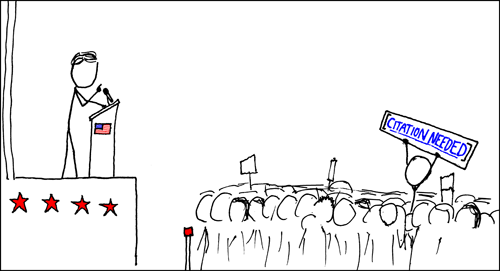
<p>Fortunately, Wikipedia can be very helpful to those looking to find other sources on a subject. Articles generally have superscript links to endnotes interspersed throughout their text. There are many articles on the site without citations, but they are viewed by regular users as unpolished and in need of substantiation, while numerous citations are a hallmark of a good article. <a href="http://en.wikipedia.org/wiki/Knut_%28polar_bear%29">Today’s featured article</a> on the site, about a polar bear named Knut, has 41 citations in a few pages of text. (Because Wikipedia is always changing, this might be different when you visit the article; you can <a href="http://en.wikipedia.org/w/index.php?title=Knut_%28polar_bear%29&oldid=189143337">see it as I did</a>.) Because it’s about recent events, these citations all include links to stories in traditional news media, but articles also frequently cite books, academic journals, and other authoritative sources. The role of citations is so central on Wikipedia that they have come to be identified with the site.</p>

<blockquote style="width: 500px; margin: 0 auto"><div><img src="http://imgs.xkcd.com/comics/wikipedian_protester.png" width="500" height="271" alt="Wikipedian Protester" /></div>
<div style="text-align: right;">Randall Munroe, “<a href="http://xkcd.com/285/">Wikipedian Protester</a>,”<br>
xkcd, 2007.</div></blockquote>

<h2>Comprehensiveness</h2>

<p>Another attractive feature of Wikipedia is its comprehensiveness. The English language site has over two million articles, many of them quite long and thorough. There have been a few studies comparing the coverage and accuract of Wikipedia to traditionally edited commercial encyclopedias.</p>

<p>The historian Roy Rosenzweig published an article on Wikipedia a year and a half ago in which he compared the site to both Encarta and American National Biography Online.</p>

<blockquote><p>To find 4 entries with errors in 25 biographies may seem a source for concern, but in fact it is exceptionally difficult to get every fact correct in reference works.… I checked 10 <cite>Encarta</cite> biographies for figures that also appear in <cite>Wikipedia</cite>, and in the commercial product I found at least 3 biographies with factual mistakes. Even the carefully edited <cite>American National Biography Online</cite>, whose biographies are written by experts, contains at least one factual error in the 25 entries I examined closely, the date of Nobel Prize winner I. I. Rabi’s doctoral degree—a date that <cite>Wikipedia</cite> gets right.…</p>
<p><cite>Wikipedia</cite>, then, beats <cite>Encarta</cite> but not <cite>American National Biography Online</cite> in coverage and roughly matches <cite>Encarta</cite> in accuracy.</p>
<div style="text-align: right;">Roy Rosenzweig, “<a href="http://chnm.gmu.edu/resources/essays/d/42">Can History be Open Source? Wikipedia and the Future of the Past</a>,”<br>
<cite>The Journal of American History</cite>, June 2006.</div></blockquote>

<p>American National Biography Online is a subscription service generally used by professional historians rather than students, so the performance of the free Wikipedia is pretty impressive. Also, Wikipedia generally improves in both accuracy and coverage as more people use and edit it, so Rosenzweig’s conclusions might be even more positive were he writing now.</p>

<p>The journal <cite>Nature</cite>, one of the two most prestigious in the sciences, published a similar comparison of Wikipedia and <cite>Encyclopedia Britannica</cite>’s web edition. They printed out copies of articles on the same topics from both websites without the source identified and sent them to experts. Their conclusions may be surprising:</p>

<blockquote><p>Among 42 entries tested, the difference in accuracy was not particularly great: the average science entry in Wikipedia contained around four inaccuracies; Britannica, about three.…</p>
<p><cite>Nature</cite>’s investigation suggests that Britannica’s advantage may not be great, at least when it comes to science entries. In the study, entries were chosen from the websites of Wikipedia and Encyclopaedia Britannica on a broad range of scientific disciplines and sent to a relevant expert for peer review. Each reviewer examined the entry on a single subject from the two encyclopaedias; they were not told which article came from which encyclopaedia.…</p>
<p>Only eight serious errors, such as misinterpretations of important concepts, were detected in the pairs of articles reviewed, four from each encyclopaedia. But reviewers also found many factual errors, omissions or misleading statements: 162 and 123 in Wikipedia and Britannica, respectively.</p>
<div style="text-align: right;">Jim Giles, “<a href="http://www.nature.com/nature/journal/v438/n7070/full/438900a.html">Internet encyclopaedias go head to head</a>,”<br>
<cite>Nature</cite>, December 15, 2005.</div></blockquote>

<p>Note that the <cite>Nature</cite> article is a couple of years old. I haven’t been able to find more recent such studies of the English language Wikipedia, though the magazine <cite>Stern</cite> did just publish an article on the German one under the heading “Wie gut ist Wikipedia?”</p>

<blockquote><p>Stern said the Wikipedia’s average rating was 1.7 on a scale where 1 is best and 6 is worst. The Brockhaus rated 2.7 on the same measure.</p>
<p>The articles were assessed for accuracy, completeness, how up to date they were and how easy they were to read.</p>
<p>In 43 matches [out of 50], the Wikipedia article was judged the winner.</p>
<div style="text-align: right;">“<a href="http://tech.monstersandcritics.com/news/article_1378822.php/Magazine_hails_German_Wikipedia_as_better_than_encyclopaedia">Magazine hails German Wikipedia as better than encyclopaedia</a>,”<br>
Deutsche Presse-Agentur, December 5, 2007.</div></blockquote>

<h2>History and Discussion</h2>

<p>The third attractive feature of Wikipedia is actually two features, the discussion and history pages. Every article has a set of links along the top. One of these links to the history of an article, which takes the form of a list of all the revisions that have been made. Because Wikipedia articles generally improve as more people edit them, simply looking at the number or frequency of these revisions can tell you something about the article. It's also possible, though, to click on the date of any one of these revisions and see how the article looked at that point in time. One can trace the development of an article all the way back to its original form, which is often only a sentence or two.</p>

<p>Another of these tabs at the top of an article to that article’s discussion page, also called the talk page. Fernanda Viégas and Martin Wattenberg, researchers at the IBM Visual Communication Lab, describe it this way.</p>

<blockquote><p>The talk page is where the writers for an article hash out their differences, plan future edits, and come to agreement about tricky rhetorical points. This kind of debate doubtless happens in the <cite>New York Times</cite> and <cite>Britannica</cite> as well, but behind the scenes. Wikipedia readers can see it all, and understand how choices were made.</p>
<div style="text-align: right;">Fernanda Viégas and Martin Wattenberg, “<a href="http://edge.org/discourse/digital_maoism.html#viegas">The Hive Mind Ain’t What It Used To Be</a>,”<br>
Edge, 2006.</div></blockquote>

<p>The talk page is a great way to learn more about how an article is put together and decide how much to trust it. One can easily imagine a writer and editor at the <cite>New York Times</cite> arguing about whether an individual sentence or idea should appear in an article, but most of us never get to see this process in action. Wikipedia allows us to peel back the veil and see how our reference source is produced.</p>

<p>The article on Knut that I mentioned earlier is a “featured article,” selected because it’s particularly good. The range of article quality on Wikipedia is enormous, so now we’ll now look at an article that, while not exactly bad, isn’t up to the same standard. Garrett Morgan was an African American inventor who lived in Cleveland and is best known for his work on gas masks and traffic signals. <a href="http://en.wikipedia.org/wiki/Garrett_A._Morgan">His article on Wikipedia</a>, unlike many websites run by museums and schools, does not claim that Morgan was the first to invent either the gas mask or the traffic signal. (The article has probably changed since I wrote this; you can <a href="http://en.wikipedia.org/w/index.php?title=Garrett_A._Morgan&oldid=189286669">see it as I did</a>.) Most of the discussion page deals with these questions of priority, and specifically with whether to cite a website that provides apparently accurate descriptions of earlier inventions similar to Morgan’s, but appears to be motivated by racism. This is the sort of discussion from which one can learn a great deal, both about history and about how people use and learn from history.</p>

<p>The Garrett Morgan article also demonstrates something completely different: that the quality of writing on Wikipedia is often very poor. This is partly because of “writing by committee” and partly because many contributors are independently poor writers. Any user can take an article and improve its structure and grammer, but users are often more excited about writing new material. Below is an excerpt from the Morgan article:</p>

<blockquote><p>It has often been claimed that Morgan invented the first “gas mask”, however, the first gas mask was invented by Scottish chemist John Stenhouse in 1854. A precursor to the “gas mask” had been invented by Lewis Haslett in 1847 and granted US Patent no. 6529 in 1859. Numerous other inventors, including, Charles Anthony Deane (1823), John Tyndall (1871), Samuel Barton (1874), George Neally (1877), Henry Fleuss (1878), before Morgan’s invention that was patented in 1914 (US Patent numbers 1090936 and 1113675), but does not diminish Morgan’s heroism in using his mask to rescue the men trapped in the tunnel explosion, which was undertaken at considerable personal risk.</p>
<p>Some claim that Morgan did not invent the first “gas mask”, however, those references are usually in reference to the “respirator.” Morgan invented the safety hood and later revised it, which was used to save trapped workers in the Lake Erie Crib Disaster of 1917. His safety hood eventually evolved to become a type of gas mask.</p>
<div style="text-align: right;">Wikipedia, “<a href="http://en.wikipedia.org/w/index.php?title=Garrett_A._Morgan&oldid=189286669">Garrett A. Morgan</a>.”</div></blockquote>

<p>I’ll leave finding the grammatical errors as an exercise to the reader, but it’s worth noticing that both paragraphs begin similarly but seem to be written without a clear awareness of each other. The writing does not flow, a common problem on Wikipedia. It’s also worth noticing, though, that the excerpt is not particularly hard to understand. It communicates sufficiently without doing so elegantly or grammatically. Wikipedia is a bad place to learn about writing style, but poor writing detracts only a little from its purpose as an encyclopedia.</p>

<p>Wikipedia should be looked at by educators as more than just a nuisance or a free encyclopedia. It's a potentially complicated tool, but one worth grappling with. I’ll close with the perspective of the researcher danah boyd, who studies relationships between youth and the internet:</p>

<blockquote><p>If educators would shift their thinking about Wikipedia, so much critical thinking could take place. The key value of Wikipedia is its transparency. You can understand how a page is constructed, who is invested, what their other investments are. You can see when people disagree about content and how, in the discussion, the disagreement was resolved. None of our traditional print media make such information available. Understanding Wikipedia means knowing how to:</p>
<ol>
	<li>Understand the assembly of data and information into publications</li>
	<li>Interpret knowledge</li>
	<li>Question purported truths and vet sources</li>
	<li>Analyze apparent contradictions in facts</li>
	<li>Productively contribute to the large body of collective knowledge</li>
</ol>
<div style="text-align: right;">danah boyd, “<a href="http://www.danah.org/papers/talks/Pearson2007.html">Information Access in a Networked World</a>,”<br>
talk presented to Pearson Publishing, November 2, 2007.</div></blockquote>

<p>For further reading, I recommend the articles linked from my citations above, as well as <a href="http://del.icio.us/zephoria/wikipedia">danah boyd’s small bookmark collection on Wikipedia</a>.</p>]]></content><author><name>Peter Sachs Collopy</name></author><category term="writing" /><category term="computing" /><category term="internet" /><category term="education" /><category term="technology" /><category term="media" /><summary type="html"><![CDATA[I gave this presentation on February 4, 2008 at the eTech Ohio Conference under the title “Can We Use Wikipedia Appropriately?” To begin with the basics, Wikipedia is an online encyclopedia that anyone can write and edit. It’s an ambitious project, and one with both positive and negative aspects. Ideally, Wikipedia will help democratize education, providing the same information for free to everyone with an internet connection. In the worst case, this will be misinformation, and the site will miseducate. The vast majority of Wikipedia articles can actually be changed by anyone. If you go to any article, you’ll find an “edit this page” link at the top, allowing you to do exactly that. Because anyone can add to or change Wikipedia entries, there’s no guarentee that information will be accurate. For the very same reason, though, anyone who finds a mistake, lie, or even grammatical error in an article can correct in themselves, making it easy to improve articles. I’m convinced that the vast majority of information on Wikipedia is accurate, and that it deserves some role in educational institutions. I also believe, however, that this role should be carefully considered and limited, and that educators should understand the process by which Wikipedia functions, not only the articles that result from it. One reason I think that educators should learn about Wikipedia is that students already are. Bill Tancer, a researcher for Hitwise who studies consumer behavior online, notes that many of the popular search terms that bring users to Wikipedia from sites like Google “bear a close resemblance to elementary school homework and research projects.” During the month of February, which is also Black History month, three of the top 20 terms sending traffic to Wikipedia were for prominent black historical figures, while two other searches were likely motivated by Presidents Day. In fact, changing timeframes to any other month during the school year reveals a similar result. Bill Tancer, “Look Who’s Using Wikipedia,” Time, March 1, 2007. If students are already using Wikipedia as a resource, it’s important that teachers understand it. You might find more to like than you expect. I’ll tell you a bit about three attractive features of Wikipedia, though I’ll mention some negative aspects along the way too. These will be citations, comprehensiveness, and the site’s history and discussion tools. The topic of Wikipedia and education has already received some press, though it’s mostly dealt with higher education. The most discussed event was a decision by the history department at Middlebury College to ban citing of Wikipedia in student papers. What’s interesting to me about this decision is that it actually reflects a consensus of educators and Wikipedians that the site is best used as a starting place for research rather than as a student’s only source. The following quotation is from Wikipedia cofounder Jimmy Wales. The advice I would give to students is be careful how you use Wikipedia. It really isn’t a trusted source. It really is edited real-time and it could be full of mistakes.… I think it basically should be fine in schools… to add a footnote saying I did a lot of my preliminary research in Wikipedia, just to acknowledge where you got a lot of knowledge. But in terms of citing specific facts, you really should go to the sources and look it up there, because that’s what you’re supposed to be doing. The encyclopedia is supposed to give you the broad overview, not be a primary research tool…. I would say the same thing about Brittanica, by the way. Jimmy Wales, net@nite 13, February 13, 2007. Citations Fortunately, Wikipedia can be very helpful to those looking to find other sources on a subject. Articles generally have superscript links to endnotes interspersed throughout their text. There are many articles on the site without citations, but they are viewed by regular users as unpolished and in need of substantiation, while numerous citations are a hallmark of a good article. Today’s featured article on the site, about a polar bear named Knut, has 41 citations in a few pages of text. (Because Wikipedia is always changing, this might be different when you visit the article; you can see it as I did.) Because it’s about recent events, these citations all include links to stories in traditional news media, but articles also frequently cite books, academic journals, and other authoritative sources. The role of citations is so central on Wikipedia that they have come to be identified with the site. Randall Munroe, “Wikipedian Protester,” xkcd, 2007. Comprehensiveness Another attractive feature of Wikipedia is its comprehensiveness. The English language site has over two million articles, many of them quite long and thorough. There have been a few studies comparing the coverage and accuract of Wikipedia to traditionally edited commercial encyclopedias. The historian Roy Rosenzweig published an article on Wikipedia a year and a half ago in which he compared the site to both Encarta and American National Biography Online. To find 4 entries with errors in 25 biographies may seem a source for concern, but in fact it is exceptionally difficult to get every fact correct in reference works.… I checked 10 Encarta biographies for figures that also appear in Wikipedia, and in the commercial product I found at least 3 biographies with factual mistakes. Even the carefully edited American National Biography Online, whose biographies are written by experts, contains at least one factual error in the 25 entries I examined closely, the date of Nobel Prize winner I. I. Rabi’s doctoral degree—a date that Wikipedia gets right.… Wikipedia, then, beats Encarta but not American National Biography Online in coverage and roughly matches Encarta in accuracy. Roy Rosenzweig, “Can History be Open Source? Wikipedia and the Future of the Past,” The Journal of American History, June 2006. American National Biography Online is a subscription service generally used by professional historians rather than students, so the performance of the free Wikipedia is pretty impressive. Also, Wikipedia generally improves in both accuracy and coverage as more people use and edit it, so Rosenzweig’s conclusions might be even more positive were he writing now. The journal Nature, one of the two most prestigious in the sciences, published a similar comparison of Wikipedia and Encyclopedia Britannica’s web edition. They printed out copies of articles on the same topics from both websites without the source identified and sent them to experts. Their conclusions may be surprising: Among 42 entries tested, the difference in accuracy was not particularly great: the average science entry in Wikipedia contained around four inaccuracies; Britannica, about three.… Nature’s investigation suggests that Britannica’s advantage may not be great, at least when it comes to science entries. In the study, entries were chosen from the websites of Wikipedia and Encyclopaedia Britannica on a broad range of scientific disciplines and sent to a relevant expert for peer review. Each reviewer examined the entry on a single subject from the two encyclopaedias; they were not told which article came from which encyclopaedia.… Only eight serious errors, such as misinterpretations of important concepts, were detected in the pairs of articles reviewed, four from each encyclopaedia. But reviewers also found many factual errors, omissions or misleading statements: 162 and 123 in Wikipedia and Britannica, respectively. Jim Giles, “Internet encyclopaedias go head to head,” Nature, December 15, 2005. Note that the Nature article is a couple of years old. I haven’t been able to find more recent such studies of the English language Wikipedia, though the magazine Stern did just publish an article on the German one under the heading “Wie gut ist Wikipedia?” Stern said the Wikipedia’s average rating was 1.7 on a scale where 1 is best and 6 is worst. The Brockhaus rated 2.7 on the same measure. The articles were assessed for accuracy, completeness, how up to date they were and how easy they were to read. In 43 matches [out of 50], the Wikipedia article was judged the winner. “Magazine hails German Wikipedia as better than encyclopaedia,” Deutsche Presse-Agentur, December 5, 2007. History and Discussion The third attractive feature of Wikipedia is actually two features, the discussion and history pages. Every article has a set of links along the top. One of these links to the history of an article, which takes the form of a list of all the revisions that have been made. Because Wikipedia articles generally improve as more people edit them, simply looking at the number or frequency of these revisions can tell you something about the article. It's also possible, though, to click on the date of any one of these revisions and see how the article looked at that point in time. One can trace the development of an article all the way back to its original form, which is often only a sentence or two. Another of these tabs at the top of an article to that article’s discussion page, also called the talk page. Fernanda Viégas and Martin Wattenberg, researchers at the IBM Visual Communication Lab, describe it this way. The talk page is where the writers for an article hash out their differences, plan future edits, and come to agreement about tricky rhetorical points. This kind of debate doubtless happens in the New York Times and Britannica as well, but behind the scenes. Wikipedia readers can see it all, and understand how choices were made. Fernanda Viégas and Martin Wattenberg, “The Hive Mind Ain’t What It Used To Be,” Edge, 2006. The talk page is a great way to learn more about how an article is put together and decide how much to trust it. One can easily imagine a writer and editor at the New York Times arguing about whether an individual sentence or idea should appear in an article, but most of us never get to see this process in action. Wikipedia allows us to peel back the veil and see how our reference source is produced. The article on Knut that I mentioned earlier is a “featured article,” selected because it’s particularly good. The range of article quality on Wikipedia is enormous, so now we’ll now look at an article that, while not exactly bad, isn’t up to the same standard. Garrett Morgan was an African American inventor who lived in Cleveland and is best known for his work on gas masks and traffic signals. His article on Wikipedia, unlike many websites run by museums and schools, does not claim that Morgan was the first to invent either the gas mask or the traffic signal. (The article has probably changed since I wrote this; you can see it as I did.) Most of the discussion page deals with these questions of priority, and specifically with whether to cite a website that provides apparently accurate descriptions of earlier inventions similar to Morgan’s, but appears to be motivated by racism. This is the sort of discussion from which one can learn a great deal, both about history and about how people use and learn from history. The Garrett Morgan article also demonstrates something completely different: that the quality of writing on Wikipedia is often very poor. This is partly because of “writing by committee” and partly because many contributors are independently poor writers. Any user can take an article and improve its structure and grammer, but users are often more excited about writing new material. Below is an excerpt from the Morgan article: It has often been claimed that Morgan invented the first “gas mask”, however, the first gas mask was invented by Scottish chemist John Stenhouse in 1854. A precursor to the “gas mask” had been invented by Lewis Haslett in 1847 and granted US Patent no. 6529 in 1859. Numerous other inventors, including, Charles Anthony Deane (1823), John Tyndall (1871), Samuel Barton (1874), George Neally (1877), Henry Fleuss (1878), before Morgan’s invention that was patented in 1914 (US Patent numbers 1090936 and 1113675), but does not diminish Morgan’s heroism in using his mask to rescue the men trapped in the tunnel explosion, which was undertaken at considerable personal risk. Some claim that Morgan did not invent the first “gas mask”, however, those references are usually in reference to the “respirator.” Morgan invented the safety hood and later revised it, which was used to save trapped workers in the Lake Erie Crib Disaster of 1917. His safety hood eventually evolved to become a type of gas mask. Wikipedia, “Garrett A. Morgan.” I’ll leave finding the grammatical errors as an exercise to the reader, but it’s worth noticing that both paragraphs begin similarly but seem to be written without a clear awareness of each other. The writing does not flow, a common problem on Wikipedia. It’s also worth noticing, though, that the excerpt is not particularly hard to understand. It communicates sufficiently without doing so elegantly or grammatically. Wikipedia is a bad place to learn about writing style, but poor writing detracts only a little from its purpose as an encyclopedia. Wikipedia should be looked at by educators as more than just a nuisance or a free encyclopedia. It's a potentially complicated tool, but one worth grappling with. I’ll close with the perspective of the researcher danah boyd, who studies relationships between youth and the internet: If educators would shift their thinking about Wikipedia, so much critical thinking could take place. The key value of Wikipedia is its transparency. You can understand how a page is constructed, who is invested, what their other investments are. You can see when people disagree about content and how, in the discussion, the disagreement was resolved. None of our traditional print media make such information available. Understanding Wikipedia means knowing how to: Understand the assembly of data and information into publications Interpret knowledge Question purported truths and vet sources Analyze apparent contradictions in facts Productively contribute to the large body of collective knowledge danah boyd, “Information Access in a Networked World,” talk presented to Pearson Publishing, November 2, 2007. For further reading, I recommend the articles linked from my citations above, as well as danah boyd’s small bookmark collection on Wikipedia.]]></summary></entry><entry><title type="html">Social Network Sites and the High Fidelity Model of Identity</title><link href="https://collopy.net/writing/2008/high-fidelity/" rel="alternate" type="text/html" title="Social Network Sites and the High Fidelity Model of Identity" /><published>2008-01-08T00:00:00-08:00</published><updated>2008-01-08T00:00:00-08:00</updated><id>https://collopy.net/writing/2008/high-fidelity</id><content type="html" xml:base="https://collopy.net/writing/2008/high-fidelity/"><![CDATA[<blockquote>
	<p>When you’re filling out your Friendster profile, it says “Give other people a chance to find out how you’re unique,” and the second question in that list is “What’s your favorite television program?”</p>
	<div style="text-align: right">—Ze Frank, “<a href="http://www.zefrank.com/smallworld/">small world</a>,” 2004</div>
</blockquote>
<p>Although 2007 brought a great deal of change with the opening of Facebook to outside developers, its original components have stayed remarkably fixed for three years. Among these initial features are some based on what I will term the <cite>High Fidelity</cite> model of identity, after a passage in Nick Hornby’s novel in which Rob, his narrator, explains that “what really matters is what you like, not what you are like.” Few of us would admit to basing our social lives on this principle, but it doesn’t seem to have hindered Facebook and other social network sites.</p>
<!--more-->
<p>The locus of the <cite>High Fidelity</cite> model on Facebook is a box on each profile with the bland and unhelpful title “Information.” The Information box holds two categories of, well, information: Contact Info and Personal Info. Oddly, sexual orientation and relationship status, the most personal info on the profile, don’t go under the Personal Info heading; they’re important enough to be trumpeted at the top of the page. The information listed in Personal Info is much more broadly social and contextual: activities and interests, as well as favorite music, TV shows, movies, books, and quotes. The most expressive element, a freeform “about me” space, comes last, appearing <a href="http://motive.co.nz/glossary/fold.php">below the fold</a> on the profile.</p>
<p>So Facebook doesn’t draw much attention to the most flexible portion of the profile, but it does draw attention to the lists of favorite things, which tend to visually dominate the Information box. Each favorite thing is a convenient link to a list of other users who share a love of that particular cultural phenomenon. From the perspective of interface design, these links appear to be a key feature of Facebook, an obvious way of finding others. In practice, however, they’re little used, and their value, which is based on the <cite>High Fidelity</cite> principle, is limited.</p>
<p><a href="http://msu.edu/~lampecli/papers/chi2007_slashdot.pdf">According to social network researchers Cliff Lampe, Nicole Ellison, and Charles Steinfield</a>, users who list many favorite things have no more friends than those who list few. (Those who list none do have fewer friends, perhaps because they spend less time on Facebook generally.) This suggests that users don’t find each other on the site through shared cultural preferences. Indeed, the links may be present less for any particular purpose and more just because they can be; even birthdays are links on Facebook, though there’s little value in a list of others with the same birthday. (Birthday links also suggest, though, that features which seem useless if unobtrusive to some may be useful to others: believers in astrology and planners of joint birthday parties might disagree with my judgment against them.)</p>
<p>It turns out that social network sites, especially Facebook, are generally used to articulate existing friendships rather than to create new ones. (Lampe, Ellison, and Steinfield have also done <a href="http://msu.edu/~lampecli/papers/cscw2006.pdf">research on this point</a> with regard to Facebook.) Lists of favorite things, though, originated in a world where users were trying to create new relationships, on dating websites like Match.com. The value of these lists on dating websites was clear: as Hornby wrote of a hypothetical questionnaire for prospective dates, “it was intended a) to dispense with awkward conversation, and b) to prevent a chap from leaping into bed with someone who might, at a later date, turn out to have every Julio Iglesias record ever made.” I suspect the effects of using such lists on dating websites are not entirely positive—there’s a reason why the questionnaire idea is somewhere between absurd and offensive in print, and we shouldn’t ignore that reaction just because computers are involved.</p>
<p>Friendster, originally designed as a more sophisticated dating site, brought these lists into the new world of social network sites in 2002. The role of lists of favorite things on social network sites is a lot less clear, though. Facebook’s founder <a href="http://businessweek.com/innovate/NussbaumOnDesign/archives/2007/06/ceos_must_be_de.html">Mark Zuckerberg has said</a> that “the other guys think the purpose of communication is to get information. We think the purpose of information is to get communication.” The information Facebook profiles provide can contribute to communication; in his webcomic xkcd, for instance, Randall Munroe depicts “<a href="http://xkcd.com/300/">looking up someone’s profile before introducing yourself so you know which of your favorite bands to mention</a>.” In general, though, lists of favorite things contribute little to communication.</p>
<p>Their greatest role might instead be in identity formation. To the extent that these lists matter, it is because they allow users to present themselves to an audience, and perhaps more importantly to themselves, in terms of their tastes. <a href="http://jcmc.indiana.edu/vol13/issue1/liu.html">Hugo Liu has studied this phenomenon in depth on MySpace</a>, <a href="http://jcmc.indiana.edu/vol13/issue1/liu.html#conclusions">concluding</a> that “the social network profile’s lists of interests might actually be more useful as an indicator of one’s aesthetics than as a factual declaration of interests.” Social network sites may not help us make friends, but they do provide us with new ways to express how we see ourselves.</p>
<hr />
<p>Both <cite>High Fidelity</cite> quotations are from page 117 in <a href="http://worldcat.org/oclc/35211299">the first Riverhead trade paperback edition</a>, and probably in other Riverhead editions as well.</p>]]></content><author><name>Peter Sachs Collopy</name></author><category term="writing" /><category term="computing" /><category term="internet" /><category term="consciousness" /><category term="technology" /><category term="media" /><summary type="html"><![CDATA[When you’re filling out your Friendster profile, it says “Give other people a chance to find out how you’re unique,” and the second question in that list is “What’s your favorite television program?” —Ze Frank, “small world,” 2004 Although 2007 brought a great deal of change with the opening of Facebook to outside developers, its original components have stayed remarkably fixed for three years. Among these initial features are some based on what I will term the High Fidelity model of identity, after a passage in Nick Hornby’s novel in which Rob, his narrator, explains that “what really matters is what you like, not what you are like.” Few of us would admit to basing our social lives on this principle, but it doesn’t seem to have hindered Facebook and other social network sites.]]></summary></entry></feed>