<?xml version="1.0" encoding="utf-8"?><feed xmlns="http://www.w3.org/2005/Atom" ><generator uri="https://jekyllrb.com/" version="4.4.1">Jekyll</generator><link href="https://collopy.net/feed/research/education.xml" rel="self" type="application/atom+xml" /><link href="https://collopy.net/" rel="alternate" type="text/html" /><updated>2026-09-02T10:12:16-07:00</updated><id>https://collopy.net/feed/research/education.xml</id><title type="html">Peter Sachs Collopy</title><author><name>Peter Sachs Collopy</name></author><entry><title type="html">A Prank, a Story, and an Origin of Oral History at Caltech</title><link href="https://collopy.net/writing/2026/a-prank/" rel="alternate" type="text/html" title="A Prank, a Story, and an Origin of Oral History at Caltech" /><published>2026-03-31T00:00:00-07:00</published><updated>2026-03-31T00:00:00-07:00</updated><id>https://collopy.net/writing/2026/a-prank</id><content type="html" xml:base="https://collopy.net/writing/2026/a-prank/"><![CDATA[In 1932, Caltech undergraduate students planned a prank on their professor, astronomer Fritz Zwicky. Zwicky often put students on the spot in class, so, noticing that he struggled with pronouncing one of their names, they put him on the spot with a harder name by registering a fictional student, Helmar Scieite, for Zwicky’s course Analytical Mechanics. Unfortunately for them, Zwicky, perhaps suspecting mischief, entirely skipped the name when taking attendance and asked instead if anyone he hadn’t named was present.

The students escalated their prank. When he administered the final exam, Zwicky wrote questions on the board and left the room; under Caltech’s Honor System, students were responsible for not cheating. Another student came into the room, copied the questions, and shared them with several graduate students, who each meticulously answered one question; the undergrad then copied the answers in uniform handwriting, “switching languages between questions,” recalled co-conspirator John Hatcher, “with interpolated insulting remarks.”

This story mutated as it spread over the years. The student pranksters became fellow faculty who resented Zwicky’s tough grading, and the events ended with Scieite receiving an A. In 1974, *Caltech News* associate editor Kay Walker investigated the story, talking to longtime faculty and writing to several alumni, prompting Hatcher to write back with the story in detail.

It was perhaps this experience of finding knowledge of the past in the minds of those present that prompted Walker to donate $300 to the Caltech Archives to begin an oral history project. In 1978, Institute Archivist Judith Goodstein hired three interviewers, Harriet Lyle, Ann Scheid, and Mary Terrall, who had previously worked for MIT’s short-lived oral history program and went on to become a history of science professor at UCLA. Before the year was out, they had interviewed chemist and Trustee Arnold Beckman, nutrition researcher Henry Borsook, soil mechanics expert Frederick Converse, economist Horace Gilbert, English professor and dean of admissions L. Winchester Jones, electrical and rocket engineer Frederick Lindvall, Jet Propulsion Laboratory co-founder Frank Malina, seismologist Charles Richter, physicist William Smythe, and chemist Ernest Swift.

Each of these oral histories was transcribed and became a volume on the shelves of the Archives, where they were consulted by Caltech community members and visiting researchers alike. Caltech deemed the pilot a success, and the Caltech Archives continued to produce oral history interviews. Over the next 45 years, we developed a collection of more than 250 interviews; it continues to grow today, now with interviews from both the Archives and the Caltech Heritage Project.

The Archives had begun a decade before the oral history project, in 1968, with the papers of George Ellery Hale, Robert Millikan, and Theodore von Kármán—unpublished records of their lives and careers, such as letters, diaries, lectures, and research notes. Faculty members and their heirs soon donated more such collections, some Caltech departments transferred their historical records, and Goodstein began bringing together thousands of photographs of Caltech and its people. Oral histories added another dimension to these collections. “History,” reported a *Caltech News* writer—perhaps Kay—“is recorded in the memories of human beings as well as in documents and letters, and Caltech is launching a program to tap this valuable, and perishable, resource for its archives.”

Decades later, in 2002, oral history transcripts were among the first items the Caltech Archives published digitally on the web, making them perhaps our most widely used collection, especially among members of the Caltech community. They have been joined online by digitized photographs, film and video, and some of our many collections of faculty papers.

Today, those faculty papers remain the heart of the Caltech Archives, and faculty and their families continue to donate more, along with increasing quantities of email and other digital media. Our collections include film, video and audiotape, dissertations, campus and student publications, websites, fine art, scientific instruments, and rare books dating back to the Scientific Revolution. We welcome appointments to visit and explore this history.]]></content><author><name>Peter Sachs Collopy</name></author><category term="writing" /><category term="science" /><category term="education" /><category term="Caltech" /><category term="archives" /><summary type="html"><![CDATA[In 1932, Caltech undergraduate students planned a prank on their professor, astronomer Fritz Zwicky. Zwicky often put students on the spot in class, so, noticing that he struggled with pronouncing one of their names, they put him on the spot with a harder name by registering a fictional student, Helmar Scieite, for Zwicky’s course Analytical Mechanics. Unfortunately for them, Zwicky, perhaps suspecting mischief, entirely skipped the name when taking attendance and asked instead if anyone he hadn’t named was present. The students escalated their prank. When he administered the final exam, Zwicky wrote questions on the board and left the room; under Caltech’s Honor System, students were responsible for not cheating. Another student came into the room, copied the questions, and shared them with several graduate students, who each meticulously answered one question; the undergrad then copied the answers in uniform handwriting, “switching languages between questions,” recalled co-conspirator John Hatcher, “with interpolated insulting remarks.” This story mutated as it spread over the years. The student pranksters became fellow faculty who resented Zwicky’s tough grading, and the events ended with Scieite receiving an A. In 1974, Caltech News associate editor Kay Walker investigated the story, talking to longtime faculty and writing to several alumni, prompting Hatcher to write back with the story in detail. It was perhaps this experience of finding knowledge of the past in the minds of those present that prompted Walker to donate $300 to the Caltech Archives to begin an oral history project. In 1978, Institute Archivist Judith Goodstein hired three interviewers, Harriet Lyle, Ann Scheid, and Mary Terrall, who had previously worked for MIT’s short-lived oral history program and went on to become a history of science professor at UCLA. Before the year was out, they had interviewed chemist and Trustee Arnold Beckman, nutrition researcher Henry Borsook, soil mechanics expert Frederick Converse, economist Horace Gilbert, English professor and dean of admissions L. Winchester Jones, electrical and rocket engineer Frederick Lindvall, Jet Propulsion Laboratory co-founder Frank Malina, seismologist Charles Richter, physicist William Smythe, and chemist Ernest Swift. Each of these oral histories was transcribed and became a volume on the shelves of the Archives, where they were consulted by Caltech community members and visiting researchers alike. Caltech deemed the pilot a success, and the Caltech Archives continued to produce oral history interviews. Over the next 45 years, we developed a collection of more than 250 interviews; it continues to grow today, now with interviews from both the Archives and the Caltech Heritage Project. The Archives had begun a decade before the oral history project, in 1968, with the papers of George Ellery Hale, Robert Millikan, and Theodore von Kármán—unpublished records of their lives and careers, such as letters, diaries, lectures, and research notes. Faculty members and their heirs soon donated more such collections, some Caltech departments transferred their historical records, and Goodstein began bringing together thousands of photographs of Caltech and its people. Oral histories added another dimension to these collections. “History,” reported a Caltech News writer—perhaps Kay—“is recorded in the memories of human beings as well as in documents and letters, and Caltech is launching a program to tap this valuable, and perishable, resource for its archives.” Decades later, in 2002, oral history transcripts were among the first items the Caltech Archives published digitally on the web, making them perhaps our most widely used collection, especially among members of the Caltech community. They have been joined online by digitized photographs, film and video, and some of our many collections of faculty papers. Today, those faculty papers remain the heart of the Caltech Archives, and faculty and their families continue to donate more, along with increasing quantities of email and other digital media. Our collections include film, video and audiotape, dissertations, campus and student publications, websites, fine art, scientific instruments, and rare books dating back to the Scientific Revolution. We welcome appointments to visit and explore this history.]]></summary></entry><entry><title type="html">Passing in the Hallway: Art and Technology at Caltech, 1968–1972</title><link href="https://collopy.net/writing/2024/passing-in-the-hallway/" rel="alternate" type="text/html" title="Passing in the Hallway: Art and Technology at Caltech, 1968–1972" /><published>2024-10-17T00:00:00-07:00</published><updated>2024-10-17T00:00:00-07:00</updated><id>https://collopy.net/writing/2024/passing-in-the-hallway</id><content type="html" xml:base="https://collopy.net/writing/2024/passing-in-the-hallway/"><![CDATA[In 1969, Caltech converted seven rooms in its defunct Earhart Plant Research Laboratory into an art studio, hosting artists who worked in the media of plastics and computer animation. In the long 1960s, artists and scientists embraced each others’ professional practices, and universities created new centers for art and technology. Artists and scientists did not come to these new programs with the same motivations and expectations. Many artists were interested in synthesizing art with science and engineering, but most scientists and engineers who engaged in art were seeking a break from their technical work rather than a different mode of it, making genuine collaboration the exception rather than the rule.]]></content><author><name>Peter Sachs Collopy</name></author><category term="writing" /><category term="art" /><category term="Caltech" /><category term="chemistry" /><category term="computing" /><category term="engineering" /><category term="media" /><category term="science" /><category term="technology" /><category term="visual culture" /><category term="California" /><category term="education" /><summary type="html"><![CDATA[In 1969, Caltech converted seven rooms in its defunct Earhart Plant Research Laboratory into an art studio, hosting artists who worked in the media of plastics and computer animation. In the long 1960s, artists and scientists embraced each others’ professional practices, and universities created new centers for art and technology. Artists and scientists did not come to these new programs with the same motivations and expectations. Many artists were interested in synthesizing art with science and engineering, but most scientists and engineers who engaged in art were seeking a break from their technical work rather than a different mode of it, making genuine collaboration the exception rather than the rule.]]></summary></entry><entry><title type="html">Crossing Over: Art and Science at Caltech, 1920–2020</title><link href="https://collopy.net/writing/2024/crossing-over/" rel="alternate" type="text/html" title="Crossing Over: Art and Science at Caltech, 1920–2020" /><published>2024-10-17T00:00:00-07:00</published><updated>2024-10-17T00:00:00-07:00</updated><id>https://collopy.net/writing/2024/crossing-over</id><content type="html" xml:base="https://collopy.net/writing/2024/crossing-over/"><![CDATA[Science is as much a visual practice as a textual or quantitative one. For centuries, scientists have used microscopes, telescopes, painting, illustration, printing, and photography to perceive nature and communicate what they see in it, often in collaboration with artists. In the twentieth century, scientists also came to view creativity as an essential resource and looked to art to foster it.

*Crossing Over* is an interdisciplinary publication that looks at one prominent university—the California Institute of Technology (Caltech) in Pasadena—as a site for scientific and artistic image production. Uncovering the rich pictorial record embedded in its Archives and Special Collections, a team of visual culture scholars examines Caltech through a series of tightly focused case studies. How, the authors ask, have science and engineering institutions like Caltech used scientific representation, art, and architecture to construct themselves and produce discovery and invention? This book reveals new facets of life and work at Caltech that will be illuminating even to those familiar with the school, showcasing views that informed—and were informed by—the vibrant visual culture of Southern California.

This volume was published to accompany [an exhibition](/exhibits/2024/crossing-over) on view at the California Institute of Technology from September 27 to December 15, 2024. It was a [finalist](https://www.collegeart.org/news/2025/11/13/announcing-the-2026-morey-book-award-and-barr-awards-shortlists/) for the College Art Association’s 2026 Alfred H. Barr Jr. Award for Smaller Museums, Libraries, Collections, and Exhibitions.]]></content><author><name>Peter Sachs Collopy</name></author><category term="writing" /><category term="architecture" /><category term="art" /><category term="astronomy" /><category term="biology" /><category term="Caltech" /><category term="chemistry" /><category term="computing" /><category term="engineering" /><category term="geology" /><category term="laboratories" /><category term="media" /><category term="physics" /><category term="science" /><category term="technology" /><category term="visual culture" /><category term="war" /><category term="California" /><category term="education" /><category term="archives" /><summary type="html"><![CDATA[Science is as much a visual practice as a textual or quantitative one. For centuries, scientists have used microscopes, telescopes, painting, illustration, printing, and photography to perceive nature and communicate what they see in it, often in collaboration with artists. In the twentieth century, scientists also came to view creativity as an essential resource and looked to art to foster it. Crossing Over is an interdisciplinary publication that looks at one prominent university—the California Institute of Technology (Caltech) in Pasadena—as a site for scientific and artistic image production. Uncovering the rich pictorial record embedded in its Archives and Special Collections, a team of visual culture scholars examines Caltech through a series of tightly focused case studies. How, the authors ask, have science and engineering institutions like Caltech used scientific representation, art, and architecture to construct themselves and produce discovery and invention? This book reveals new facets of life and work at Caltech that will be illuminating even to those familiar with the school, showcasing views that informed—and were informed by—the vibrant visual culture of Southern California. This volume was published to accompany an exhibition on view at the California Institute of Technology from September 27 to December 15, 2024. It was a finalist for the College Art Association’s 2026 Alfred H. Barr Jr. Award for Smaller Museums, Libraries, Collections, and Exhibitions.]]></summary></entry><entry><title type="html">Sitting Down with Uncomfortable Things in the Caltech Archives</title><link href="https://collopy.net/presentations/2020/uncomfortable-things/" rel="alternate" type="text/html" title="Sitting Down with Uncomfortable Things in the Caltech Archives" /><published>2020-10-02T00:00:00-07:00</published><updated>2020-10-02T00:00:00-07:00</updated><id>https://collopy.net/presentations/2020/uncomfortable-things</id><content type="html" xml:base="https://collopy.net/presentations/2020/uncomfortable-things/"><![CDATA[{% include youtube.html id=page.youtube %}

In this event, members of the Caltech community presented their reflections on a collection of digitized materials curated from the Caltech Archives. The “uncomfortable things” selected for this discussion were artifacts of experiences of exclusion, inequality, discrimination, and bigotry in the history of Caltech. In this session, we acknowledged that the legacy of Caltech is intertwined with stories of injustice. By asking participants to personally reflect on that legacy, this event highlighted how there is no single solution or perspective sufficient to answer the multitude of questions and concerns that our community has about its history.

This event took place on October 2, 2020 as part of the series “Critical Intersections: Conversations on History, Race, and Science,” sponsored by the Caltech Division of the Humanities and Social Sciences.]]></content><author><name>Peter Sachs Collopy</name></author><category term="presentations" /><category term="eugenics" /><category term="Caltech" /><category term="politics" /><category term="science" /><category term="conservatism" /><category term="human sciences" /><category term="education" /><category term="white supremacy" /><category term="California" /><category term="archives" /><summary type="html"><![CDATA[In this event, members of the Caltech community presented their reflections on a collection of digitized materials curated from the Caltech Archives. The “uncomfortable things” selected for this discussion were artifacts of experiences of exclusion, inequality, discrimination, and bigotry in the history of Caltech. In this session, we acknowledged that the legacy of Caltech is intertwined with stories of injustice. By asking participants to personally reflect on that legacy, this event highlighted how there is no single solution or perspective sufficient to answer the multitude of questions and concerns that our community has about its history. This event took place on October 2, 2020 as part of the series “Critical Intersections: Conversations on History, Race, and Science,” sponsored by the Caltech Division of the Humanities and Social Sciences.]]></summary></entry><entry><title type="html">Becoming Caltech, 1910–1930: Presentations from the Archives</title><link href="https://collopy.net/presentations/2020/becoming-caltech/" rel="alternate" type="text/html" title="Becoming Caltech, 1910–1930: Presentations from the Archives" /><published>2020-06-11T00:00:00-07:00</published><updated>2020-06-11T00:00:00-07:00</updated><id>https://collopy.net/presentations/2020/becoming-caltech</id><content type="html" xml:base="https://collopy.net/presentations/2020/becoming-caltech/"><![CDATA[A century ago, a small institution called Throop Polytechnic Institute dramatically reinvented itself, transforming from a manual arts academy to an engineering school, then expanding into a research institute. In 1920, it became the California Institute of Technology. In summer 2020, Caltech archivists gave a series of livestreamed presentations on the science, engineering, architecture, and community life of early Caltech.]]></content><author><name>Peter Sachs Collopy</name></author><category term="presentations" /><category term="Caltech" /><category term="science" /><category term="technology" /><category term="medicine" /><category term="geology" /><category term="chemistry" /><category term="physics" /><category term="biology" /><category term="engineering" /><category term="education" /><category term="architecture" /><category term="California" /><category term="archives" /><summary type="html"><![CDATA[A century ago, a small institution called Throop Polytechnic Institute dramatically reinvented itself, transforming from a manual arts academy to an engineering school, then expanding into a research institute. In 1920, it became the California Institute of Technology. In summer 2020, Caltech archivists gave a series of livestreamed presentations on the science, engineering, architecture, and community life of early Caltech.]]></summary></entry><entry><title type="html">Becoming Caltech: Building a Research Community, 1910–1930</title><link href="https://collopy.net/exhibits/2020/becoming-caltech/" rel="alternate" type="text/html" title="Becoming Caltech: Building a Research Community, 1910–1930" /><published>2020-02-10T00:00:00-08:00</published><updated>2020-02-10T00:00:00-08:00</updated><id>https://collopy.net/exhibits/2020/becoming-caltech</id><content type="html" xml:base="https://collopy.net/exhibits/2020/becoming-caltech/"><![CDATA[In the 1910s and 1920s, Caltech dramatically reinvented itself, transforming from a manual arts academy to an engineering school, then expanding into a research institute. The school began building its current campus, recruited renowned faculty, constructed sophisticated laboratories, trained students to become leading researchers, and established new relationships with industry and government. On February 10, 1920, the Institute’s trustees acknowledged this transformation by changing the institution’s name from Throop College of Technology to California Institute of Technology.

A century later, the Caltech Archives presents the exhibition “Becoming Caltech: Building a Research Community, 1910–1930.” It tells the story of Caltech's early growth through historical documents, objects, photographs, and film, organized into three sections. “Becoming” traces Caltech's evolution through the reformation instigated by George Ellery Hale and catalyzed by World War I. “Building Research” chronicles both the history of science, engineering, and the humanities at Caltech—ranging from the core activities of the 1910s (electrical engineering, chemistry, and physics) to the new fields of the 1920s (genetics, seismology, and aeronautics)—and the architecture and construction of the buildings which housed this research. “Community” explores the lives and culture of the students, faculty, and staff who made up the Institute, including athletics, clubs, the Athenaeum, and the big T that students carved out of the forest on the side of Mt. Wilson.]]></content><author><name>Peter Sachs Collopy</name></author><category term="exhibits" /><category term="Caltech" /><category term="science" /><category term="technology" /><category term="engineering" /><category term="laboratories" /><category term="architecture" /><category term="visual culture" /><category term="education" /><category term="California" /><summary type="html"><![CDATA[In the 1910s and 1920s, Caltech dramatically reinvented itself, transforming from a manual arts academy to an engineering school, then expanding into a research institute. The school began building its current campus, recruited renowned faculty, constructed sophisticated laboratories, trained students to become leading researchers, and established new relationships with industry and government. On February 10, 1920, the Institute’s trustees acknowledged this transformation by changing the institution’s name from Throop College of Technology to California Institute of Technology. A century later, the Caltech Archives presents the exhibition “Becoming Caltech: Building a Research Community, 1910–1930.” It tells the story of Caltech’s early growth through historical documents, objects, photographs, and film, organized into three sections. “Becoming” traces Caltech’s evolution through the reformation instigated by George Ellery Hale and catalyzed by World War I. “Building Research” chronicles both the history of science, engineering, and the humanities at Caltech—ranging from the core activities of the 1910s (electrical engineering, chemistry, and physics) to the new fields of the 1920s (genetics, seismology, and aeronautics)—and the architecture and construction of the buildings which housed this research. “Community” explores the lives and culture of the students, faculty, and staff who made up the Institute, including athletics, clubs, the Athenaeum, and the big T that students carved out of the forest on the side of Mt. Wilson.]]></summary></entry><entry><title type="html">The Mind’s Eye: Richard Feynman in Word and Image</title><link href="https://collopy.net/exhibits/2018/minds-eye/" rel="alternate" type="text/html" title="The Mind’s Eye: Richard Feynman in Word and Image" /><published>2018-05-11T00:00:00-07:00</published><updated>2018-05-11T00:00:00-07:00</updated><id>https://collopy.net/exhibits/2018/minds-eye</id><content type="html" xml:base="https://collopy.net/exhibits/2018/minds-eye/"><![CDATA[In work and play, Richard Feynman was a distinctively visual thinker. He achieved fame as a theoretical physicist by making sense of the interactions of elementary particles, and in the process inventing the Feynman diagrams that illustrated these interactions. For Feynman to do physics was to write and draw.]]></content><author><name>Peter Sachs Collopy</name></author><category term="exhibits" /><category term="Caltech" /><category term="science" /><category term="visual culture" /><category term="education" /><category term="physics" /><category term="art" /><summary type="html"><![CDATA[In work and play, Richard Feynman was a distinctively visual thinker. He achieved fame as a theoretical physicist by making sense of the interactions of elementary particles, and in the process inventing the Feynman diagrams that illustrated these interactions. For Feynman to do physics was to write and draw.]]></summary></entry><entry><title type="html">When Caltech Was Throop University</title><link href="https://collopy.net/writing/2017/throop-university/" rel="alternate" type="text/html" title="When Caltech Was Throop University" /><published>2017-11-01T00:00:00-07:00</published><updated>2017-11-01T00:00:00-07:00</updated><id>https://collopy.net/writing/2017/throop-university</id><content type="html" xml:base="https://collopy.net/writing/2017/throop-university/"><![CDATA[On November 2, 1891, classes began at Throop University—the school that would become Caltech—in a rented building in downtown Pasadena. Founder Amos Throop was a Universalist preacher and abolitionist politician who made his fortune in lumber and real estate in Chicago before moving to Los Angeles, where he bought orchards and farms, in 1880. His school offered courses in literature, music, art, elocution, stenography, typewriting, and law—with only six faculty. Throop University had trouble recruiting students, so its trustees renamed it Throop Polytechnic Institute in 1893 and reorganized it to train Pasadena’s youth, from elementary school through college, for factory work in an industrial society. Although namesake Amos Throop passed away in 1894, over the decades that followed Throop Polytechnic Institute formed alliances with influential scientists—astronomer George Hale, physicist Robert Millikan, and chemist Arthur Noyes—and reinvented itself again as a pioneering science and engineering university, renamed the California Institute of Technology in 1920.]]></content><author><name>Peter Sachs Collopy</name></author><category term="writing" /><category term="Caltech" /><category term="education" /><category term="California" /><summary type="html"><![CDATA[On November 2, 1891, classes began at Throop University—the school that would become Caltech—in a rented building in downtown Pasadena. Founder Amos Throop was a Universalist preacher and abolitionist politician who made his fortune in lumber and real estate in Chicago before moving to Los Angeles, where he bought orchards and farms, in 1880. His school offered courses in literature, music, art, elocution, stenography, typewriting, and law—with only six faculty. Throop University had trouble recruiting students, so its trustees renamed it Throop Polytechnic Institute in 1893 and reorganized it to train Pasadena’s youth, from elementary school through college, for factory work in an industrial society. Although namesake Amos Throop passed away in 1894, over the decades that followed Throop Polytechnic Institute formed alliances with influential scientists—astronomer George Hale, physicist Robert Millikan, and chemist Arthur Noyes—and reinvented itself again as a pioneering science and engineering university, renamed the California Institute of Technology in 1920.]]></summary></entry><entry><title type="html">Technology Education</title><link href="https://collopy.net/writing/2009/technology-education/" rel="alternate" type="text/html" title="Technology Education" /><published>2009-04-27T00:00:00-07:00</published><updated>2009-04-27T00:00:00-07:00</updated><id>https://collopy.net/writing/2009/technology-education</id><content type="html" xml:base="https://collopy.net/writing/2009/technology-education/"><![CDATA[<p>This is the most brilliant thought I’ve ever read on technology education:</p>

<blockquote>
	<p><cite>The Second Self</cite> portrays a time of relative innocence [in the early 1980s]. There was not much talk of screen violence and there seemed to be so much time. The fact that “regular” people, from home computer hobbyists to fifth-grade teachers, were still discussing the merits of computer programming as an intellectual pastime gave the sense that there was time to think, time to experiment with new forms, time to look at effects. Today, the computer culture acts on the individual with new speed and ferocity.</p>
	<div style="text-align: right;">
		Sherry Turkle, “Epilogue (2004),” <cite>The Second Self</cite> 20th Anniversary Edition
	</div>
</blockquote>
	
<p>This paragraph prompted me to reread David Brin’s 2006 essay “<a href="https://www.salon.com/2006/09/14/basic_2/">Why Johnny Can’t Code</a>,” another attempt to answer the  question of why kids don’t learn to program like they did in the 1980s. It’s a stirring essay, but it’s conclusion is merely that no one is providing “tools that teach creative thinking and technological mastery.” This begs another level of analysis—why aren’t these tools available to kids?—and Turkle provides part of it. I’m going to try to take her conclusion a step further.</p>
	
<p>We’ve come to see computers as tools for efficiency, not exploration. Sure, “surfing the web” has seen a resurgence in Wikipedia link-hopping, but I suspect even this is a minority activity. And even this is not an exploration of the computer. The meaning of the computer is less contested now than it was in decades past: computers are tools now, not worlds and certainly not the “mathland” Seymour Papert saw in them. It is as tools that teachers see computers, that managers see computers, that the developers at Microsoft and Apple see the interfaces they’re giving us. And they’re <i>developers</i>, not <i>programmers</i>, because they’re focused on the product of software, not the practice of programming.</p>
	
<p>Is there room in this world for programming as an intellectual pastime? Of course there is. That spirit is with us in free software and in other hacker communities. But hacking has become countercultural again, like it was in the 1970s. The idea that programming is worthwhile for the lessons it provides about logic, math, systems, and philosophy is as marginal now as it has ever been. The idea that it’s the best way for kids to learn these lessons is even more marginal.</p>
	
<p>All of this, Turkle hints, is not because computers themselves are marginal but precisely because they’re central to our lives. We have to learn so much just to use them—and we think that we have to teach so much to kids—that there’s no time for thinking, for experimenting with new forms, for looking at effects. If the geeky among us, adult and child alike, do find a spare hour, our “information consumption devices”—Brin’s phrase—rush to fill it. The personal computer has become less so, a device for listening like the radio before it.</p>

<p>Brin’s essay is structured around a quest for a tool his son can use to learn to program. He and his son eventually conclude that this tool is not, as they expected, some software that they can install on their Mac OS X or Windows machines; it is, instead, a used Commodore 64, released in 1982. It is a machine that does not connect to the internet and the web, a machine for which it has become a challenge to find software (not to mention that their floppy drive doesn’t really work). It’s a computer built with a set of purposes almost entirely different from those of a 2005 Dell box. Tinkerers, hobbyists, and gamers bought the Commodore 64; everyone buys Dells, which are supposed to have a practical function. The Commodore 64 boots to a BASIC prompt; any modern machine boots to a GUI. There is very little about computers built in the last twenty years that invites experimentation.</p>

<h4>Epilogue</h4>

<p>I’m bothered by Brin’s preference for BASIC over other programming languages his son could learn. There are two options that strike me as superior. The first is Logo. It was actually designed for education, and depending on the implementation it can do lots of exciting things. (The technology education consulting company I used to work for endorses Terrapin Logo, which looks pretty cool.) The second is Ruby. There’s a <a href="http://tryruby.hobix.com/">Ruby interpreter</a> you can try without even leaving your browser, with a really amazing built-in tutorial. It’s at least a way to discover how a command line feels, which is pretty cool.</p>

<p>There is another path Brin and his son could have followed. They could have installed Linux, or Cygwin, or resorted to the Terminal application on their Mac, and turned their machine into one that does invite experimentation. It would have taken some tinkering to get it to work how they wanted it to, of course, but that too is a learning experience—one about which Brin seems strangely unenthusiastic. They could have closed their browsers and the other ethereal apparatus of computing as consumption, even booted the machine to a command line and vanished the distractions of the GUI. Our polished, functional information consumption devices are flexible; they can still be subverted and used like the messy, hobbyist learning machines of the early 1980s.</p>]]></content><author><name>Peter Sachs Collopy</name></author><category term="writing" /><category term="computing" /><category term="education" /><category term="technology" /><category term="media" /><summary type="html"><![CDATA[This is the most brilliant thought I’ve ever read on technology education: The Second Self portrays a time of relative innocence [in the early 1980s]. There was not much talk of screen violence and there seemed to be so much time. The fact that “regular” people, from home computer hobbyists to fifth-grade teachers, were still discussing the merits of computer programming as an intellectual pastime gave the sense that there was time to think, time to experiment with new forms, time to look at effects. Today, the computer culture acts on the individual with new speed and ferocity. Sherry Turkle, “Epilogue (2004),” The Second Self 20th Anniversary Edition This paragraph prompted me to reread David Brin’s 2006 essay “Why Johnny Can’t Code,” another attempt to answer the question of why kids don’t learn to program like they did in the 1980s. It’s a stirring essay, but it’s conclusion is merely that no one is providing “tools that teach creative thinking and technological mastery.” This begs another level of analysis—why aren’t these tools available to kids?—and Turkle provides part of it. I’m going to try to take her conclusion a step further. We’ve come to see computers as tools for efficiency, not exploration. Sure, “surfing the web” has seen a resurgence in Wikipedia link-hopping, but I suspect even this is a minority activity. And even this is not an exploration of the computer. The meaning of the computer is less contested now than it was in decades past: computers are tools now, not worlds and certainly not the “mathland” Seymour Papert saw in them. It is as tools that teachers see computers, that managers see computers, that the developers at Microsoft and Apple see the interfaces they’re giving us. And they’re developers, not programmers, because they’re focused on the product of software, not the practice of programming. Is there room in this world for programming as an intellectual pastime? Of course there is. That spirit is with us in free software and in other hacker communities. But hacking has become countercultural again, like it was in the 1970s. The idea that programming is worthwhile for the lessons it provides about logic, math, systems, and philosophy is as marginal now as it has ever been. The idea that it’s the best way for kids to learn these lessons is even more marginal. All of this, Turkle hints, is not because computers themselves are marginal but precisely because they’re central to our lives. We have to learn so much just to use them—and we think that we have to teach so much to kids—that there’s no time for thinking, for experimenting with new forms, for looking at effects. If the geeky among us, adult and child alike, do find a spare hour, our “information consumption devices”—Brin’s phrase—rush to fill it. The personal computer has become less so, a device for listening like the radio before it. Brin’s essay is structured around a quest for a tool his son can use to learn to program. He and his son eventually conclude that this tool is not, as they expected, some software that they can install on their Mac OS X or Windows machines; it is, instead, a used Commodore 64, released in 1982. It is a machine that does not connect to the internet and the web, a machine for which it has become a challenge to find software (not to mention that their floppy drive doesn’t really work). It’s a computer built with a set of purposes almost entirely different from those of a 2005 Dell box. Tinkerers, hobbyists, and gamers bought the Commodore 64; everyone buys Dells, which are supposed to have a practical function. The Commodore 64 boots to a BASIC prompt; any modern machine boots to a GUI. There is very little about computers built in the last twenty years that invites experimentation. Epilogue I’m bothered by Brin’s preference for BASIC over other programming languages his son could learn. There are two options that strike me as superior. The first is Logo. It was actually designed for education, and depending on the implementation it can do lots of exciting things. (The technology education consulting company I used to work for endorses Terrapin Logo, which looks pretty cool.) The second is Ruby. There’s a Ruby interpreter you can try without even leaving your browser, with a really amazing built-in tutorial. It’s at least a way to discover how a command line feels, which is pretty cool. There is another path Brin and his son could have followed. They could have installed Linux, or Cygwin, or resorted to the Terminal application on their Mac, and turned their machine into one that does invite experimentation. It would have taken some tinkering to get it to work how they wanted it to, of course, but that too is a learning experience—one about which Brin seems strangely unenthusiastic. They could have closed their browsers and the other ethereal apparatus of computing as consumption, even booted the machine to a command line and vanished the distractions of the GUI. Our polished, functional information consumption devices are flexible; they can still be subverted and used like the messy, hobbyist learning machines of the early 1980s.]]></summary></entry><entry><title type="html">Wikipedia for Educators</title><link href="https://collopy.net/writing/2008/wikipedia-for-educators/" rel="alternate" type="text/html" title="Wikipedia for Educators" /><published>2008-02-04T00:00:00-08:00</published><updated>2008-02-04T00:00:00-08:00</updated><id>https://collopy.net/writing/2008/wikipedia-for-educators</id><content type="html" xml:base="https://collopy.net/writing/2008/wikipedia-for-educators/"><![CDATA[<p><i>I gave this presentation on February 4, 2008 at the <a href="http://www.etech.ohio.gov/conference/">eTech Ohio Conference</a> under the title “Can We Use Wikipedia Appropriately?”</i></p>

<p>To begin with the basics, <a href="http://en.wikipedia.org/">Wikipedia</a> is an online encyclopedia that anyone can write and edit. It’s an ambitious project, and one with both positive and negative aspects. Ideally, Wikipedia will help democratize education, providing the same information for free to everyone with an internet connection. In the worst case, this will be misinformation, and the site will miseducate.</p>

<p>The vast majority of Wikipedia articles can actually be changed by anyone. If you go to any article, you’ll find an “edit this page” link at the top, allowing you to do exactly that. Because anyone can add to or change Wikipedia entries, there’s no guarentee that information will be accurate. For the very same reason, though, anyone who finds a mistake, lie, or even grammatical error in an article can correct in themselves, making it easy to improve articles. I’m convinced that the vast majority of information on Wikipedia is accurate, and that it deserves some role in educational institutions. I also believe, however, that this role should be carefully considered and limited, and that educators should understand the process by which Wikipedia functions, not only the articles that result from it.</p>

<p>One reason I think that educators should learn about Wikipedia is that students already are. Bill Tancer, a researcher for Hitwise who studies consumer behavior online, notes that many of the popular search terms that bring users to Wikipedia from sites like Google “bear a close resemblance to elementary school homework and research projects.”</p>

<blockquote><p>During the month of February, which is also Black History month, three of the top 20 terms sending traffic to Wikipedia were for prominent black historical figures, while two other searches were likely motivated by Presidents Day. In fact, changing timeframes to any other month during the school year reveals a similar result.</p>
<div style="text-align: right;">Bill Tancer, “<a href="http://www.time.com/time/business/article/0,8599,1595184,00.html">Look Who’s Using Wikipedia</a>,”<br>
<cite>Time</cite>, March 1, 2007.</div></blockquote>

<p>If students are already using Wikipedia as a resource, it’s important that teachers understand it. You might find more to like than you expect. I’ll tell you a bit about three attractive features of Wikipedia, though I’ll mention some negative aspects along the way too. These will be citations, comprehensiveness, and the site’s history and discussion tools.</p>

<p>The topic of Wikipedia and education has already received some press, though it’s mostly dealt with higher education. The most discussed event was a decision by the history department at Middlebury College to ban citing of Wikipedia in student papers. What’s interesting to me about this decision is that it actually reflects a consensus of educators and Wikipedians that the site is best used as a starting place for research rather than as a student’s only source. The following quotation is from Wikipedia cofounder Jimmy Wales.</p>

<blockquote><p>The advice I would give to students is be careful how you use Wikipedia. It really isn’t a trusted source. It really is edited real-time and it could be full of mistakes.… I think it basically should be fine in schools… to add a footnote saying I did a lot of my preliminary research in Wikipedia, just to acknowledge where you got a lot of knowledge. But in terms of citing specific facts, you really should go to the sources and look it up there, because that’s what you’re supposed to be doing. The encyclopedia is supposed to give you the broad overview, not be a primary research tool…. I would say the same thing about Brittanica, by the way.</p>
<div style="text-align: right;">Jimmy Wales, <a href="http://twit.tv/natn13">net@nite 13</a>,<br>
February 13, 2007.</div></blockquote>

<h2>Citations</h2>

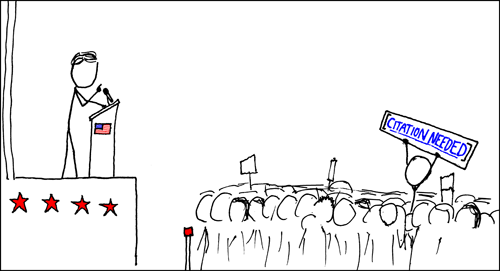
<p>Fortunately, Wikipedia can be very helpful to those looking to find other sources on a subject. Articles generally have superscript links to endnotes interspersed throughout their text. There are many articles on the site without citations, but they are viewed by regular users as unpolished and in need of substantiation, while numerous citations are a hallmark of a good article. <a href="http://en.wikipedia.org/wiki/Knut_%28polar_bear%29">Today’s featured article</a> on the site, about a polar bear named Knut, has 41 citations in a few pages of text. (Because Wikipedia is always changing, this might be different when you visit the article; you can <a href="http://en.wikipedia.org/w/index.php?title=Knut_%28polar_bear%29&oldid=189143337">see it as I did</a>.) Because it’s about recent events, these citations all include links to stories in traditional news media, but articles also frequently cite books, academic journals, and other authoritative sources. The role of citations is so central on Wikipedia that they have come to be identified with the site.</p>

<blockquote style="width: 500px; margin: 0 auto"><div><img src="http://imgs.xkcd.com/comics/wikipedian_protester.png" width="500" height="271" alt="Wikipedian Protester" /></div>
<div style="text-align: right;">Randall Munroe, “<a href="http://xkcd.com/285/">Wikipedian Protester</a>,”<br>
xkcd, 2007.</div></blockquote>

<h2>Comprehensiveness</h2>

<p>Another attractive feature of Wikipedia is its comprehensiveness. The English language site has over two million articles, many of them quite long and thorough. There have been a few studies comparing the coverage and accuract of Wikipedia to traditionally edited commercial encyclopedias.</p>

<p>The historian Roy Rosenzweig published an article on Wikipedia a year and a half ago in which he compared the site to both Encarta and American National Biography Online.</p>

<blockquote><p>To find 4 entries with errors in 25 biographies may seem a source for concern, but in fact it is exceptionally difficult to get every fact correct in reference works.… I checked 10 <cite>Encarta</cite> biographies for figures that also appear in <cite>Wikipedia</cite>, and in the commercial product I found at least 3 biographies with factual mistakes. Even the carefully edited <cite>American National Biography Online</cite>, whose biographies are written by experts, contains at least one factual error in the 25 entries I examined closely, the date of Nobel Prize winner I. I. Rabi’s doctoral degree—a date that <cite>Wikipedia</cite> gets right.…</p>
<p><cite>Wikipedia</cite>, then, beats <cite>Encarta</cite> but not <cite>American National Biography Online</cite> in coverage and roughly matches <cite>Encarta</cite> in accuracy.</p>
<div style="text-align: right;">Roy Rosenzweig, “<a href="http://chnm.gmu.edu/resources/essays/d/42">Can History be Open Source? Wikipedia and the Future of the Past</a>,”<br>
<cite>The Journal of American History</cite>, June 2006.</div></blockquote>

<p>American National Biography Online is a subscription service generally used by professional historians rather than students, so the performance of the free Wikipedia is pretty impressive. Also, Wikipedia generally improves in both accuracy and coverage as more people use and edit it, so Rosenzweig’s conclusions might be even more positive were he writing now.</p>

<p>The journal <cite>Nature</cite>, one of the two most prestigious in the sciences, published a similar comparison of Wikipedia and <cite>Encyclopedia Britannica</cite>’s web edition. They printed out copies of articles on the same topics from both websites without the source identified and sent them to experts. Their conclusions may be surprising:</p>

<blockquote><p>Among 42 entries tested, the difference in accuracy was not particularly great: the average science entry in Wikipedia contained around four inaccuracies; Britannica, about three.…</p>
<p><cite>Nature</cite>’s investigation suggests that Britannica’s advantage may not be great, at least when it comes to science entries. In the study, entries were chosen from the websites of Wikipedia and Encyclopaedia Britannica on a broad range of scientific disciplines and sent to a relevant expert for peer review. Each reviewer examined the entry on a single subject from the two encyclopaedias; they were not told which article came from which encyclopaedia.…</p>
<p>Only eight serious errors, such as misinterpretations of important concepts, were detected in the pairs of articles reviewed, four from each encyclopaedia. But reviewers also found many factual errors, omissions or misleading statements: 162 and 123 in Wikipedia and Britannica, respectively.</p>
<div style="text-align: right;">Jim Giles, “<a href="http://www.nature.com/nature/journal/v438/n7070/full/438900a.html">Internet encyclopaedias go head to head</a>,”<br>
<cite>Nature</cite>, December 15, 2005.</div></blockquote>

<p>Note that the <cite>Nature</cite> article is a couple of years old. I haven’t been able to find more recent such studies of the English language Wikipedia, though the magazine <cite>Stern</cite> did just publish an article on the German one under the heading “Wie gut ist Wikipedia?”</p>

<blockquote><p>Stern said the Wikipedia’s average rating was 1.7 on a scale where 1 is best and 6 is worst. The Brockhaus rated 2.7 on the same measure.</p>
<p>The articles were assessed for accuracy, completeness, how up to date they were and how easy they were to read.</p>
<p>In 43 matches [out of 50], the Wikipedia article was judged the winner.</p>
<div style="text-align: right;">“<a href="http://tech.monstersandcritics.com/news/article_1378822.php/Magazine_hails_German_Wikipedia_as_better_than_encyclopaedia">Magazine hails German Wikipedia as better than encyclopaedia</a>,”<br>
Deutsche Presse-Agentur, December 5, 2007.</div></blockquote>

<h2>History and Discussion</h2>

<p>The third attractive feature of Wikipedia is actually two features, the discussion and history pages. Every article has a set of links along the top. One of these links to the history of an article, which takes the form of a list of all the revisions that have been made. Because Wikipedia articles generally improve as more people edit them, simply looking at the number or frequency of these revisions can tell you something about the article. It's also possible, though, to click on the date of any one of these revisions and see how the article looked at that point in time. One can trace the development of an article all the way back to its original form, which is often only a sentence or two.</p>

<p>Another of these tabs at the top of an article to that article’s discussion page, also called the talk page. Fernanda Viégas and Martin Wattenberg, researchers at the IBM Visual Communication Lab, describe it this way.</p>

<blockquote><p>The talk page is where the writers for an article hash out their differences, plan future edits, and come to agreement about tricky rhetorical points. This kind of debate doubtless happens in the <cite>New York Times</cite> and <cite>Britannica</cite> as well, but behind the scenes. Wikipedia readers can see it all, and understand how choices were made.</p>
<div style="text-align: right;">Fernanda Viégas and Martin Wattenberg, “<a href="http://edge.org/discourse/digital_maoism.html#viegas">The Hive Mind Ain’t What It Used To Be</a>,”<br>
Edge, 2006.</div></blockquote>

<p>The talk page is a great way to learn more about how an article is put together and decide how much to trust it. One can easily imagine a writer and editor at the <cite>New York Times</cite> arguing about whether an individual sentence or idea should appear in an article, but most of us never get to see this process in action. Wikipedia allows us to peel back the veil and see how our reference source is produced.</p>

<p>The article on Knut that I mentioned earlier is a “featured article,” selected because it’s particularly good. The range of article quality on Wikipedia is enormous, so now we’ll now look at an article that, while not exactly bad, isn’t up to the same standard. Garrett Morgan was an African American inventor who lived in Cleveland and is best known for his work on gas masks and traffic signals. <a href="http://en.wikipedia.org/wiki/Garrett_A._Morgan">His article on Wikipedia</a>, unlike many websites run by museums and schools, does not claim that Morgan was the first to invent either the gas mask or the traffic signal. (The article has probably changed since I wrote this; you can <a href="http://en.wikipedia.org/w/index.php?title=Garrett_A._Morgan&oldid=189286669">see it as I did</a>.) Most of the discussion page deals with these questions of priority, and specifically with whether to cite a website that provides apparently accurate descriptions of earlier inventions similar to Morgan’s, but appears to be motivated by racism. This is the sort of discussion from which one can learn a great deal, both about history and about how people use and learn from history.</p>

<p>The Garrett Morgan article also demonstrates something completely different: that the quality of writing on Wikipedia is often very poor. This is partly because of “writing by committee” and partly because many contributors are independently poor writers. Any user can take an article and improve its structure and grammer, but users are often more excited about writing new material. Below is an excerpt from the Morgan article:</p>

<blockquote><p>It has often been claimed that Morgan invented the first “gas mask”, however, the first gas mask was invented by Scottish chemist John Stenhouse in 1854. A precursor to the “gas mask” had been invented by Lewis Haslett in 1847 and granted US Patent no. 6529 in 1859. Numerous other inventors, including, Charles Anthony Deane (1823), John Tyndall (1871), Samuel Barton (1874), George Neally (1877), Henry Fleuss (1878), before Morgan’s invention that was patented in 1914 (US Patent numbers 1090936 and 1113675), but does not diminish Morgan’s heroism in using his mask to rescue the men trapped in the tunnel explosion, which was undertaken at considerable personal risk.</p>
<p>Some claim that Morgan did not invent the first “gas mask”, however, those references are usually in reference to the “respirator.” Morgan invented the safety hood and later revised it, which was used to save trapped workers in the Lake Erie Crib Disaster of 1917. His safety hood eventually evolved to become a type of gas mask.</p>
<div style="text-align: right;">Wikipedia, “<a href="http://en.wikipedia.org/w/index.php?title=Garrett_A._Morgan&oldid=189286669">Garrett A. Morgan</a>.”</div></blockquote>

<p>I’ll leave finding the grammatical errors as an exercise to the reader, but it’s worth noticing that both paragraphs begin similarly but seem to be written without a clear awareness of each other. The writing does not flow, a common problem on Wikipedia. It’s also worth noticing, though, that the excerpt is not particularly hard to understand. It communicates sufficiently without doing so elegantly or grammatically. Wikipedia is a bad place to learn about writing style, but poor writing detracts only a little from its purpose as an encyclopedia.</p>

<p>Wikipedia should be looked at by educators as more than just a nuisance or a free encyclopedia. It's a potentially complicated tool, but one worth grappling with. I’ll close with the perspective of the researcher danah boyd, who studies relationships between youth and the internet:</p>

<blockquote><p>If educators would shift their thinking about Wikipedia, so much critical thinking could take place. The key value of Wikipedia is its transparency. You can understand how a page is constructed, who is invested, what their other investments are. You can see when people disagree about content and how, in the discussion, the disagreement was resolved. None of our traditional print media make such information available. Understanding Wikipedia means knowing how to:</p>
<ol>
	<li>Understand the assembly of data and information into publications</li>
	<li>Interpret knowledge</li>
	<li>Question purported truths and vet sources</li>
	<li>Analyze apparent contradictions in facts</li>
	<li>Productively contribute to the large body of collective knowledge</li>
</ol>
<div style="text-align: right;">danah boyd, “<a href="http://www.danah.org/papers/talks/Pearson2007.html">Information Access in a Networked World</a>,”<br>
talk presented to Pearson Publishing, November 2, 2007.</div></blockquote>

<p>For further reading, I recommend the articles linked from my citations above, as well as <a href="http://del.icio.us/zephoria/wikipedia">danah boyd’s small bookmark collection on Wikipedia</a>.</p>]]></content><author><name>Peter Sachs Collopy</name></author><category term="writing" /><category term="computing" /><category term="internet" /><category term="education" /><category term="technology" /><category term="media" /><summary type="html"><![CDATA[I gave this presentation on February 4, 2008 at the eTech Ohio Conference under the title “Can We Use Wikipedia Appropriately?” To begin with the basics, Wikipedia is an online encyclopedia that anyone can write and edit. It’s an ambitious project, and one with both positive and negative aspects. Ideally, Wikipedia will help democratize education, providing the same information for free to everyone with an internet connection. In the worst case, this will be misinformation, and the site will miseducate. The vast majority of Wikipedia articles can actually be changed by anyone. If you go to any article, you’ll find an “edit this page” link at the top, allowing you to do exactly that. Because anyone can add to or change Wikipedia entries, there’s no guarentee that information will be accurate. For the very same reason, though, anyone who finds a mistake, lie, or even grammatical error in an article can correct in themselves, making it easy to improve articles. I’m convinced that the vast majority of information on Wikipedia is accurate, and that it deserves some role in educational institutions. I also believe, however, that this role should be carefully considered and limited, and that educators should understand the process by which Wikipedia functions, not only the articles that result from it. One reason I think that educators should learn about Wikipedia is that students already are. Bill Tancer, a researcher for Hitwise who studies consumer behavior online, notes that many of the popular search terms that bring users to Wikipedia from sites like Google “bear a close resemblance to elementary school homework and research projects.” During the month of February, which is also Black History month, three of the top 20 terms sending traffic to Wikipedia were for prominent black historical figures, while two other searches were likely motivated by Presidents Day. In fact, changing timeframes to any other month during the school year reveals a similar result. Bill Tancer, “Look Who’s Using Wikipedia,” Time, March 1, 2007. If students are already using Wikipedia as a resource, it’s important that teachers understand it. You might find more to like than you expect. I’ll tell you a bit about three attractive features of Wikipedia, though I’ll mention some negative aspects along the way too. These will be citations, comprehensiveness, and the site’s history and discussion tools. The topic of Wikipedia and education has already received some press, though it’s mostly dealt with higher education. The most discussed event was a decision by the history department at Middlebury College to ban citing of Wikipedia in student papers. What’s interesting to me about this decision is that it actually reflects a consensus of educators and Wikipedians that the site is best used as a starting place for research rather than as a student’s only source. The following quotation is from Wikipedia cofounder Jimmy Wales. The advice I would give to students is be careful how you use Wikipedia. It really isn’t a trusted source. It really is edited real-time and it could be full of mistakes.… I think it basically should be fine in schools… to add a footnote saying I did a lot of my preliminary research in Wikipedia, just to acknowledge where you got a lot of knowledge. But in terms of citing specific facts, you really should go to the sources and look it up there, because that’s what you’re supposed to be doing. The encyclopedia is supposed to give you the broad overview, not be a primary research tool…. I would say the same thing about Brittanica, by the way. Jimmy Wales, net@nite 13, February 13, 2007. Citations Fortunately, Wikipedia can be very helpful to those looking to find other sources on a subject. Articles generally have superscript links to endnotes interspersed throughout their text. There are many articles on the site without citations, but they are viewed by regular users as unpolished and in need of substantiation, while numerous citations are a hallmark of a good article. Today’s featured article on the site, about a polar bear named Knut, has 41 citations in a few pages of text. (Because Wikipedia is always changing, this might be different when you visit the article; you can see it as I did.) Because it’s about recent events, these citations all include links to stories in traditional news media, but articles also frequently cite books, academic journals, and other authoritative sources. The role of citations is so central on Wikipedia that they have come to be identified with the site. Randall Munroe, “Wikipedian Protester,” xkcd, 2007. Comprehensiveness Another attractive feature of Wikipedia is its comprehensiveness. The English language site has over two million articles, many of them quite long and thorough. There have been a few studies comparing the coverage and accuract of Wikipedia to traditionally edited commercial encyclopedias. The historian Roy Rosenzweig published an article on Wikipedia a year and a half ago in which he compared the site to both Encarta and American National Biography Online. To find 4 entries with errors in 25 biographies may seem a source for concern, but in fact it is exceptionally difficult to get every fact correct in reference works.… I checked 10 Encarta biographies for figures that also appear in Wikipedia, and in the commercial product I found at least 3 biographies with factual mistakes. Even the carefully edited American National Biography Online, whose biographies are written by experts, contains at least one factual error in the 25 entries I examined closely, the date of Nobel Prize winner I. I. Rabi’s doctoral degree—a date that Wikipedia gets right.… Wikipedia, then, beats Encarta but not American National Biography Online in coverage and roughly matches Encarta in accuracy. Roy Rosenzweig, “Can History be Open Source? Wikipedia and the Future of the Past,” The Journal of American History, June 2006. American National Biography Online is a subscription service generally used by professional historians rather than students, so the performance of the free Wikipedia is pretty impressive. Also, Wikipedia generally improves in both accuracy and coverage as more people use and edit it, so Rosenzweig’s conclusions might be even more positive were he writing now. The journal Nature, one of the two most prestigious in the sciences, published a similar comparison of Wikipedia and Encyclopedia Britannica’s web edition. They printed out copies of articles on the same topics from both websites without the source identified and sent them to experts. Their conclusions may be surprising: Among 42 entries tested, the difference in accuracy was not particularly great: the average science entry in Wikipedia contained around four inaccuracies; Britannica, about three.… Nature’s investigation suggests that Britannica’s advantage may not be great, at least when it comes to science entries. In the study, entries were chosen from the websites of Wikipedia and Encyclopaedia Britannica on a broad range of scientific disciplines and sent to a relevant expert for peer review. Each reviewer examined the entry on a single subject from the two encyclopaedias; they were not told which article came from which encyclopaedia.… Only eight serious errors, such as misinterpretations of important concepts, were detected in the pairs of articles reviewed, four from each encyclopaedia. But reviewers also found many factual errors, omissions or misleading statements: 162 and 123 in Wikipedia and Britannica, respectively. Jim Giles, “Internet encyclopaedias go head to head,” Nature, December 15, 2005. Note that the Nature article is a couple of years old. I haven’t been able to find more recent such studies of the English language Wikipedia, though the magazine Stern did just publish an article on the German one under the heading “Wie gut ist Wikipedia?” Stern said the Wikipedia’s average rating was 1.7 on a scale where 1 is best and 6 is worst. The Brockhaus rated 2.7 on the same measure. The articles were assessed for accuracy, completeness, how up to date they were and how easy they were to read. In 43 matches [out of 50], the Wikipedia article was judged the winner. “Magazine hails German Wikipedia as better than encyclopaedia,” Deutsche Presse-Agentur, December 5, 2007. History and Discussion The third attractive feature of Wikipedia is actually two features, the discussion and history pages. Every article has a set of links along the top. One of these links to the history of an article, which takes the form of a list of all the revisions that have been made. Because Wikipedia articles generally improve as more people edit them, simply looking at the number or frequency of these revisions can tell you something about the article. It's also possible, though, to click on the date of any one of these revisions and see how the article looked at that point in time. One can trace the development of an article all the way back to its original form, which is often only a sentence or two. Another of these tabs at the top of an article to that article’s discussion page, also called the talk page. Fernanda Viégas and Martin Wattenberg, researchers at the IBM Visual Communication Lab, describe it this way. The talk page is where the writers for an article hash out their differences, plan future edits, and come to agreement about tricky rhetorical points. This kind of debate doubtless happens in the New York Times and Britannica as well, but behind the scenes. Wikipedia readers can see it all, and understand how choices were made. Fernanda Viégas and Martin Wattenberg, “The Hive Mind Ain’t What It Used To Be,” Edge, 2006. The talk page is a great way to learn more about how an article is put together and decide how much to trust it. One can easily imagine a writer and editor at the New York Times arguing about whether an individual sentence or idea should appear in an article, but most of us never get to see this process in action. Wikipedia allows us to peel back the veil and see how our reference source is produced. The article on Knut that I mentioned earlier is a “featured article,” selected because it’s particularly good. The range of article quality on Wikipedia is enormous, so now we’ll now look at an article that, while not exactly bad, isn’t up to the same standard. Garrett Morgan was an African American inventor who lived in Cleveland and is best known for his work on gas masks and traffic signals. His article on Wikipedia, unlike many websites run by museums and schools, does not claim that Morgan was the first to invent either the gas mask or the traffic signal. (The article has probably changed since I wrote this; you can see it as I did.) Most of the discussion page deals with these questions of priority, and specifically with whether to cite a website that provides apparently accurate descriptions of earlier inventions similar to Morgan’s, but appears to be motivated by racism. This is the sort of discussion from which one can learn a great deal, both about history and about how people use and learn from history. The Garrett Morgan article also demonstrates something completely different: that the quality of writing on Wikipedia is often very poor. This is partly because of “writing by committee” and partly because many contributors are independently poor writers. Any user can take an article and improve its structure and grammer, but users are often more excited about writing new material. Below is an excerpt from the Morgan article: It has often been claimed that Morgan invented the first “gas mask”, however, the first gas mask was invented by Scottish chemist John Stenhouse in 1854. A precursor to the “gas mask” had been invented by Lewis Haslett in 1847 and granted US Patent no. 6529 in 1859. Numerous other inventors, including, Charles Anthony Deane (1823), John Tyndall (1871), Samuel Barton (1874), George Neally (1877), Henry Fleuss (1878), before Morgan’s invention that was patented in 1914 (US Patent numbers 1090936 and 1113675), but does not diminish Morgan’s heroism in using his mask to rescue the men trapped in the tunnel explosion, which was undertaken at considerable personal risk. Some claim that Morgan did not invent the first “gas mask”, however, those references are usually in reference to the “respirator.” Morgan invented the safety hood and later revised it, which was used to save trapped workers in the Lake Erie Crib Disaster of 1917. His safety hood eventually evolved to become a type of gas mask. Wikipedia, “Garrett A. Morgan.” I’ll leave finding the grammatical errors as an exercise to the reader, but it’s worth noticing that both paragraphs begin similarly but seem to be written without a clear awareness of each other. The writing does not flow, a common problem on Wikipedia. It’s also worth noticing, though, that the excerpt is not particularly hard to understand. It communicates sufficiently without doing so elegantly or grammatically. Wikipedia is a bad place to learn about writing style, but poor writing detracts only a little from its purpose as an encyclopedia. Wikipedia should be looked at by educators as more than just a nuisance or a free encyclopedia. It's a potentially complicated tool, but one worth grappling with. I’ll close with the perspective of the researcher danah boyd, who studies relationships between youth and the internet: If educators would shift their thinking about Wikipedia, so much critical thinking could take place. The key value of Wikipedia is its transparency. You can understand how a page is constructed, who is invested, what their other investments are. You can see when people disagree about content and how, in the discussion, the disagreement was resolved. None of our traditional print media make such information available. Understanding Wikipedia means knowing how to: Understand the assembly of data and information into publications Interpret knowledge Question purported truths and vet sources Analyze apparent contradictions in facts Productively contribute to the large body of collective knowledge danah boyd, “Information Access in a Networked World,” talk presented to Pearson Publishing, November 2, 2007. For further reading, I recommend the articles linked from my citations above, as well as danah boyd’s small bookmark collection on Wikipedia.]]></summary></entry><entry><title type="html">Educational Choice “on the Side of the Child”: Liberalism and Libertarian Education</title><link href="https://collopy.net/writing/2006/libertarian-education/" rel="alternate" type="text/html" title="Educational Choice “on the Side of the Child”: Liberalism and Libertarian Education" /><published>2006-06-01T00:00:00-07:00</published><updated>2006-06-01T00:00:00-07:00</updated><id>https://collopy.net/writing/2006/libertarian-education</id><content type="html" xml:base="https://collopy.net/writing/2006/libertarian-education/"><![CDATA[<p>
	Over the last few centuries states have taken on increasing responsibility for the education of children. This trend is often characterized as one of making formal education available to more children. The institutionalization of education has other ramifications, however. As states have made schools available to their entire populations, they have also made attendance compulsory, raising a number of questions about the rights and liberties of states, parents, and children as they relate to education. 
</p>
<!--more-->
<p>
	In this paper, I will begin by exploring the dominant views on <a href="#choice">educational liberty in contemporary America</a>. I will then explore the libertarian educational philosophies of <a href="#neill">A.S. Neill</a> and <a href="#holt">John Holt</a>, first with overviews and then with a more focused investigation of their views on <a href="#freedom">freedom in education</a>. Finally, I will draw upon the writings of Neill and Holt to analyze the concept of <a href="#compulsory">compulsory education</a>, illustrating the depth of their critiques of schooling and the extent to which they challenge liberal and conservative ideas about the nature of education. As a historical conclusion, I will briefly summarize the <a href="#influence">influence of libertarian educational theory</a> in America. 
</p>
<h2 id="choice">School Choice in America</h2> 
<p>
	In contemporary America, the most vocal parties on the so-called “school choice” issue have been adherents of the streams of thought best represented in American politics. Conservatives with a libertarian bent, for example, have argued that parents have the right to choose how to educate their children. <a href="http://cato.org/" title="The Cato Institute">The Cato Institute</a>, for instance, has a <a href="http://cato.org/research/education/" title="Cato Institute, “Education and Child Policy”.">Center for Education Freedom</a> “founded on the principle that parents are best suited to make important decisions regarding the care and education of their children.” Terming educational choice “the fundamental right of parents,” the Center prescribes capitalist markets as the solution to educational problems, foreseeing “a future when state-run schools give way to a dynamic, independent system of schools competing to meet the needs of American children.” 
</p>
<p>
	Religious conservatives have also supported legislation that gives parents more control over where their children are educated. Many have enrolled their children in religious schools or homeschooled them in order to give them a pervasive religious education. Political organizations like the <a href="http://cc.org/" title="Christian Coalition of America">Christian Coalition of America</a> <a href="http://cc.org/content.cfm?id=22" title="Christian Coalition of America, “Supreme Court Decision Marks Victory for School Choice”." class="cite">favor</a> government vouchers that pay part or all of private and religious school tuition for families that opt out of the public school system. 
</p>
<p>
	American liberals, on the other hand, have tended to support the public school system and the ideal of equal education for all to the exclusion of alternatives. They have generally argued that allocating public funding to private school tuition weakens the public school system. <a href="http://www.pfaw.org/pfaw/general/" title="People for the American Way">People for the American Way</a>, for instance, <a href="http://www.pfaw.org/pfaw/general/default.aspx?oid=12074" title="People for the American Way, “Vouchers and Tuition Tax Credits”." class="cite">states</a> that it “has consistently opposed school vouchers and tuition tax credit programs that divert scarce education funding away from public schools.” Liberals often favor improving public schools, which are available to all Americans, rather than funding alternatives which will only be utilized by some. 
</p>
<p>
	Despite their respective adoption in this debate by Americans who call themselves conservatives and liberals, liberty and equality are both ideals of liberalism broadly defined. Debates over American education thus often appear to involve a conflict between two liberal ideals. To frame the debate in these simplistic terms, however, is to adopt a number of prior assumptions. Because educational choice in the United States involves several (sometimes overlapping) parties—not only parents and the state, but students, teachers, administrators, voters, and taxpayers—any educational policy must involve judgments not only about the balance between liberty and equality but about whose liberty and equality are important. (Furthermore, “the state” is itself not monolithic. Federal, state, and local governments all play roles in educational policy and funding, complicating the issue further.) These assumptions can be unearthed and questioned through comparison with rival theories. 
</p>
<p>
	Mainstream American political discourse tends to emphasize the rights of parents and the equality of children’s educations. Conservatives argue that <em>parents</em> ought to be able to choose how to educate their children, not that children ought to shape their own educations. Liberals argue that children should have equal educations, and often emphasize the socializing function of public schooling. 
</p>
<p>
	The voice of the libertarian left is less prominent in contemporary America than those of the liberal left and the conservative/libertarian right. In the last century, however, it has been from this political perspective that the educational innovations of the free school and unschooling movements have originated. The most prominent leaders of these movements, <a href="#neill">A.S. Neill</a> and <a href="#holt">John Holt</a>, thought and wrote about the same issues of freedom, democracy, and equality now addressed in the school choice debate. In divorcing responsibility for the education of children from the state, Neill and Holt developed complex relationships with the ideal of equality. Each also emphasized the freedom of children, rather than parents, presenting a perspective today’s debates often lack. These educators reached a conclusion previously proposed by Jean-Jacques Rousseau: that the best education for a free person is one that integrally involves freedom. 
</p>
<h2 id="neill">A.S. Neill</h2> 
<p>
	In his children’s book <cite>The Last Man Alive</cite>, the Scottish educator A.S. Neill recounts a story he told to his students in 1938. Its characters are Neill and the children themselves, who are among the few to survive a green cloud that turns people to stone. In his preface, Neill <a href="http://worldcat.org/oclc/74596" title="A.S. Neill, The Last Man Alive (1969), 8." class="cite">describes</a> his school and his attitude towards authority. 
</p>
<blockquote>
	<p>
		To readers who never heard of Summerhill School, I explain that it is a school where children are free in a self-governing system where the laws are made by general vote. The staff hasn’t, and never has had, any dignity: in real life, as in the story, I am just Neill without the <i>Mister</i>. Fathers reading this book aloud can substitute <i>Daddy</i> for <i>Neill</i> all the way; but only fathers who inspire no fear, fathers who are on equal terms with their children. 
	</p>
</blockquote>
<p>
	Neill was the man who gave the free school movement its canonical expression in his 1960 book <cite>Summerhill: A Radical Approach to Child Rearing</cite>. In <cite>Summerhill</cite>, Neill describes how he put his philosophy of education, which focused on freedom and happiness, into practice at his school. The book was in fact <a href="http://worldcat.org/oclc/1175417" title="A.S. Neill, Summerhill (1960), vii." class="cite">compiled</a> by its editor, Harold H. Hart, from four of Neill’s earlier books, as well as some new material. The result is considered shallow by some critics. In order to adequately describe “the Summerhill idea” in this paper, I rely not only upon <cite>Summerhill</cite> but upon Neill’s other related books as well. <cite>Summerhill</cite> itself represents the later thoughts of a man who had been writing about education for 45 years, and is based largely on his experiences as headmaster of its namesake, which he founded in 1921. 
</p>
<h3>Early Years</h3> 
<p>
	Alexander Sutherland Neill <a href="http://worldcat.org/oclc/9576063" title="Jonathan Croall, Neill of Summerhill: The Permanent Rebel (1983), 8." class="cite">was born</a> in 1883 and so was already in his late 70s when <cite>Summerhill</cite> was published. He was the son of a traditional schoolmaster, and <a href="http://worldcat.org/oclc/403087" title="“Neill! Neill! Orange Peel!”: An Autobiography (1972), 35." class="cite">was</a> in fact among his father’s students in primary school. George Neill’s school was a loud and chaotic place, but, as Alexander <a href="http://worldcat.org/oclc/403087" title="“Neill! Neill! Orange Peel!”: An Autobiography (1972), 37." class="cite">wrote</a> in his autobiography, “in the main a happy school.” Alexander <a href="http://worldcat.org/oclc/9576063" title="Jonathan Croall, Neill of Summerhill: The Permanent Rebel (1983), 25." class="cite">was not</a> a good student, and was more interested in machinery and invention than in books, priorities he held throughout his life. His transition from unsuccessful student to influential educator had a profound impact on his educational philosophy. In order to shed some light on the younger Neill’s development as an educator, a brief review of his professional life before Summerhill is in order. 
</p>
<p>
	Neill’s father—who, as he <a href="http://worldcat.org/oclc/403087" title="“Neill! Neill! Orange Peel!”: An Autobiography (1972), 31." class="cite">later wrote</a>, “did not care for me when I was a boy”—<a href="http://worldcat.org/oclc/403087" title="“Neill! Neill! Orange Peel!”: An Autobiography (1972), 83." class="cite">made him</a> get a job at 14 rather than going to boarding school as his siblings did. After Neill worked briefly as an office clerk and a draper’s apprentice and studied for the Civil Service exam but was unable to focus, his father <a href="http://worldcat.org/oclc/403087" title="“Neill! Neill! Orange Peel!”: An Autobiography (1972), 84–89." class="cite">made him</a> his apprentice. This was a gesture inspired more by despair at Neill’s failures than by confidence in his teaching ability, and as a student teacher Neill was again a failure: after his four-year apprenticeship he <a href="http://worldcat.org/oclc/9576063" title="Jonathan Croall, Neill of Summerhill: The Permanent Rebel (1983), 30." class="cite">received</a> the second worst score of 104 candidates on a college entry examination for teacher training. Nonetheless, he was able to find work as an assistant teacher, and while teaching <a href="http://worldcat.org/oclc/9576063" title="Jonathan Croall, Neill of Summerhill: The Permanent Rebel (1983), 34." class="cite">met</a> a minister, Aeneas Gunn Gordon, who befriended and tutored him. Gordon kindled in Neill a new interest in academics, and particularly in literature. 
</p>
<p>
	Thus inspired, Neill <a href="http://worldcat.org/oclc/9576063" title="Jonathan Croall, Neill of Summerhill: The Permanent Rebel (1983), 39." class="cite">entered</a> Edinburgh University at the age of 24. He <a href="http://worldcat.org/oclc/403087" title="“Neill! Neill! Orange Peel!”: An Autobiography (1972), 120." class="cite">edited</a> the university magazine, <cite>The Student</cite>, and graduated with an M.A. in Honors English. After college Neill <a href="http://worldcat.org/oclc/9576063" title="Jonathan Croall, Neill of Summerhill: The Permanent Rebel (1983), 52–55." class="cite">worked</a> for a while as an editor, then, when World War I began in 1914, <a href="http://worldcat.org/oclc/9576063" title="Jonathan Croall, Neill of Summerhill: The Permanent Rebel (1983), 58." class="cite">took</a> a job as a schoolmaster in the village of Gretna. 
</p>
<h3>Politics and Educational Theory</h3> 
<p>
	Neill began to develop his views on politics and education while at college. He began his written critique of the educational system with <a href="http://worldcat.org/oclc/9576063" title="Jonathan Croall, Neill of Summerhill: The Permanent Rebel (1983), 46." class="cite">editorials</a> in <cite>The Student</cite> entitled “The Cursed Exam System” and “In Which We Criticise Our Professors.” Neill <a href="http://worldcat.org/oclc/9576063" title="Jonathan Croall, Neill of Summerhill: The Permanent Rebel (1983), 47." class="cite">developed</a> socialist political views while at college as well, in part due to the influence of H.G. Wells, George Bernard Shaw, and Henrik Ibsen. These views <a href="http://worldcat.org/oclc/9576063" title="Roy Hemmings, Children’s Freedom: A. S. Neill and the Evolution of the Summerhill Idea (1973), 13." class="cite">took the form</a> of a somewhat cynical utopian socialism: Neill was clearly an anti-capitalist, but found British socialists “bureaucratic” and frequently quoted Ibsen’s anti-democratic maxim that “The Majority <em>never</em> has right on its side.” Among his utopian influences <a href="http://worldcat.org/oclc/9576063" title="Jonathan Croall, Neill of Summerhill: The Permanent Rebel (1983), 75." class="cite">was</a> William Morris’ <cite>News from Nowhere</cite>. 
</p>
<p>
	Once he became a schoolmaster, Neill’s pedagogy quickly became radical as well. It was at Gretna that Neill <a href="http://worldcat.org/oclc/9576063" title="Jonathan Croall, Neill of Summerhill: The Permanent Rebel (1983), 60." class="cite">wrote</a> his first book, <cite>A Dominie’s Log</cite>. This 1915 book chronicled his attempt to develop an educational philosophy from scratch as he taught, for he <a href="http://worldcat.org/oclc/1858724" title="A.S. Neill, The Dominie Books of A.S. Neill (1975), 13." class="cite">believed</a> that “there has been no real authority on education, and I do not know of any book from which I can crib.” Neill quickly established his goal: “I want these boys and girls,” he <a href="http://worldcat.org/oclc/1858724" title="A.S. Neill, The Dominie Books of A.S. Neill (1975), 15." class="cite">wrote</a>, “to acquire the habit of looking honestly at life.” Other aspects of his philosophy soon followed. Neill developed some of the educational theories and practices he later implemented at Summerhill during this period; in particular, he <a href="http://worldcat.org/oclc/9576063" title="Jonathan Croall, Neill of Summerhill: The Permanent Rebel (1983), 60." class="cite">began</a> to have class periods during which students could do as they wished, and attempted to abdicate his authority as teacher. 
</p>
<p>
	The basic principles of Neill’s thought are manifestly political; his ideals are often simply the politics of the libertarian left applied to children. Neill opposed authority, for instance, and thus the authority of teachers. He opposed oppression, and thus the oppression of schoolchildren. He valued happiness, and thus children’s happiness. He was skeptical of traditional notions of morality, particularly sexual morality, and eventually came to argue that children should not be shackled by them. (Neill was particularly concerned with sexual freedom, and attributed many of society’s flaws to the “masturbation prohibition.” In his foreword to <cite>Summerhill</cite>, supporter Erich Fromm expressed some “reservations” about Neill’s fixation on sex, <a href="http://worldcat.org/oclc/1175417" title="A.S. Neill, Summerhill (1960), xv." class="cite">writing</a> that “the author is steeped in the assumptions of Freud; and as I see it, he somewhat overestimates the significance of sex, as Freudians tend to do.”) 
</p>
<p>
	Neill did not claim that his primary goal was to educate well in an academic sense. Indeed, he opposed the idea that the quality of education should be judged by the academic success of students, <a href="http://worldcat.org/oclc/1175417" title="A.S. Neill, Summerhill (1960), 29." class="cite">writing</a> that “my own criterion of success is the <em>ability to work joyfully and to live positively</em>.” This criterion too fit into Neill’s broader philosophy, for he <a href="http://worldcat.org/oclc/1175417" title="A.S. Neill, Summerhill (1960), 24." class="cite">held</a> that “that the aim of life is to find happiness” and that “education should be a preparation for life.” Neill’s philosophy was thus hedonistic but not shortsighted; he believed that the best preparation for a free and happy adult life was a free and happy education. 
</p>
<p>
	Though Neill’s earliest educational thought was highly independent, and though he read little of others’ theories on education until well after his own had cemented, he did give a great deal of credit for his ideas and techniques to one other educator, Homer Lane. (Neill sometimes gave Lane too much credit. For example, Neill <a href="http://worldcat.org/oclc/403087" title="“Neill! Neill! Orange Peel!”: An Autobiography (1972), 120." class="cite">attributed</a> the phrase “on the side of the child,” often associated with him, to Lane, but he had himself <a href="http://worldcat.org/oclc/9576063" title="Roy Hemmings, Children’s Freedom: A. S. Neill and the Evolution of the Summerhill Idea (1973), 16." class="cite">written</a> that he was “on the side of the bairns” before meeting Lane.) Lane <a href="http://worldcat.org/oclc/9576063" title="Jonathan Croall, Neill of Summerhill: The Permanent Rebel (1983), 81–83." class="cite">ran</a> The Little Commonwealth, a school for juvenile delinquents that practiced self-government, a concept which Neill adopted for Summerhill. Lane was also a practitioner of Freudian psychoanalysis who introduced Neill to the world of psychology. 
</p>
<p>
	As Neill’s interests shifted from politics to psychology, he made an effort to understand the psychology of the children with whom he worked. He concluded that children are born good and corrupted by society, agreeing with both Lane and Jean-Jacques Rousseau, who had begun his work on education, <cite><a href="http://www.ilt.columbia.edu/pedagogies/rousseau/">&Eacute;mile</a></cite>, with the statement that “God makes all things good; man meddles with them and they become evil.” This marks a sharp break from the view that formal education is necessary for the socialization of children. In its most radical forms, which Rousseau approaches, this view suggests that children should ideally be isolated from the world. Neill took a more moderate view, arguing that children would be more free if protected from adult influence, but that contact with other children was a good thing. His great confidence in the virtue of the free child was reinforced by Lane who, he <a href="http://worldcat.org/oclc/1175417" title="A.S. Neill, Summerhill (1960), 274." class="cite">wrote</a>, “gave delinquent children the freedom to be themselves, and they became good.” 
</p>
<p>
	Much of Neill’s work consists of advice on child-rearing for parents, but here I draw primarily on his educational philosophy and his implementation of it as he describes it. (As Neill believed that adults generally corrupt children, his child-rearing advice can be summarized as “leave your children alone.”) Though Neill died in 1973, Summerhill is still running. I nonetheless refer to the operations of the school in the past tense because my source on them are decades old and—even though the school seems to cleave to Neill’s philosophy—policies may have changed. 
</p>
<h2 id="holt">John Holt</h2> 
<p>
	During the 1960s, a number of teachers began writing about educational philosophies that focused on children’s freedom. Among the most original was John Holt, an American teacher who became first an influential critic of American educational institutions and then an advocate of homeschooling. Holt was born in 1923, forty years after Neill. His own education was both elite and traditional: he <a href="http://worldcat.org/oclc/47696625" title="Ron Miller, Free Schools, Free People: Education and Democracy After the 1960s (2002), 79." class="cite">attended</a> Exeter Academy and an Ivy League university. He <a href="http://worldcat.org/oclc/21328733" title="John Holt, A Life Worth Living: Selected Letters of John Holt, edited by Susannah Sheffer (1990), 1." class="cite">held</a> that “a person’s schooling is as much a part of his private business as his politics or religion,” and never identified his undergraduate alma mater. Holt served in a submarine during World War II, then began teaching at elite private schools. With his first book, <cite>How Children Fail</cite>, he began to build a reputation as a commentator on schooling who cared deeply about children. Holt was known as a practical thinker and school reformer, so he surprised other educators when he began to write more theoretically with <cite>Freedom and Beyond</cite> in 1972. Holt <a href="http://worldcat.org/oclc/21328733" title="John Holt, A Life Worth Living: Selected Letters of John Holt, edited by Susannah Sheffer (1990), 1." class="cite">died</a> in 1985. 
</p>
<h3>Politics and Educational Theory</h3> 
<p>
	Holt is sometimes <a href="http://worldcat.org/oclc/49872009" title="Debra M. Freedman and J. Dan Marshall, “Holt, John (1923–1985),” Encyclopedia of Education, 2nd edition, James W. Guthrie, editor in chief (2003), 1059." class="cite">described</a> by more mainstream, institutionalist scholars of education as “a conservative libertarian,” or words to that effect, but this characterization reflects only a narrow understanding of his political interests. Holt <a href="http://worldcat.org/oclc/47696625" title="John Holt, quoted in Ron Miller, Free Schools, Free People: Education and Democracy After the 1960s (2002), 85." class="cite">described himself</a> as a “decentralist” and said that he “leaned in the direction of anarchism.” His politics were both conservative and libertarian, but not in the common American senses of the words. 
</p>
<p>
	Holt was conservative in that he believed that the idea of “progress” was dangerous. He was particularly concerned about the environmental and social effects of economic growth, which he <a href="http://worldcat.org/oclc/47696625" title="John Holt, quoted in Ron Miller, Free Schools, Free People: Education and Democracy After the 1960s (2002), 84." class="cite">thought</a> “dehumanizes and trivializes people.” Holt was also a libertarian in that he saw a free democratic society without concentrations of power as the solution to America’s problems. His ultimate concern <a href="http://worldcat.org/oclc/47696625" title="John Holt, quoted in Ron Miller, Free Schools, Free People: Education and Democracy After the 1960s (2002), 85." class="cite">was</a> that capitalism and political centralization were linked and—in the names of “science, bigness, efficiency, growth, progress”—were leading to a more hierarchical society and eventually to fascism. Holt began, but never published, a book entitled <cite>Progress: The Road to Fascism</cite>, which he <a href="http://worldcat.org/oclc/47696625" title="John Holt, quoted in Ron Miller, Free Schools, Free People: Education and Democracy After the 1960s (2002), 85." class="cite">said</a> would describe an alternative “society of much smaller scale institutions, smaller scale tools with very drastic limits on the uses of energy and growth.” He saw his educational work as a form of resistance to a centralization of power that threatened both democracy and freedom. 
</p>
<p>
	Holt was thus conservative and libertarian in substantial ways, but his opposition to capitalism makes clear that his ideology was not that implied in American politics by the phrase “conservative libertarian.” Furthermore, Holt’s views outside the realm of political economy generally had more in common with the American left than with the right. Holt <a href="http://worldcat.org/oclc/47696625" title="Ron Miller, Free Schools, Free People: Education and Democracy After the 1960s (2002), 80–81." class="cite">became</a> a pacifist at the end of World War II after serving as a submarine officer. He then <a href="http://worldcat.org/oclc/47696625" title="Ron Miller, Free Schools, Free People: Education and Democracy After the 1960s (2002), 80." class="cite">worked</a> as an organizer for the World Federalists—an organization promoting world government—for six years before becoming a teacher in private schools in 1953. Holt’s pacifism <a href="http://worldcat.org/oclc/47696625" title="Ron Miller, Free Schools, Free People: Education and Democracy After the 1960s (2002), 81." class="cite">was</a> a major force in his life during the Vietnam War, when he didn’t pay taxes and assisted draft resisters. He <a href="http://worldcat.org/oclc/47696625" title="Ron Miller, Free Schools, Free People: Education and Democracy After the 1960s (2002), 84." class="cite">campaigned</a> for George McGovern’s bid for the presidency in 1972 and wrote a controversial <cite>New York Times Magazine</cite> essay in 1970 that supported protesters in Berkeley. 
</p>
<p>
	Like Neill, Holt was concerned more with the quality of people’s lives than with academic success. In a letter to Susannah Sheffer, who eventually became in a sense his successor as a leader of the unschooling movement, Holt <a href="http://worldcat.org/oclc/21328733" title="John Holt, A Life Worth Living: Selected Letters of John Holt, edited by Susannah Sheffer (1990)." class="cite">wrote</a>, “A life worth living and work worth doing—that is what I want for children (and all people), not just, or not even, something called ‘a better education.’” Holt was not concerned only about the quality of <em>individual</em> lives, but about community as well. Indeed, his interest in <i>unschooling</i>—the educational freedom of individuals—developed from an interest in <i><a href="http://worldcat.org/oclc/154591" title="Ivan Illich, Deschooling Society (1971), 11." class="cite">deschooling</a></i>, Ivan Illich’s term for “the disestablishment of the monopoly of school,” or the educational freedom of society as a whole. Holt’s argument for unschooling as a form of resistance to institutionalization in education paralleled Illich’s argument against the placement of educational resources overwhelmingly in the realm of compulsory education. 
</p>
<p>
	Though Holt <a href="http://worldcat.org/oclc/21328733" title="John Holt, A Life Worth Living: Selected Letters of John Holt, edited by Susannah Sheffer (1990), 246." class="cite">later said</a> that Neill had not influenced his work, one stream of Holt’s thought was directly inspired by Neill and Summerhill. Holt’s writing on the issues raised by Summerhill began with <a href="http://worldcat.org/oclc/77774" title="[Harold H. Hart, editor], Summerhill: For &amp; Against (1970), 84–97." class="cite">a chapter</a> of the anthology <cite>Summerhill: For &amp; Against</cite>, compiled by Neill’s American editor Harold H. Hart. It continued in <cite>Freedom and Beyond</cite>, which he originally <a href="http://worldcat.org/oclc/349705" title="John Holt, Freedom and Beyond (1972), 3." class="cite">considered</a> calling <cite>Summerhill and Beyond</cite>, and which marked the beginning of his theoretical work. 
</p>
<h2 id="freedom">The Educational Politics of Freedom</h2> 
<p>
	Freedom is perhaps the most important conceptual element of both the free school and unschooling movements. These movements define themselves by their opposition to institutionalized schooling, in which they identify the great fault of restricting children. At the same time, they raise questions about the relationship between the freedom of children and the freedom of parents. 
</p>
<p>
	A.S. Neill became interested in children’s freedom when he taught at Gretna. “I am against law and discipline,” he <a href="http://worldcat.org/oclc/9576063" title="A.S. Neill, quoted in Roy Hemmings, Children’s Freedom: A. S. Neill and the Evolution of the Summerhill Idea (1973), 16." class="cite">wrote</a>. “I am all for freedom of action.” The parallels between Neill’s political and educational philosophies are clear in his ambiguity, for though he was writing about the classroom, Neill could just as well have been writing about the politics of adults. The obvious implication of allowing freedom in schools—and one of the major reasons why adults who favor freedom elsewhere oppose it in schools—is that children might choose not to study. Neill accepted this as an implication, <a href="http://worldcat.org/oclc/9576063" title="A.S. Neill, quoted in Roy Hemmings, Children’s Freedom: A. S. Neill and the Evolution of the Summerhill Idea (1973), 16." class="cite">writing</a> that “I force no bairn to learn in my school.” This is a provocative sentence. If children go to school and do not learn, what purpose is the school serving? Is not the entire purpose of school to educate—to teach students? 
</p>
<p>
	There are a number of ways to address this question. One is to answer that education is the purpose of schools, but that education—whatever that may be—depends on freedom as a prerequisite and is useless without it. This position comes close to that of Rousseau, but also that of Neill’s friend Bertrand Russell, who <a href="http://worldcat.org/oclc/9576063" title="Roy Hemmings, Children’s Freedom: A. S. Neill and the Evolution of the Summerhill Idea (1973), 77." class="cite">founded</a> the progressive Beacon Hill School soon after Neill founded Summerhill. Russell believed that students would learn more if they learned voluntarily, but <a href="http://worldcat.org/oclc/9576063" title="Bertrand Russell, quoted in Roy Hemmings, Children’s Freedom: A. S. Neill and the Evolution of the Summerhill Idea (1973), 79." class="cite">wrote</a> that “I should see to it that they were bored if they were absent during lesson-time.” 
</p>
<p>
	Neill’s answer is both more radical and more interesting. He thought that the value of freedom was greater than that of education, or at least of education defined so narrowly as to include only that which is taught. He didn’t claim that one must sacrifice knowledge for freedom, however; instead he <a href="http://worldcat.org/oclc/2765089" title="A.S. Neill, Hearts Not Heads in the School (1944), 48." class="cite">asserted</a> that “if the emotions are free the intellect will look after itself.” Unlike Russell, who clearly disapproved of his students skipping classes, Neill trusted that children have a better idea than adults do of what they should learn, and that the correlation between the things that interest children and the things useful to them is high. (Interestingly, even though Neill’s writings on freedom form a theory of education, they rarely deal directly with the methods of pedagogy. The teachers at Summerhill generally taught using traditional methods, and Neill <a href="http://worldcat.org/oclc/2804823" title="A.S. Neill, That Dreadful School (1937), 34." class="cite">wrote</a> that “we do not have new methods of teaching because we do not consider that teaching very much matters.”) 
</p>
<p>
	Neill claimed that Summerhill provided empirical support for his belief that children can learn well without being told what to do. In his books, he occasionally mentions his students who went on to academic success as professors of mathematics and history, but is most interested in describing those who challenge traditional notions of success. These include, for instance, a boy who <a href="http://worldcat.org/oclc/1175417" title="A.S. Neill, Summerhill (1960), 29." class="cite">was</a> a student at Summerhill for twelve years and never attended a lesson, instead spending his time “in the workshop making things.” He <a href="http://worldcat.org/oclc/1175417" title="A.S. Neill, Summerhill (1960), 30." class="cite">went on</a> to work as a “camera boy” in a film studio, which he enjoyed so much that he tried to work on weekends. Neill <a href="http://worldcat.org/oclc/1175417" title="A.S. Neill, Summerhill (1960), 31–32." class="cite">claims</a> that in contrast his only failures were those who found nothing to interest them at Summerhill, and these were uniformly students who came there already teenagers, already corrupted by a traditional education. 
</p>
<h3>The Nature of Freedom</h3> 
<p>
	The claim that a school such as Summerhill is free of course raises the question of the nature of freedom. The definitions and characteristics of freedom have been a central topic in the writings of twentieth century progressive educators. At the core of Neill’s theory of freedom is his distinction between <i>freedom</i>, which everyone should have, and <i>license</i>, which no one should. “Freedom,” he <a href="http://worldcat.org/oclc/934206" title="A.S. Neill, Freedom—Not License! (1966), 13." class="cite">writes</a>, “is doing what you like so long as you do not interfere with the freedom of others.” License <a href="http://worldcat.org/oclc/934206" title="A.S. Neill, Freedom—Not License! (1966), 7." class="cite">is</a> “interfering with another’s freedom.” Neill was constantly frustrated by two categories of parents: those who read his books and objected to freedom on the grounds that free children would be destructive, and those who raised their children according to their understanding of his philosophy, but in fact allowed them license as well as freedom. He <a href="http://worldcat.org/oclc/934206" title="A.S. Neill, Freedom—Not License! (1966), 7." class="cite">wrote</a> of Summerhill that “a child is free to go to lessons or stay away from lessons because that is his own affair, but he is not free to play a trumpet when others want to study or sleep.” 
</p>
<p>
	Neill placed great value on this freedom of action, but he thought another sort of freedom even more important. In addition to exercising the outer freedom of doing what one likes, Neill <a href="http://worldcat.org/oclc/224932" title="A.S. Neill, Talking of Summerhill (1967), 19." class="cite">believed</a> that one should strive to be “free internally, free from fear, free from hypocrisy, from hate, from intolerance.” If children are in fact born good—and by good both Rousseau and Neill meant not only virtuous in the modern sense but virtuous in the medieval sense, strong and courageous—then the uncorrupted child will be free internally as well as externally. 
</p>
<p>
	Neill often viewed freedom as an ideal somewhat separate from education, but he also related the two concepts sometimes. Indeed, both he and Holt sometimes echoed Homer Lane when describing an important but somewhat complex link between freedom and education. “<em>Freedom cannot be given</em>,” <a href="http://worldcat.org/oclc/9576063" title="Homer Lane, quoted in Roy Hemmings, Children’s Freedom: A. S. Neill and the Evolution of the Summerhill Idea (1973), 25." class="cite">wrote</a> Lane. “It is taken by the child.&hellip; Freedom involves discovery and invention, neither of which, by their nature, can be embodied in any system. Freedom demands the privilege of conscious wrong-doing.” 
</p>
<p>
	Lane makes a number of rather enigmatic claims here. He is perhaps more easily understood if he is interpreted as describing a particular sort of freedom that operates in education, rather than providing a universal analysis of freedom. In this case, Lane here argues that the rigidity of an educational system is antithetical to discovery and thus to true learning. In order to truly understand the world, one must be able to experiment with it, and thus sometimes to make mistakes. If children learn best when free, they also learn best when unguided, when allowed to fail sometimes. The sort of freedom described by Rousseau and Russell, in which a child is <em>given</em> freedom but guided as to how to use it, is to Lane not freedom at all but merely the illusion thereof. 
</p>
<p>
	Both Lane and Neill believed that true freedom also depends on self-governance. One of the most unusual aspects of Summerhill <a href="http://worldcat.org/oclc/1175417" title="A.S. Neill, Summerhill (1960), 45." class="cite">was</a> its General School Meetings, at which teachers and students alike voted on “laws,” most of which then applied to both students and teachers. The meetings were also the jury that heard the cases of those who broke the laws. Neill <a href="http://worldcat.org/oclc/1175417" title="A.S. Neill, Summerhill (1960), 50, 52." class="cite">developed</a> a number of good arguments for giving democracy a role in schools, including the educational value of actually debating and governing, but the reason to which he devotes the most attention is the relationship between democracy and freedom. “You cannot have freedom,” he <a href="http://worldcat.org/oclc/1175417" title="A.S. Neill, Summerhill (1960), 52." class="cite">wrote</a>, “unless children feel completely free to govern their own social life. When there is a boss, there is no real freedom.” 
</p>
<p>
	Neill <a href="http://worldcat.org/oclc/2804823" title="A.S. Neill, That Dreadful School (1937), 61." class="cite">believed</a> for much of his life that “the future of the world is obviously one of socialism of some kind,” and thought that the educational hierarchy of schools involved many of the same injustices as the economic hierarchy of capitalism. Indeed, as he became more skeptical about whether a democratic socialist society was possible, he <a href="http://worldcat.org/oclc/2765089" title="A.S. Neill, Hearts Not Heads in the School (1944), 145." class="cite">expressed</a> his skepticism in terms of similarities between the structures of schools and nations. 
</p>
<blockquote>
	<p>
		Only the people, led by the people, can succeed. Politically that is the greatest problem in Socialism. Bureaucracy will arise, and the bureaucratic class will draw away from the people, and democracy proper will die. The situation in the school is the same in miniature. Teacher&nbsp;=&nbsp;Bureaucrat:&nbsp;Pupil&nbsp;=&nbsp;People. A class society again. 
	</p>
</blockquote>
<p>
	Holt began his writings on freedom from a similar position, arguing that true freedom depends not only on absence of restraints on speech, religion, association, and so on, but on absence of hierarchy. He <a href="http://worldcat.org/oclc/349705" title="John Holt, Freedom and Beyond (1972), 3." class="cite">wrote</a> that “a large part of our problem is that few of us really believe in freedom” in this sense. Holt became convinced that school reformers who tried to bring more freedom into schools, himself included, couldn’t really substantively improve education as long as society as a whole was unfree, because education does not take place only or even mostly in schools. 
</p>
<p>
	Neill was able to create a truly free environment in a boarding school only because he had the ability to form a community as well as a school. This success, though, could not be replicated at day schools within existing communities unless the community as a whole could be freed. Furthermore, even schools like Summerhill can only impact some children as long as their parents live within a hierarchical society, <a href="http://worldcat.org/oclc/349705" title="John Holt, Freedom and Beyond (1972), 5." class="cite">because</a> “most adults will not tolerate too great a difference between the way they experience their own lives and the way their children live their lives in school.” 
</p>
<h3>Children and Adults</h3> 
<p>
	Despite this rather cynical view of parents, Holt thought much more highly of them than did Neill. Indeed, the nature of the relationship between children and adults is the point of greatest divergence between the philosophies of Neill and Holt. Neill <a href="http://worldcat.org/oclc/2804823" title="A.S. Neill, That Dreadful School (1937), 148." class="cite">wrote</a> that “children are not young adults; they are a different species.” He believed that adults corrupt children and that children should be protected from them, and thus approved of the school’s effect of separating children from their families. “It is better to send a child to a bad school,” he <a href="http://worldcat.org/oclc/2804823" title="A.S. Neill, That Dreadful School (1937), 193." class="cite">wrote</a>, “that to educate it at home.” 
</p>
<p>
	Holt came to disagree with this position, <a href="http://worldcat.org/oclc/730847" title="John Holt, Escape from Childhood (1974), 25." class="cite">arguing</a> that people develop continuously, not discretely, and that “we do not, like some insects, suddenly turn from one kind of creature into another that is very different.” He also thought that children should be allowed, though not required, to integrate into the dominant adult society. In order to make this possible society must eliminate “the institution of childhood,” the most central tenet of which is that “children” are categorically distinct from “adults.” Holt <a href="http://worldcat.org/oclc/730847" title="John Holt, Escape from Childhood (1974), 25–26." class="cite">defines</a> this institution as 
</p>
<blockquote>
	<p>
		all those attitudes and feelings, and also customs and laws, that put a great gulf or barrier between the young and their elders, and the world of their elders; that make it difficult or impossible for young people to make contact with the larger society around them, and, even more, to play any kind of active, responsible, useful part in it; that lock the young into eighteen years or more of subserviency and dependency, and make of them&hellip; a mixture of expensive nuisance, fragile treasure, slave, and super-pet. 
	</p>
</blockquote>
<p>
	In the book in which he develops his critique of the institution of childhood, <cite>Escape from Childhood</cite>, Holt argues that children should be treated first and foremost as people and granted the same rights society grants to older people. His <a href="http://worldcat.org/oclc/730847" title="John Holt, Escape from Childhood (1974), 27–28." class="cite">challenge</a> to traditional views of childhood is rooted in the claim that, while there is one category of people who experience childhood as a valuable and happy part of their lives, there is also a category of people who find it dangerous and painful, either because they do not have families or because they are “exploited, bullied, humiliated, and mistreated by their families.” Furthermore, there is an intermediate category of children whose childhood “simply goes on too long,” who become rebellious because they long for independence from their parents. The most oppressed children might want to escape their families or caretakers altogether, while others might simply want to live independently sometimes. 
</p>
<p>
	This is not possible, however, because our society has a rigid conception of childhood that requires people to rely on parents and the state in various ways—including to make decisions about their education, social life, and environment—as they mature. Decentralist Holt <a href="http://worldcat.org/oclc/730847" title="John Holt, Escape from Childhood (1974), 8." class="cite">predicts</a> that many young people would live happier lives if legally granted a number of rights adults already have, including the rights to vote, work, own property, travel, hold legal and financial responsibility, “control one’s own learning,” and drive. Holt also argues for “the right to choose one’s guardian” and, for people of all ages, the right to a guaranteed minimum income from the state, which he <a href="http://worldcat.org/oclc/730847" title="John Holt, Escape from Childhood (1974), 220–221." class="cite">argues</a> is necessary for independence in a society with more people than jobs. Young people would not each exercise all of these rights, but each would have the protection of the state if she decided to live on her own, for instance, or to leave school and become an apprentice. The rights Holt describes are complexly interrelated, and he devotes his book not only to arguing for them but to explaining the ways in which they are interdependent. 
</p>
<p>
	It is in this book, his most radical, that Holt most clearly distinguishes his political position from both liberalism and conservatism. He writes that the power of parents over children should be limited, disagreeing with conservatives, but he also favors diminished state power, disagreeing with liberals. The contrast between Holt and American liberalism is most stark in his rejection of compulsory education, which he describes as a violation of fundamental human rights. 
</p>
<h2 id="compulsory">Compulsory Education</h2> 
<p>
	The strange thing about public education in contemporary liberal societies is not that it is available but that it is <em>compulsory</em>. Compulsory education is in a way merely the other side of the universal education coin, for in order to ensure that everyone attend school one must require them to do so. It is nonetheless something of an anomaly in liberal societies in which citizens generally resist compulsion in order to remain free. A society of free adults can compel their unfree children to attend school. 
</p>
<p>
	There are multiple ways in which education can be compulsory. Students can be compelled to attend a specific school, or there can be a choice of several schools. If there are several, parents might choose which school their child should attend—making the parents as well as the state a force of compulsion on them—or the student might choose. The phrase <i>compulsory education</i> could even have a meaning distinct from that of <i>compulsory schooling</i> and mean simply that one must learn somehow, though given that people universally learn without being compelled the term would become meaningless. 
</p>
<p>
	The <a href="http://www.unhchr.ch/udhr/lang/eng.htm" title="United Nations, “Universal Declaration of Human Rights” (1948), article 26.">Universal Declaration of Human Rights</a> provides a concrete example of how the concept of compulsory education is discussed. It states the following on the topic of education in article 26. 
</p>
<blockquote>
	<p>
		Everyone has the right to education. Education shall be free, at least in the elementary and fundamental stages. Elementary education shall be compulsory.&hellip; Parents have a prior right to choose the kind of education that shall be given to their children. 
	</p>
</blockquote>
<p>
	The nature of the right to elementary education in the Declaration is somewhat strange. It is the only right that involves compulsion; indeed, this is the only use of the work <i>compulsory</i> in the document. (There are two uses of the word compel, both of which frame it negatively. One, in the preamble, cautions that when human rights are not protected by law, “man” may “be compelled to have recourse&hellip; to rebellion.” The other, in article 20, states simply that “no one may be compelled to belong to an association.”) This right to compulsory education is an oft-repeated component of international law, and in each document in which it appears—the <a href="http://www.ohchr.org/english/law/education.htm#wp1006470" title="United Nations, “Convention against Discrimination in Education” (1960), article 4.">Convention against Discrimination in Education</a>, the <a href="http://www.ohchr.org/english/law/cescr.htm" title="United Nations, “International Covenant on Economic, Social and Cultural Rights” (1966), article 13.">International Covenant on Economic, Social and Cultural Rights</a>, and the <a href="http://www.ohchr.org/english/law/crc.htm#art28" title="United Nations, “Convention on the Rights of the Child” (1989), article 28">Convention on the Rights of the Child</a>—it is the only compulsory right. 
</p>
<p>
	The Declaration also provides parents with a “prior right” to determine their children’s education, but this right is restricted to determining the “kind of education,” and thus does not allow parents to decide that their children will not be educated. Neill <a href="http://worldcat.org/oclc/403087" title="“Neill! Neill! Orange Peel!”: An Autobiography (1972), 337–338." class="cite">points out</a> that in the world of British party politics liberals tend to oppose this right of parents, while conservatives tend to support it, leaving the socialist Neill with strange bedfellows. 
</p>
<blockquote>
	<p>
		The Labour Party is against private enterprise in business and in schools; and when again in power, it may well sat about abolishing private schools altogether. One result would be the end of pioneering in education. A teacher is a State school can experiment with methods of teaching history or maths, but he cannot experiment with methods of living.&hellip; It is ironic to say that Summerhill is safer under a Tory government than under a Labour government. So, in my own interests, I should really vote Tory; for as long as Eton and Harrow exist, Summerhill is safe. 
	</p>
</blockquote>
<p>
	Leftist homeschoolers following Holt’s philosophy of unschooling have found themselves in a similar political situation, allied with religious conservatives who want to indoctrinate their children and wealthy families who hire private tutors. The very idea of a “prior right” of parents, however, is in opposition to Holt’s agenda. It implies that children should be controlled by parents, that they can be thought of like property. It is an implication of the institution of childhood. 
</p>
<p>
	Holt argues for a right entirely contrary to the internationally-recognized right to compulsory education. He <a href="http://worldcat.org/oclc/730847" title="John Holt, Escape from Childhood (1974), 243." class="cite">opposes</a> “not just compulsory schooling but compulsory Education”—being “made to learn what someone else thinks would be good for you”—by arguing that compulsory education would necessarily involve an official canon of knowledge worth learning even if it took place outside of schools. Compulsory education stands in violation of a human right never written in law, a right so deep that Holt <a href="http://worldcat.org/oclc/730847" title="John Holt, Escape from Childhood (1974), 240–241." class="cite">speculates</a> the framers of the American Constitution did not imagine it might be violated. 
</p>
<blockquote>
	<p>
		No human right, except the right to life itself, is more fundamental than this. A person’s freedom of learning is part of his freedom of thought, even more basic than his freedom of speech. If we take from someone his right to decide what he will be curious about, we destroy his freedom of thought. We say, in effect, you must think not about what interests you and concerns you, but about what interests and concerns us. 
	</p>
</blockquote>
<p>
	Schooling <a href="http://worldcat.org/oclc/730847" title="John Holt, Escape from Childhood (1974), 242." class="cite">infringes</a> on “the right <em>to decide what goes into our minds</em>.” It infringes on this right not only a little bit but drastically; as schooling consumes an ever greater portion of Americans’ time, we have less and less time to follow our own interests. An educational system in the hands of experts does not exist in addition to self-education; as Ivan Illich argued, educational resources are monopolized in schools, but our time as learners is monopolized by schools as well. It was the former teacher Holt who <a href="http://worldcat.org/oclc/730847" title="John Holt, Escape from Childhood (1974), 247–248." class="cite">wrote</a> the following impassioned sentences. 
</p>
<blockquote>
	<p>
		Schools seem to me among the most anti-democratic, most authoritarian, most destructive, and most dangerous institutions of modern society. No other institution does more harm or more lasting harm to more people or destroys so much of their curiosity, independence, trust, dignity, and sense of identity and worth.&hellip; It is in school that most people learn to expect and accept that some expert can always place them in some sort of rank or hierarchy. It is in school that we meet, become used to, and learn to believe in the totally controlled society.&hellip; The school is the closest we have yet been able to come to Huxley’s <cite>Brave New World</cite>, with its alphas and betas, deltas and epsilons—and now it even has its soma. Everyone, including children, should have the right to say “No!” to it. 
	</p>
</blockquote>
<p>
	In writing this, Holt was consciously <a href="http://worldcat.org/oclc/21328733" title="John Holt, A Life Worth Living: Selected Letters of John Holt, edited by Susannah Sheffer (1990), 243." class="cite">repudiating</a> not only mainstream theories of education and children’s rights but the ideas of other radical educators, including Neill. Holt realized that he was placing himself on the fringe of the fringe libertarian education movement, but despite his harsh rhetoric <a href="http://worldcat.org/oclc/7283665" title="John Holt, Teach Your Own: A Hopeful Path for Education (1981), 66–67." class="cite">argued</a> not for revolution but for gradual social change. Holt advocated unschooling as a political cause as opposed to an individualist cause—he <a href="http://worldcat.org/oclc/7283665" title="John Holt, Teach Your Own: A Hopeful Path for Education (1981), 66–68." class="cite">believed</a> that unschooling was something that “many others, not rich nor powerful nor otherwise unusual” could discover through books and the examples of those already engaging in it, and “<em>could</em> do if they wanted, without undue risk or sacrifice.” 
</p>
<h2 id="influence">Influence of Libertarian Educational Theory</h2> 
<p>
	As education became more institutionalized, centralized, and mandatory over the course of the twentieth century, the anti-institutional libertarian left produced educators who argued that children should have greater freedom in non-coercive environments. Though libertarian theories of education were presented by several notable figures, including Homer Lane, Bertrand Russell, and Ivan Illich, A.S. Neill and John Holt were the most prolific writers on the topic and achieved the greatest prominence in the field of education. 
</p>
<p>
	Recently conservative libertarians have adopted many of the educational ideas pioneered by libertarian leftists. A leading figure in the conservative adoption of unschooling is <a href="http://johntaylorgatto.com/aboutus/john.htm" title="John Taylor Gatto bio">John Taylor Gatto</a>, a New York State Teacher of the Year who, upon quitting his job in 1991, submitted <a href="http://johntaylorgatto.com/underground/prologue2.htm" title="John Taylor Gatto, “I Quit, I Think” (1991).">an essay</a> to <cite>The Wall Street Journal</cite> that began,“Government schooling is the most radical adventure in history. It kills the family by monopolizing the best times of childhood and by teaching disrespect for home and parents.” Gatto’s essay ended by promoting “real free-market choices, variety that speaks to every need and runs risks.” Though he brushed aside Holt’s anti-capitalist and arguably anti-family conclusions, as well as Neill’s attack on the concept of respect, Gatto adopted Holt’s arguments about the negative consequences of schools. “If you hear of a job where I don’t have to hurt kids to make a living,” he wrote, “let me know.” 
</p>
<p>
	At the same time, the decentralist, anti-“progress” ideas that Holt applied to education are being applied to topics such as globalization and environmental sustainability by Holt’s anarchist successors. Among unschooling advocates it is <a href="http://www.gracellewellyn.com/bio.htm" title="Grace Llewellyn bio">Grace Llewellyn</a>, another former teacher and the author of the bold <cite>Teenage Liberation Handbook</cite>, who most shares the place of Neill and Holt in the libertarian left, <a href="http://worldcat.org/oclc/39778436" title="Grace Llewellyn, The Teenage Liberation Handbook: How to Quit School and Get a Real Life and Education, revised edition (1998), 38." class="cite">writing</a> that it is “strange and self-defeating that a supposedly free country should train its young for life in totalitarianism.” Other educators who borrow from the ideas of Neill and Holt are often close to the mainstream of American liberalism. 
</p>
<p>
	The impact of Neill’s ideas has largely been through teachers at traditional and alternative public and private schools who have been inspired by him to restrict their students’ behavior less. The impact of Holt’s ideas has spread across the ideological breadth of the homeschooling movement. Both have brought into the field of education a focus on the importance of freedom that continues to provide valuable contrast with today’s dominant educational philosophies and practices. 
</p>]]></content><author><name>Peter Sachs Collopy</name></author><category term="writing" /><category term="education" /><category term="anarchism" /><category term="utopianism" /><category term="liberalism" /><category term="conservatism" /><summary type="html"><![CDATA[Over the last few centuries states have taken on increasing responsibility for the education of children. This trend is often characterized as one of making formal education available to more children. The institutionalization of education has other ramifications, however. As states have made schools available to their entire populations, they have also made attendance compulsory, raising a number of questions about the rights and liberties of states, parents, and children as they relate to education.]]></summary></entry><entry><title type="html">Writing Technologies and Processes, or An Exploration of the Relationships between Technology, Structure, Linearity, Revision, and Metaphor</title><link href="https://collopy.net/writing/2005/writing-technologies/" rel="alternate" type="text/html" title="Writing Technologies and Processes, or An Exploration of the Relationships between Technology, Structure, Linearity, Revision, and Metaphor" /><published>2005-12-01T00:00:00-08:00</published><updated>2005-12-01T00:00:00-08:00</updated><id>https://collopy.net/writing/2005/writing-technologies</id><content type="html" xml:base="https://collopy.net/writing/2005/writing-technologies/"><![CDATA[The tools which writers use affect their work. I have long described my own chaotic revision strategy as arising largely from the facts that I have written on computers for most of my literary life and that word processing seems to have a substantial impact on my writing process; the machine in front of me makes it easy to move sentences or paragraphs that seem to be in the wrong order, for instance, even if I’m not confident that the new order will be an improvement. “We often lose sight of writing as technology”[^1]; it is typically taught and discussed as a medium-neutral skill, when in fact the process of writing, and particularly the linearity of this process, varies depending on the technologies one employs.

In order to examine the ways in which this is the case I conducted interviews of Oberlin College students in which we discussed their writing processes, technologies, and techniques.[^2] I developed this revision of this essay from an earlier, more theoretical version. Here I maintain and expand some of the theory I described and developed in the previous revision, comparing my thoughts about writing processes and technologies with the experiences of others. I focus as much as possible on writing technologies, given the relative homogeneity of writing technology utilization at Oberlin, where the vast majority of students have and use computers. Technology is not, however, the only determining factor of writing process, so I describe other writing methods utilized by my interviewees as well, emphasizing the diversity of writing technique among Oberlin students.

<!--more-->

## Pens and Structured Prewriting

Because pens and similar instruments have been the primary writing tools for millennia, the ways in which people write with a pen are still often viewed as the only ways people write. The chief characteristic of writing with a pen is linearity: words cannot be moved, so the obvious thing to do after writing a word is to write the next word. Rewriting requires either crossing out and writing in margins or between lines or writing another draft altogether. Traditional revision processes are thus highly structured, because while it takes a substantial amount of time to write out a new draft, there is little alternative once one’s paper becomes covered with corrections and changes.

This necessity of producing multiple distinct drafts, physically rewriting one’s paper each time, has a profound impact on how students are taught the process of writing. Students are often instructed to write in regimented and distinct stages such as outlining and the creation of rough and final drafts. Alternately, they are taught very little about revision processes and embrace the linearity of paper, revising only as an afterthought and thus only at the most detail-oriented levels of word choice and grammar.[^3]

The writing and prewriting processes of Oberlin students vary a great deal on these dimensions. Some view structures such as outlines as the foundations of their writing processes, for instance, while others shun them. Sally, a junior, handwrites a detailed outline laying out the paragraph structure of her essay, including her thesis at the head. Sandra, a first-year student, also handwrites a detailed outline if she has a clear idea of what she’s going to write, but develops a less precise mental outline if she does not. Jenny also keeps an outline in her head, and says that this process is precise enough that she can estimate the length of her paper based on the mental outline. These writers plan their essay structures before they write, and view writing primarily as a way to explain to others ideas that are already clear to them.

## Word Processors and Nonlinearity

Beginning to write without structure is just as common, however. Divya, for instance, begins “by writing a sentence here and there” in word processing software, then moves the sentences around and fills the gaps in between them. It was not until the invention of computerized word processing that writing became so nonlinear. It did so because word processing allows one to jump around within a document, adding a paragraph in one place and editing a sentence in another. Indeed, chaotic revision becomes as natural with a computer as it is unnatural with ink. One of the fundamental functions of a computer is to move data between locations within its memory. Just as fundamental is the tendency of ink to stay where it is, to be unmoving and relatively unchanging.

This suggests that the availability of word processors marked a revolution in writing revision; though in some ways it did, it did not entirely. There is reason to suspect that the impact of new technologies on the writing of experienced writers, for instance, is small. In 1980, when few writers used word processors, Nancy Sommers studied the revision processes of experienced writers, who often reported that they did not work in discrete drafts, but rather shaped their works organically, following processes not much different from those they would probably use today with computers.[^4] The impact upon student writers seems to be greater, however. In an early comparative study of revision in 1983, Richard Collier found that his subjects revised more and produced longer documents with text editing software, though the writing was not itself subjectively better.[^5]

Later studies generally found that students taught using word processors “improved the quality of their writing.”[^6] This improvement is due in part to the more positive attitudes many students had toward writing with a computer, but in a few studies most students reported negative views towards word processing. It is also thus likely due to the greater amount of revision done by the students using computers. Computers are not necessary for revision, but they make it a more obvious and central part of the writing process.

## Anti-Revision Technologies

This raises the question of whether computers sometimes provide distractions to writers more than they aid them. Oberlin writers to whom I spoke are sufficiently seduced by technology that none avoid word processing entirely, but many find that revision distracts them from writing their thoughts when they use a computer enough to use other technologies as well. Some of these writers are thus attracted to anti-revision technologies, including writing by hand and typewriting.

For instance, Sally writes her first drafts longhand from beginning to end, then types and revises them. We discussed her reasons for avoiding computers when writing her first draft. When she uses a computer, “I just lose track of everything,” she said. “I don't have any direction.” Sally find the nonlinearity of word processing frustrating, preferring to work only on one passage of her paper at a time. When typing, she spends time changing things she has already written, whereas when she handwrites she simply marks such flaws for later revision. It is only with the linearity of writing that she feels she can “keep a sense of… structure, direction, and flow.”

## ``Typewriters``

A second student to whom I spoke also found the distractions of computer revision bothersome enough to partially avoid them. Zoe, an Oberlin Conservatory of Music junior, wrote some of her short papers on a typewriter made in the 1930s. Zoe described how the typewriter slows down her writing process, forcing her to think more about the words she puts down on paper in two ways: the typewriter jams if she types quickly, and it makes fixing mistakes much more difficult. She told me that she thus often writes things the way she wants the first time. Writing on a typewriter also saves her the distractions provided by the internet and other capabilities of her computer, as well as those described by Sally of continually second-guessing that which one has just written. Zoe writes only short reading response papers on her typewriter, but writes more or less in one draft on computers as well, reflecting the same skills that allow her to use a typewriter effectively.

The similarities between Sally’s and Zoe’s writing processes demonstrate how the invention of the typewriter did little to change writing processes, as typewriters too utilize paper as a medium and are bound to its linear qualities. Typewriters also force their users to input one word after another even more strictly than do pen and paper, reinforcing the linearity of the writing process. It is harder to cross out or whiteout and edit typewritten text while writing than to do the same with a pen. Furthermore, it is not as feasible to insert additional text into a document with a typewriter as in the margins or between the lines of a handwritten text. Such amendments can be added to the typewritten document with a pen, but typewriters themselves compound the difficulty of revision.

The typewriter did introduce the keyboard, however, making it possible to generate multiple drafts in less time than with a pen. Writers who are capable of touch-typing can typically type much faster than they can write, and the ability to get words onto paper quickly accelerates the writing process. Because typewriters and personal computers share the technology of keyboards, there is some similarity of this sort between their uses.

## Metaphor I: Computers and Paper

Ted Nelson, most famous for coining the term *hypertext* in 1963 and beginning a project to implement it, argues that typewriters and computers are far more similar than they should be. One of his main arguments against the paradigms used to handle text on computers, including the word processor, is that they operate on metaphors drawn from our pre-computerized lives, metaphors that limit the range of things we can do with a computer. “Today’s arbitrarily constructed computer world,” writes Nelson, “is also based on paper simulation.… Paper is the flat heart of most of today’s software concepts.”[^7]

The word processor interface I am using to type this essay is intentionally designed to look like a paper page, in part because I am expected to print this out on paper. I have greater control over my writing process than I would on a typewriter, as I am able to move text around and edit at any point in the document. This too is often done through metaphor, though, as I cut, copy, and paste text. The metaphors relating to what is sometimes termed the clipboard—the virtual space in which text is stored after it has been cut or copied—are deliberately imprecise; in particular, I am not left with disturbing holes in my page after cutting. It is often such imprecise metaphors that lead to effective interface structures, and it is clear that a more literal cut function, for instance, would be less useful.

These imprecise metaphors often allow us to easily do things that would be much more challenging with the referenced media. Cecilia, for instance, uses numerous word processing windows to keep track of notes and ideas as she writes. According to the dominant metaphor, these represent “documents” placed in an overlapping manner on a “desktop.” She can in fact do more with her computerized documents than with real ones, however, such as moving text from one to another without rewriting it.

## Metaphor II: Text and Speech

Computing is not the only context in which metaphor is relevant to composition, however; the role of metaphor in writing actually applies at multiple levels. Were I typing on a typewriter or writing with a pen rather than using a word processor, for instance, I would still be using a metaphorical interface. Linearity makes writing with these tools similar to speech, but the relationship between speech and writing is stronger than mere similarity. Sommers writes that prescribed linear writing processes are “based on traditional rhetorical models… created to serve the spoken art of oratory.”[^8] The organization of ideas into a document, whether it be an essay, a story, or a poem, makes it fit the constraints of speech. The space of a page on which one writes replaces the time through which one might talk. The linear model of writing is imposed not only by the medium of paper, but also by the metaphor of speech. 

Historically, the transition from oratory to composition was a gradual one, and literate people read only out loud well into the medieval period. The deep basis of writing in the metaphor of speech sheds some light on the importance of speech in writing—the value, for instance, of reading one’s compositions aloud. It also restrains writing, however, restricting arrangement with the demand that a document be read linearly and given only one structure by its author.

Revision, whether implemented with a pen or more conveniently with a computer, is a “recursive shaping of thought by language” that breaks this metaphor with regard to process.[^9] As Roland Barthes cleverly explains, “paradoxically, it is ephemeral speech which is indelible, not monumental writing.”[^10] Nonetheless, as long as writers think in terms of the concept of a final and linear version of a document, written text draws heavily on its metaphorical relationship with speech.

These metaphors are forgotten with time, however, and consideration of the similarities and differences between a medium and the medium on which it is conceptually grounded becomes rare. Writers think only occasionally about the importance of the media in which they write because we have become so used to using them in static ways. A look at the variety of approaches people have to writing technologies helps to shake us from this state.

## Reliance

One concern about writing technology that is recurring and constant is that about reliance. The concern that we will lose our ability to do something once we have technology to do it for us is a concern that applies to all technologies, but it is particularly strong in technologies that relate to thought, since thought is widely viewed as the characteristic that makes us human. Dennis Baron describes how when he tried to write a memo on a pad of paper, “I found that I had become so used to composing virtual prose at the keyboard I could no longer draft anything coherent directly onto a piece of paper.”[^11]

This passage reminded me of the Isaac Asimov story “The Feeling of Power,” in which the people of the future have become so reliant on computers to perform mathematics that the techniques of arithmetic become lost knowledge.[^12] Skills that are lost due to dependence on technology are not truly obsoleted if situations remain which demand their use, and writing by hand is still, as Baron explains, a useful skill. While concerns of educators and intellectuals about the diminishing skill of students utilizing new technologies are often unfounded — I’ve heard about opposition to the pencil in the late 19th century because it allowed for revision — there are also legitimate reasons for concern. If we are unable to keep track of the interweaving of metaphor and new technique that forms a new writing technology, for instance, we cannot remain native users of both the new and the old technology; we cannot write with pen and computer with equal ease unless we have some understanding of the differences between them.

Baron continues, writing that “it wasn't so much that I couldn't think of the words, but the physical effort of handwriting, crossing out, revising, cutting and pasting… now seemed to overwhelm and constrict me, and I longed for the flexibility of digitized text.”[^13] This passage, and its context, which implies that Baron once wrote with these techniques, raises some questions to me: I can easily believe that Baron used to handwrite, cross out, and revise in order to produce written documents, but did he really cut and paste? Does the metaphor used in computing refer to a literal practice that was once widespread? Though I have not spoken with anyone who relies on scissors and glue in essay writing, Divya told me that a friend prints out drafts of her essays, cuts them into paragraphs, and experiments with paragraph order by laying out the individual paragraphs in various ways. As we gradually lose track of the metaphors that underlie our technologies, we lose track of how real and common the practices to which they refer were. I am genuinely uncertain whether the practice of physically cutting and pasting text to form a document was widespread and influenced the developers of computer interfaces; it seems an unlikely way of writing, but also perhaps a useful one.

Some of my interviewees engage in fiction writing and journaling, and tend to write creatively and journal in handwriting but write academically on a computer. They recognize the value of fluid revision for essays in which they focus upon an argument, but prefer linear writing when telling a story that takes place in linear time. Developing this kind of balance between the strengths of the different technologies available to us seems a sensible way to act in a world of multiple writing technologies.

[^1]: Dennis Baron, “From Pencils to Pixels: The Stages of Literacy Technologies,” in Gail E. Hawisher and Cynthia L. Selfe, *Passions, Pedagogies, and 21st Century Technologies* (1999), 16.

[^2]: Interviews took place in December 2005 and are not individually cited below.

[^3]: Nancy Sommers, “Revision Strategies of Student Writers and Experienced Adult Writers,” in Victor Villanueva, ed., *Cross-Talk in Comp Theory: A Reader*, 2nd ed. (2003), 46­–49.

[^4]: Sommers, “Revision Strategies,” 52­–53.

[^5]: Gail E. Hawisher and Cynthia L. Selfe, “Reflection on Computers and Composition Studies at the Century’s End,” in Ilana Snyder, ed., *Page to Screen: Taking Literacy into the Electronic Era* (1998), 4.

[^6]: Robert L. Bangert-Drowns, “The Word Processor as an Instructional Tool: A Meta-Analysis of Word Processing in Writing Instruction,” *Review of Education Research* 63, no. 1 (1993): 69; see also Hawisher and Selfe, “Reflection,” 77.

[^7]: Theodore Holm Nelson, “[Way Out of the Box](http://ted.hyperland.com/TQdox/zifty.d9-TQframer.html)” (1999), Ted Nelson Home Page.

[^8]: Sommers, “Revision Strategies,” 44.

[^9]: Sommers, “Revision Strategies,” 43.

[^10]: Roland Barthes, “Writers, Intellectuals, Teachers,” in *Image-Music-Text*, trans. Stephen Heath (1977), 190–191, quoted in Sommers, “Revision Strategies,” 44.

[^11]: Baron, “From Pencils to Pixels,” 16.

[^12]: Isaac Asimov, “The Feeling of Power,” in *The Complete Stories*, vol. 1 (1990), 208–216.

[^13]: Baron, “From Pencils to Pixels,” 16.]]></content><author><name>Peter Sachs Collopy</name></author><category term="writing" /><category term="education" /><category term="media" /><category term="technology" /><category term="computing" /><category term="text" /><summary type="html"><![CDATA[The tools which writers use affect their work. I have long described my own chaotic revision strategy as arising largely from the facts that I have written on computers for most of my literary life and that word processing seems to have a substantial impact on my writing process; the machine in front of me makes it easy to move sentences or paragraphs that seem to be in the wrong order, for instance, even if I’m not confident that the new order will be an improvement. “We often lose sight of writing as technology”1; it is typically taught and discussed as a medium-neutral skill, when in fact the process of writing, and particularly the linearity of this process, varies depending on the technologies one employs. In order to examine the ways in which this is the case I conducted interviews of Oberlin College students in which we discussed their writing processes, technologies, and techniques.2 I developed this revision of this essay from an earlier, more theoretical version. Here I maintain and expand some of the theory I described and developed in the previous revision, comparing my thoughts about writing processes and technologies with the experiences of others. I focus as much as possible on writing technologies, given the relative homogeneity of writing technology utilization at Oberlin, where the vast majority of students have and use computers. Technology is not, however, the only determining factor of writing process, so I describe other writing methods utilized by my interviewees as well, emphasizing the diversity of writing technique among Oberlin students. Dennis Baron, “From Pencils to Pixels: The Stages of Literacy Technologies,” in Gail E. Hawisher and Cynthia L. Selfe, Passions, Pedagogies, and 21st Century Technologies (1999), 16. &#8617; Interviews took place in December 2005 and are not individually cited below. &#8617;]]></summary></entry><entry><title type="html">The Value of Role-Playing Games</title><link href="https://collopy.net/writing/1999/value-of-role-playing-games/" rel="alternate" type="text/html" title="The Value of Role-Playing Games" /><published>1999-03-01T00:00:00-08:00</published><updated>1999-03-01T00:00:00-08:00</updated><id>https://collopy.net/writing/1999/value-of-role-playing-games</id><content type="html" xml:base="https://collopy.net/writing/1999/value-of-role-playing-games/"><![CDATA[Five friends and I get together once a week to play role-playing games. A role-playing game is a game in which the players control characters, usually in a fantasy or science fiction setting. One player, called the gamemaster, controls all of the external effects on the players’ characters, including other characters, monsters, animals, and even the weather. The other players each control one or more player characters who, in almost all role-playing games, go through various adventures.]]></content><author><name>Peter Sachs Collopy</name></author><category term="writing" /><category term="education" /><summary type="html"><![CDATA[Five friends and I get together once a week to play role-playing games. A role-playing game is a game in which the players control characters, usually in a fantasy or science fiction setting. One player, called the gamemaster, controls all of the external effects on the players’ characters, including other characters, monsters, animals, and even the weather. The other players each control one or more player characters who, in almost all role-playing games, go through various adventures.]]></summary></entry></feed>